
Nickel sensitivity averaged 17.5% among more than 44,000 patch-tested patients in a North American Contact Dermatitis Group analysis covering 1994 to 2014, as reported in Contact Dermatitis. For a shopper, a gold hoop's nickel-free claim needs to cover the whole earring, including the post, hinge, solder, and backing, with release testing supporting its performance, because gold color or karat alone never proves it.
Table of Contents
- Why Nickel Free Matters for Gold Hoops
- Gold Hoop Constructions and Nickel Risk
- Nickel Release Limits and How to Check a Claim
- When Old Piercings Start to React
- Hoop Size and Everyday Styling
- Care That Keeps the Surface Intact
- Confirm the Earring Before You Order
Why Nickel Free Matters for Gold Hoops
Gold hoops can look alike while using different metals in the parts you cannot see. A polished yellow surface does not identify the post, hinge, solder, or backing, and those components may differ from the decorative arc.
Judge the arc and the fastening separately. The arc can be yellow gold while the post, hinge, solder, and backing are made from another alloy. Since the post passes through the piercing and the backing rests against the lobe, a claim about the visible surface alone leaves those contact points unclear.
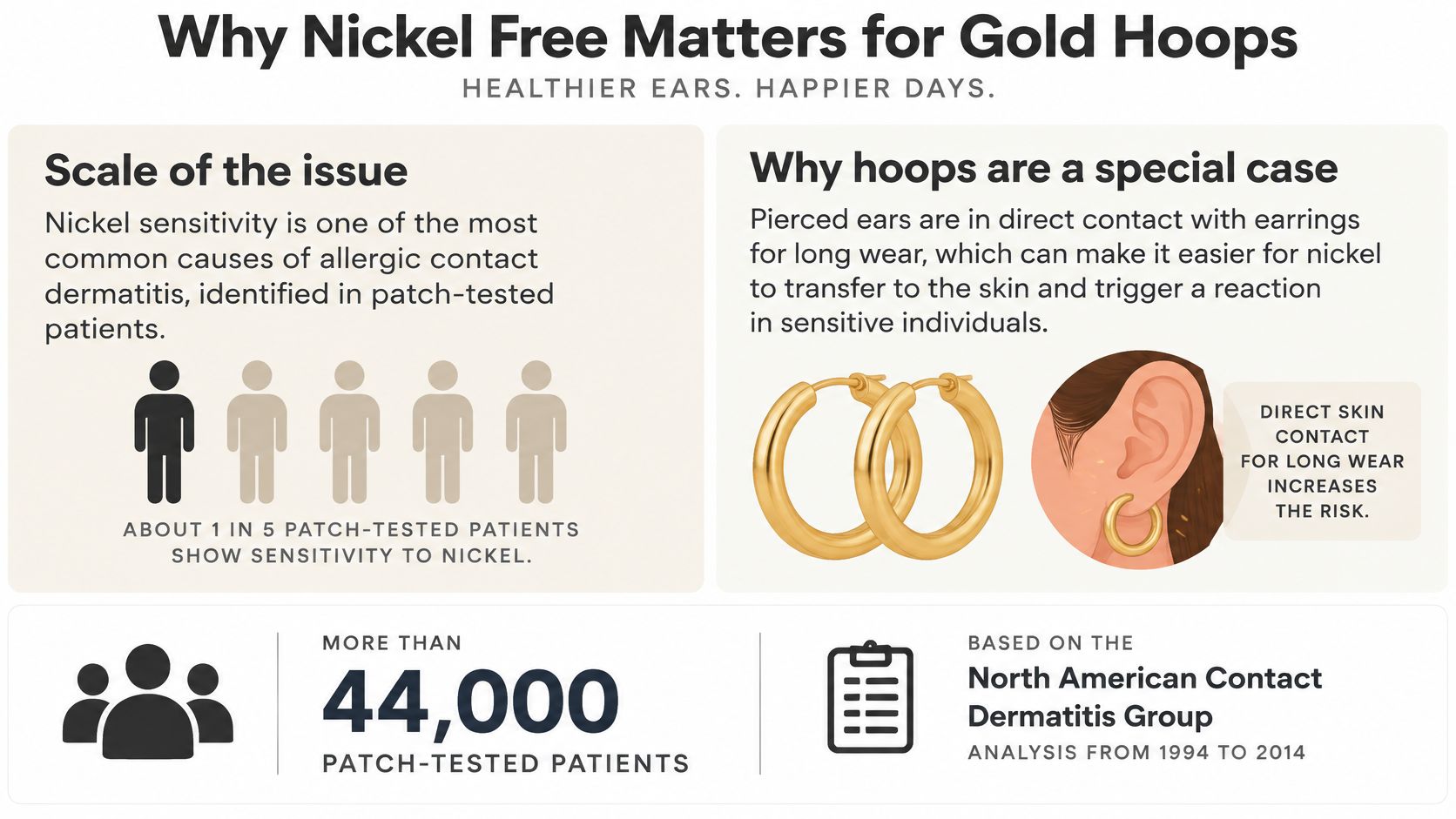
A useful claim describes the assembly
Nickel-free is a material claim, not a style description. Look for wording that describes the parts that touch your ear, rather than relying on the gold color or a label such as “hypoallergenic.”
Check what the product information says about the visible hoop, post, backing, hinge, clasp, and solder. Composition details can help identify the materials; relevant release testing can help show whether the assembled earring releases nickel.
Redness or discomfort can have causes other than nickel, including moisture and rubbing. A material claim helps you make an informed choice, but it does not diagnose a reaction.
Gold Hoop Constructions and Nickel Risk
Gold hoop constructions and what nickel free should mean
| Construction | Gold share | Where nickel can hide | Wording that helps |
|---|---|---|---|
| 24k yellow gold | Highest-purity gold category | Separate hardware or joining materials | Solid yellow gold with a whole-earring nickel-free declaration |
| 22k yellow gold | High-gold alloy identified by karat | Alloying metals, solder, or posts | Karat, yellow gold, and nickel-free posts specified |
| 18k yellow gold | Gold concentration identified by karat | Alloy, solder, or post | Yellow gold, nickel free throughout |
| 14k yellow gold | Gold concentration identified by karat | Post, hinge, clasp, or other alloyed parts | Alloying metals named and nickel free |
| 10k gold | Lower gold concentration than higher-karat gold | Alloying metals throughout the assembly | Whole-earring composition and release testing |
| White gold | Gold concentration follows the stated karat | Nickel-bearing whitening alloy or hardware | Whitening metals identified, with a nickel-free declaration |
| Gold filled | Gold layer over a base metal | Base metal, solder, and closure | Gold filled with a nickel-free base and fittings |
| Vermeil | Gold over sterling silver | Solder, backing, or underlying components | Sterling base and nickel-free joining materials |
| Gold plated or gold tone | Surface finish, not a whole-item gold share | Base alloy beneath the finish | Base metal identified and release performance documented |
Use the row that matches the written construction, not the photograph. A plated hoop and a solid-gold hoop can look similar on a screen while requiring different questions about the metal beneath the surface.
What karat actually tells you
As SELF's dermatology guidance explains, 18-karat gold contains approximately 75% gold and 25% alloying metals, while 14-karat gold contains about 58% gold and 42% other metals. Those other metals matter because an alloy recipe can include nickel.
Yellow gold may use silver and copper, while some white-gold formulations use nickel to whiten and strengthen the alloy. A white-gold listing therefore needs more than a statement of purity, and a yellow finish doesn't establish the composition of a separate post.
Our guide to whether 10k gold is a good choice can help you evaluate that construction without confusing gold concentration with allergy testing.
Coated jewelry needs a layer-by-layer reading
Gold filled, vermeil, and gold plated aren't interchangeable descriptions. Each asks you to consider both the outer gold and what sits underneath, especially where the closure rubs during opening and closing.
A concrete example of why wording matters is the Pave Heart Spiral Ring, whose materials description includes gold plating. A gold-colored appearance shouldn't lead you to describe a plated item as solid gold.
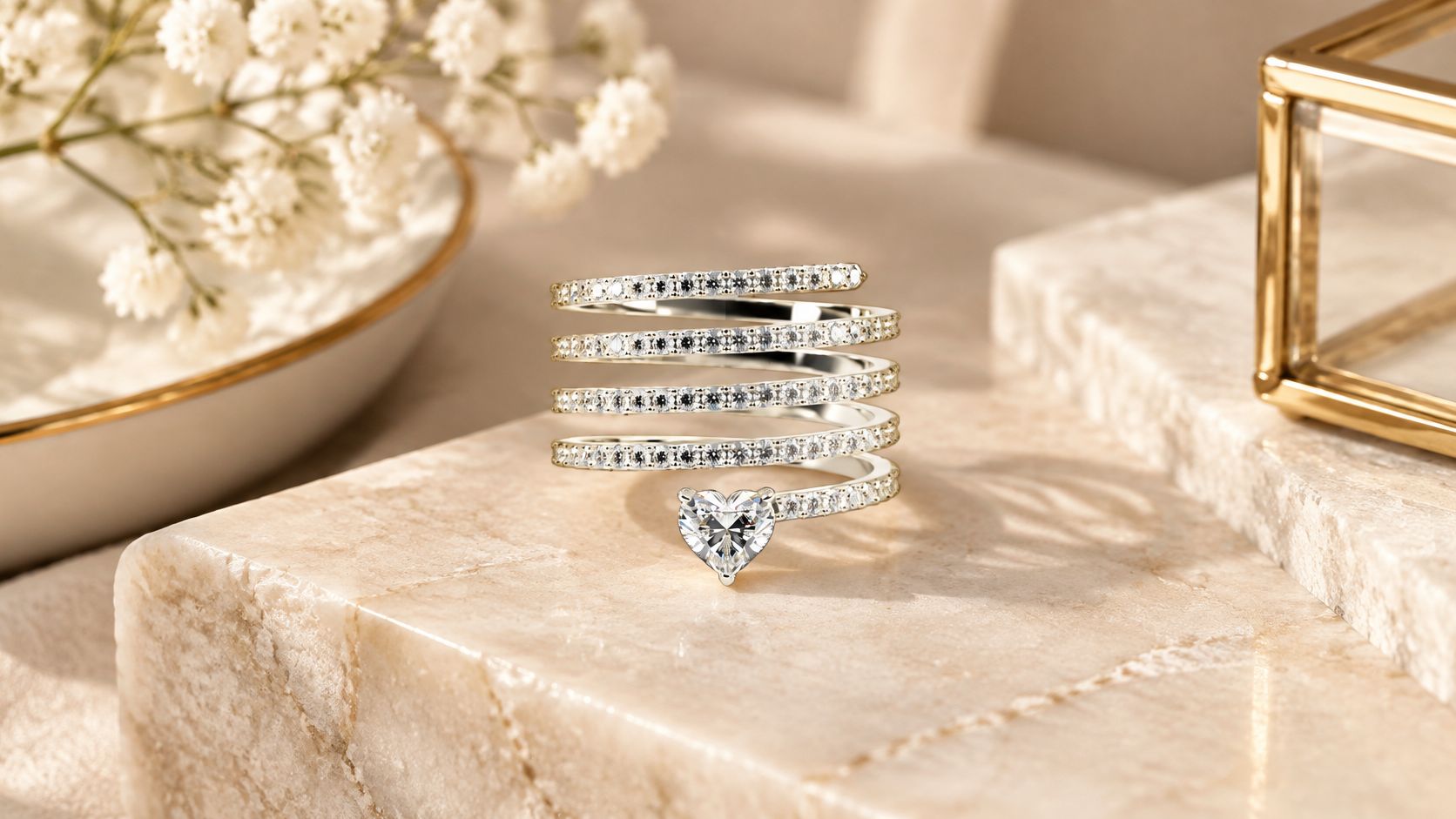
The same patient approach helps when you choose a comfortable wedding band: identify construction and fit separately instead of treating an attractive finish as proof of comfort.
Buying rule: A precise material description is useful. A precise description covering every component, supported by release testing, is stronger.
Higher-karat yellow gold can be an option to discuss when choosing jewelry for sensitive ears, but it isn't permission to ignore the fastening. Ask for the karat, gold color, underlying metal where applicable, and the scope of the nickel-free declaration.
Nickel Release Limits and How to Check a Claim
Nickel content describes what is in an alloy. Nickel release describes how much can migrate from the finished hoop, post, hinge, solder, and backing during wear. A result within a release limit does not, by itself, prove the item contains no nickel.
Understand the testing language
The Danish Environmental Protection Agency's nickel fact sheet describes EU requirements of less than 0.2 micrograms per square centimeter per week for components inserted into pierced ears and no more than 0.5 micrograms per square centimeter per week for direct, prolonged skin contact, with EN 1811 testing using artificial sweat for one week.
The applicable limit depends on how the part is worn. A post passes through the piercing, so evidence about a decorative surface alone doesn't answer what the post may release.
Coatings still need to be considered as part of the finished earring. Scratches and repeated friction at a clasp can affect the surface, so a claim about a new outer layer is not a substitute for evidence about the whole assembly.
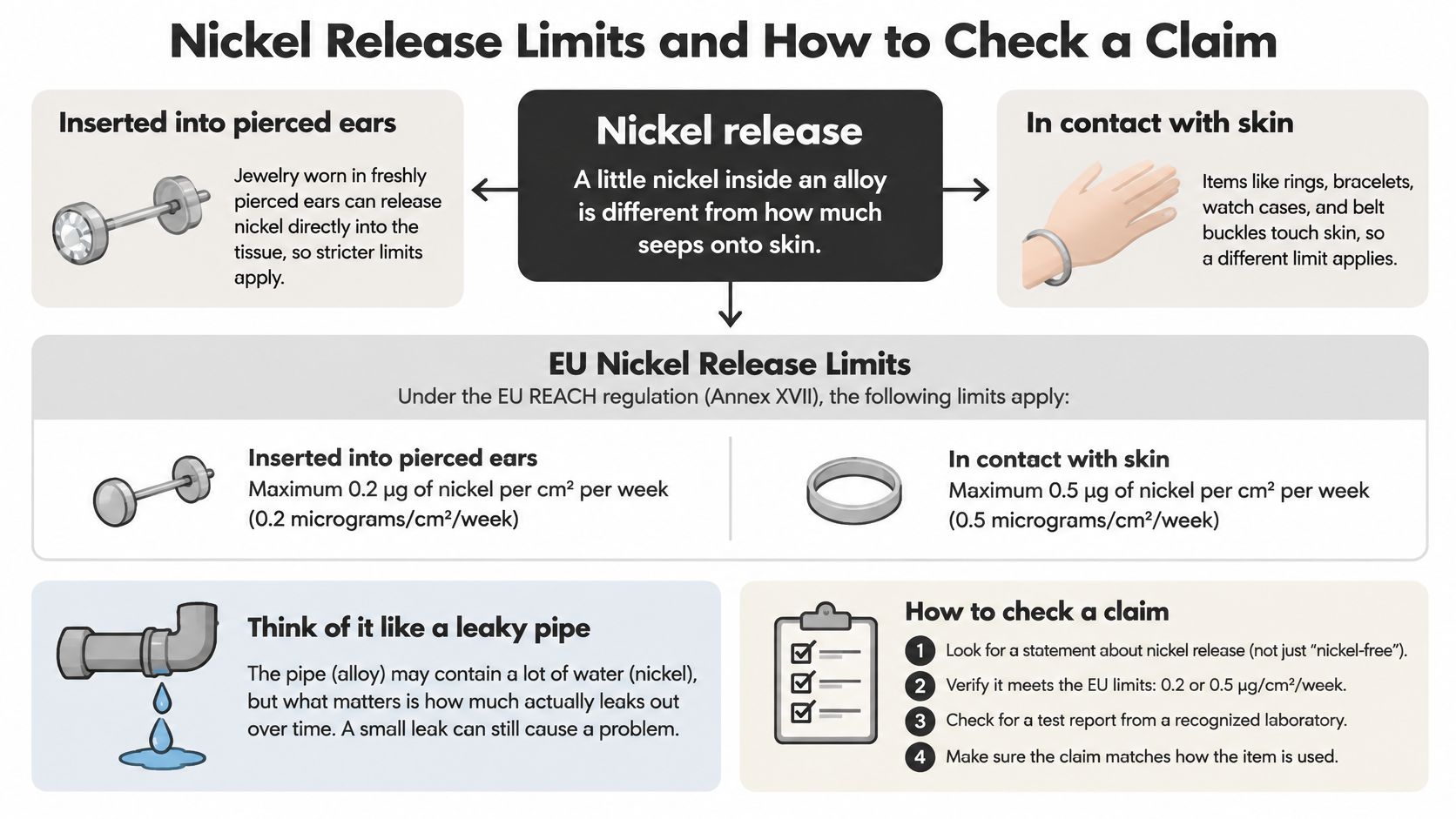
Run these checks on a listing
- Find the construction words. Look for solid karat gold, gold filled, vermeil, or gold plated. If a listing says only “gold,” check whether that describes the whole piece or just its finish.
- Read the stamp carefully. A karat mark identifies stated gold purity, while other marks may describe a silver base or filled construction. A stamp is not an allergy-test certificate, and a mark on the hoop doesn't automatically describe a separate backing.
- Check what the declaration covers. Ask whether it applies to the hoop body, post, hinge, solder, and backing. For a design without a separate back, check whether the integrated latch is included. The goal is to account for every component.
- Separate composition from release. Look for a material declaration supporting nickel-free wording and a report that names the release test. The report should identify the earring design or assembly tested, not just an unspecified metal sample.
- Read broad labels as limited information. “Hypoallergenic” describes an intention to reduce reactions, not a full alloy recipe. “Gold tone” describes appearance, and “gold plated” describes a surface treatment. None alone establishes what the finished hoop releases.
- Compare the listing with your allergy information. If a clinician has identified your allergens, check them against the materials declaration. For recurring reactions without a clear explanation, ask about medical evaluation and whether patch testing could help instead of repeatedly wearing jewelry on irritated skin.
The guide to what nickel-free jewelry means explains how to read these claims alongside material details.
Ask for evidence that matches the earring you're buying, not just a reassuring description of gold.
What useful documentation looks like
A useful supplier declaration identifies the product or construction and states which components the claim covers. Laboratory documentation should identify the tested assembly and method, with results that can be compared with the applicable requirement.
Check for gaps between documents. A certificate for the hoop's raw alloy may not cover solder added during assembly, a separately sourced hinge, or a different backing.
You don't need to become a laboratory specialist. Look for a specific answer rather than a phrase such as “sensitive ears friendly.”
A systematic review of nickel release from earrings reported critical release in 11.3% of tested European earrings, 34.5% of earrings from Asia, and 31.1% from North America. Those findings show why documentation can be useful, but country of origin alone doesn't establish how an individual pair performs.
Keep the diagnosis question separate from the buying decision. Friction, trapped moisture, cleaning-product residue, and reactions to other materials can also cause trouble, as explained in the clinical overview of nickel allergy. A materials declaration can narrow uncertainty, but it can't explain every sore lobe.
When Old Piercings Start to React
Your old hoops used to feel fine. Now your lobes itch by lunchtime, and you're wondering whether replacing them with nickel-free earrings will solve it.
A new pair isn't treatment for an actively inflamed piercing. Previously comfortable wear doesn't rule out a later reaction, and a red, swollen ear needs more attention than another product description.
In a 2025 Japanese retrospective study of 1,085 patients, 81.3% of patients with a history of inflammation from pierced earrings tested positive for a metal allergy, compared with 60.4% without that history. That association is a reason to take recurring symptoms seriously, not a diagnosis for every itchy ear.
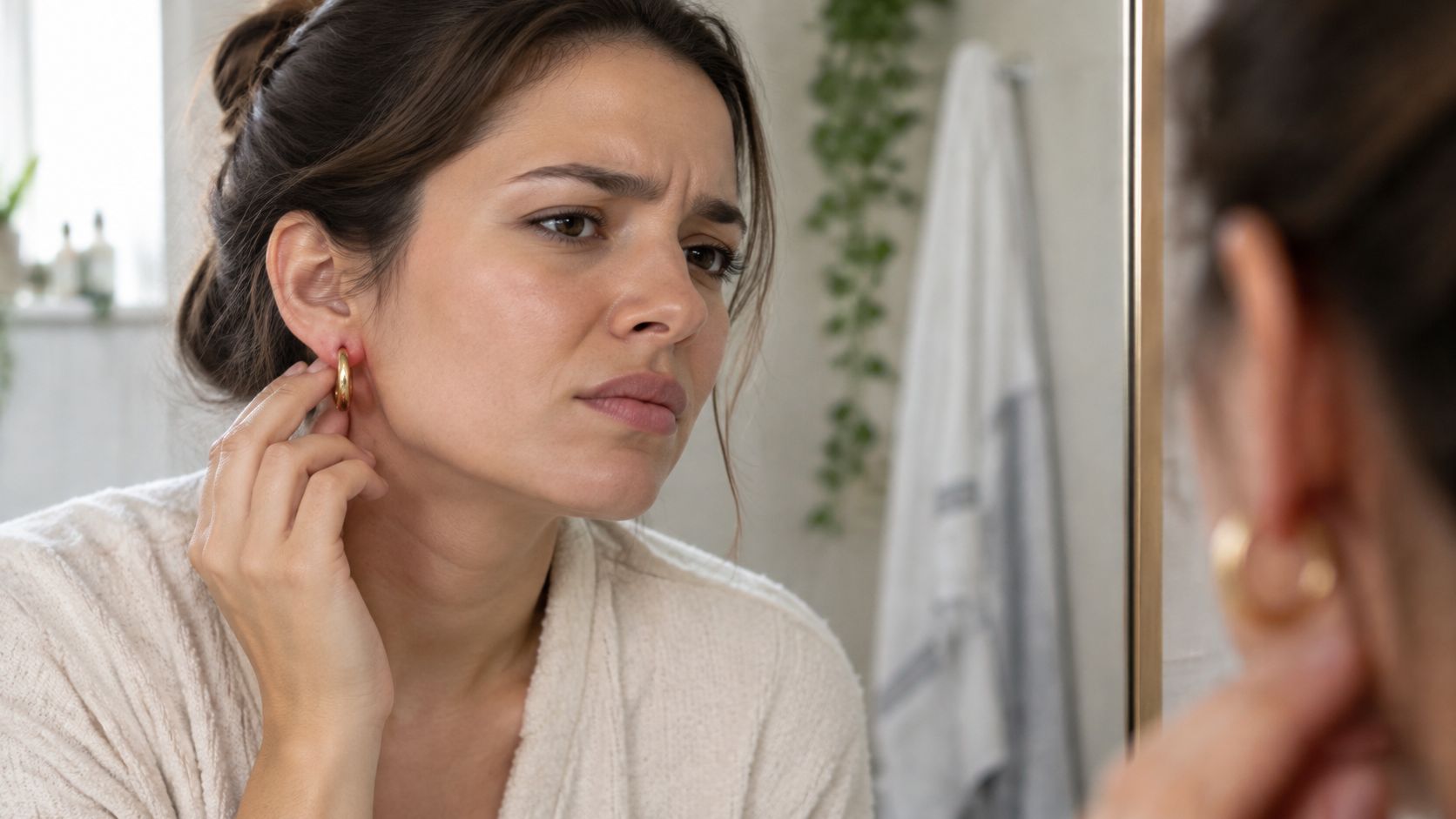
Different symptoms need different decisions
Consider a healed lobe that itches only when you wear a particular plated pair. Stop wearing that pair and note where and when the reaction occurs. Once the skin has settled, that history can help a clinician distinguish a suspected contact reaction from pressure or another cause.
Now consider a piercing that weeps, swells, or hurts with every attempted metal. That's not a reason to keep testing jewelry at home. Seek medical evaluation, especially if there's discharge, severe swelling, worsening pain, or symptoms that keep returning.
- During active irritation: Stop wearing the offending jewelry and avoid tight or heavy hoops.
- For daily care: Keep the area clean and dry without scrubbing or adding harsh cleaners.
- If infection is possible: Get clinical advice about treatment and whether jewelry should be removed, rather than forcing a swollen piercing or making repeated changes.
Nickel isn't the only possibility
A person may react to palladium, cobalt, chromium, another alloy component, or an adhesive. A thick post or tight latch can also cause discomfort without a metal allergy.
Comfort check: Don't use a sore piercing as a testing ground for a new purchase.
Our ear-piercing aftercare guidance is useful for reviewing routine care, but persistent symptoms need individual assessment. Once the skin is calm, you can make a more informed decision about both material and fit.
Hoop Size and Everyday Styling
Gold hoop sizes for everyday wear
| Style | Typical diameter description | Best for | Comfort limit |
|---|---|---|---|
| Huggie or small hoop | Close-fitting, with clearance around the lobe | Understated daily outfits and smaller lobes | A tight latch can rub |
| Medium classic hoop | A visible arc below the lobe | Work, denim, and weekend outfits | Check post length and hinge position |
| Large statement hoop | A pronounced circle extending below the lobe | Occasional styling with a simple neckline | Weight and swing can pull; remove for sport and sleep |
| Extra-large hoop | An oversized silhouette | Short styled outings | Avoid leverage on an already reactive ear |
Treat size labels as starting points, not measurements you can transfer between stores. Check the listing's actual diameter and whether it describes the inside opening or the outside edge.
Diameter and weight are separate choices. A broad but lightweight hoop may feel different from a smaller, solid construction, and a tiny huggie can still pinch if there isn't enough room around your lobe.
Match the silhouette to the outfit
Small hoops work well with a charm necklace or an additional stud when there's comfortable space between piercings. Let the necklace carry the detail rather than crowding the ear with pieces that press against one another.
Medium yellow hoops are an easy option for a shirt, knitwear, or denim. They give you a visible shape without requiring an oversized silhouette, especially when your necklace is simple.
- Statement hoops: Pair them with an uncluttered neckline and check that scarves or collars won't catch the lower edge.
- Extra-large hoops: Reserve them for occasions when you can remove them easily if they start pulling.
- Gift choices: Favor a straightforward, lightweight shape unless you know the recipient enjoys oversized earrings.
Fit the closure as carefully as the circle
Our hoop earring size guide can help you compare shapes before ordering. For a close-fitting style, inspect the space between the bottom of the piercing and the lobe's edge, rather than judging from the front-facing photograph alone.
Don't use matching metal color as a substitute for matching materials. A spare yellow backing may look right while having an entirely different construction.
For a personalized gift, a charm or engraved piece can carry the meaning while the earrings stay light. Heavy hoops aren't a sensible shortcut to a more substantial gift, especially for fresh lobes or cartilage piercings.
Choose the smallest silhouette you enjoy wearing, with enough clearance to avoid pinching. Then check that its closure is as suitable as its shape.
Care That Keeps the Surface Intact
Put hoops on after perfume, hairspray, and lotion, once your skin is dry. Take them off before the evening routine that involves washing, skincare, or changing into clothing that might catch the clasp.
After a long day, wipe the posts and closure gently with a clean, dry, soft cloth. Don't scrape around a hinge with a pin or abrasive tool, and don't force a latch that has become stiff.
Reduce avoidable exposure
Gold filled and silver jewelry can be worn in water, but they last much longer when removed before showering, swimming, or working out. For plated pieces, make removal your default rather than assuming the finish will tolerate every pool, cleanser, or workout.
These habits protect the jewelry without promising that care can fix an unsuitable base metal:
- Before water or exercise: Remove the earrings and put them somewhere dry and secure.
- During storage: Keep each pair from rubbing against chains, rings, and other clasps.
- When traveling: Use a box or separate compartment instead of dropping loose hoops into a bag.
- During cleaning: Use a non-abrasive cloth and follow the maker's instructions for any cleaning solution.
Our guide to caring for gold-plated jewelry gives you a useful routine for maintaining coated pieces. Avoid harsh dips and ultrasonic cleaning on plated fashion jewelry unless the maker specifically approves them.
Inspect the parts you can't see while wearing them
Look closely at the post, inside edge, and fastening when you put the pair away. A pale patch, rough area, exposed underlying metal, or damaged latch is a reason to stop wearing the piece and assess it.
Don't assume a pair remains suitable just because it was comfortable when new. Care helps preserve a surface, but it doesn't restore missing plating or repair a worn fastening.
We carry a 90-day warranty, and plating isn't covered under warranty. Read the terms before treating normal surface wear as a covered repair, and keep your care decisions separate from any assumption about coverage.
Confirm the Earring Before You Order
A good checkout decision rests on a specific description, a wearable fit, and clear terms. Save the listing details you relied on so you can compare the delivered pair with what you ordered.
Make the final decision concrete
- Identify the construction: The listing should distinguish solid gold from filled, vermeil, or plated construction and identify the relevant underlying metal.
- Resolve material gaps: Confirm the scope of the declaration and whether supporting supplier documentation or release testing is available. Don't assume a report exists unless it's provided.
- Choose for a healed lobe: Use the actual dimensions and closure details, not just a model photograph.
- Plan gifts around the wearer: A simple hoop is a more flexible choice when you don't know whether the recipient likes large silhouettes. Personalization can carry the sentiment elsewhere.
- Read fulfillment details: Check whether the item is in stock or made to order before setting a gift deadline.
We state that none of our jewelry contains nickel. That composition statement shouldn't be presented as an individual laboratory result or a guarantee against every possible cause of irritation.
Check the terms before paying
Some of our items may qualify for a size exchange or store credit. Read the applicable shipping and return terms, especially for personalized or made-to-order selections, rather than assuming every item has the same options.
If a listing leaves an important question unanswered, pause the purchase. Choose the construction you understand, the fastening you can verify, and the diameter you'll comfortably wear.
We offer fashion jewelry in silver and 14K gold, alongside personalized pieces, and none of our jewelry contains nickel. Visit EP Fine Jewelry to browse earrings, compare the listed materials and dimensions, and choose a pair that suits your everyday routine.