
The usual advice to buy 14K because it's better is too simple. 14K buys you more gold per gram, not an automatic upgrade in durability or skin comfort. A substantial 10K piece can be the smarter purchase than a lightweight 14K design, and neither karat tells you whether nickel is touching your skin.
Table of Contents
- What the Karat Choice Really Decides
- 10K and 14K Gold Side by Side
- Hardness Color and Everyday Wear
- Nickel Sensitivity and the Stamp to Check
- When Heavier 10K Holds More Gold
- Rings Chains Earrings and Personalized Gifts
- Choose 10K or 14K Before You Buy
What the Karat Choice Really Decides
An initial necklace for a birthday makes the karat question concrete. One listing shows a delicate 14K letter; another offers a more substantial 10K version at a lower price. The higher karat sounds like the obvious gift, until you consider that the wearer might prefer a letter with more presence on a chain that feels less fragile.
That choice is a budget decision. Gold concentration, construction, alloy composition, and intended wear all deserve a place in it. Paying more for purity makes sense only when the finished piece also suits the person wearing it, so decide which grade of quality your budget should buy before you compare listings.
Separate the material from the finish
Both karats can describe solid gold alloys. That's a different construction from a gold layer over another metal, so don't group solid gold, gold-filled, and plated pieces together just because their photographs look similar. Our guide to gold-filled versus gold-plated jewelry covers that separate buying decision.
Before comparing listings, write down what matters most:
- For the wearer: where the piece will sit, and whether it stays against skin.
- For the design: whether it needs substantial links, a sturdy band, or a lightweight silhouette.
- For the budget: whether you're paying primarily for gold, personalization, stones, or workmanship.
Skip the warm photograph as proof of purity. Lighting and screens distort finishes, and we make every effort to display product colors accurately without being able to guarantee how your monitor shows them. Judge each option by its stated specifications instead.
10K and 14K Gold Side by Side
10 karat gold vs 14 karat gold at a glance
The purity figures, common stamps, and same-weight comparison below follow the FindArtInfo gold hallmarks chart, which identifies 10K as about 41.7% gold, 14K as about 58.3%, and the latter as containing about 40% more pure gold at the same weight.
| Feature | 10 karat gold | 14 karat gold |
|---|---|---|
| Gold fraction | 10 of 24 parts | 14 of 24 parts |
| Gold by weight | About 41.7% | About 58.3% |
| Common fineness stamp | 417 | 585 |
| Pure gold versus the other karat | Baseline for the same weight | About 40% more pure gold |
| Alloy share | Larger share of copper, silver, zinc, nickel, or palladium | Smaller alloy share |
| Typical color | Often paler | Usually warmer |
| Scratch tendency | Generally harder when alloys are comparable | Generally softer and easier to scratch |
| US status | Legitimate solid-gold specification when accurately represented | Legitimate solid gold when accurately represented |
| Best first fit | Budget high-contact pieces where surface wear leads | All-purpose gifts when color and gold content lead |
Read the stamp before the photograph
Start with the fineness mark. It tells you the stated gold concentration, while the listing's material description should establish whether you're buying solid gold rather than a coated product. An honest 10K designation isn't shorthand for gold plating.
Ask for a clear photograph of the mark inside a ring, on a clasp, or beside a chain tag. Include any maker mark in the photograph rather than cropping it out. Save that image alongside the product description so you have a record of what the seller represented.
The alloy row explains why the lower-karat option isn't diluted jewelry. The other metals add useful working properties, although the exact mixture matters. Don't assume every listed alloy metal appears in every piece.
Color is a weaker identification tool. Yellow, white, and rose gold can all be made at either karat, so use the stamp to establish purity and your eyes to choose the appearance you like. If you're still deciding between metal colors rather than gold purities, our gold or silver guide addresses that choice.
Compare the price on a useful basis
For similar designs, calculate the approximate gold weight by multiplying the metal weight by the gold fraction. Then divide the listed price by that estimated gold weight.
That produces a retail price per gram of contained gold, not a scrap valuation or a promise about resale. It's useful for spotting when a lighter piece costs more despite containing less gold. It's less useful when you compare a plain band with a diamond-set, labor-intensive design.
Buying rule: Compare like with like. Gold concentration explains material content, but it doesn't price the craftsmanship, stones, or personalization.
Keep surface wear, skin compatibility, and total gold weight as separate questions. A strong answer to one doesn't settle the others.
Hardness Color and Everyday Wear
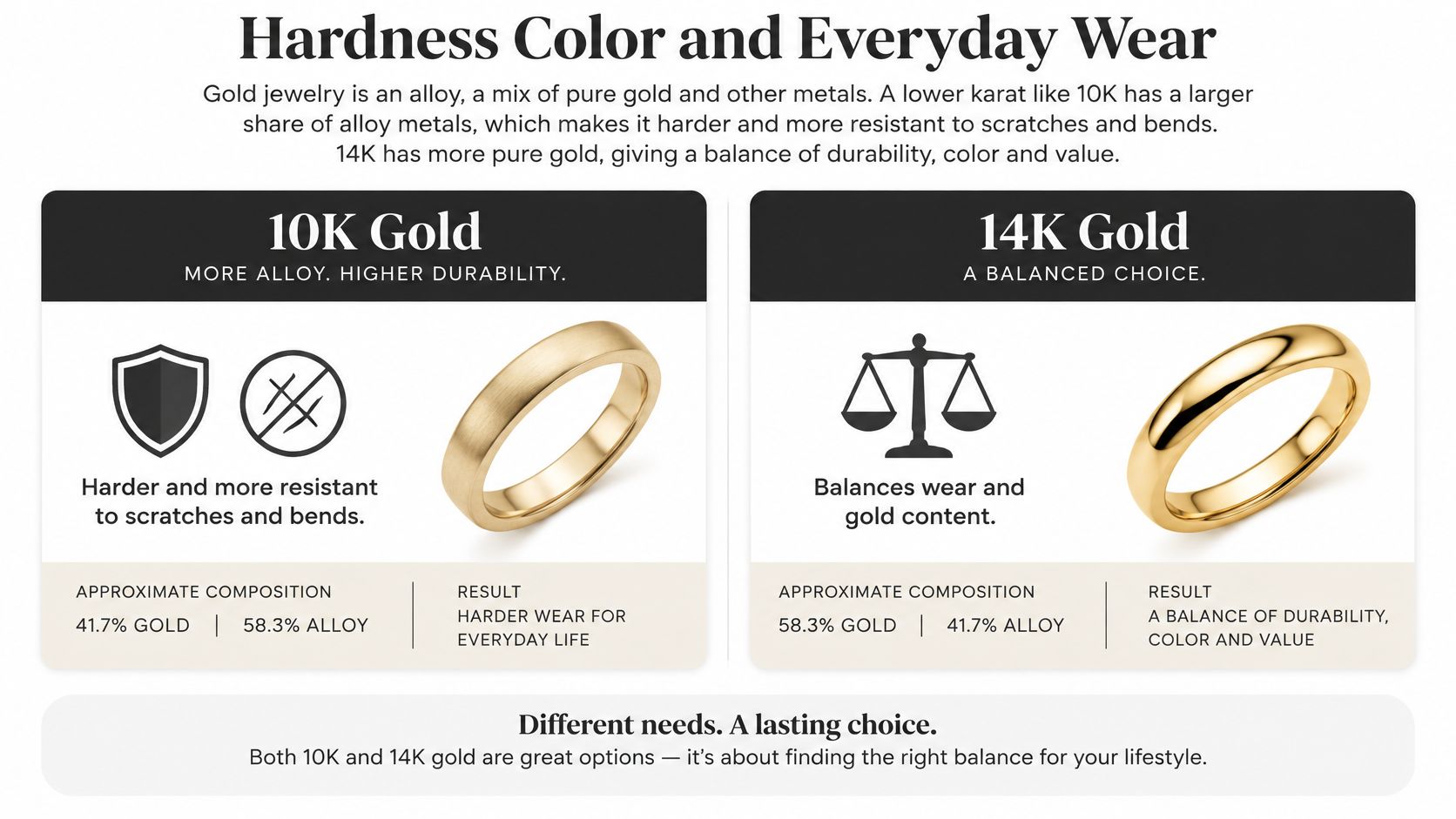
Buy the trade-off plainly: 10K usually wins on surface hardness, while 14K buys a richer yellow look; total gold still depends on grams, so a heavier 10K piece can contain more gold than a lighter 14K design. According to USA Jewels' gold education guide, alloyed gold sits broadly around Mohs hardness 3–4, with 10K described as harder than 14K, although alloy chemistry and manufacturing affect the result.
Hardness and finished construction answer different questions. Compare them separately before you treat karat as armor.
Hardness has limits
A harder alloy generally resists surface scratching and deformation better, which helps jewelry that brushes desks, counters, and door frames. It leaves a fine chain easy to snag and a thin prong easy to bend.
Heat treatment, casting, fabrication, and the alloy recipe all affect performance. A well-made 14K ring can outlast a poorly formulated 10K ring. Inspect the spot where the band narrows, the tightness of link joints, and whether the setting supports the stone.
Skip the thinnest design in either karat. Spend on construction where failure would mean losing a stone or pendant.
Choose color deliberately
Copper pushes gold toward rose tones, while whitening metals such as silver or palladium shift it toward white. For a yellow-gold piece, 14K usually looks warmer because more of the alloy is gold. If warmth drives the design, that is the reason to pay for 14K.
White gold needs a separate check. Some pieces use rhodium plating for a bright surface, and that finish can need renewal as it wears. Surface change can reflect finish loss rather than a purity problem.
In the video, watch the underside of bands and the joints of links: those are the first places thinning, pitting, and loose movement show up before the karat becomes the issue.
- Choose 10K for surface wear: a smart buy for a simple, frequently bumped piece when the budget is tight and the gram weight still looks substantial.
- Choose 14K for appearance: my default for a daily-wear gift when the wearer wants a richer yellow look and the build is not feather-light.
- Protect either choice: remove jewelry before rough work; karat is not permission to wear it through everything.
Follow EP Fine Jewelry's jewelry care instructions before choosing a cleaning method, especially for stones or plated finishes. Skin comfort is a separate question decided by the alloy recipe touching the wearer.
Nickel Sensitivity and the Stamp to Check
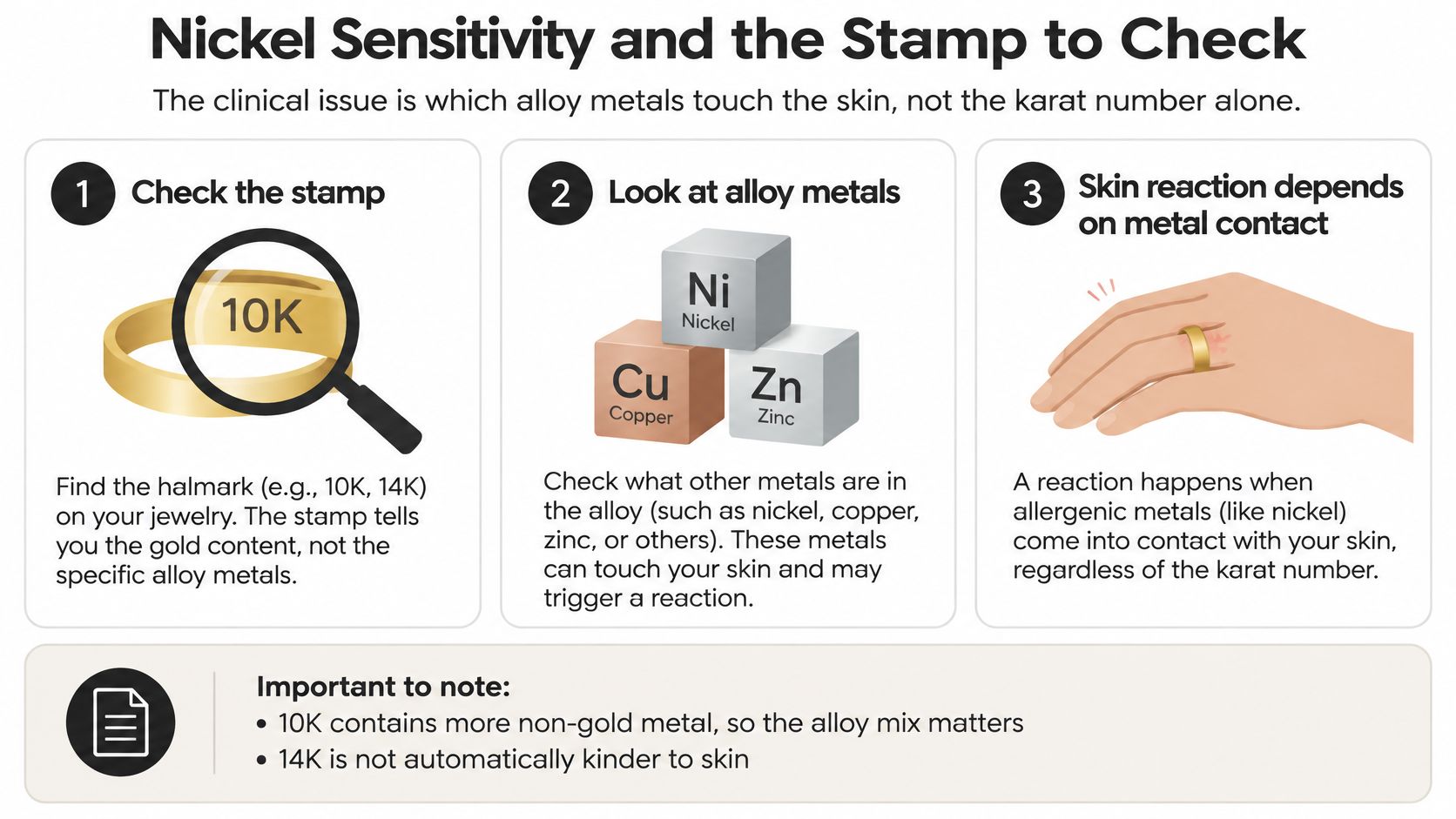
14K isn't automatically hypoallergenic. The relevant question is which alloy metals contact your skin, not whether the product title carries the higher karat number.
The Federal Trade Commission's jewelry buying guide advises checking both the karat quality mark and the company trademark, and explains that gold-filled or overlay jewelry can have a base metal such as nickel beneath its gold layer. A gold-colored surface isn't enough information for a nickel-sensitive buyer.
Get answers about the actual piece
A lower-karat alloy contains more non-gold metal, but that alone doesn't identify the metal causing a reaction. Manufacturers can use different recipes for different colors and product lines. Don't transfer a comfortable experience with one ring to every item carrying the same karat.
Before buying, get these answers:
- Nickel content: Is nickel present in the alloy, and does the answer apply to this exact color and design?
- Material construction: Is the item solid gold, gold-filled, overlay, or plated?
- Responsible maker: Is there an identifiable company trademark alongside the quality mark?
For earrings, extend the question to the posts and backs. For a necklace, include the clasp rather than asking only about the pendant. A reassuring description of the decorative part doesn't answer what the fastening components are made from.
Judge contact, not just composition
A ring shank rests against skin throughout wear. Earring posts and backs create contact at a different body location, while a pendant worn over clothing may have little direct contact. Your intended wearing pattern matters.
Sweat and moisture can also change the conditions under a close-fitting piece. Don't use a workout as the first test of unfamiliar jewelry when you already know you react to certain metals. Choose a design and wearing routine that make it easy to notice discomfort and remove the item.
Our nickel-free jewelry guide gives more context for reading material descriptions. For known sensitivity, documented composition is more useful than a broad claim that one karat is gentler.
An undisclosed alloy is an unknown comfort risk, even when the jewelry is expensive.
If the seller can't identify the alloy, don't treat the purchase as a reliable solution to a known allergy. Pick a piece with clearer documentation instead, and stop wearing jewelry that causes irritation.
When Heavier 10K Holds More Gold
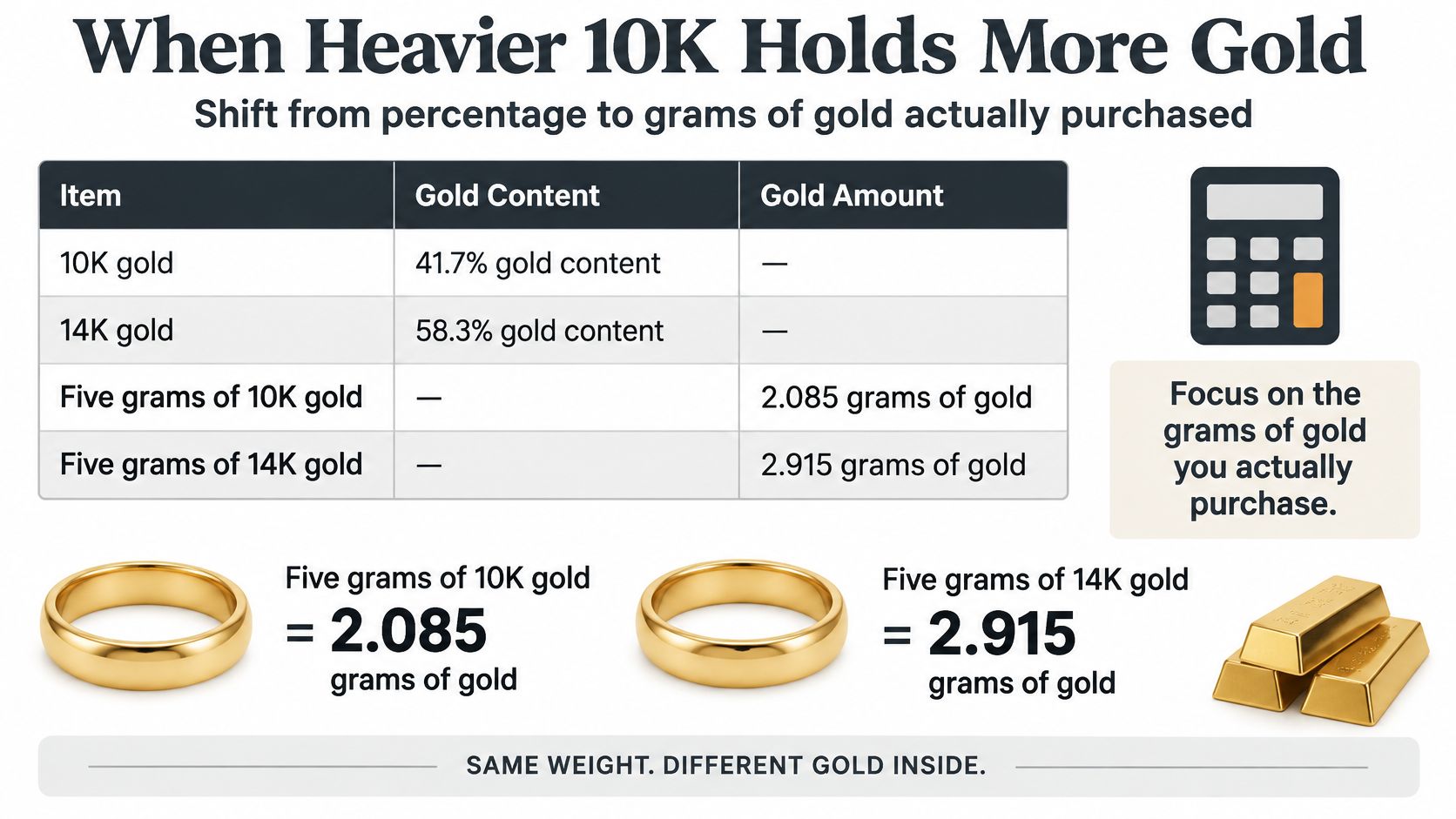
At the same weight, 14K contains more gold. At different weights, the heavier 10K piece can win. A karat-only comparison can lead you to spend more without buying more precious metal.
The Jewelers of America gold jewelry guide gives the fineness basis for these calculations: 41.7% for 10K and 58.3% for 14K.
Gold grams by piece weight
| Comparison | What it shows |
|---|---|
| 5 g of either karat | About 2.1 g of gold in 10K versus 2.9 g in 14K. Same weight, 14K holds more gold. |
| 8 g of 10K versus 5 g of 14K | About 3.3 g versus 2.9 g of gold. Heavier 10K can beat lighter 14K. |
| 10 g of 10K versus 7 g of 14K | About 4.2 g versus 4.1 g of gold. Extra mass can offset the purity gap. |
These examples assume the stated weight is the gold alloy's weight, not a combined weight that includes stones or unrelated components. The math estimates gold content. It does not set the finished piece's retail or resale value.
Buy useful mass, not weight alone
When gold prices stretch your budget, compare what the lighter design gives up. A smaller pendant might suit the wearer perfectly. A chain reduced to an impractically fine construction might not.
Choose heavier 10K when the added grams buy something you can use: a wider band, a charm with presence, a piece that feels substantial in hand. Weight by itself is not quality. If the extra mass sits in a decorative face while the attachment point stays fragile, you are paying for bulk where it does least good.
Ask whether the listed grams describe the metal or the complete item. If the seller can't separate stone weight from metal weight, treat your calculation as an approximation rather than a precise comparison.
Keep design costs separate
Our 14k Pave Lock Charm lists gold and diamonds as its materials. The stones and their setting change the price beyond what the gold weight alone would suggest, so judge that purchase on the whole piece rather than on karat arithmetic.
Use the arithmetic to understand the material, then decide whether the finished object deserves its price. A personalized piece can be worth buying for its meaning without pretending it's a low-premium gold purchase.
Value check: Choose higher purity when that's what you want. Choose a heavier lower-karat design when useful substance matters more.
Rings Chains Earrings and Personalized Gifts
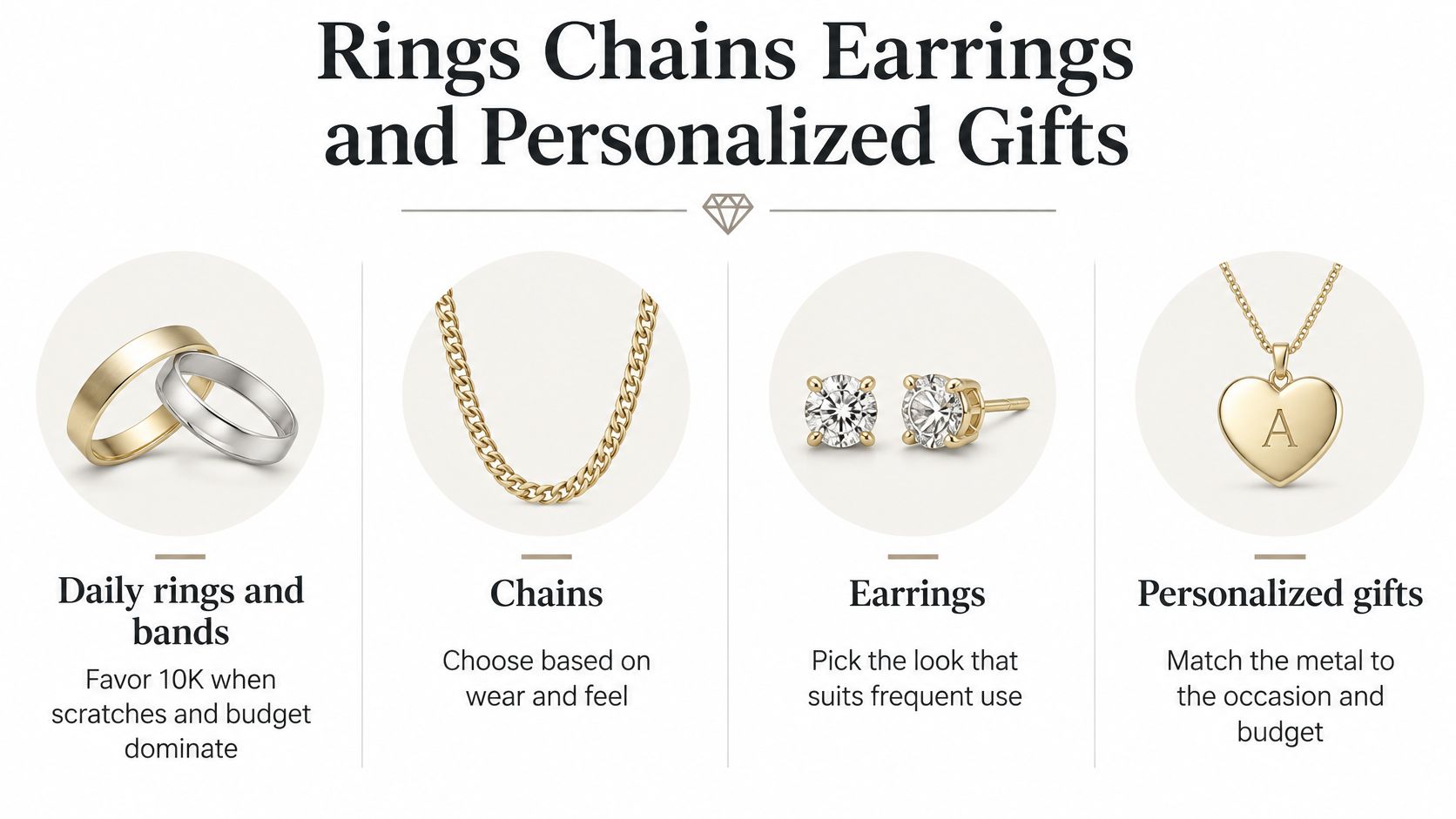
Choose the karat for the jewelry's job. A work band, a pair of hoops, and a birthday initial necklace don't need the same buying priorities.
Rings and bands
For a stackable band worn during ordinary desk work, I'd lean toward 10K when budget and surface marks dominate. Choose a profile that feels comfortable between the fingers and inspect the underside rather than judging only the decorative face.
For a yellow-gold ring bought chiefly for its appearance, I'd lean toward 14K. The exception is a design so thin that you're sacrificing practical construction to afford the higher karat. Buy the sturdier design instead.
A work band still needs to come off around machinery and activities where jewelry can catch. No alloy choice makes wearing a ring safe in every setting.
Chains and charm pieces
A substantial 10K chain can be a sensible purchase when you want noticeable scale without stretching the budget. Examine how the links join and how the pendant attaches, not just the chain's stated width.
For delicate chains, don't choose on karat alone. Look at the clasp, the end connections, and whether the chain suits the pendant it will carry. A decorative charm can place demands on a chain that looks adequate when worn alone.
For bracelets, fit matters too. A loose piece may catch on objects, while an overly tight one can be uncomfortable. Our personalized gold bracelet guide can help you think through the format before choosing the material.
Earrings and meaningful gifts
Earrings are a contact-first purchase. Choose the documented material your skin tolerates, then consider weight, closure, and appearance. A higher karat printed on a card shouldn't outweigh uncertainty about the posts or backs.
For a birthday initial worn on a chain most weeks, 14K is my preferred keepsake choice when the budget supports a well-made piece. You're choosing its gold content and appearance because those qualities matter to the recipient, not because the occasion demands the largest karat number you can afford.
A bulky personalized letter can justify 10K instead. If the recipient wants a bold silhouette, a substantial lower-karat version may be a more thoughtful gift than a smaller higher-karat letter they wouldn't have chosen.
- For a frequent wearer: Prioritize comfortable fit and dependable fastenings.
- For a gift recipient: Match their existing jewelry's scale and preferred finish.
- For a limited budget: Preserve useful construction before paying for greater purity.
Choose 10K or 14K Before You Buy
The karat stamp alone doesn't settle this decision. A heavier 10K piece can contain more gold than a lighter 14K design, and skin reaction risk follows the alloy recipe rather than the karat number. Weigh grams, alloy disclosure, and construction together before paying for either.
Pick 10K when the design calls for substantial metal at a lower price, such as a wide band or a bold charm where the extra grams do the visual work. Require an accurate solid-gold description and enough alloy information to make an informed skin-contact decision.
Pick 14K for most personalized keepsakes and yellow-gold pieces where the richer appearance is part of what you're buying. Don't accept flimsy construction just to reach the higher karat.
Keep plated jewelry in its own category
Our charm bangle is brass with heavy 18 karat gold plating and a coating to prevent tarnishing. It sits in the plated fashion category with its own care rules, and its matching charms carry their own limits: the Yellow C charm with CZ is made for the charm bangle and pendant only.
EP Fine Jewelry carries a 90-day warranty, and plating isn't covered under that warranty. Read the material description and policy together rather than assuming that gold-colored products share the same construction or coverage.
For readers buying inventory rather than an individual gift, JewelryBuyDirect's resource on sourcing wholesale 14K gold jewelry addresses the wholesale purchasing context. Keep that task separate from choosing a finished piece for personal wear.
Make the final checks
- The karat stamp, maker-mark photographs, and alloy disclosure from the sensitivity check belong in your records before checkout.
- The construction question applies to either karat: solid gold versus filled or plated, and hollow versus solid weight.
- The wearer's contact points, habits, and budget rank the design. The karat number comes after all three.
- Care guidance and warranty terms deserve a read before the first wear, while returns are still simple.
Buy the piece whose material, construction, and wearing demands you can name. A higher karat number earns its price only when the rest of the piece holds up to the way it will be worn.
We make fashion jewelry in silver and 14K gold, with personalized pieces, charms, necklaces, rings, earrings, and bangles to browse. Visit EP Fine Jewelry to compare designs, read their material descriptions, and choose a piece that fits your gift budget and the way it will be worn.