
Nickel-free jewelry is designed to release little or no nickel onto your skin during normal wear. In practice, it's a nickel-release concept, not an absolute promise that the piece contains no nickel atoms at all.
You may be asking because a new pair of earrings looked perfect in the mirror, but your ears became red and itchy before the day was over. Or perhaps a ring leaves an irritated patch beneath it while the rest of your skin feels fine. The useful question isn't only, “Does this piece say nickel free?” It's, “Which parts touch my skin, and has anyone tested how much nickel they release?”
That distinction matters for earrings, necklaces, bracelets, watches, and rings. A decorative front can be coated with a safer material while a post, clasp, spring, solder joint, or hidden base metal remains in contact with your skin.
Table of Contents
- Why Nickel Matters When You Wear Jewelry
- How Common Nickel Allergy Really Is
- What Nickel Free Actually Means on a Label
- Materials That Hold Up Against Nickel
- Reading Nickel Release Standards the EU Way
- Where to Look on the Product Page Before You Buy
- Hidden Components That Can Sabotage a Nickel Free Piece
- Care Tips and a Quick Buyer Checklist
Why Nickel Matters When You Wear Jewelry
A shopper picks up silver-toned hoops at a weekend market. They feel light, look polished, and seem harmless. By dinner, the earlobes are pink, itchy, and slightly swollen.
That reaction can be caused by nickel contact allergy, an immune response that develops when nickel reaches the skin. Nickel is widely used in metal alloys because it can add strength and create a bright, silvery appearance. It may appear in parts that buyers rarely inspect, including earring posts, chains, clasps, and ring components.

How skin exposure turns into irritation
Sweat and moisture can help metal ions move from a jewelry surface onto the skin. Friction adds another problem, especially where an earring post moves through a piercing or a ring rubs against a finger. If plating becomes scratched or worn, the material underneath may make direct contact.
That's why a reaction isn't limited to very inexpensive jewelry. Plated and mid-priced pieces can still cause trouble if the coating is thin, damaged, or applied over a nickel-containing base. Earrings deserve particular care because the post passes through skin and often remains in place for long periods.
Practical rule: Treat every skin-contact component as part of the jewelry, not just the visible decorative surface.
A shopper with sensitive ears might begin by reading a guide to stud earrings for sensitive ears, but the same inspection applies to hoops, huggies, necklaces, and rings. Ask what the post, back, clasp, and connecting parts are made from. A label that describes only the front of a piece leaves an important question unanswered.
Nickel exposure doesn't always produce an immediate reaction. Some people tolerate a piece briefly, then develop redness or itching after repeated wear. Once the skin becomes sensitized, avoiding nickel release becomes a practical part of choosing jewelry, not an obscure technical concern.
How Common Nickel Allergy Really Is
Nickel allergy is a contact-immune reaction. After sensitization, immune cells recognize nickel during later contact and can produce an eczema-like response, including redness, itching, swelling, dryness, or blisters. The rash usually appears where the metal touches the skin, although irritation can spread around the original contact area.
This isn't a rare issue reserved for people who describe themselves as unusually sensitive. The American Academy of Dermatology's nickel allergy guidance says more than 18% of people in North America are allergic to nickel, including 11 million children in the United States. A 2025 systematic review reports a pooled nickel-allergy prevalence of 11.4% across Europe, North America, and China in its review of nickel allergy prevalence.
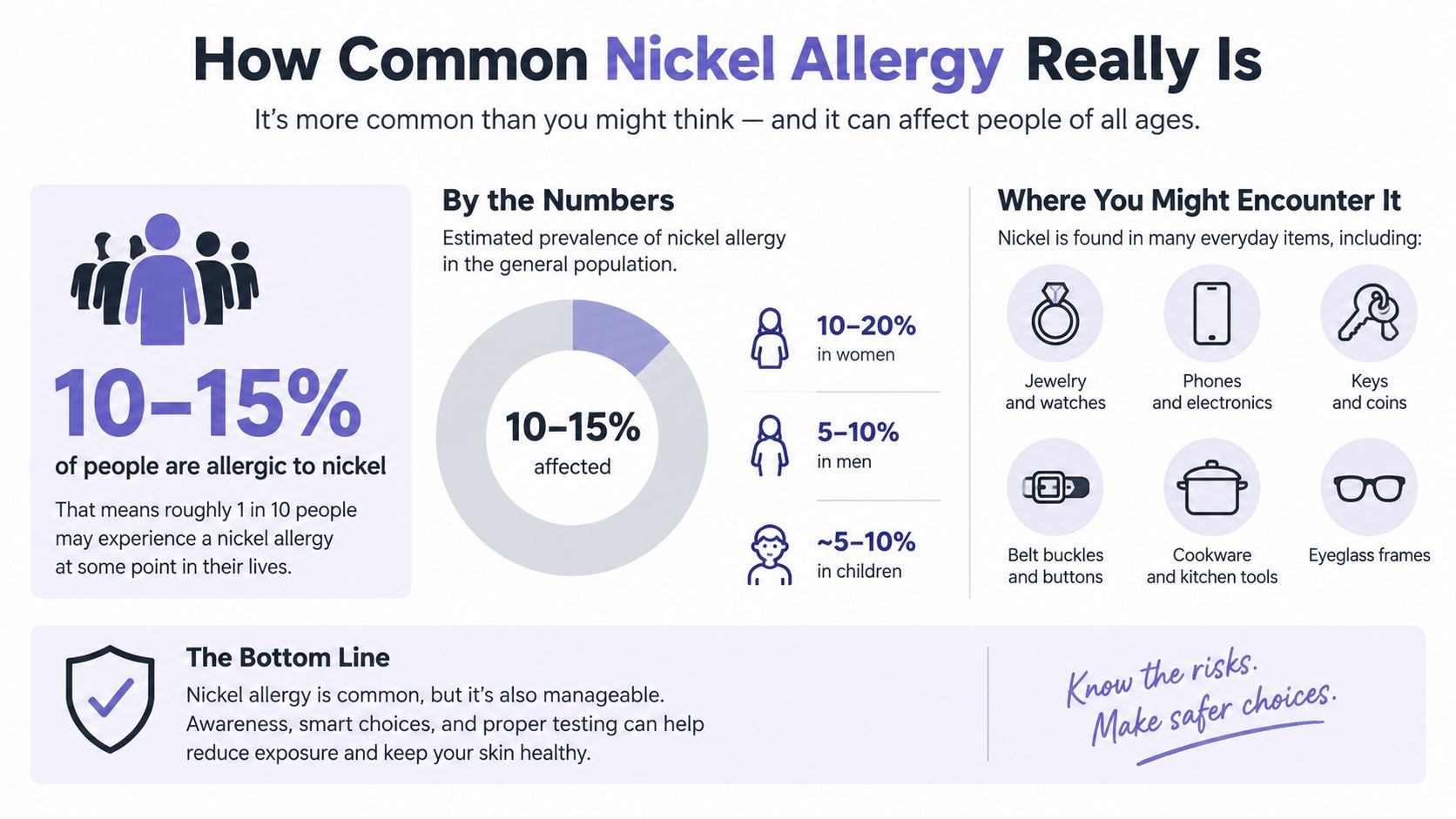
Why earrings deserve special attention
Piercings create a direct and repeated route for exposure. The 2025 systematic review identifies piercing as a significant risk factor for nickel allergy and reports that many earrings still release nickel at amounts that may cause allergic nickel dermatitis. Fresh piercings are especially demanding because the skin barrier is still healing, while moisture and friction can increase irritation.
The reaction can also seem unpredictable. A wearer may tolerate one necklace but react to earrings, or manage a ring for a short outing but not for a full day. Different components, coatings, contact pressure, and exposure time can produce different results.
For example, Evil Eye Studs are listed as sold as a pair and made with 14K plated gold, silver, and cubic zirconia. That description identifies the visible materials, but it doesn't by itself confirm the composition of the posts, backs, or nickel-release performance. Buyers who already react to nickel should ask those specific questions before ordering.
The main lesson is simple. Nickel allergy affects a substantial share of shoppers, so “nickel free” is a reasonable starting point. It's still only a starting point unless the seller explains the materials and testing behind the label.
What Nickel Free Actually Means on a Label
The phrase nickel free sounds absolute, but jewelry labels don't always use it with the same level of precision. For practical shopping, interpret it as a claim about low or negligible nickel exposure during wear, then look for evidence about release testing and every component that touches your skin.
The most useful distinction is between a material recipe and a release result. A manufacturer may say what an alloy is intended to contain, but your skin responds to what migrates from the finished item. A coating can delay contact with a base metal, yet scratches and wear may change the result.
Four labels with different levels of meaning
| Label | What It Means | Typical Standard | Strength of Claim |
|---|---|---|---|
| Nickel-free | A claim that the piece contains little or no intentionally added nickel, or releases very little nickel | No single universal number is implied by the phrase alone | Limited unless supported by documentation |
| Nickel-safe or nickel-compliant | A claim that nickel release meets a specified requirement | Often connected to measured release under EN 1811-style testing | Stronger when a test report is available |
| Hypoallergenic | A general suggestion that the item is less likely to cause an allergy | No universal jewelry threshold | Weak without material and testing details |
| Biocompatible | A claim that a material has been assessed for compatibility with living tissue | May involve medical or implant-related testing | Potentially strong, but the exact test and material still matter |
In the European Union and United Kingdom, skin-contact jewelry is evaluated by nickel release, not merely by the alloy's stated composition. The European Chemicals Agency information on nickel restrictions gives measurable limits for items intended for direct and prolonged skin contact.
A gold-plated piece can therefore look safe while remaining uncertain. The gold layer may cover the base, but a clasp or post can use a different alloy. For a useful explanation of why surface treatment and underlying metal matter, see this guide to gold-filled versus gold-plated jewelry.
A product page that names the alloy but says nothing about release testing gives you useful information, not a complete safety answer.
Materials That Hold Up Against Nickel
Material choice gives sensitive-skin shoppers a practical way to narrow the field. Stable materials with a clear composition are generally easier to evaluate than mystery alloys covered by an unspecified coating.
Implant-grade titanium, niobium, and platinum sit near the cautious end of the spectrum. Titanium is light and corrosion resistant, niobium is commonly used for piercing jewelry, and platinum is a durable precious metal. For a fresh piercing or a history of strong reactions, clear documentation matters more than a fashionable color or a broad “hypoallergenic” label.
High-grade 316L stainless steel can work well for many wearers, but people with a known nickel allergy shouldn't assume that every stainless-steel item behaves identically. The alloy and finished product still need evaluation. Solid gold can also be a sensible option, especially when the seller identifies the alloy and karat clearly. White-gold formulations deserve extra questions because their color may come from alloying metals rather than the gold itself.
A practical comparison
| Metal | Typical Nickel Content | Skin Contact Suitability |
|---|---|---|
| Implant-grade titanium | Intended for very low nickel exposure | Strong option, particularly for sensitive ears and piercings |
| Niobium | Generally selected as a nickel-free piercing material | Strong option when the component is genuinely niobium |
| Platinum | Typically used in a high-purity, stable form | Strong option for prolonged contact |
| High-grade 316L stainless steel | May contain nickel as part of the alloy | Often suitable, but verify the grade and release performance |
| Solid 14K or higher gold | Depends on the alloy recipe and color | Often suitable when the alloy is disclosed and tested |
| Sterling silver | Usually silver mixed with other metals | Variable, especially when the alloy or plating is unclear |
| Brass or copper-based alloys | May be covered with a surface coating | More dependent on plating, wear, and the underlying recipe |
“Pure” doesn't automatically mean “skin safe.” A piece can contain a high proportion of a desirable metal while still using another metal in the part that touches your skin. Conversely, a carefully selected alloy can perform well when its release has been measured.
Plating deserves separate attention. Rhodium can create a bright protective surface, but the base metal remains relevant if the coating thins or chips. The discussion of rhodium-plated sterling silver is useful for understanding why the coating and the substrate should be considered together.
Reading Nickel Release Standards the EU Way
You find an earring described as “nickel free,” but the product page says nothing about its post or back. EU nickel rules offer a more useful question: how much nickel can the finished component release during skin contact?
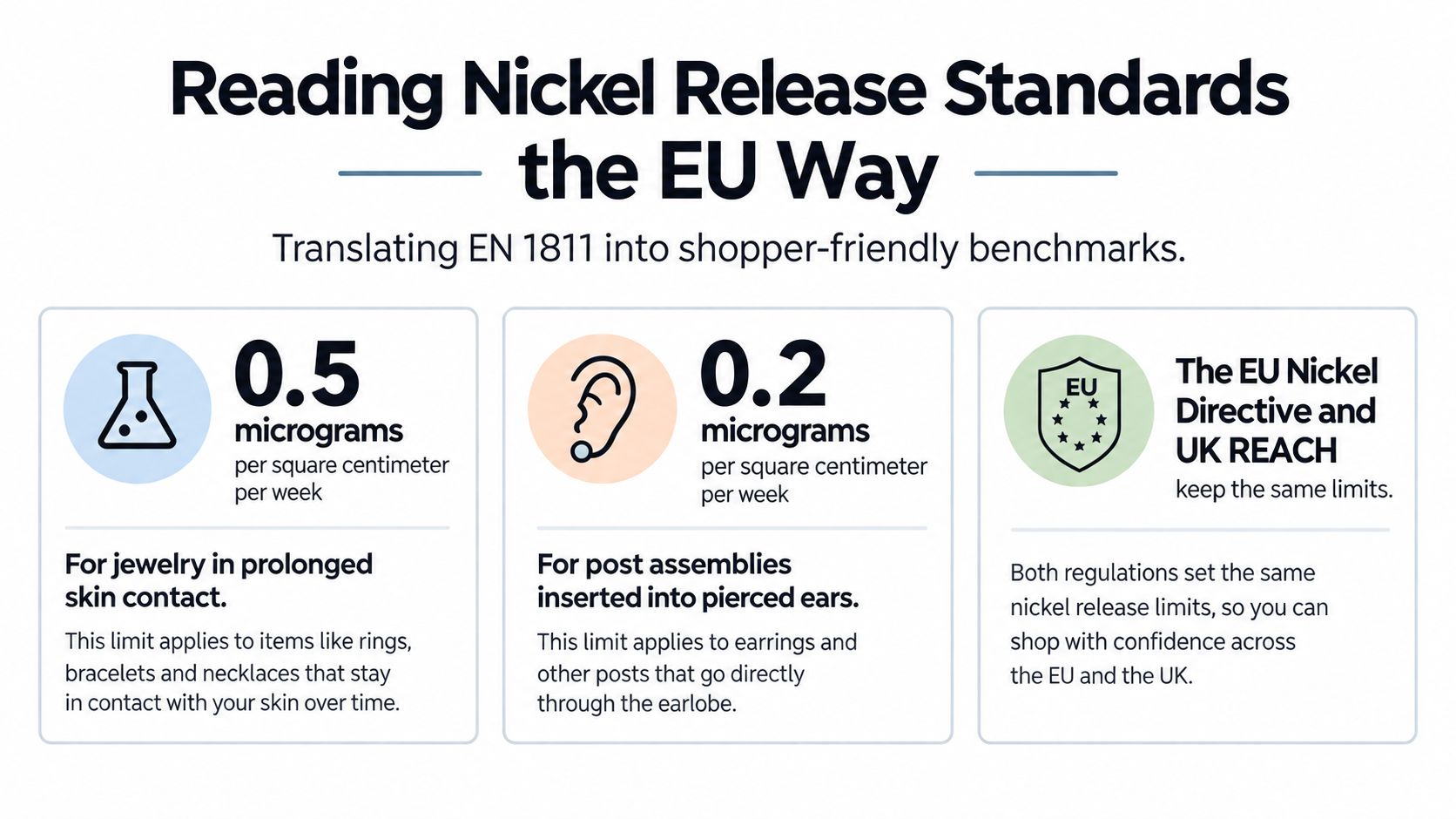
The European benchmark for jewelry intended for direct and prolonged skin contact is no more than 0.5 µg/cm²/week. For post assemblies inserted into pierced ears and other pierced parts, the tighter limit is 0.2 µg/cm²/week. These figures come from the European Chemicals Agency's nickel restriction documentation.
What the numbers mean in practice
The 0.5 µg/cm²/week limit covers necklaces, bracelets, chains, anklets, and rings designed for prolonged skin contact. The 0.2 µg/cm²/week limit covers parts placed inside piercings, including earring posts. Since a post enters a piercing, it has a tighter release threshold than jewelry resting on intact skin.
The EU also requires a non-nickel coating to remain effective for at least two years of normal use. A coating can look safe when new yet lose protection as rubbing and wear expose the base metal. Durability therefore belongs on your shopping checklist alongside the alloy itself.
Ask the seller: “Do you have a nickel-release test report for the finished piece, and does it cover the post, back, clasp, and other skin-contact components?”
An EN 1811-style test examines migration from the finished product under standardized conditions. That provides more useful evidence than a statement that the alloy contains no intentionally added nickel. The limits can guide shoppers outside Europe too, although local rules and testing systems may differ.
A compliant item cannot guarantee that every wearer will tolerate every material. Reactions may involve other metals, adhesives, cleaning products, or friction. Compliance does show that the product was assessed against a defined nickel-release target, rather than supported only by an unverified label. When comparing pieces, check the visible metal, posts, backs, clasps, and hidden connectors. Safety depends on the parts touching you, not just the surface you can see.
Where to Look on the Product Page Before You Buy
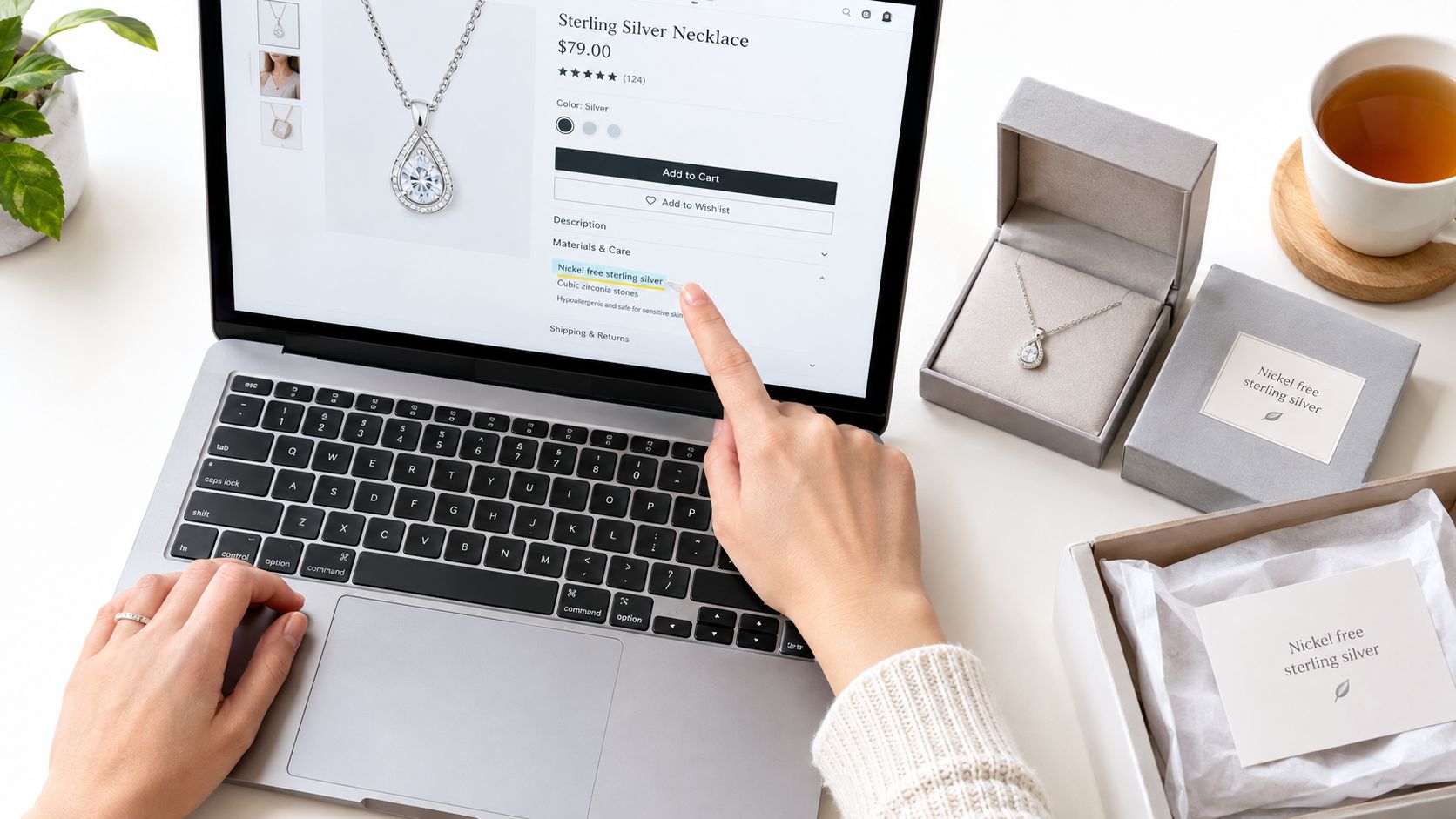
A necklace may look safe in a polished photograph, yet its clasp or connector can be made from a different metal. Begin with the materials section, then compare it with the product images. Look for a complete materials list covering the decorative metal, posts, backs, clasps, jump rings, springs, and any coating. “Gold plated” names a finish, while “titanium post” identifies a component. For earrings, both details matter because the post enters the piercing.
A product-page inspection
Read the bullet points, then open the specifications, FAQ, and care information. Look for named materials such as titanium, niobium, platinum, solid gold, or a clearly identified stainless-steel grade. Certification language has more value when it names a standard and identifies what was tested. A logo without supporting details leaves important questions unanswered.
Treat hypoallergenic, nickel safe, and lead free as starting points, not proof. These phrases may express the seller's intention, but they do not identify every part touching your skin or provide nickel-release results. Lead-free tells you about lead, not nickel.
A listing may mention a small earring weight in an exemption or compliance explanation. Weight does not show whether the post or back is suitable for you. Ask for the release information and the material of each skin-contact component.
Use this checklist:
- Read the full materials list. Look beyond the plated finish.
- Identify the post and back. These parts matter most for earrings.
- Find the clasp and connectors. Necklace and bracelet listings may leave them out.
- Check test documentation. Confirm the standard, tested item, and result.
- Contact customer service. Ask directly about any unnamed component.
The product page can suggest what you are seeing, while documentation supports what you are buying.
If the seller cannot identify the post, clutch, clasp, or solder, treat the piece as unverified. That does not prove it will cause a reaction. It means you lack enough information for a confident purchase.
Hidden Components That Can Sabotage a Nickel Free Piece
A nickel-free front plate doesn't protect you if the earring post contains nickel. The same principle applies to a necklace whose clasp rubs your neck, a ring whose inner shank includes an unknown repair solder, or a bracelet whose fold-over mechanism touches the wrist all day.
Consider a hypothetical earring with a titanium-colored decorative front and a nickel-containing post. The visible part passes a casual inspection, but the post enters the piercing and remains exposed to moisture and friction. One unsuitable component can undo the benefit of the safer-looking front.
The parts shoppers often miss
- Earring posts and butterfly backs: Both may touch the ear, and the back can trap sweat against the skin.
- Necklace clasps and jump rings: These small connectors often use a different alloy from the chain or pendant.
- Watch case backs: The back can sit against the wrist for prolonged contact, especially during exercise or warm weather.
- Bracelet mechanisms: Fold-over closures, springs, and hinges may press against the skin.
- Ring shanks and resizing solder: A repair area can introduce a metal that wasn't part of the original description.
- Prongs and bezel cups: Plated settings may expose a different base metal where the stone is held.
Fresh piercings make these weak points more consequential because the skin is vulnerable while healing. Sweaty skin and repeated rubbing can also increase contact with hidden surfaces. A coating may shield a base metal for a while, but abrasion eventually changes the boundary between the jewelry and the wearer.
For a clearer understanding of the hardware that secures earrings, review the different earring clasp types. The goal isn't to memorize every mechanism. It's to recognize that the closure is part of the exposure surface.
If a seller names only the pendant, charm, or visible face, ask for the material of every part that rests on or passes through your skin.
A practical message to customer service can be short: “What are the post, clutch, clasp, spring, jump ring, and solder made from, and do you have nickel-release testing for the finished item?” A precise answer gives you something to assess. A vague reply tells you to keep looking.
Care Tips and a Quick Buyer Checklist
Good material choices reduce risk, but care helps preserve the surface you're relying on. Remove jewelry before showering, swimming, and workouts. Dry each piece after moisture, store items separately to reduce abrasion, and wipe posts and backs with a soft cloth after wear.
Retire or repair pieces when you see green tarnish, peeling, flaking, or exposed base metal. A coating that has changed is no longer the same contact surface you evaluated at purchase. The gold-plated jewelry care guide offers additional maintenance guidance for plated pieces.
Your one-minute buyer checklist
- Confirm the release rate: Look for a test result, not only “nickel free.”
- Check the post and clasp: Make sure the parts touching skin are identified.
- Inspect the finish details: Ask whether plating thickness and durability are documented.
- Ask about solder: This matters for rings, settings, chains, and repairs.
- Prefer solid construction for sensitive spots: A stable material avoids some coating-related uncertainty.
- Choose transparent sellers: Full component specifications are a practical trust signal.
- Keep the packaging and details: Save the materials information in case you need to compare reactions later.
EP Fine Jewelry offers personalized jewelry along with earrings, necklaces, rings, bracelets, bangles, charms, and care information, so shoppers can review its product details and policies while comparing options. Visit EP Fine Jewelry and contact the store before ordering if a product page doesn't identify the skin-contact components you need to verify.