
Personalized jewelry is a substantial category, not a niche gift idea. Dataintelo's market estimate valued the global sector at approximately USD 33.5 billion in 2025, covering everything from name necklaces to engraved rings and buyer-assembled charms. That's a commercial estimate for the broader category, not sales of name charms alone, but it puts personal jewelry choices into perspective.
Choosing name charms for necklaces takes more than picking attractive lettering. The charm, its connector, the chain, and the clasp need to work together. The wording matters too, especially when the wearer is a child and the name will be visible in public.
Table of Contents
- Name Charm Styles Worth Comparing
- Metals That Stay Comfortable on Skin
- Chain Size Placement and Weight
- What to Personalize and What to Leave Off
- Styling Ideas and Gift Occasions
- Order, Care and the Final Check
Name Charm Styles Worth Comparing
A 2025 Plumb Club research presentation found that nearly 70% of respondents considered personalization important when selecting jewelry, and 64% wanted to personalize a piece with a message or symbol, such as a name, initial, letter, or date. A name charm carries that personal detail on a chain, either as a complete nameplate or as separate letters.
A fixed nameplate keeps the letters in order. Separate charms can be rearranged, though they may overlap as the necklace moves.
Name charm styles compared
| Style | Look | Practical letter count | Readability | Best for |
|---|---|---|---|---|
| Block | Thick, even strokes | A short name that fits without compressed letters | Easy from a short distance | Names that should be read quickly |
| Script | Connected cursive | One short name | Easier to read up close | A handwritten-feeling gift |
| Monogram | Overlapping initials, center letter often largest | A compact group of initials | Initials rather than a full name | Representing several people on one pendant |
| Single letter | One movable letter charm | One initial per charm | One initial at a time | Mix-and-match arrangements |
| Bubble or cutout | Rounded solid or open letters | Follow the design's available options | Bold shape, best viewed up close | A playful nameplate |
For a concrete bubble-style example, the 14k Diamond Bubble Cutout Name Necklace shows how rounded letters create a bolder outline. Check the letter shapes in the product image or preview before ordering, especially if the name includes narrow openings or closely spaced characters.
Monograms need a layout check, too. Confirm which initial appears in the center rather than assuming the preview follows the wearer's usual written order.
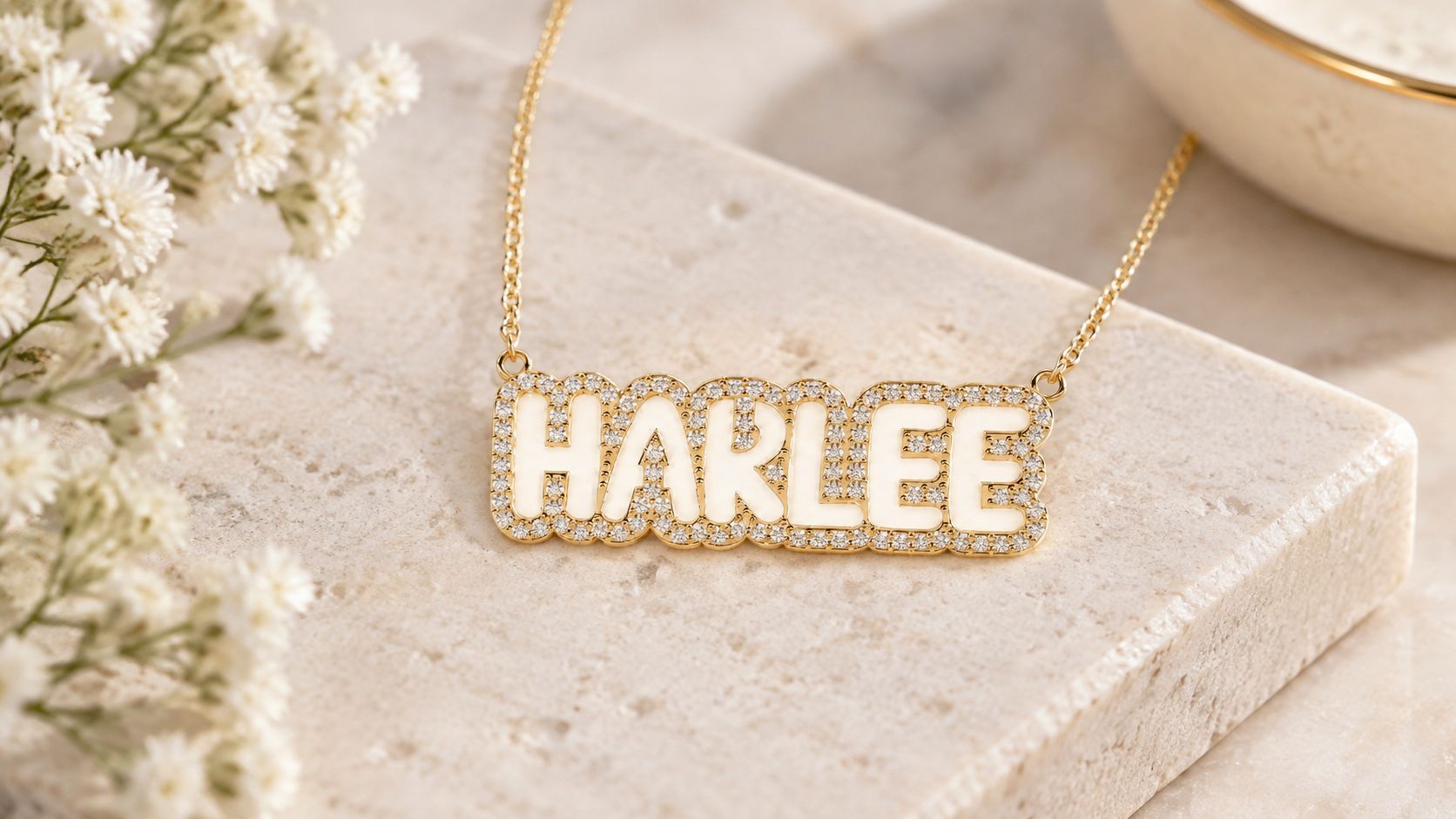
Match the shape to the wearer
The charm, its bail, the chain, and the clasp form one loaded assembly. A long nameplate or several separate letters can shift and turn as the wearer moves, so consider how the pieces will sit together, not just how the lettering looks in a product image.
Separate letters suit someone who enjoys changing an arrangement. These charm necklace ideas show ways to combine personal elements without letting each charm compete for attention. A symbol can carry meaning without spelling out a name. For someone drawn to protective meaning, Kailash Way offers a spiritual gift symbolizing protection.
A visible name is also a privacy choice, especially for a child. If you prefer not to display a child's name in public, initials or a meaningful symbol can keep the gift personal without showing the full name. Use block lettering when the name needs to be read across a room; choose a more compact arrangement when keeping it less prominent matters.
Metals That Stay Comfortable on Skin
Skin comfort depends on every part that touches the wearer. The bail, the connector that lets the chain pass through the charm, may use a different alloy from the pendant. The chain, clasp, and joining rings can differ too. Check each component, much as you would inspect every link in a chain.
Name charm metals and skin contact
| Material | Nickel exposure | How it wears | Care note | Best for |
|---|---|---|---|---|
| Solid gold | Confirm the alloy, including findings | No surface plating to wear through | Mild soap when appropriate; dry thoroughly | Keepsakes and regular wear when the alloy is tolerated |
| Gold-filled | Check the base metal and exposed connections | Bonded gold layer can wear through with abrasion | Avoid abrasive polishing | A gold surface at a lower material cost |
| Sterling silver | Confirm alloy and solder details | Can tarnish | Dry after water and sweat | Bright everyday pieces |
| Stainless steel | Grade and findings determine suitability | Resists everyday knocks well | Clean off sweat; inspect connections | Active wearers whose skin tolerates the alloy |
| Plated base metal | Exposure can increase when plating wears | Finish may fade at edges and contact points | Stop wearing if damaged plating irritates skin | Occasional wear with clear material disclosure |
Solid gold has no surface coating to wear through, while its alloy still determines whether the piece suits sensitive skin. Check the alloy of the bail and clasp before relying on a gold label. Gold-filled jewelry has a bonded gold layer over base metal; ask whether the clasp spring and joining rings match the stated materials.
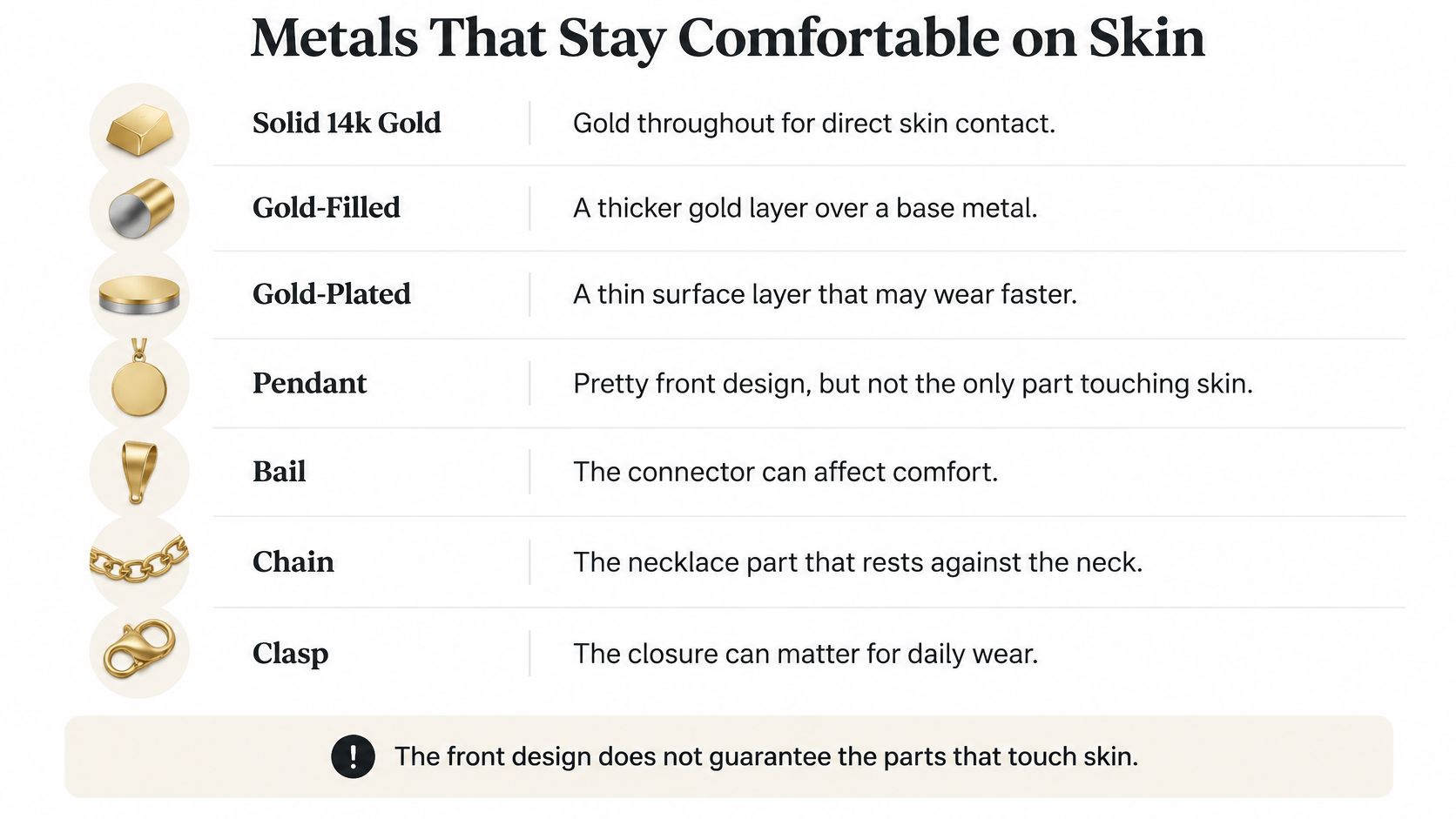
Read the material description as a checklist
Use the listing to check what each part is made of, then consider how the necklace will be worn. Sterling silver can tarnish and needs routine care. Stainless steel resists everyday knocks, but its grade and findings still matter for someone concerned about nickel. With plated jewelry, inspect the bail and chain links, where rubbing can wear the finish.
A font preview answers how a name will look, not what metal touches the skin. For example, when reviewing Dorado's custom name necklace, check the material details separately from the personalization choices. A visible name is also a privacy choice, especially for a child who may wear the necklace outside the home.
Before buying, look for clear answers to these questions:
- Underlying metal: What is the pendant made from beneath any coating?
- Matching components: Do the bail, chain, clasp, and joining rings use the same alloy?
- Testing information: Is nickel content or nickel-release testing documented?
- Finish maintenance: What cleaning methods could damage the surface?
The guide to understanding nickel-free jewelry explains what material descriptions can tell you. If you already know you react to a particular alloy, choose based on disclosed composition rather than color. Remove the necklace if irritation develops.
Chain Size Placement and Weight
Treat the necklace as a loaded assembly, not a pendant with a decorative string attached. The charm places weight on the bail, chain links, joining rings, and closure whenever the wearer moves.
The starting ranges below come from GadgetsFeed's everyday-chain guidance: approximately 1.0 to 1.6 mm for pendants under 5 g, 1.6 to 2.5 mm for 5 to 12 g, and at least 3 mm above 12 g. These are shopping guidelines, not strength guarantees, because link construction and manufacturing quality also matter.
Chain and clasp by charm weight
| Pendant weight | Chain thickness | Clasp | Connection check |
|---|---|---|---|
| Lightweight pendant | Fine chain within the light-pendant range | Small spring-ring or light lobster | Bail clears the clasp; end ring soldered |
| Medium-weight pendant | Medium chain within the corresponding range | Lobster | Soldered rings; no unsupported open connector |
| Heavy pendant | Heavier chain within the corresponding range | Lobster or carabiner | Check the finished assembly, not the chain alone |
| Pendant requiring a larger closure | Chain selected for the actual load | Appropriately sized lobster | Professional testing of chain and connectors |
A hollow or delicately constructed chain shouldn't be judged by width alone. A chain can look substantial while its weakest connection remains a small unsoldered ring.
Check each connection before choosing placement
Start with the combined pendant load, including additional letters and attachment hardware. If you intend to add more charms later, tell the seller before choosing the chain rather than assuming there's spare capacity.
Next, check the bail opening. For a removable pendant, the chain's thickest part must pass through it, which may be the clasp or end fitting rather than the links. A fixed nameplate uses a different arrangement, so inspect the attachment points at both ends.
For heavier pendants above approximately 10 g, Honho's jewelry-findings guidance includes a lobster-clasp specification of approximately 14 to 18 mm long, with wire at least 0.8 mm and a clasp-post gauge of at least 1.02 mm. Its quality-control guidance also calls for testing with at least a 20% strength margin above the expected load. These are specifications to discuss with a jeweler, not a reason to pull-test a necklace at home.
A strong chain can still lose its pendant if the small connector between them opens.
Fit the wearer rather than the photograph
Use a soft tape measure or a piece of string to find where the name should sit. Mark the position while wearing the neckline you expect to pair with it, then compare that measurement with the necklace listing.
Our necklace length chart helps translate that position into a shopping choice. Leave enough separation between layered pendants that they don't continually strike or overlap.
A wide nameplate can catch on a shirt edge or turn when it sits partly inside a neckline. Choose a position where the whole plate rests freely, and move your shoulders during a try-on rather than checking only while standing still.
What to Personalize and What to Leave Off
More personal information doesn't automatically make a better gift. A full name may feel meaningful to the buyer while being more visible than the wearer wants. For a child, that's a privacy decision before it's a lettering decision.
A readable name gives an unfamiliar person information they wouldn't otherwise have. That doesn't mean every name necklace creates the same risk, but it's a sensible reason to discuss the design with a parent or guardian before ordering.
Choose a quieter identifier for children
An initial, birthstone, or meaningful symbol can make a necklace personal without displaying a full identity. A nickname may be appropriate if the family is comfortable showing it publicly, but it still reveals a name the child recognizes.
Back engraving offers another option. Keep in mind that a pendant can turn over, so hidden wording is less visible, not guaranteed private.
- Initial: Recognizable to the family without spelling out a name.
- Birthstone: Personal meaning without readable text.
- Small symbol: A flower, animal, or other familiar motif.
- Back engraving: A message intended for close viewing rather than public display.
Small detachable letters and beads also deserve attention because loose components can become choking hazards. Young children need adult supervision, and necklaces should come off for sleep, sports, and rough play. Don't assume a shorter chain removes all catching or pulling risks.
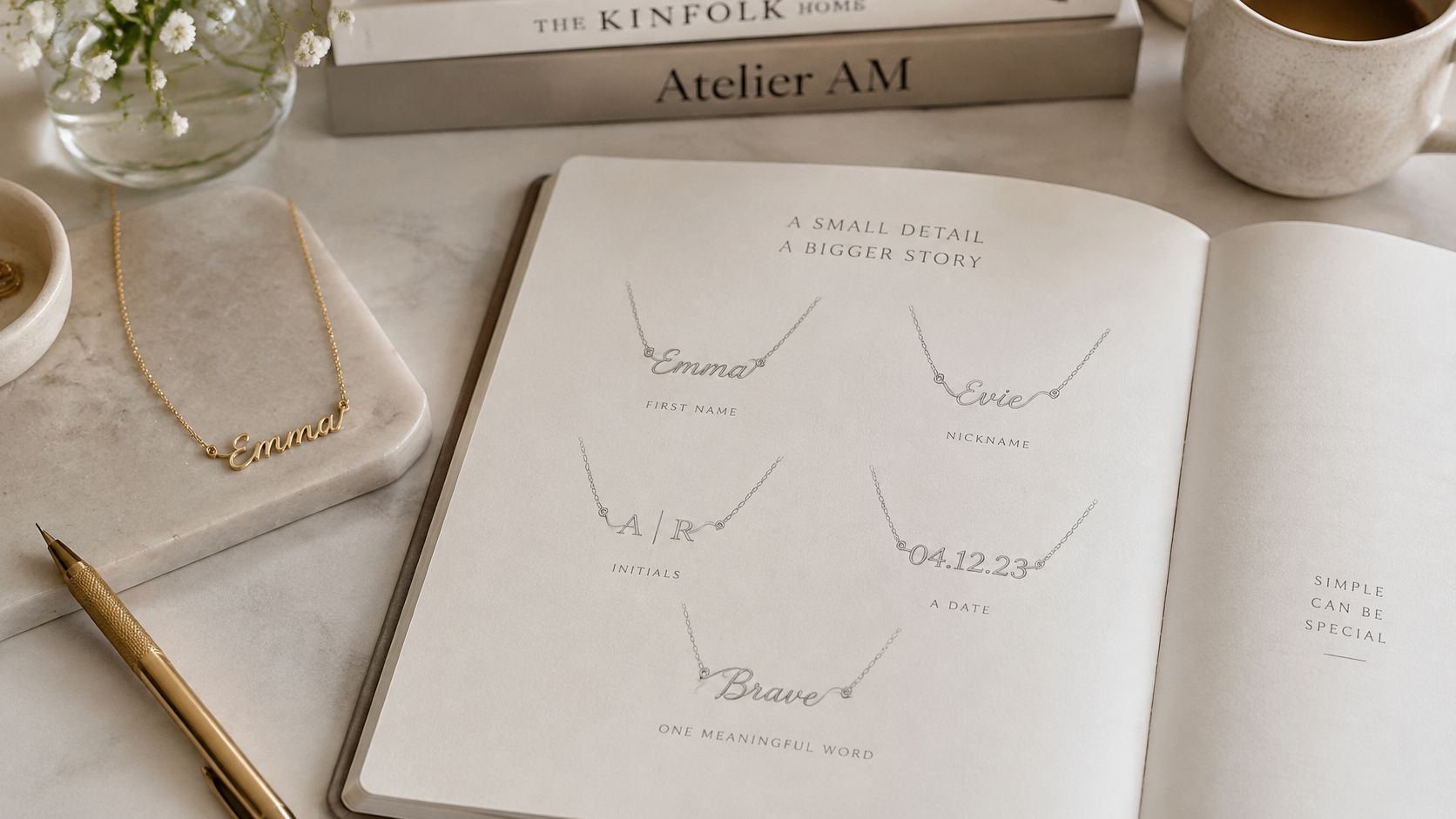
Keep health and privacy questions separate
Material suitability remains a different decision from age-appropriate personalization. Mayo Clinic's nickel-allergy guidance addresses allergic reactions, not whether a visible child's name is appropriate. A necklace can meet a family's material preferences and still be the wrong design for unsupervised wear.
Before putting it on a child, check for loose letters, damaged connections, or a closure that no longer works smoothly. A keepsake can stay in its box until the recipient is ready to wear it responsibly.
For adults, start with what the wearer uses: a chosen name, familiar nickname, initials, meaningful date, or a short word. Don't substitute a legal name for someone's preferred name because it feels more formal.
Personalization should reflect the wearer's comfort, not the buyer's wish to include every detail.
A grandparent can give an initial and birthstone with the same affection as a full-name pendant. Choose publicly visible wording only when the wearer can manage it and is comfortable with the setting.
Styling Ideas and Gift Occasions
A block name at the collarbone works with a plain tee because there's little else competing with the lettering. Let the pendant sit against an uninterrupted area of fabric or skin. A busy print directly behind open letters can make the name harder to pick out.
For a lower neckline, a small script initial can sit inside a longer plain chain. The surrounding space makes the initial visible without requiring a wide nameplate. Keep the arrangement simple enough that the wearer doesn't have to untangle it whenever they adjust a collar.
A short nickname made from separate letter charms gives a different effect. The letters move rather than forming a rigid line, so consider that part of the look instead of expecting them to stay perfectly spaced.
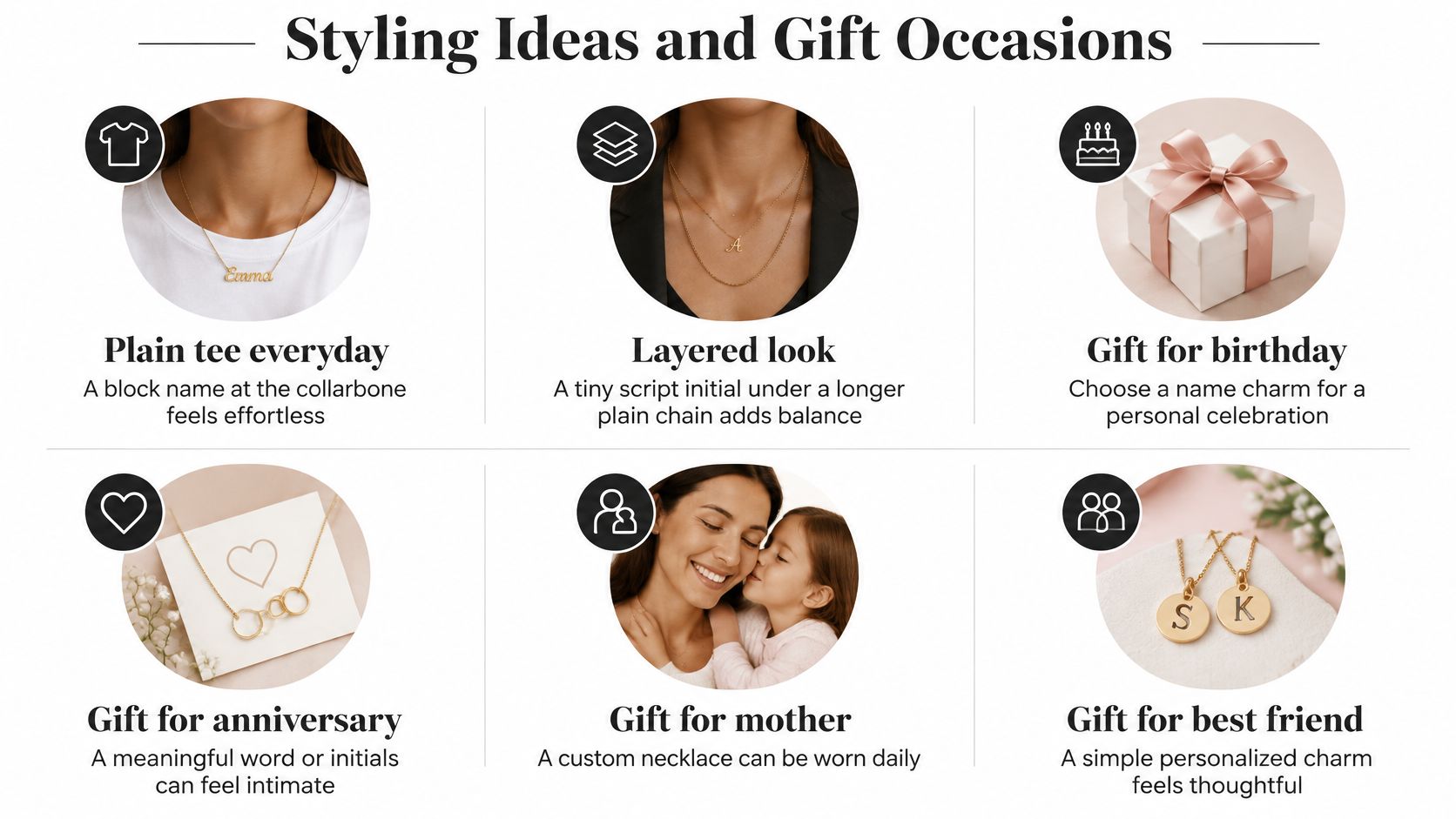
Match the message to the occasion
The best gift choice starts with the recipient's habits. Someone who wears a single small pendant may not want a large nameplate, even if they love the meaning behind it.
| Occasion | Charm choice | Why it fits |
|---|---|---|
| Close friend's birthday | Their preferred name in script | Personal without adding a long message |
| New-parent gift | The baby's initial on a necklace for the parent | Marks the relationship without requiring a full name |
| Wedding-party thank-you | Each recipient's own monogram | Gives everyone a related gift with individual meaning |
| Graduation | An initial with a small meaningful symbol | Connects identity with a new beginning |
For Mother's Day, decide whether the recipient would rather represent children individually or wear a shared family symbol. Don't force several names into lettering too small for her to enjoy.
Cedar & Lily Clothier's jewelry gifting tips for special occasions can help you think through the occasion before settling on the design. Our personalized jewelry gifts for her also offers a starting point for matching personalization to the recipient rather than choosing by occasion alone.
Make the card do some of the work
The necklace doesn't have to carry the whole message. Put the longer sentiment in the card, where you can explain why you chose that name, initial, or symbol.
Keep customization instructions separate from the gift message. The order needs exact spelling and case preferences; the recipient's card needs warmth, not manufacturing details. Decide whether the box should arrive ready to hand over so you aren't repacking a finished gift at the last moment.
Order, Care and the Final Check
Treat the charm, bail, chain, and clasp as one assembly: each part must fit and support the others. Before ordering, check the details that affect how the necklace will look, wear, and arrive.
Check the order before paying
- Write the exact text. Copy the preferred spelling into the customization field, including accents when the design supports them. State uppercase or lowercase preferences instead of assuming they will be inferred.
- Approve the layout. Check where the name begins and ends, whether script letters are clearly joined, and which initial occupies the center of a monogram. Use the final preview rather than a sample bearing someone else's name.
- Read every measurement. Distinguish letter height from total pendant width and chain length. If the listing mentions an extender, check whether the stated length includes it or describes the chain before extension.
- Save the order details once. Keep the confirmation, approved wording, and material description together. A screenshot of only the front photograph won't preserve the specifications you chose.
- Check the sale terms. Charm pendants, including letter or initial charms, cuffs, and personalized charm necklaces are final sale. Personalized name necklaces and bracelets, excluding charm bangles, are also final sale and don't qualify for store credit.
After those checks, add a gift note or optional gift box. Use the order-notes field for a clear message or handling request, but don't assume a note can override a product's customization limits.
Keep care simple and material-specific
Fasten the clasp completely before wearing the necklace. If it sticks or a ring begins opening, stop wearing the piece and arrange a repair rather than squeezing parts together with household pliers.
A soft, dry cloth is a useful first step after wear. For more involved cleaning, follow the material-specific jewelry care instructions, especially if the necklace combines finishes or includes stones.
- Apply products first: Let perfume, lotion, and hair products dry before putting on the necklace.
- Remove for wet or strenuous activities: Keep it off for swimming, showers, and workouts.
- Store without pressure: Lay delicate script pieces flat and keep other jewelry from pressing against the letters.
- Inspect before reuse: Check the connections and finish, not only the front of the charm.
Preserve the details that matter
When the gift arrives, compare it with the approved wording before the occasion. Check that the letters are correct, the chain isn't tangled around the nameplate, and the closure operates normally. Raise any concern promptly through the store's support process rather than trying to alter a custom piece yourself.
A visible name is also a privacy choice, especially for a child. Consider whether an initial or symbol would carry the same meaning without displaying a full name in public.
EP Fine Jewelry offers personalized name necklaces and bracelets, along with charm options for building a personal combination. Visit EP Fine Jewelry to browse designs, including the 14k Diamond Three Name Necklace. Check the live listing for its current customization details and shipping terms before ordering.