
You've just left the piercing studio, checking your ears in every mirror and enjoying that small rush of excitement. Then the questions begin: Should you touch the earrings? Can you sleep normally? Is a little redness expected, or is something wrong? Good ears pierced aftercare starts with simple habits, not a cabinet full of products.
A fresh piercing is healing tissue with jewelry passing through it. The safest approach is gentle cleaning, minimal handling, appropriate jewelry, and close attention to how the site changes. The routine below will help you care for both lobes and cartilage, understand what normal healing can feel like, and recognize when a professional should take a closer look.
Table of Contents
- What to Know Right After Your Ears Are Pierced
- Why Ears Pierced Aftercare Matters More Than You Expect
- Your Step-by-Step Daily Cleaning Routine
- Healing Timelines for Lobe Versus Cartilage Piercings
- Products That Help and Products to Skip
- Warning Signs and When to Seek Help
- Quick Reference Checklist for the First Six Weeks
What to Know Right After Your Ears Are Pierced
The first hours are usually less dramatic than nervous first-timers expect. You may notice mild tenderness, slight swelling, a small spot of blood, or light crusting around the front and back of the piercing. Those sensations can be part of the body's early repair response, especially during the first couple of days.
Your first job is to leave the original jewelry in place. The starter earrings create space for the healing channel and accommodate early swelling. Removing them or changing them too soon can irritate the tissue, introduce bacteria, or allow the opening to narrow around an earring that hasn't been professionally fitted.
Let the jewelry support healing
Ask your piercer what metal was used and follow their guidance about fit and follow-up. Materials commonly selected for fresh piercings include implant-grade titanium, solid gold of at least 14K, and niobium. The important point is that the jewelry should be suitable for a new piercing, correctly sized, and left undisturbed unless a qualified piercer needs to adjust it.
A post that feels tight, presses into the skin, or begins to disappear needs prompt professional attention. Don't force the backing loose or remove the jewelry yourself. A piercer can assess swelling and change the fit without unnecessarily traumatizing the channel.
Clean-touch habit: Treat every touch as a choice. Wash your hands first, touch only when your routine requires it, and leave the jewelry alone afterward.
Hair, headphones, helmets, clothing, and pillows can all catch on a fresh earring. Keep hair away from the site when possible, handle clothing carefully, and avoid testing the jewelry by pushing or turning it. If you're choosing pieces for later, learning about different earring types can help you plan without swapping jewelry before the piercing is ready.
You'll finish the early stage with a clear routine: clean gently, dry carefully, protect the ear from pressure and snags, and observe rather than constantly inspect. That calm consistency gives the skin the best chance to repair itself.
Why Ears Pierced Aftercare Matters More Than You Expect
The first few days can feel deceptively easy. Your ear may look calm while the new channel is still fragile, much like a small cut that has closed on the surface but has not finished repairing underneath. Care matters because complications after piercing are common enough to deserve attention. A clinical review cited in Cleveland Clinic's guidance on infected ear piercings reported that up to 35% of people with pierced ears experienced at least one complication, with 77% of those complications being minor infections. Serious infection in the general population was reported at less than 1% in the same evidence base.
A public-health review from the U.S. CDC on piercing-related infections states that localized infections occur at 10% to 30% of new piercing sites. Organisms often identified include Staphylococcus aureus, Streptococcus pyogenes, and Pseudomonas aeruginosa. These figures do not mean every piercing will become infected. They show why clean hands, limited touching, and protection from pressure matter while irritated tissue is sealing.
What the figures mean in daily life
Trouble can begin with repeated pressure during sleep, an early jewelry change, unwashed hands touching the post, or hair and skin products collecting around the entry point. Swimming and soaking may also expose an open healing site to unsuitable water. Lobe piercings and cartilage piercings deserve the same clean habits, but cartilage has less flexible tissue and can become more difficult to manage when swelling or infection develops.
| Piercing Type | Reported Complication Rate | Most Common Issue |
|---|---|---|
| Pierced ears overall | Up to 35% | Minor infections among most reported complications |
| New piercing sites | 10% to 30% localized infection | Localized bacterial infection |
| Serious infection in the general population | Less than 1% | Serious infection |
These figures support a minimalist routine. Aftercare isn't decorative maintenance. It limits unnecessary contact, reduces irritation, and helps you notice a change before a small concern grows. More products do not automatically improve healing. Creams can trap moisture and debris, while some aftercare solutions irritate tissue or increase infection risk. Gentle, consistent care is usually safer than adding treatments whenever the ear looks imperfect.
A product such as Evil Eye Studs is better considered for a later jewelry change, not placed in a fresh piercing unless a qualified professional confirms that it suits the healing stage.
Your Step-by-Step Daily Cleaning Routine
Think of cleaning as a quiet, repeatable ritual rather than a medical procedure. You don't need to scrub, rotate, or keep checking the piercing. You need clean hands, sterile saline, a gentle touch, and enough patience to let loosened debris come away without force.
Follow the same sequence each time
- Wash your hands first. Use mild, fragrance-free soap and wash thoroughly before touching the area. Clean hands matter more than complicated equipment because they prevent dirt and bacteria from transferring to the healing site.
- Choose sterile saline. Use a product containing 0.9% sodium chloride with no additives. Spray the piercing directly if the applicator allows it, or wet clean non-woven gauze with saline.
- Soften rather than scrape. Hold the damp gauze against the front and back of the piercing for 30 to 60 seconds. This helps soften dried fluid. Don't pick crusts with your fingernails, and don't pull at anything that remains firmly attached.
- Clean around the channel. Wipe gently around the jewelry and entry points. You're removing surface residue, not trying to scrub inside the fistula. Never twist or rotate the jewelry during cleaning. Movement can disturb fragile tissue and prolong irritation.
- Dry with a disposable paper product. Pat the area gently with a fresh paper towel. Shared cloth towels can carry residue and may snag on the jewelry, especially when the post or backing catches in the fabric.
- Leave it alone. Once the area is clean and dry, stop touching it. Repeated cleaning or checking can create the irritation you're trying to prevent.
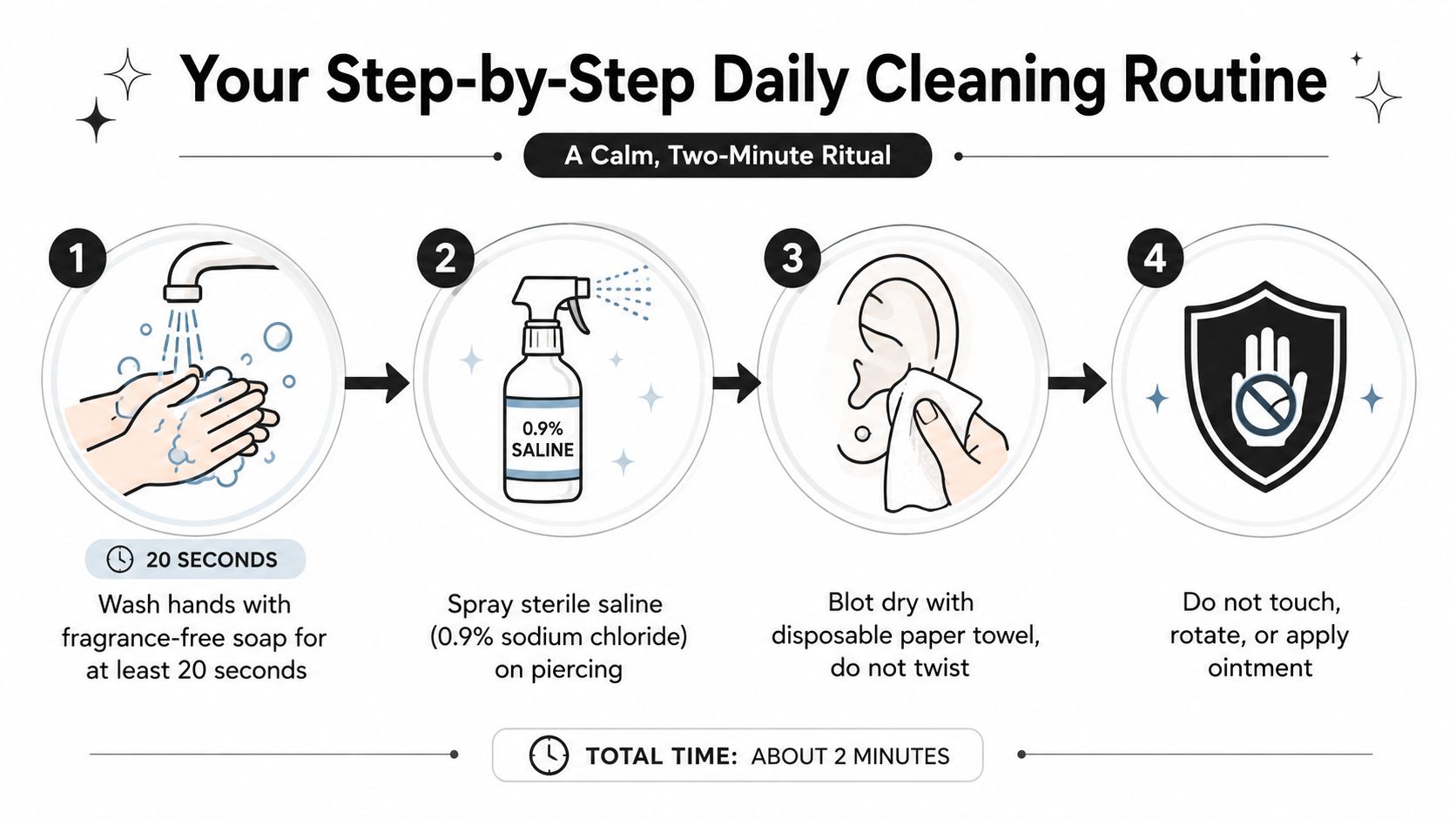
For many new piercings, twice-daily saline care is a practical starting routine during the early healing period. Follow your piercer's specific instructions, especially if your skin becomes dry or irritated. More cleaning isn't automatically better. If you're also caring for other jewelry, keep those habits separate by following a guide to cleaning jewelry at home, since healed jewelry and fresh piercing tissue don't need identical treatment.
Here's a visual reminder of the sequence:
Healing Timelines for Lobe Versus Cartilage Piercings
Lobes and cartilage shouldn't be treated as interchangeable. They're different tissues, experience different kinds of pressure, and show different complication patterns. A lobe piercing often feels easier sooner, while cartilage can look calm on the outside and remain vulnerable inside.
Clinical evidence supports taking cartilage more seriously. In a large adult study, any complication occurred in 40.2% of cartilage piercings compared with 25.4% of lobule piercings, while infection occurred in 30.3% of cartilage piercings compared with 23.8% of lobule piercings, as reported in this comparative study of ear-piercing complications. These results don't predict exactly what will happen to you, but they do explain why a cartilage piercing deserves more protection and a lower threshold for professional advice.
| Factor | Lobe Piercing | Cartilage Piercing |
|---|---|---|
| Tissue location | Soft tissue with generally easier access to circulation | Firmer tissue with more limited blood supply |
| Typical experience | Tenderness and swelling often settle more readily | Irritation can persist after the surface appears calmer |
| Pressure concerns | Sleep pressure can still cause problems | Sleep, headphones, helmets, and hair can apply repeated pressure |
| Jewelry changes | Wait for professional confirmation of readiness | Be especially cautious about early changes |
| Escalation | Seek advice when symptoms persist or worsen | Seek medical advice sooner when infection signs appear |
Use milestones, not impatience
Improvement looks like steadily reduced tenderness, less crusting, and no expanding redness. A piercing that feels fine for a day isn't automatically healed. The internal tissue still needs time to strengthen, so jewelry should remain in place until a professional confirms that changing it is safe.
Cartilage infections can become perichondritis, a deeper problem that may damage the shape of the ear. A systematic review found that 87.2% of infections in transcartilaginous ear piercings were caused by Pseudomonas aeruginosa, according to this review of transcartilaginous piercing infections. If cartilage becomes increasingly hot, painful, swollen, or red, contact a doctor rather than relying on home care alone.
Once your piercing is fully settled, you can think about styling choices such as a minimalist ear stack without treating the healing stage as a race.
Products That Help and Products to Skip
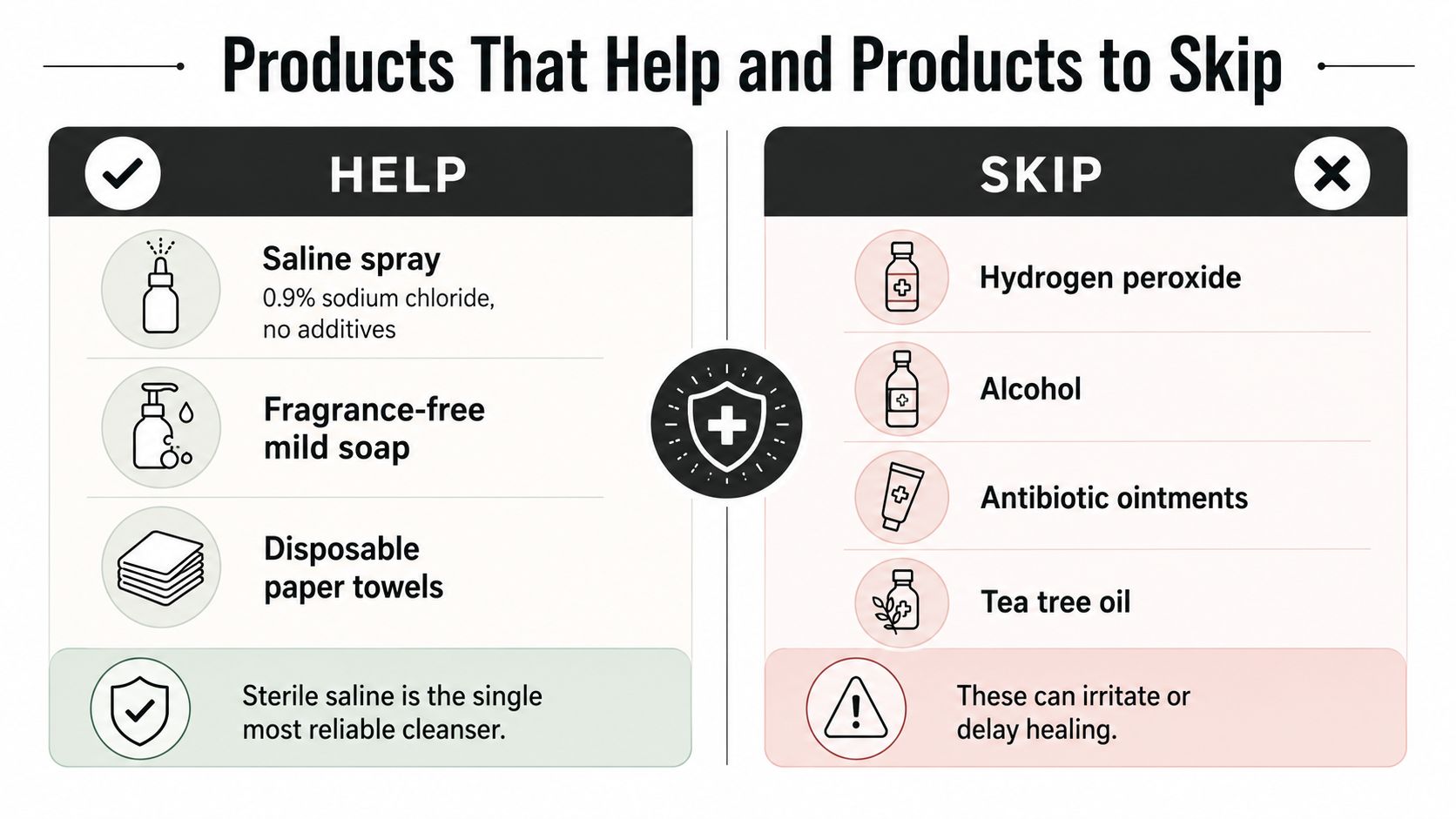
The safest aftercare shelf is usually a short one. Sterile saline is the main cleanser, while clean gauze and disposable paper products support application and drying. A mild, fragrance-free soap can be useful for cleaning the surrounding skin, but it shouldn't replace gentle saline care or become something you scrub into the piercing.
Keep the routine deliberately simple
Helpful options include:
- Sterile saline: Choose 0.9% sodium chloride with no additives.
- Non-woven gauze: Use it to apply saline and soften surface crusting without aggressive rubbing.
- Disposable paper towels: Pat the area dry with a fresh piece after cleaning.
- Mild fragrance-free soap: Use sparingly on nearby external skin, keeping strong cleansers away from the healing channel.
Why extra products can create extra problems
Alcohol and hydrogen peroxide can irritate fragile tissue. Essential oils such as tea tree oil can also cause irritation, and thick creams may keep the area overly moist or trap residue against the skin. Antibiotic products shouldn't be used casually without medical advice.
An outbreak investigation in England found that using a specific aftercare solution was strongly associated with becoming a case of Pseudomonas infection, with an adjusted odds ratio of 4.60, while any cream use was associated with higher odds, with an adjusted odds ratio of 5.89, as reported in this investigation of a piercing-associated Pseudomonas outbreak. The finding challenges the instinct to add more antiseptics, creams, and specialty formulas whenever healing looks imperfect.
A useful filter: If a product stings, leaves a heavy film, or promises to solve every possible piercing problem, pause before applying it. Simple care is often easier for your skin to tolerate.
Product care for healed jewelry is a separate subject. For example, understanding whether sterling silver tarnishes over time can help you maintain older pieces, but tarnish care doesn't belong on fresh piercing tissue.
Warning Signs and When to Seek Help
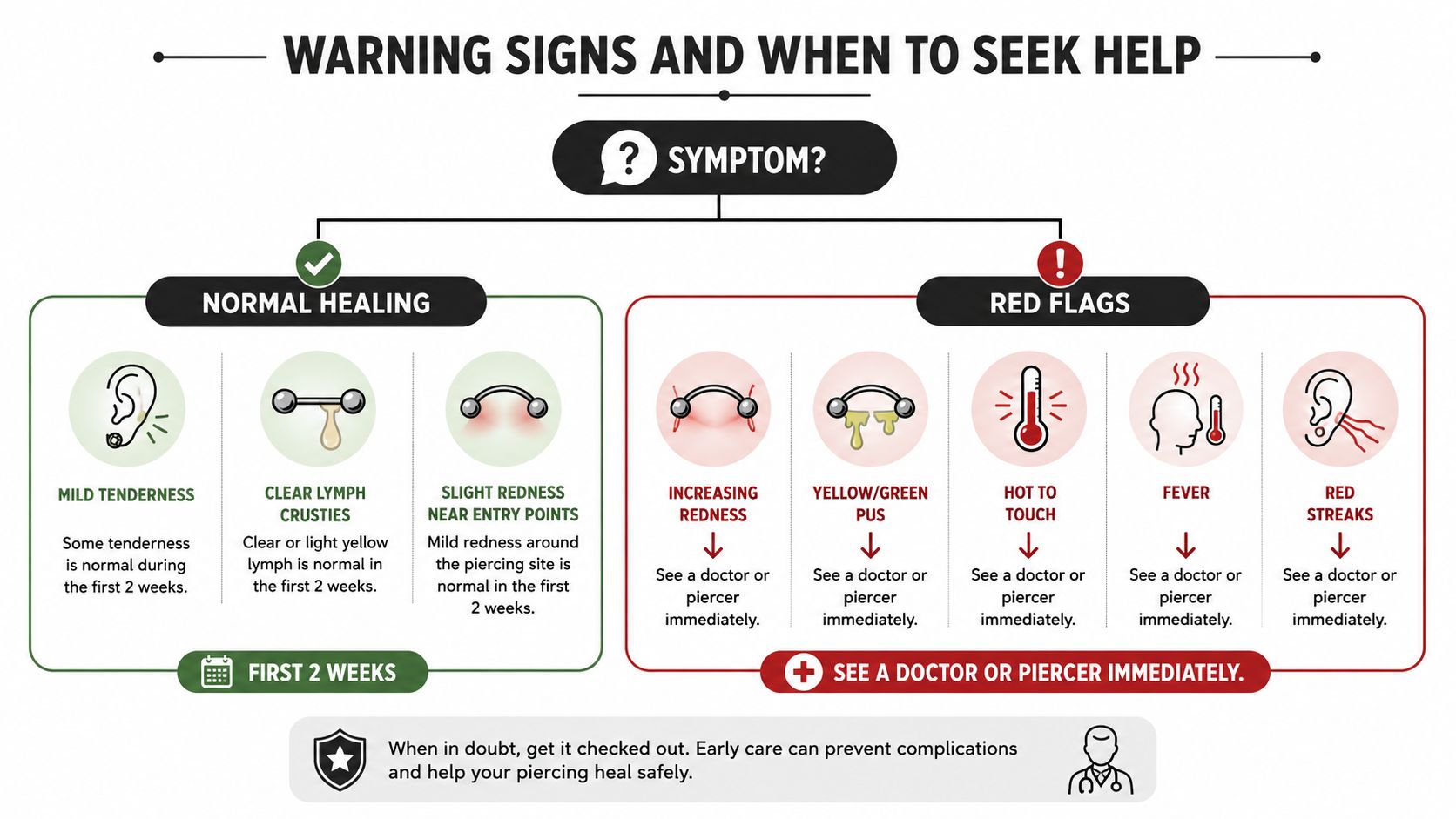
New piercings can look slightly pink and feel tender without being infected. Clear or pale fluid that dries into light crusting can also occur during normal healing. The key is the direction of change. Symptoms that gradually settle are different from symptoms that become stronger, spread, or feel hot.
Sort ordinary irritation from a developing problem
Mild tenderness, limited swelling, and slight redness close to the entry points can be part of early healing. Give the site gentle care and avoid provoking it with pressure, twisting, or repeated product changes.
Contact your piercer for assessment if you notice:
- Persistent warmth: The area remains noticeably hot rather than gradually calming.
- Expanding redness: Redness spreads away from the piercing.
- Thick discharge: Yellow-green or foul-smelling drainage needs attention.
- Increasing pain: Pain that worsens after the initial period is more concerning than tenderness that steadily improves.
- Embedding jewelry: A backing or post appears to be sinking into swollen tissue.
Know when a doctor should take over
Seek medical attention for fever, swollen lymph nodes, red streaks moving away from the piercing, or an abscess. For cartilage, don't wait through worsening symptoms to see whether another product helps. The evidence on transcartilaginous infections shows why cartilage concerns can require medical treatment rather than routine home care.
Don't remove jewelry from a suspected infection unless a healthcare professional tells you to. Closing the opening can interfere with drainage and may complicate assessment. A piercer can evaluate jewelry fit and irritation, but a doctor should assess systemic symptoms, spreading infection, significant swelling, or suspected cartilage infection.
Take clear photos in consistent lighting and note when symptoms began, whether they're spreading, and how pain has changed. Those details can help a piercer or clinician understand the progression, especially if you're asking for remote guidance.
Quick Reference Checklist for the First Six Weeks
Use this as a practical reminder, not a substitute for professional advice when symptoms are worsening. Keep it somewhere visible during the early routine, then adjust based on how the tissue responds and what your piercer recommends.
Daily habits
- Wash hands: Clean your hands before touching the earrings or nearby skin.
- Use saline: Apply sterile saline gently as part of your morning and evening routine.
- Dry carefully: Pat with a fresh disposable paper product.
- Leave jewelry still: Don't twist, rotate, or remove starter jewelry.
Protection during sleep and water exposure
- Reduce pressure: Sleep on your back when possible, or use a clean travel pillow with your ear resting in the center opening.
- Protect from snags: Keep hair, headphones, hats, and clothing from catching on the posts.
- Avoid submerging: Stay away from pools, lakes, and other soaking environments during the healing window.
- Keep products away: Prevent hair spray, fragrance, makeup, and heavy skin products from collecting around the piercing.
Weekly checks
- Look in a mirror: Check front and back for changes in swelling, redness, drainage, and jewelry fit.
- Track the trend: Improvement matters more than one isolated moment of tenderness.
- Escalate early: Cartilage symptoms deserve faster medical attention than mild, settling lobe irritation.
Starter jewelry should remain untouched through the early healing period. A lobe may be ready for a professional change after the initial healing stage, while cartilage usually needs substantially more patience. Don't use a calendar alone. Let the condition of the tissue and a professional assessment guide the decision.
When your ears are ready for new pieces, learning about earring clasp types can help you choose a fastening style that suits your comfort and daily routine. Consistent aftercare takes only a small part of your day, but it protects the result you wanted when you first left the studio.
EP Fine Jewelry offers earrings alongside personalized jewelry, charms, bracelets, necklaces, and rings, with Jewelry Care and FAQ content for ownership questions. Visit EP Fine Jewelry to browse pieces for a future, fully healed piercing and choose jewelry with your styling and care routine in mind.