
You're standing in front of the mirror with a hoop in one hand and a product photo open on your phone. Online, the pair looked polished and effortless. On your ear, it either disappears, pulls the lobe forward, catches in your hair, or sits so close that the closure feels irritating. The problem usually isn't your face shape. It's that the diameter was treated as the whole fit.
A reliable hoop earring size guide needs to account for the hoop's outer diameter, inner wearable space, wire gauge, weight, material, balance, and closure. It also needs to answer a practical question: will you still want to wear this pair after a full day of calls, commuting, headphones, exercise, or sleep? Use the checklist below before you buy, especially when shopping online through a catalog such as EP Fine Jewelry's earring collection, which organizes styles by jewelry category. EP Fine Jewelry also states that orders of $200 qualify for free shipping, though policies can change, so confirm current terms before checkout.
Table of Contents
- Why Hoop Size Matters More Than You Think
- Understanding Hoop Measurements
- Standard Hoop Size Categories
- How to Measure Your Ear for the Right Hoop
- Weight, Gauge, and Balance
- Closure Types and How They Change Wear
- Matching Hoop Size to Face Shape and Ear
- Best Hoop Sizes by Occasion
- Why Diameter Alone Is Not Enough
- Material Safety and Sensitive Ears
- Quick Reference Hoop Size Chart
Why Hoop Size Matters More Than You Think
A hoop can look perfect in a listing and still be wrong for your ear. Product photography often shows only the front view, while your comfort depends on the space below the post, the thickness of the metal, the closure, and how the hoop's weight sits on the piercing.
Diameter is only the starting point. A larger hollow hoop may feel easier to wear than a smaller solid hoop. A thick hoop can leave less usable room than its outside measurement suggests. A decorative section at the front can shift the balance and make the earring tug even when the circle itself is modest.
Practical rule: Choose the hoop that fits your daily routine, not the hoop that looks most impressive for five minutes in a product photo.
Your ear also changes the answer. Piercing height, lobe thickness, stretched tissue, and the shape of the lobe can make the same nominal size sit differently from person to person. A huggie that closes neatly on one ear may press against another, while a medium hoop may hang comfortably if its inner opening is generous and its weight is centered.
Use the rest of this guide as a fit checklist. First identify the measurements, then compare construction, and finally test the size against the way you live. The right pair should look intentional without making you think about your ears all day.
Understanding Hoop Measurements
Before comparing products, separate the three measurements that listings often blur together.
Outer diameter is the full distance across the outside of a round hoop. It tells you how large the outline looks from the front. Inner diameter is the clear opening inside the metal, and it tells you more about how much room the hoop has around your lobe. Gauge is the thickness of the wire or band. A thicker gauge changes both the visual weight and the space left inside the hoop.
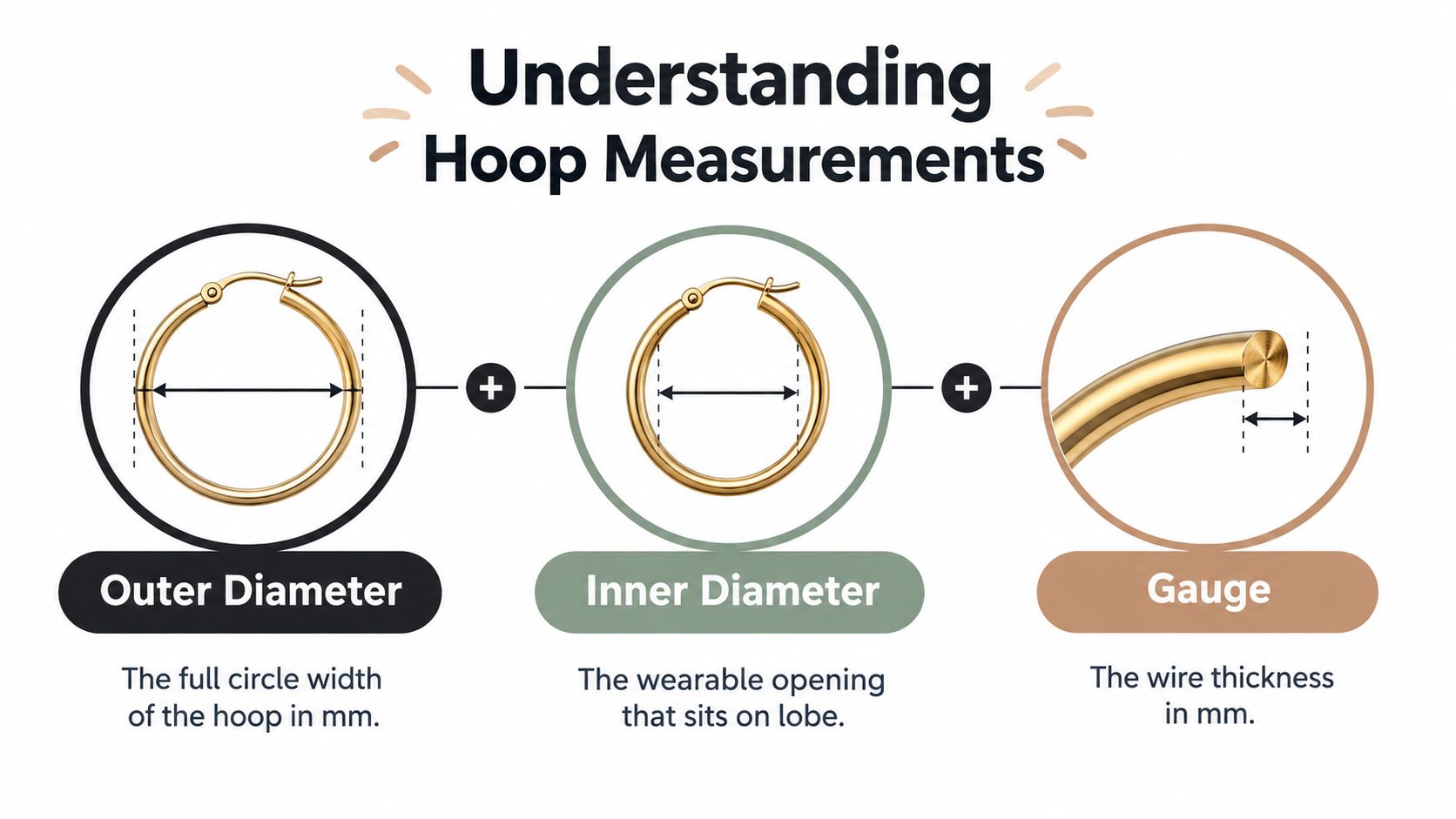
A listing that says only “12mm” leaves an important question unanswered. Ask whether that number describes the outside edge or the inner opening, and check whether the closure or post reduces the usable space. Two hoops with the same outer diameter can look very different if one is thin and delicate while the other is chunky.
Match the measurement to the style
For a close-fitting huggie, prioritize the usable inner height below the post. For an everyday medium hoop, compare outer diameter, inner opening, and gauge together. For a statement hoop, check the full shape, not just the diameter, because an oval or open design may need separate height and width measurements.
Marketing names such as “mini,” “midi,” and “oversized” aren't standardized measurements. Treat them as style language, then find the actual dimensions. The Mini Pave Ear Huggies, for example, are listed as a set with 18K plated Gold /Silver/ Cubic Zirconia materials, but the product snapshot doesn't provide a diameter, so you'd need that measurement before judging the fit.
For a quick visual check, place a ruler beside the hoop or draw the outside diameter on paper. A small coin can help you judge scale, but don't use the coin as a precise measurement. Record the outside width, inside opening, gauge, and closure separately.
Standard Hoop Size Categories
Hoop labels are easiest to use when you connect them to a job. A huggie stays close to the lobe. An everyday medium adds visible movement without dominating your outfit. A statement hoop creates the focus and needs more attention to weight, balance, and snag risk.
The ranges below are practical styling tiers, not universal industry rules. Product construction can move a hoop from comfortable to troublesome within the same diameter range.
Hoop Size Tier Comparison
| Tier | Diameter | Gauge | Best Use |
|---|---|---|---|
| Huggie | About 8mm to 12mm | Slim to moderate | Sleep-adjacent wear, second piercings, minimalist daily styling |
| Everyday medium | About 13mm to 25mm | Slim to medium | Office outfits, errands, dinners, regular rotation |
| Statement hoop | About 26mm and above | Slim, medium, or bold | Events, evening outfits, pulled-back hair, dramatic styling |
A huggie is the safest starting point if you want low movement and a quiet profile. It should close flush without pinching, and it needs enough inner room to avoid pressing against the lobe. Skip an extremely thick huggie if your piercing sits high or your lobe is thin.
An everyday medium is the most flexible category. Choose a slimmer gauge for long wear, or a more substantial gauge when you want the hoop to read clearly against loose hair. Check the weight before assuming a smaller diameter will be comfortable.
A statement hoop is a styling decision, not a default daily size. Keep the rest of your jewelry simpler, wear your hair back if you want the shape visible, and avoid a front-heavy design if your lobes are delicate. The label “oversized” tells you the mood, not whether the construction will behave well on your ear.
How to Measure Your Ear for the Right Hoop
The most useful reference is a hoop you already enjoy wearing. Fasten it normally, remove it, and place it on a flat surface. Measure straight across the outside edges through the center, then measure the clear opening separately. If the hoop has a hinge or latch, note how much room the mechanism occupies near the post.
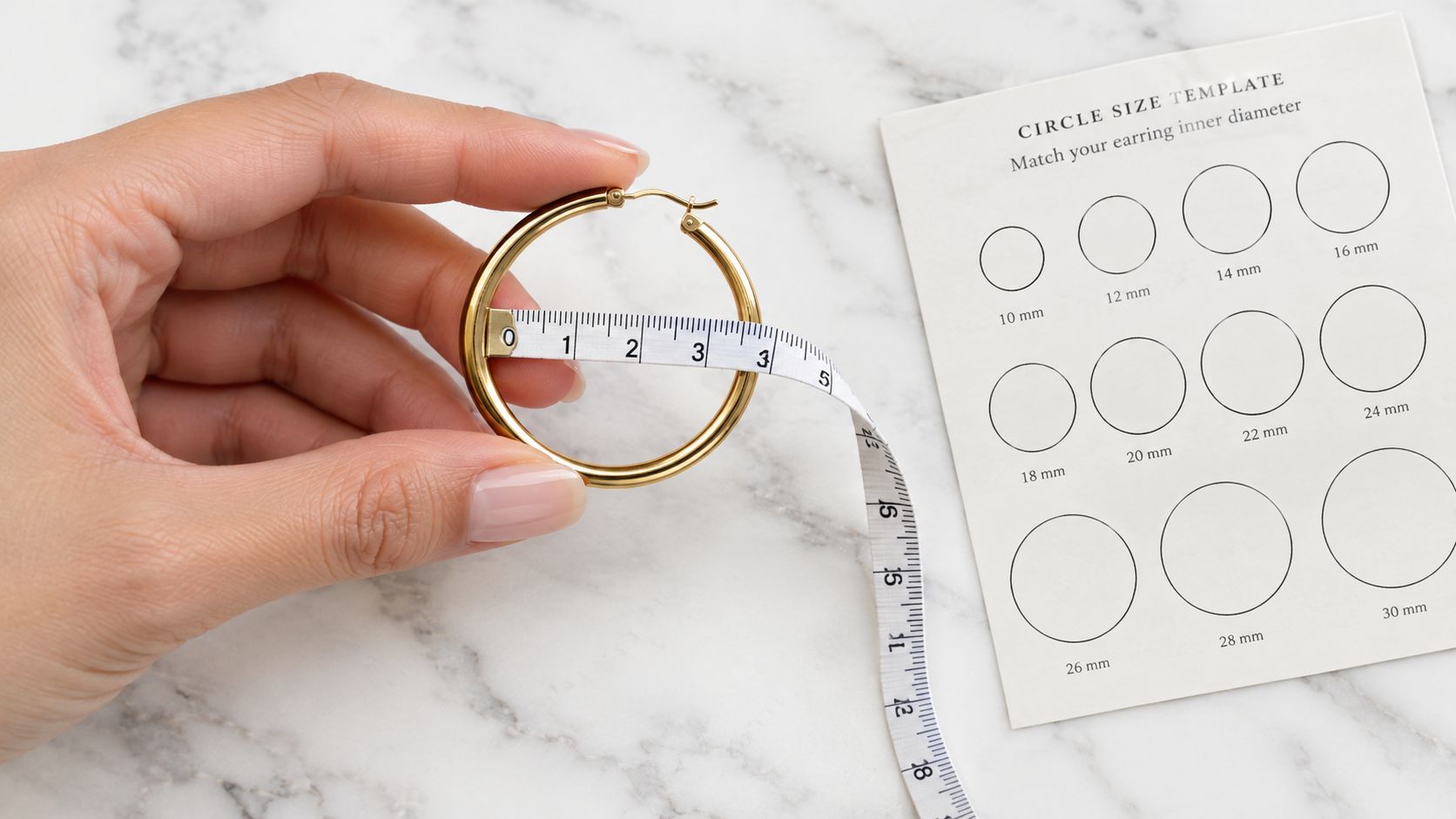
Write down four details:
- Outside size: The full visible width of the hoop.
- Inside opening: The space available around the lobe.
- Gauge: The thickness of the metal.
- Wear behavior: Whether it stays in place, rotates, catches, or pulls.
If you're measuring your ear rather than an existing hoop, use a soft measuring tape or a paper template against the front of the lobe. Don't push a ruler or measuring tool into the piercing. A comfortable existing pair remains the better reference because it already accounts for your piercing height and lobe shape.
Adjust for construction
When a new hoop has a thicker gauge than your current pair, don't assume the same outside diameter will fit the same way. The thicker metal can reduce the inner opening and make the hoop sit tighter. If your favorite pair barely clears the lobe, choose a slightly larger inner opening rather than matching its listed outer diameter.
For related sizing habits, compare this approach with the bangle bracelet size chart, especially the practice of measuring an item that already fits.
Use the video below as a visual demonstration of measuring technique.
Thin or stretched lobes need a stricter test. If the hoop pulls the piercing downward, rotates forward, or leaves a tender mark, size down, reduce the gauge, or choose a lighter construction. Don't chase a larger outline at the expense of a stable, supported lobe.
Weight, Gauge, and Balance
A hoop's diameter tells you the size of its circle. It doesn't tell you how much metal creates that circle. A 30mm hollow gold hoop can feel lighter than a 20mm solid silver hoop, because the smaller-looking pair may contain more material. The visual size and the physical load aren't the same measurement.
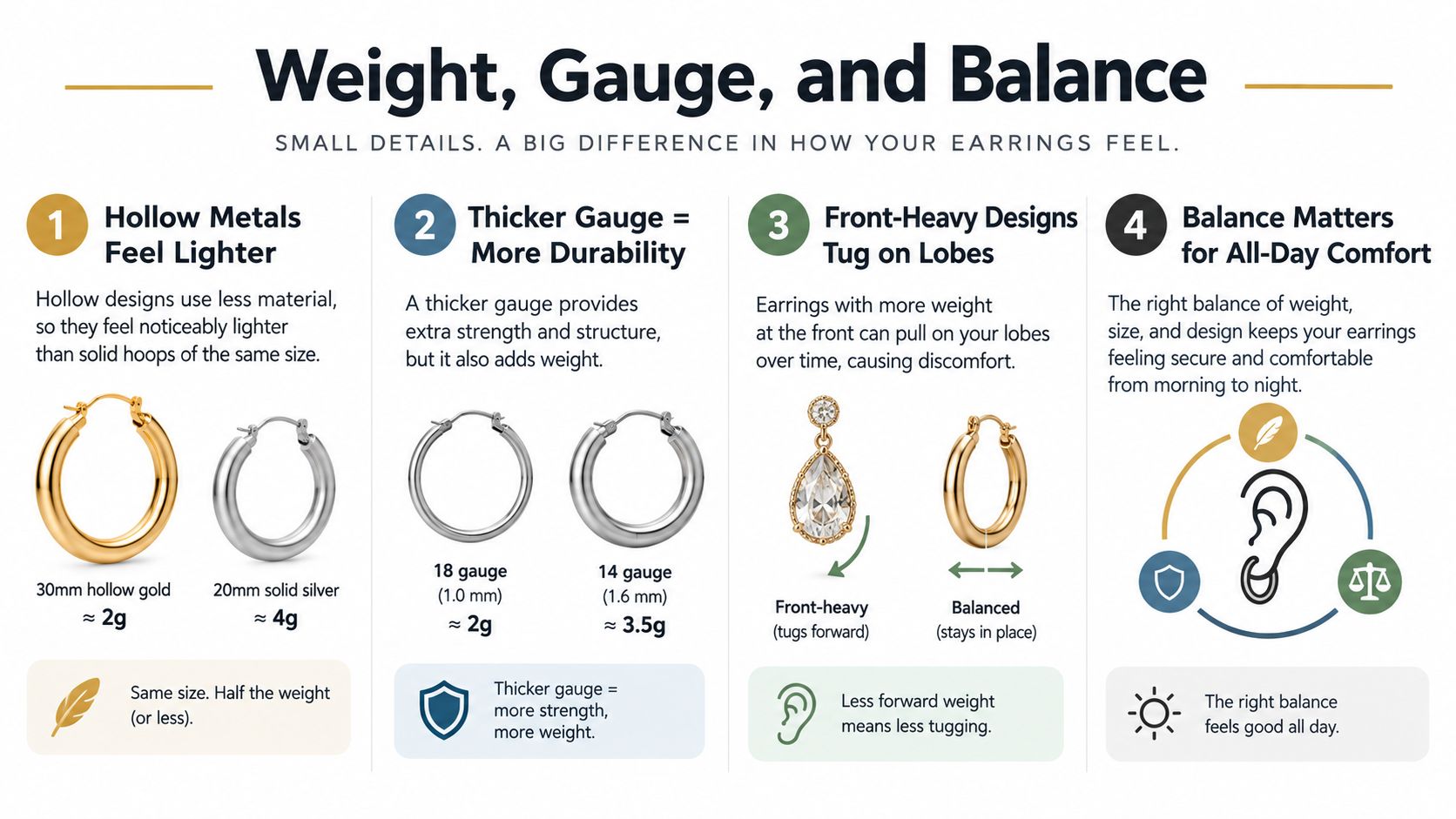
Gauge changes the personality of a hoop. A thin wire looks airy and usually leaves more inner space. A thick band looks bolder and can offer more visual structure, but it may feel heavier and sit closer to the lobe. Neither is automatically better. Choose based on the support your ear can comfortably provide.
Find the balance point
Front-heavy hoops cause problems because the decorative area pulls away from the lobe. Check where the closure sits and how the hoop hangs when you hold it by the post. If the front drops sharply or the hoop tips forward, expect more movement and pressure during wear.
Read the product details in this order:
- Material: Solid, filled, plated, hollow, or another construction.
- Weight: Total weight, per-ear weight, or no weight disclosure.
- Gauge: Thin, medium, or thick, preferably with a measurement.
- Balance: Whether the decorative section sits evenly around the circle.
- Closure: Whether the fastening adds bulk behind or below the lobe.
Wearability equation: Perceived size equals diameter plus gauge, material, weight, and balance.
The practical test is simple. Put the hoop on and tilt your head from side to side. A balanced pair should settle without continually dragging the piercing forward. If you notice the pull while standing still, the design won't become more comfortable during a long day.
Closure Types and How They Change Wear
The closure can matter more than a small change in diameter. A well-made huggie that sits flush may be comfortable during calls and travel, while a larger hoop with a smooth continuous profile may outperform a smaller latch hoop that catches on hair.
| Closure | Main advantage | Main drawback | Best fit |
|---|---|---|---|
| Huggie click-top | Sits close and keeps the profile neat | Can pinch if the inner opening is too small | Daily wear, headphones, low-snag styling |
| Hinged snap | Easy to open and close | The hinge may add bulk near the lobe | Regular medium hoops |
| Continuous endless | Smooth, minimal outline | Can be harder to insert and align | Travel and simple lightweight designs |
| Latch | Familiar and secure when fitted well | Can catch on hair, masks, and clothing | Shorter wear or carefully balanced hoops |
A huggie click-top is usually the strongest choice when you want the earring to stay close to the ear. Check that the click mechanism closes completely and doesn't press into the back of the lobe. For sleep, choose only a pair that feels flush and doesn't create a hard pressure point.
A hinged snap works well for an everyday medium hoop because it makes removal straightforward. The trade-off is a visible hinge or thicker section that can affect inner space. A continuous design has fewer protruding parts, which is useful for travel, masks, and hair that tends to catch.
Latch closures deserve a deliberate check. The post and receiving tube can snag when you pull on a mask, brush your hair, or put on headphones. For a broader overview of fastening mechanisms, see EP Fine Jewelry's guide to earring clasp types.
Matching Hoop Size to Face Shape and Ear
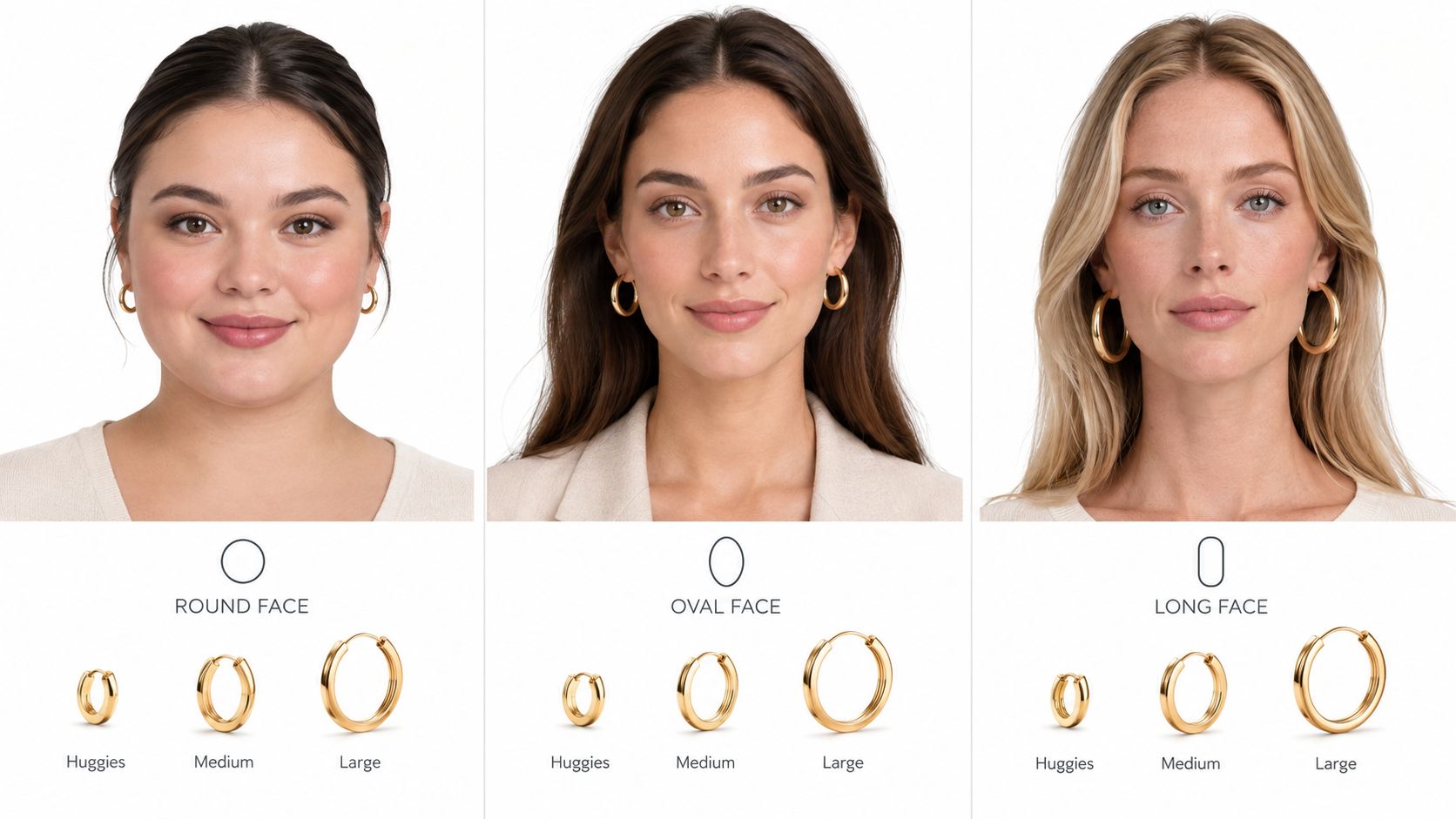
Face shape can guide styling, but it shouldn't overrule your lobe. Start by looking at the distance between your piercing and the lower edge of the lobe, then decide how much movement you want. A hoop that suits your proportions but strains the piercing is still the wrong hoop.
Use the mirror, then check the lobe
- Smaller face: Start with a huggie or short everyday medium. A slim hoop keeps the earrings from dominating your features.
- Longer face: Try an everyday medium or a statement hoop if your lobe supports it. The wider circle adds visible width around the face.
- Rounder face: Choose a medium hoop with an open, clean outline. The goal is presence, not a rigid rule about “correcting” your features.
- Small or thin lobe: Keep the gauge slim and the weight low. A compact hoop that curves neatly against the lobe will look more intentional than a heavy circle that pulls downward.
- Large or sturdy lobe: You have more freedom to test thicker gauges and larger diameters, provided the closure and weight remain comfortable.
The best two-pair rotation for many shoppers is a close huggie for quiet days and a medium hoop for visible styling. Add a statement pair only after you know how your lobe handles movement and weight. For bolder outfit planning, use statement earrings in gold as a styling reference, then verify the actual construction of the pair you're considering.
Don't let a face-shape chart convince you that one diameter is mandatory. Your piercing position and lobe support decide whether the hoop hangs cleanly.
Best Hoop Sizes by Occasion
Choose the hoop by the physical demands of the day. The same pair that looks excellent at dinner may be irritating during a long video-call day or a commute with headphones.
| Occasion | Strong starting choice | Why it works |
|---|---|---|
| Office and calls | Huggie or slim everyday medium | Keeps the profile neat around hair, glasses, and headphones |
| Dinner out | Medium hoop | Adds movement and polish without requiring a dramatic outfit |
| Travel | Lightweight continuous or smooth hinged hoop | Reduces snag points during packing, masks, and movement |
| Gym and outdoor wear | Small, close-fitting huggie | Limits swinging and catching during exercise |
| Gift giving | A lightweight huggie or modest medium hoop | Easier to wear across different styles and routines |
For office days, choose a hoop that won't compete with a headset, glasses, or a high collar. A slim huggie is the safest default, while a modest medium hoop works when you want more visibility on camera.
For dinner, move up to an everyday medium with a clean closure and balanced weight. You don't need a huge diameter to make an outfit feel finished. A well-proportioned medium hoop usually looks more polished than an oversized pair that keeps rotating.
Travel favors simplicity. Avoid exposed latch parts if you'll wear a mask, sleep in unfamiliar beds, or handle luggage. At the gym, reduce movement first, then think about style. A close huggie is less likely to catch than a swinging statement hoop.
For a gift, don't guess from face shape alone. Look at the recipient's current earrings, note whether they wear close or dangling styles, and choose a lightweight pair with a clearly disclosed material. If you want to understand the styling role of a larger piece, consult what statement jewelry means, then keep the gift's comfort profile conservative.
Why Diameter Alone Is Not Enough
Diameter-only charts are attractive because they're easy to scan. They also hide the variables that determine whether the hoop works on your ear. A listed outside diameter says little about the inner opening, the wire thickness, the closure bulk, the alloy, or the way the hoop's weight is distributed.
Consider two hoops with the same outside diameter. One is a thin hollow design with a smooth hinge and centered weight. The other is a thick solid design with a decorative front and a latch beneath the lobe. They may look similar in a product grid, but the second pair can feel heavier, sit tighter, and catch more often.
The reverse can happen too. A larger hollow hoop may feel easier than a smaller solid hoop. A broad inner opening may accommodate a thicker lobe better than a smaller hoop with a thin wire. The number on the listing is a comparison point, not a comfort guarantee.
Run this check before buying
- Is the diameter outer or inner?
- How much clear space sits below the post?
- What is the gauge?
- Is the weight disclosed, and is the design hollow or solid?
- Does the front section hang evenly?
- Will the closure interfere with hair, masks, headphones, or sleep?
- Are the metal and plating details clear?
Ask yourself, “Would I still want this on my ear after ten hours?” If the answer depends on ignoring a tug, pinch, or snag, choose another construction.
Face shape can help you choose the visual mood. It cannot predict how your lobe will respond to a particular hoop. Fit wins over theory every time.
Material Safety and Sensitive Ears
A larger or smaller hoop will not solve irritation caused by the metal, plating, post, or clasp. Itching, redness, warmth, swelling, or discharge means you should remove the earring and stop testing different diameters. Persistent or worsening symptoms need medical assessment.
Read the alloy details before choosing a style. “Hypoallergenic” is not a precise guarantee, so check the metal used in every part touching your ear, including the post, hinge, latch, and plating. Plated jewelry can change as the surface wears, exposing the base metal underneath. Solid gold, gold-filled metal, sterling silver, and titanium can all behave differently depending on their composition and the parts included.
Nickel sensitivity affects a meaningful portion of the population. Clinical literature reports prevalence of approximately 8% to 19% among adults in Europe and 8% to 10% among children and adolescents, with substantially higher rates among people with dermatitis, according to this clinical review of nickel allergy and piercing. The review also discusses an association between pierced ears and increased nickel sensitization. If you have a history of piercing reactions, treat the material specification as a deciding factor, not a footnote.
Shop with a material checklist
- Solid gold: Ask about the karat and alloy rather than relying on the word “hypoallergenic.” See our guide to gold hoops for sensitive ears.
- Gold-filled: Confirm how the piece is constructed and which parts use gold-filled material.
- Sterling silver: Verify the metal used in both the post and closure.
- Titanium: Choose a listing that identifies the material across the full contact area.
- Plated options: Treat plating as a surface layer and investigate the base metal.
Check the listing before contacting the seller. If the post or clasp material is unclear, ask directly. A comfortable hoop size paired with an undisclosed alloy remains a poor choice.
If a reaction appears, remove the hoop and keep the area clean according to medical guidance. Do not continue testing the same pair. Seek professional advice if symptoms persist, spread, or include discharge or significant warmth.
Quick Reference Hoop Size Chart
Save this chart before you shop. Use it to narrow the style first, then verify the product's actual inner opening, material, weight, and closure.
Hoop Size Quick Reference
| Tier | Diameter | Gauge | Closure | Best Use |
|---|---|---|---|---|
| Huggie | About 8mm to 12mm | Slim to moderate | Click-top or smooth hinged | Close daily wear, second piercings, low-snag routines |
| Everyday medium | About 13mm to 25mm | Slim to medium | Hinged snap or continuous | Work, errands, dinners, regular rotation |
| Statement hoop | About 26mm and above | Slim to bold | Secure hinged or carefully fitted latch | Events, evening outfits, strong styling moments |
Choose huggies when you want the least movement and the clearest chance of working with headphones, travel, or exercise. Choose an everyday medium when you want one versatile hoop that remains visible without taking over your outfit. Choose a statement hoop when the earrings are meant to lead the look and your lobes can support the construction.
EP Fine Jewelry's earrings category lets you browse hoop styles alongside other earring formats, while its catalog also includes personalized jewelry and gift-oriented options. Before ordering, confirm the current product dimensions, material details, closure, shipping terms, and return policy.
Start with a comfortable pair you already own, record its outer diameter, inner opening, gauge, and closure, then use those details to compare EP Fine Jewelry hoops. Choose a close huggie for low-snag daily wear or a balanced medium hoop for more presence, and contact the store before checkout if the listing doesn't disclose the measurement or material detail you need.