
You've found a bracelet that looks perfect for a birthday, anniversary, or meaningful personal milestone. Then the practical questions arrive. Will the gold survive daily wear? Is the engraving readable? How much room should the bracelet have around the wrist? And if the name is misspelled, can anything be changed?
A personalized gold bracelet deserves more scrutiny than an ordinary fashion accessory because the customization affects durability, fit, resale value, and return options. Choose the metal first, then the personalization method, then the finished size. Treat the order confirmation as a final proof, not a formality.
Table of Contents
- Why a Personalized Gold Bracelet Is Worth Choosing Carefully
- Understanding Gold Types Before You Customize
- The Four Main Ways to Personalize a Gold Bracelet
- How to Get the Bracelet Size Right the First Time
- Why Personalization Raises the Stakes on Your Order
- Caring for Your Personalized Gold Bracelet So It Lasts
- Checkout Tips, Gift Options, and Final Smart Moves
Why a Personalized Gold Bracelet Is Worth Choosing Carefully
A ready-made bracelet can be judged by appearance and fit before purchase. A custom bracelet adds decisions that are harder to reverse. Once a name, date, or message is engraved, the piece may no longer suit another recipient, and a sizing mistake can become expensive or impossible to correct.
That makes the buying moment more specific than choosing a gold color. You're deciding whether the bracelet should be a discreet daily reminder, a visible statement piece, or a flexible charm design that can change over time. The right answer depends on the recipient's routine, wrist size, sensitivity to metals, and willingness to care for jewelry.
Gold also occupies a substantial global jewelry market, not a narrow gift niche. In 2025, global gold jewelry consumption reached approximately 1,542.3 metric tonnes, while spending rose to a record US$172 billion, according to the World Gold Council's 2025 gold demand report. Buyers purchased less physical gold than in the prior year but spent more overall, a pattern that supports choosing fewer, more meaningful pieces carefully.
Start with the recipient, not the engraving
For someone who wears jewelry every day, prioritize a durable alloy, a secure clasp, and a personalization element that won't catch on sleeves or press into the wrist. For a milestone gift, richer-colored gold and a visible nameplate may matter more than maximum resistance to abrasion.
A short date or pair of initials often works best on a protected plate. A child's initials, birth symbol, or travel memory may suit interchangeable charms. A bracelet intended to mark an anniversary can justify a custom link, but only if the structure is strong enough for repeated movement.
Practical rule: The more permanent the personalization, the more conservative you should be about fit, construction, and proofing.
Before ordering, make four decisions:
- Gold construction: Choose solid, plated, filled, or vermeil based on wear expectations and budget.
- Purity and alloy: Match karat to the friction and bending the bracelet will experience.
- Personalization location: Favor protected, adequately thick surfaces over exposed protrusions.
- Finished length: Measure the wrist, then account for charms, clasp size, and the preferred drape.
A thoughtful personalized gold bracelet can function as jewelry and keepsake at once. A rushed purchase can produce the opposite result, a piece that looks attractive online but feels uncomfortable, wears quickly, or cannot be exchanged after customization.
Understanding Gold Types Before You Customize
Karat measures the proportion of gold in the alloy. Pure 24K gold is soft, so manufacturers mix it with metals such as copper, silver, zinc, nickel, or palladium to improve hardness and shape retention. U.S. government guidance explains that 14K gold contains 14 parts gold and 10 parts other metals, while 24K gold is generally alloyed to improve durability. See the FTC jewelry guidance before accepting a vague “gold” product description.
Think of the difference like butter. 24K is soft butter, easy to mark and reshape. 18K is firmer, with a richer gold presence but still more vulnerable to wear than lower-karat alloys. 14K is closer to a firm stick, making it the practical choice for a bracelet that bends, rubs against clothing, and rests on desks.
Match purity to the way the bracelet will be worn
For daily use, I usually recommend 14K solid gold when the design has fine links, a lightweight chain, or a raised nameplate. It provides a strong balance between gold content and resistance to dents or distortion. Choose 18K when color and gold content are more important than maximum abrasion resistance, particularly for occasional wear or premium gifting.
Choose 24K only when the recipient specifically prioritizes purity and understands the maintenance trade-off. It's a poor default for a thin personalized bracelet that will face constant friction.
Don't confuse solid gold with surface treatments:
- Solid gold: The alloy runs through the piece, although purity still varies by karat.
- Gold-plated: A layer of gold covers a base metal. The surface can wear through, especially at edges and contact points.
- Gold-filled: A bonded gold layer covers a base metal and is different from ordinary plating. The construction and disclosure should be clear.
- Gold vermeil: Gold is applied over sterling silver. Check the gold surface karat and the seller's durability information.
The difference between gold-filled and gold-plated jewelry matters because the product title alone may not tell you how the bracelet is built.
| Gold Type | Approx. Gold Content | Durability for Daily Wear | Best For | Stamp to Look For |
|---|---|---|---|---|
| 14K solid gold | About 58.3% | Strong practical balance | Frequent wear and active gifting | 585 or 14K |
| 18K solid gold | 75% | Durable, but softer than 14K | Rich color and special gifts | 750 or 18K |
| 24K gold | About 99.9% | Softest option | Purity-focused occasional wear | 999 or 24K |
| Gold-plated, filled, or vermeil | Varies by construction | Depends on surface and base | Fashion styling or controlled wear | Product-specific disclosure |
Check the alloy, not just the number
A karat stamp doesn't reveal the complete alloy recipe. Nickel-containing alloys may bother people with sensitive skin, so ask what metals are present if the recipient reacts to jewelry. Sellers should also identify whether the bracelet is solid or plated, state the karat fineness of a plated surface, and describe reasonable care limits.
For a personalized bracelet, 14K solid gold is my default recommendation for continuous wear. Move to 18K when the recipient values a deeper color and will treat the bracelet more carefully. Don't pay for 24K purity if the design itself is too delicate for daily handling.
The Four Main Ways to Personalize a Gold Bracelet
Personalization changes the bracelet's stress points. Engraving removes or displaces material, a nameplate concentrates force around its attachment points, and charms add weight and movement. Pick the method according to how the recipient will use the bracelet, not only how it appears in a product photo.
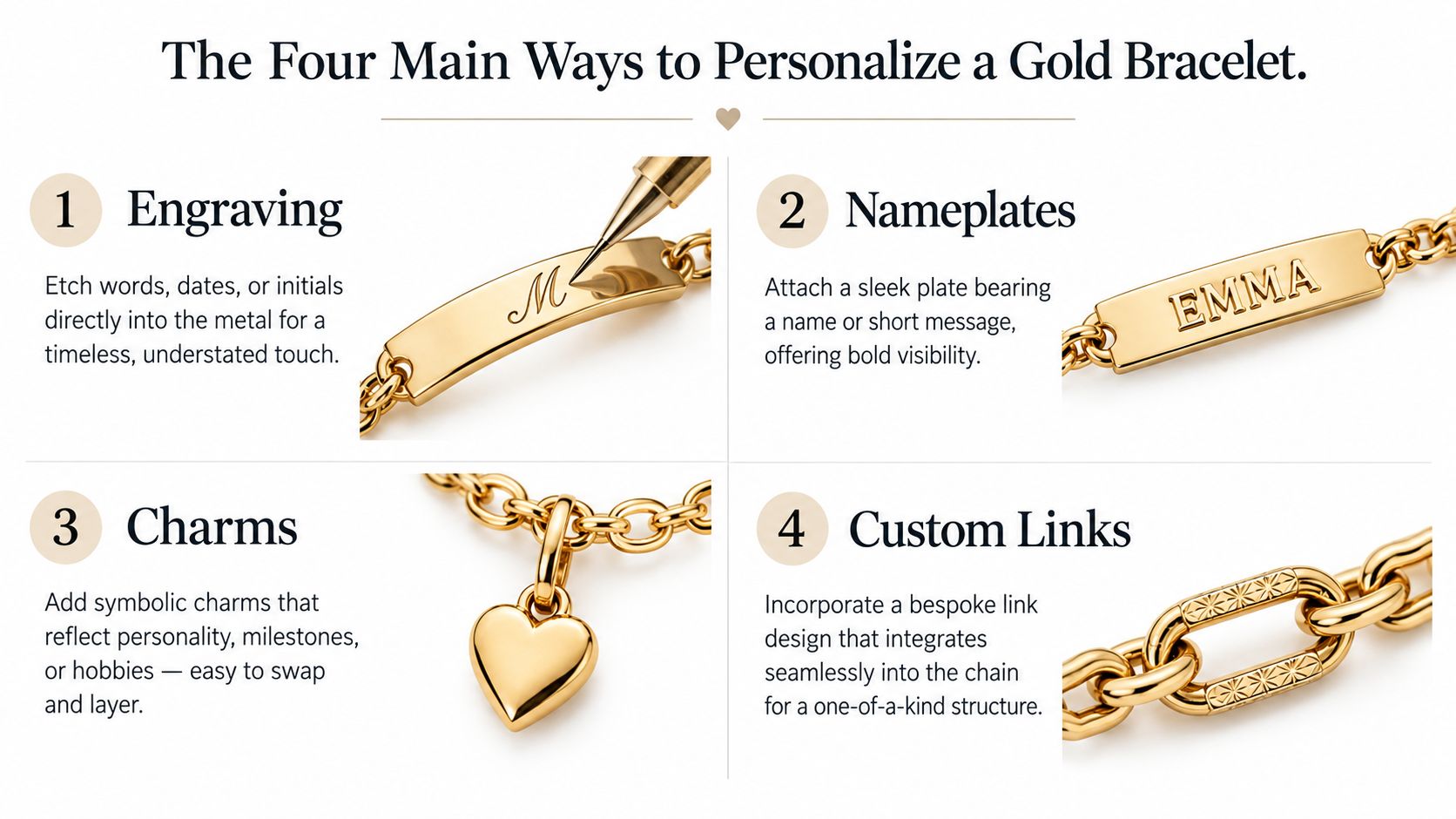
Engraving
Engraving is the best option for short, permanent information. Initials, a meaningful date, or a compact word can sit neatly on a disc, bar, or plate without adding a dangling component.
The trade-off is permanence. Deep engraving can reduce the local thickness of the personalized surface, while very fine shallow marks can become less distinct after repeated polishing and abrasion. Request a preview, choose a readable font, and avoid fitting a long message into a tiny area.
A rounded plate with adequate thickness is safer than a thin sharp-edged tag. Keep the engraving surface away from direct contact with desks or hard objects whenever possible.
Nameplates
A nameplate gives the strongest visual impact. It suits a recipient who wants the name clearly visible rather than hidden on the underside of a bracelet.
Choose a low-profile plate with smooth edges. Raised letters and protruding corners can snag clothing, and a long plate can rotate or press against the wrist. A nameplate also needs strong attachment points because the plate moves differently from the chain.
Nameplates work well when you want the recipient's name to be the entire message. They're less suitable for someone who prefers minimal jewelry or works with their hands.
Charms
Charms are the most flexible route. A heart, initial, symbol, or hobby-related shape can tell a story, and additional charms can be added later if the bracelet has enough structural capacity.
That flexibility introduces movement. Charms may collide with one another, pull the bracelet downward, and create more contact with clothing. Start with a secure clasp and a chain that can support the intended charm weight. For someone who likes changing accessories, charms are usually a better choice than permanent engraving.
Custom links
A custom link integrates the personalization into the chain itself. This creates a cohesive appearance and suits an anniversary or milestone gift where the bracelet should feel designed as one object.
The construction deserves close inspection. Ask how the custom link joins the surrounding links, whether the personalized section is hollow or solid, and whether the clasp and connection points are reinforced. A decorative link shouldn't become the weakest part of the bracelet.
Best match: Choose engraving for discretion, a nameplate for visibility, charms for flexibility, and custom links for a fully integrated milestone design.
For examples of personalized formats and bracelet styles, browse personalized bracelet designs, then judge each option by its attachment points and intended wear rather than its photograph alone.
How to Get the Bracelet Size Right the First Time
A wrist measurement and a finished bracelet length are not the same thing. The wrist measurement describes the body, while the finished length must include enough room for movement, the clasp, the chain thickness, and any charms or plates attached to the bracelet.
Use a soft measuring tape around the wrist bone. Keep it snug without compressing the skin. If you don't have a tape, wrap a strip of paper or thread around the wrist, mark the overlap, and measure that length against a ruler.
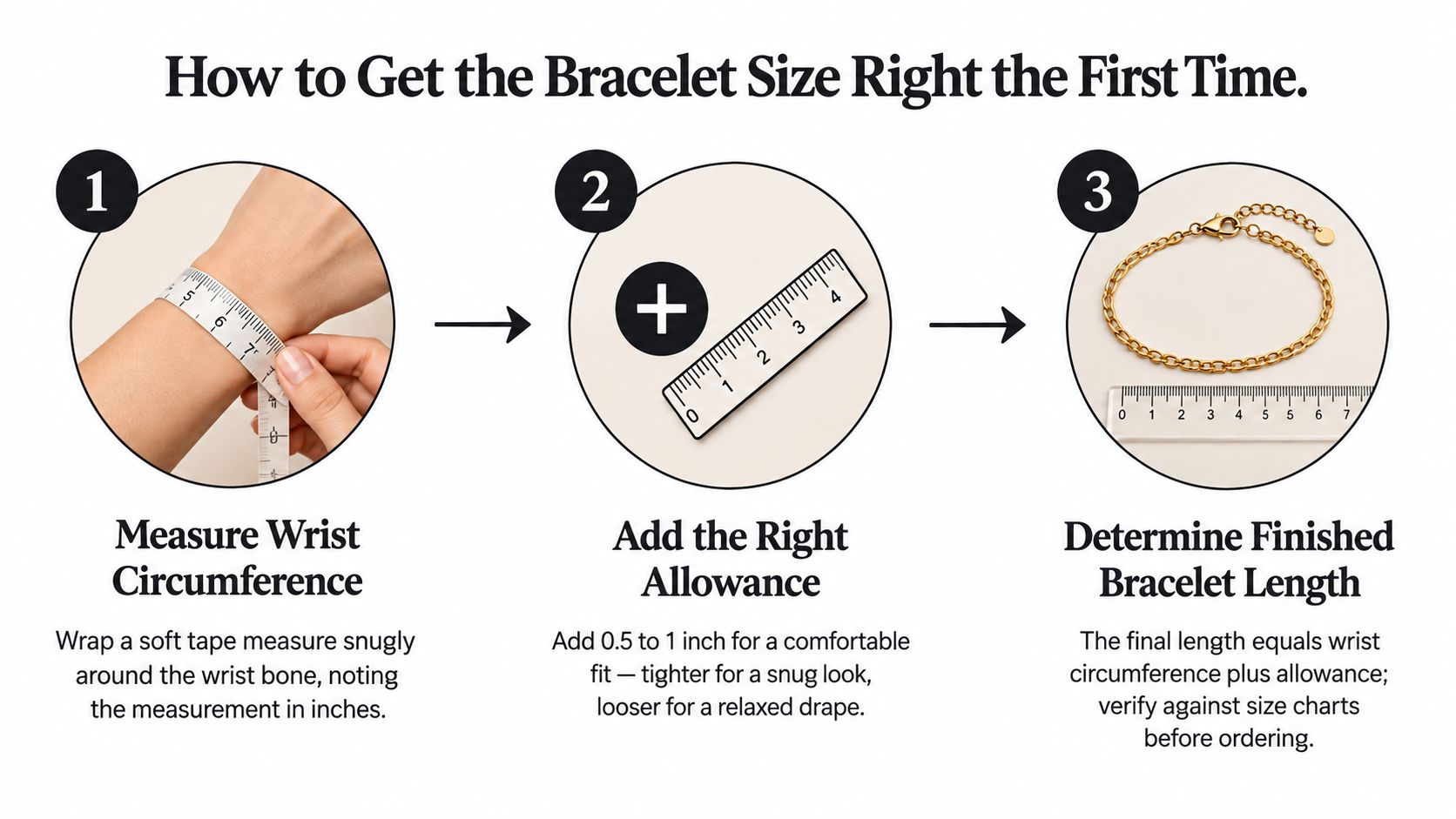
Use the recipient's habits to adjust the fit
A close fit suits a person who wants the bracelet to stay in place. A relaxed fit allows more drape and movement, which may be useful for charms but can increase contact with desks and clothing.
Account for details that ordinary size charts often overlook:
- Wrist shape: A prominent wrist bone can make a rigid or narrow bracelet feel tighter than the measurement suggests.
- Dominant hand: The hand used most often may experience more movement and temporary swelling during the day.
- Charm weight: A heavy charm can pull the bracelet downward and make a looser fit feel even less secure.
- Stacking: A bracelet worn beside a watch or another chain needs enough room to move without trapping the clasp.
- Clasp size: A large clasp can change how the finished bracelet sits, even when the chain length appears correct.
Don't copy the size of an existing bracelet without measuring it and the wrist separately. A stretched chain, a different clasp, or a heavier personalized element can make the same nominal length feel completely different.
Proof the size and personalization together
Before production, confirm the finished bracelet length rather than only the wrist circumference. Check how much space the nameplate or charm needs, and verify whether the seller measures from clasp end to clasp end or excludes part of the fastening hardware.
Use this checklist before submitting the order:
- Measure the recipient's wrist with a flexible material.
- Decide whether the desired fit is close, comfortable, or relaxed.
- Account for the size and weight of the personalized element.
- Compare the finished length with the seller's sizing chart.
- Confirm spelling, capitalization, symbols, and character limits.
- Review the engraving preview at its actual orientation.
- Ask whether corrections remain possible before production.
A sizing guide such as the bangle bracelet size chart can help, but a chain bracelet and a rigid bangle don't fit the same way. Use the product's own measurement method whenever the seller provides one.
Why Personalization Raises the Stakes on Your Order
A personalized bracelet can fail in several ways at once. A nameplate may sit awkwardly, an alloy may not suit frequent wear, or correctly engraved letters may be too shallow to read. Custom work also changes the return and correction risk, so verify the design before production, not after the bracelet arrives.
A simple proofing mistake shows why. If a preview displays “Micheal” instead of “Michael,” the error can be corrected before production. After the name is engraved, the seller may treat the piece as a custom order and limit corrections or returns. Read the terms before submitting payment.
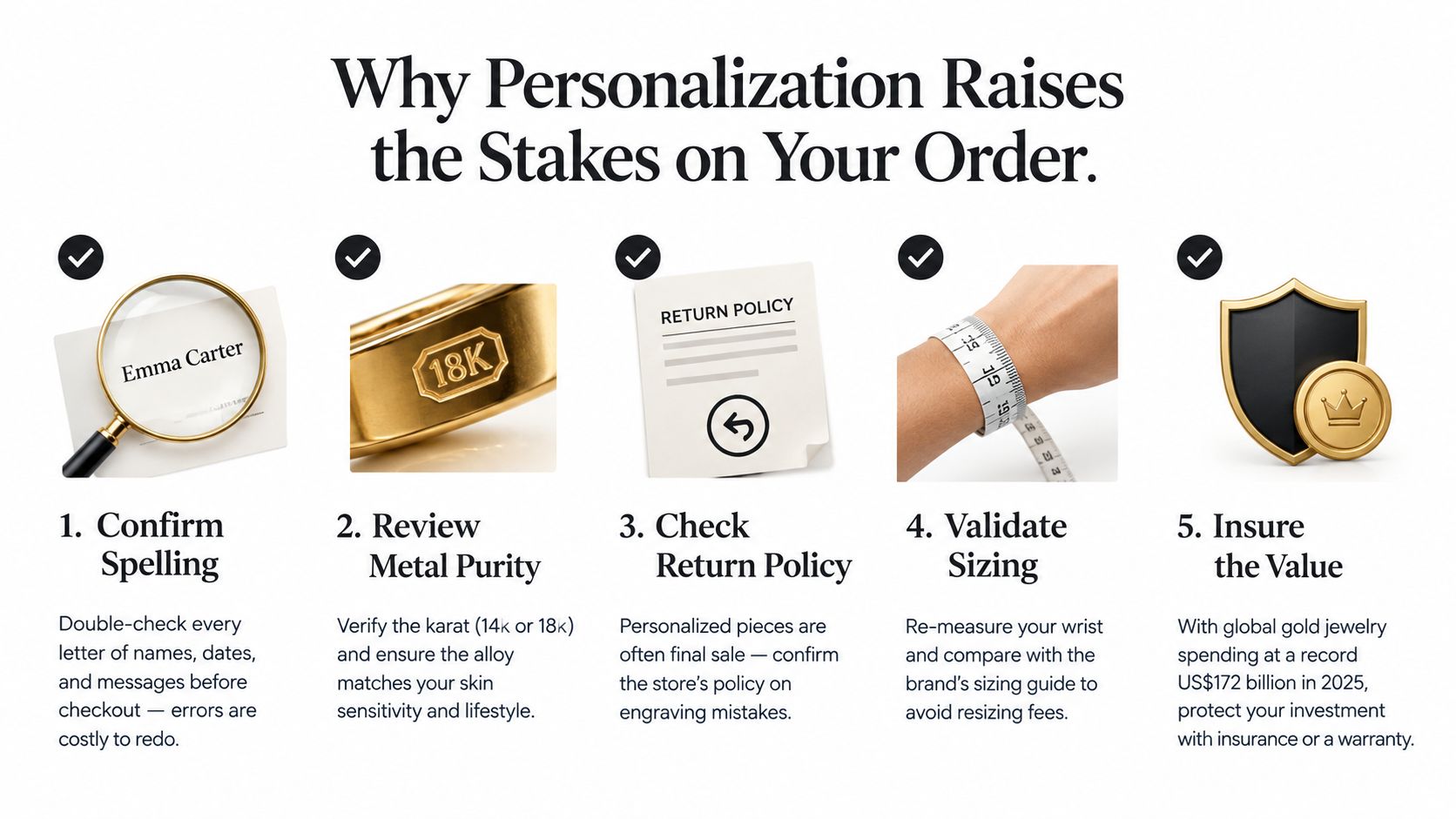
Treat the product page as a specification sheet
Before checkout, confirm these points in writing:
- Spelling and character limits: Copy the name or date into a separate note, then compare every character with the personalization field.
- Engraving preview: Check legibility at the displayed size. Confirm the selected font, placement, orientation, and whether the preview shows the actual engraving area.
- Correction window: Ask whether edits remain possible before production starts. Payment does not guarantee that an order can still be changed.
- Production and shipping timing: Custom work may follow a different schedule from ready-to-ship jewelry. Check the stated window before promising a gift date.
- Mistake policy: Confirm what happens if the seller makes an error and what happens if the buyer submits incorrect information.
Treat placement as an engineering decision. Engraving close to a clasp, hinge, or sharply curved edge can reduce legibility and create wear points. Ask where the personalized element is supported, how thick it is, and whether the chain and attachment can carry its weight without twisting.
Technical guidance in the Federal Trade Commission's jewelry statement also matters for plated products. Judge the bracelet by more than its color or a plating label. Confirm the base metal, the karat of the surface, and whether the personalized component has adequate structural support.
Virtual try-on and detailed imagery can clarify appearance, but they do not verify spelling, engraving depth, tactile comfort, or alloy sensitivity. Use the preview to inspect proportions and placement, then confirm the written specifications separately.
Before clicking buy: Save the personalization preview, product specifications, size selection, and return terms with your order confirmation.
Caring for Your Personalized Gold Bracelet So It Lasts
Daily wear creates the exact friction that can dull polished surfaces and soften the visibility of fine personalization. Remove the bracelet before showering, swimming, exercising, or applying lotion and perfume. Chlorine, residues, and abrasive contact can affect both the gold surface and the small spaces around the clasp and engraving.
Store the bracelet separately in a lined pouch or jewelry box. Don't toss it into a drawer with rings and chains, where hard edges can scratch the nameplate or force links out of alignment.
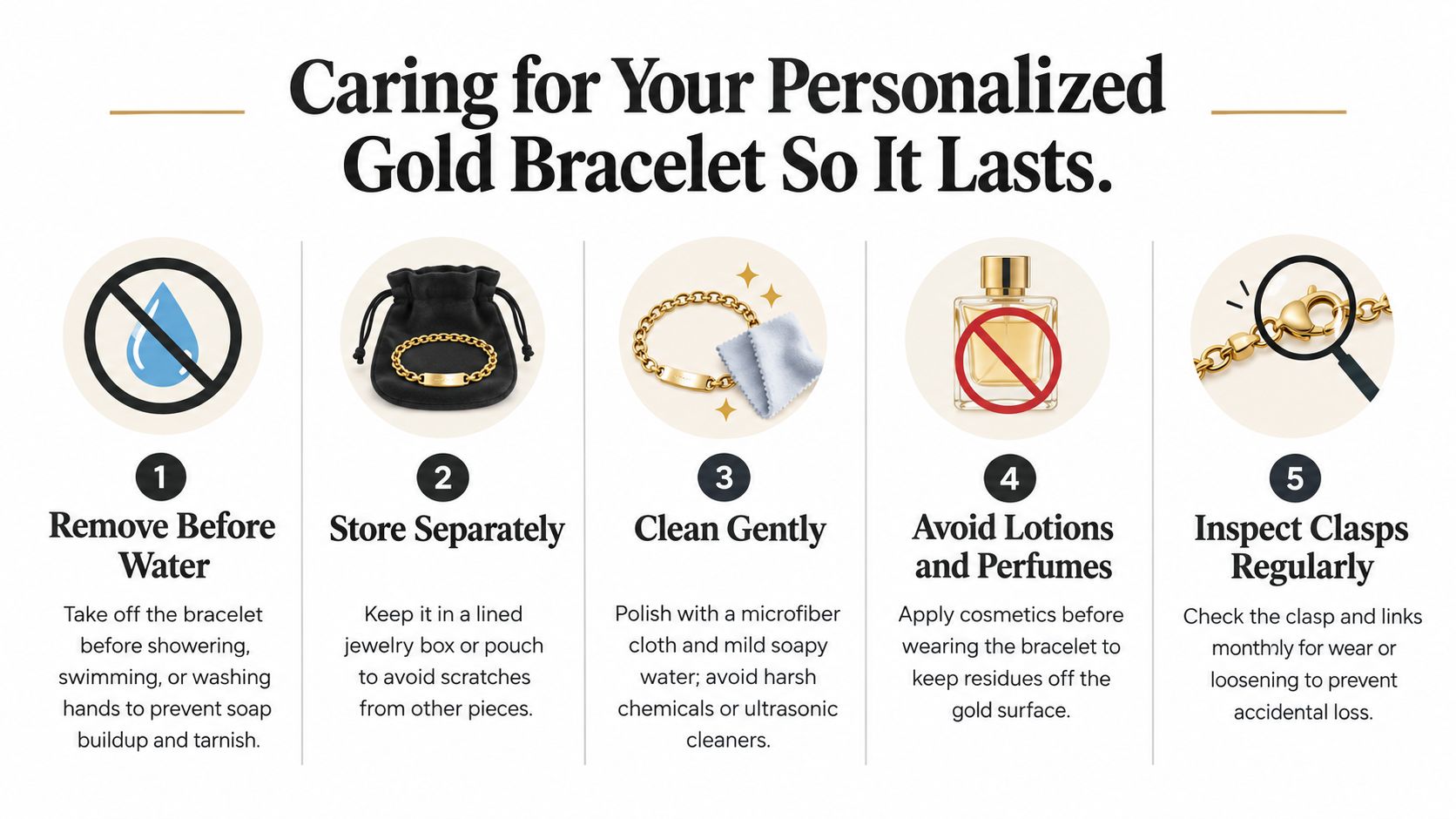
Use a gentle cleaning routine
Clean the bracelet when surface residue makes the gold look dull, not by aggressively polishing it. Harsh compounds can round crisp engraving edges over time.
- Fill a small bowl with warm water and add a little mild soap.
- Place the bracelet in the solution briefly.
- Use a soft cloth to wipe the chain, clasp, and personalized surface.
- Rinse with clean water if the construction allows it.
- Pat dry with a lint-free cloth and leave the piece fully dry before storage.
Follow the more detailed guide to cleaning jewelry at home when the bracelet includes mixed materials or delicate components. Avoid abrasive cloths, strong chemicals, and aggressive tools unless a jeweler specifically recommends them.
Troubleshoot small problems early
Lower-karat alloys can develop surface discoloration depending on the metals used and the wearer's environment. Gentle cleaning may remove residue, but persistent changes deserve a jeweler's inspection rather than repeated polishing.
Light scratches on a high-polish surface are normal signs of use. Don't try to erase them with household products. A professional can assess whether refinishing is appropriate without unnecessarily thinning a personalized plate.
A stiff clasp, stretched link, or loose charm should be addressed promptly. Stop wearing the bracelet if the clasp no longer closes securely, because a small fastening problem can lead to loss.
Once a month, inspect the engraving, plate edges, attachment points, and clasp under good light. That brief check catches loosened components before they become a missing bracelet.
Checkout Tips, Gift Options, and Final Smart Moves
The checkout page should answer practical questions before it accepts your payment. Look for a dedicated personalization field, visible character limits, and a preview or proofing step. Enter the recipient's name exactly as intended, including capitalization, punctuation, and symbols.
If you're sending the bracelet directly to the recipient, use the order notes field for a gift message or special handling request. A gift box add-on can make the piece present-ready, but confirm whether the packaging is included or selected separately by reviewing the gift box packaging option.
Make the final review deliberate
Check these details in order:
- Metal: Confirm karat, solid or plated construction, and any alloy information relevant to skin sensitivity.
- Personalization: Compare every character against your saved proof.
- Size: Verify the finished bracelet length, not only the wrist measurement.
- Timing: Read the production, shipping, and delivery information before committing to a date.
- Returns: Confirm how customization affects exchanges, corrections, and refunds.
- Shipping: Orders of $200 or more qualify for free shipping at EP Fine Jewelry, according to the store's shopping information.
- Payment: Available payment methods include American Express, Apple Pay, Discover, Mastercard, Shop Pay, and Visa.
- Aftercare: Keep the product details and consult the store's FAQ and Jewelry Care resources after delivery.
EP Fine Jewelry offers personalized bracelet options, gift packaging, order notes, and support content for care and ownership questions. Review the product details and policies on the specific item before placing a custom order.
EP Fine Jewelry offers personalized bracelet designs, including custom name and date styles, along with gift packaging and care guidance for ownership after purchase. Visit EP Fine Jewelry to compare personalized options, verify the details, and choose a bracelet built for the way it will be worn.