
Your skin isn't dyed, and no copper has soaked into it. What you're seeing is a surface film of copper salts, mainly copper chloride and copper carbonate, that lifted off the metal and settled on the top layer of your skin.
It's late on a warm afternoon, you've been carrying a bag in the same hand for hours, and when you slide your ring off there's a pale green band underneath it, exactly the width of the band. Nothing hurts. The skin looks completely normal apart from the color. You turn the ring over looking for damage and find none.
That gap between what you see and what the piece looks like is where many get stuck, and it's why the question of why does jewelry turn skin green comes back every summer. The answer is chemistry running at room temperature inside a film of moisture thinner than a sheet of paper.
Table of Contents
- Why a Green Line Appears
- Green Stain or a Skin Allergy
- Sweat Lotions and a Tight Fit
- Which Pieces Leave a Green Mark
- How to Keep Skin from Turning Green
- What to Wear Next
Why a Green Line Appears
The mark follows the shape of the metal. A ring prints a band, a chain prints a row of links, an earring prints a small circle around the post. That shape is the first clue that the color came off the piece and settled on your skin.
The metal carries the color
Copper sits behind almost every green mark. Many fashion-jewelry alloys and lower-karat gold or silver alloys contain copper because it adds hardness, shifts the color, and makes the metal easier to work, and copper is the element that reacts once the piece meets your skin. What lands on your finger is a surface deposit, a film of reacted metal, as a published medical case report on green skin staining documents.
When a piece is exposed to sweat, skin oils, oxygen, soap, or cosmetics, copper atoms can leach onto the skin and react with chloride, bicarbonate, and other compounds. The salts that form, especially copper chloride and copper carbonate, appear green or blue-green, and oxidation deepens the color toward teal.
From alloy to a film you can wash off
The sequence is short and repeatable, which is why the mark shows up so fast.
- Moisture sits against the metal. Sweat, leftover lotion, soap residue, or a splash of water holds a film on the surface. No film, no reaction.
- Acid pulls copper out. Sweat is mildly acidic, and that acidity can leach copper from a pendant or a band.
- Salts form and turn color. Chloride and bicarbonate in sweat meet the freed copper and build copper chloride and copper carbonate, both green or blue-green.
- Friction transfers the film. Rubbing moves those salts onto the epidermis, which is why the line has such sharp edges.
This is the same family of reaction as verdigris, the green patina on an old penny or a weathered copper roof. It runs faster on a finger, because a warm, salty, faintly acidic film is a harsher environment for copper than rain ever is.
What the green proves. There is copper in the alloy touching your skin. It says nothing about whether the piece is dirty, cheaply made, or unsafe.
Why the same piece marks one wrist and spares another
Sweat chemistry, skin pH, and how snugly a piece sits all change the speed and the shade of the reaction, so two people wearing identical bracelets can get completely different results. A brass cuff that marks one wearer within an hour may leave nothing on a drier, looser wrist in the same metal.
The two salts behave differently when you clean up. Copper chloride is water-soluble and rinses away during bathing. Copper carbonate is less soluble, so it clings and may need mild soap, a soft cloth, and a little patience instead of a hard scrub.
Plating delays the reaction. A plated piece can look flawless and still mark you, because the film starts where the coating has thinned under constant rubbing: the inside of a ring band, the underside of a bangle, the links near a clasp. EP Fine Jewelry's charm bangle, for instance, is brass under heavy 18 karat gold plating with a coating to prevent tarnishing, and once the finish wears through at a friction point, the copper-bearing base is exposed to your skin. Knowing the difference between gold-filled and gold-plated jewelry tells you how much base metal sits under a finish and how long that surface is likely to hold.
A green line usually means one thing: copper-bearing metal met sweat and air.
Green Stain or a Skin Allergy
A green line and a jewelry rash can start in the same spot and behave nothing alike. One is a surface event. Copper salts sit on the skin the way a grass stain sits on a knee: color on the surface, nothing underneath, gone after a wash. An allergy involves the immune system, which can keep reacting after the jewelry is back in the box.
Match what you feel against when it started, and the answer is usually clear before you look anything up.
Green mark versus a jewelry rash
| What you notice | When it shows | Likely cause | What to do |
|---|---|---|---|
| Green or blue-green line, no discomfort | Same day of wear | Copper salts transferred to skin | Wash skin; dry the piece |
| Green film that needs soap to lift | After long or sweaty wear | Less-soluble copper carbonate plus oxidation | Gentle soap and a soft cloth |
| Itch, redness, or swelling without green | Hours to a couple of days later | Contact dermatitis, often nickel | Stop wearing it |
| Scaling, blisters, or a rash that stays | Persists after removal | Delayed allergic reaction | See a clinician; ask about patch testing |
| Green color plus itch or rash | During or after repeated wear | Stain and allergy can occur together | Stop the piece; do not treat the color as proof it is harmless |
Timing matters as much as appearance. A copper deposit shows up during wear and fades with one wash. An allergic reaction often waits hours or a day or two, and it can keep flaring after the piece is off. The last row is the one people miss: staining and sensitivity can share the same finger at the same time. Gold-colored plating doesn't exempt a piece either, since once the finish wears thin at a rub point, the copper-bearing base underneath can still leave the same green deposit.
What the patch-test numbers do and don't say
Copper allergy is uncommon next to jewelry-metal sensitivity in general. A 2014 review of copper hypersensitivity described a retrospective dataset of 2,660 routine patch tests in which 94 patients, or 3.53%, reacted positively to copper sulfate, with a weighted average positive rate of 3.8% among people evaluated for suspected exposure. Those figures come from people already sent for testing because a reaction was suspected, so they describe that selected group. Most wearers who see a green line never sit for a patch test at all.
Nickel is the metal to watch when a rash is the problem. It remains the most common cause of contact allergy worldwide, with reported adult prevalence in Europe of approximately 8% to 19%, and jewelry is still a major exposure source, according to Nebraska Medicine's dermatology explainer. Pieces sold as nickel-free jewelry, including EP Fine Jewelry's fashion pieces in silver and 14K gold, which contain no nickel, take the likeliest allergen out of the equation. That choice has no effect on the green film itself, since the stain comes from copper chemistry on the skin's surface.
Practical rule: color alone means clean, dry, and carry on. Color plus itch means stop that piece and get an opinion.
If a rash has been scratched raw, repairing a damaged skin barrier with gentle, unfragranced care is worth doing before you test another metal against that patch of skin. A barrier that is already broken reacts to more things, and it makes the next piece harder to judge fairly.
Sweat Lotions and a Tight Fit
The same ring behaves differently on a cool, dry Tuesday and after a Saturday workout. Nothing about the metal changed between those two days. What changed is how much moisture sat against it, for how long, and what else was on your skin.
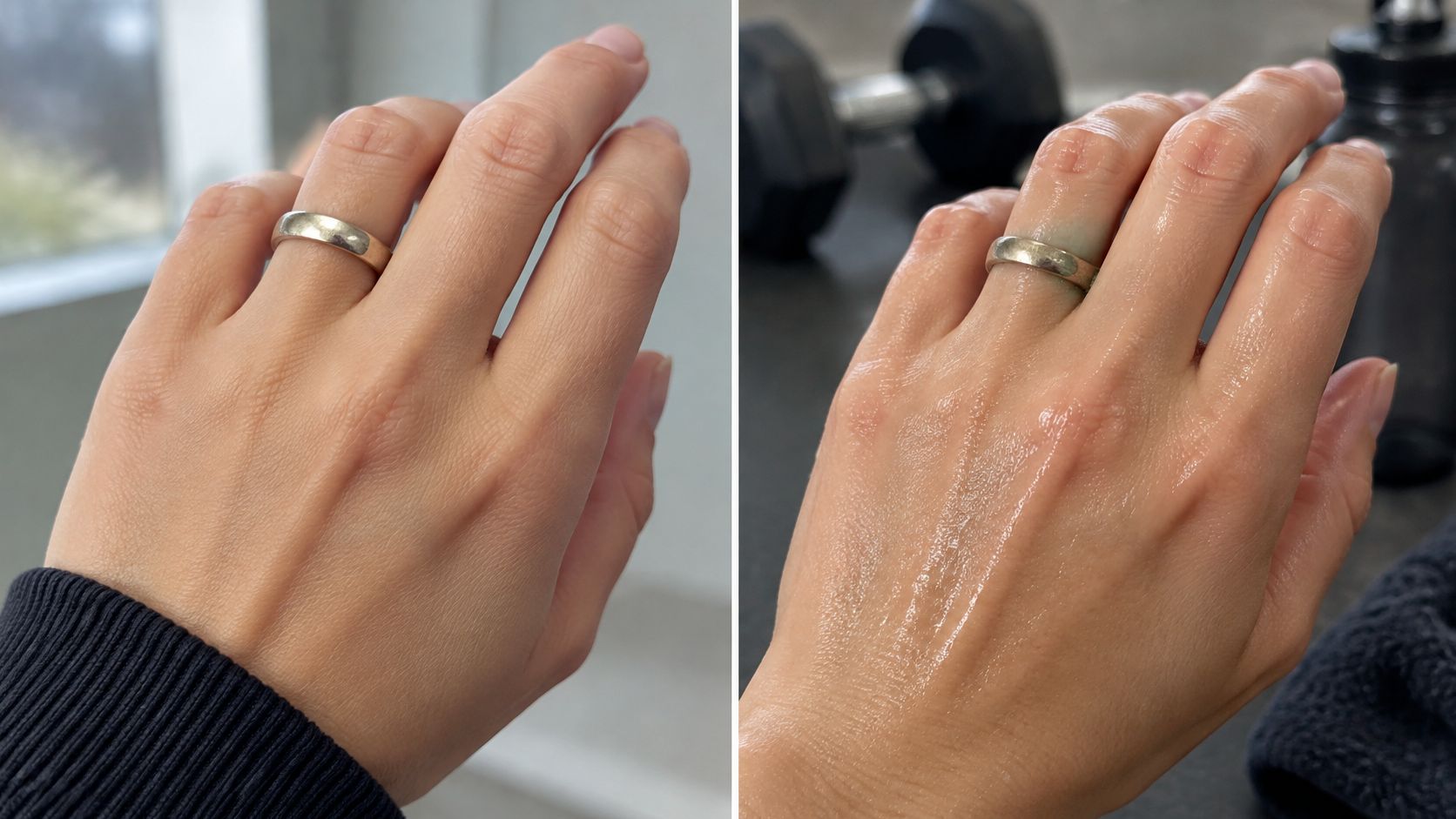
What Sweat Contributes to the Reaction
Sweat delivers water, chloride from sodium chloride, lactic acid, and other electrolytes to the metal's surface, and that mix raises ionic conductivity so copper dissolves faster than it would against dry skin. A corrosion study built around artificial sweat used a formulation of 20 g/L sodium chloride, 17.5 g/L ammonium chloride, 5 g/L acetic acid, and 15 g/L lactic acid at pH 4.7, a recipe that shows how salty and mildly acidic perspiration really is, as this breakdown of green-mark chemistry sets out.
That recipe is a lab stand-in, and your own sweat won't match it exactly. Perspiration shifts with hydration, exertion, and what you ate, and skin pH varies from person to person. Alloy composition, plating wear, skin pH, humidity, contact pressure, and sweat chemistry all weigh in together, which is why two people can wear the same brass ring through the same afternoon and end up with very different marks.
Where lotion, heat, and a tight fit come in
Heat and humidity keep the film of moisture wet for longer, so the reaction gets more time to run. A snug band raises contact pressure and traps dampness where air can't reach it.
Lotions, sunscreen, soap left on the skin, and perfume hold water against the metal and add their own compounds to the mix. Applying sunscreen with a brass bracelet already on is close to a worst case, because you're sealing a moist, chemically busy layer right where the metal touches. Alcohol-based products bring a second problem: ingredients like perfume and hand sanitizer can burn or dull a finish, so jewelry does best kept away from anything containing alcohol.
Plating wear belongs in this list as a trigger. Once a thin gold- or silver-colored layer rubs through, a copper-bearing base touches the skin directly, and a piece can mark a finger while it still reads as gold from arm's length.
This short walkthrough covers the same process from the wearer's side, including what changes when a piece is worn daily.
The pattern to remember is simple. The worst conditions for a green mark are long wear, heavy sweat, layered products, and a tight fit, often all four at once. The full jewelry care instructions break down which finishes handle water and which come off first, so a quick check before a workout or a beach day is easier than scrubbing a green line afterward.
Which Pieces Leave a Green Mark
A copper or brass fashion cuff can print a faint band on the wrist after one humid commute, because copper already sits at the surface. A gold-colored ring that looked perfect for months starts leaving a shadow on the side that rubs against everything all day. Same skin, same sweat, different metal. The difference is where the copper sits.
How likely common jewelry is to leave a green mark
| Piece or metal | Green-mark chance | Why |
|---|---|---|
| Copper or brass fashion jewelry | High | Copper is already on the surface |
| Gold- or silver-colored plating over brass | Rises after the coating wears | Base metal reaches the skin |
| Lower-karat gold or sterling with copper in the alloy | Low to moderate | Some copper, usually slower than bare brass |
| Solid higher-karat gold | Low | A smaller share of the alloy is copper, so salts form slowly |
| Stainless steel or titanium | Very low | Little or no copper to form green salts |
Lower-karat gold sits in the middle ground, so whether 10K gold is a good choice for everyday wear comes down to how much alloy, and therefore how much copper, shares the metal with the gold.
The earring problem is a different problem
Earrings deserve their own warning because a green lobe and a nickel rash can come from the same post. In a Springer reference work entry on metal release from jewelry, one tested earring component released about 43 micrograms of copper per square centimeter per week alongside 0.87 micrograms of nickel. A single piece can deliver the harmless stain and the allergen at once.
The wider picture doesn't match the marketing. The Journal of Medical Science's analysis of nickel release in jewelry reports that a 2024 Polish clinical study found excessive nickel release in 7.5% of tested jewelry items, while a 2025 systematic review linked piercings with nickel allergy at an odds ratio of 5.9 (95% confidence interval 3.6 to 9.4). Many earrings still release nickel at amounts capable of causing allergy.
Words like hypoallergenic, gold-colored, and plated describe a surface or a marketing claim. They say nothing about the base metal after months of friction, showers, and hand cream. Turn a ring over and look at the palm side. Check the post of an earring where it meets the butterfly. A different color showing through means the coating has opened, and the copper-bearing base now touches skin. A washable green film wipes off. A lasting rash is different, and that piece has done its last season of daily wear no matter how gold the outside still looks.
How to Keep Skin from Turning Green
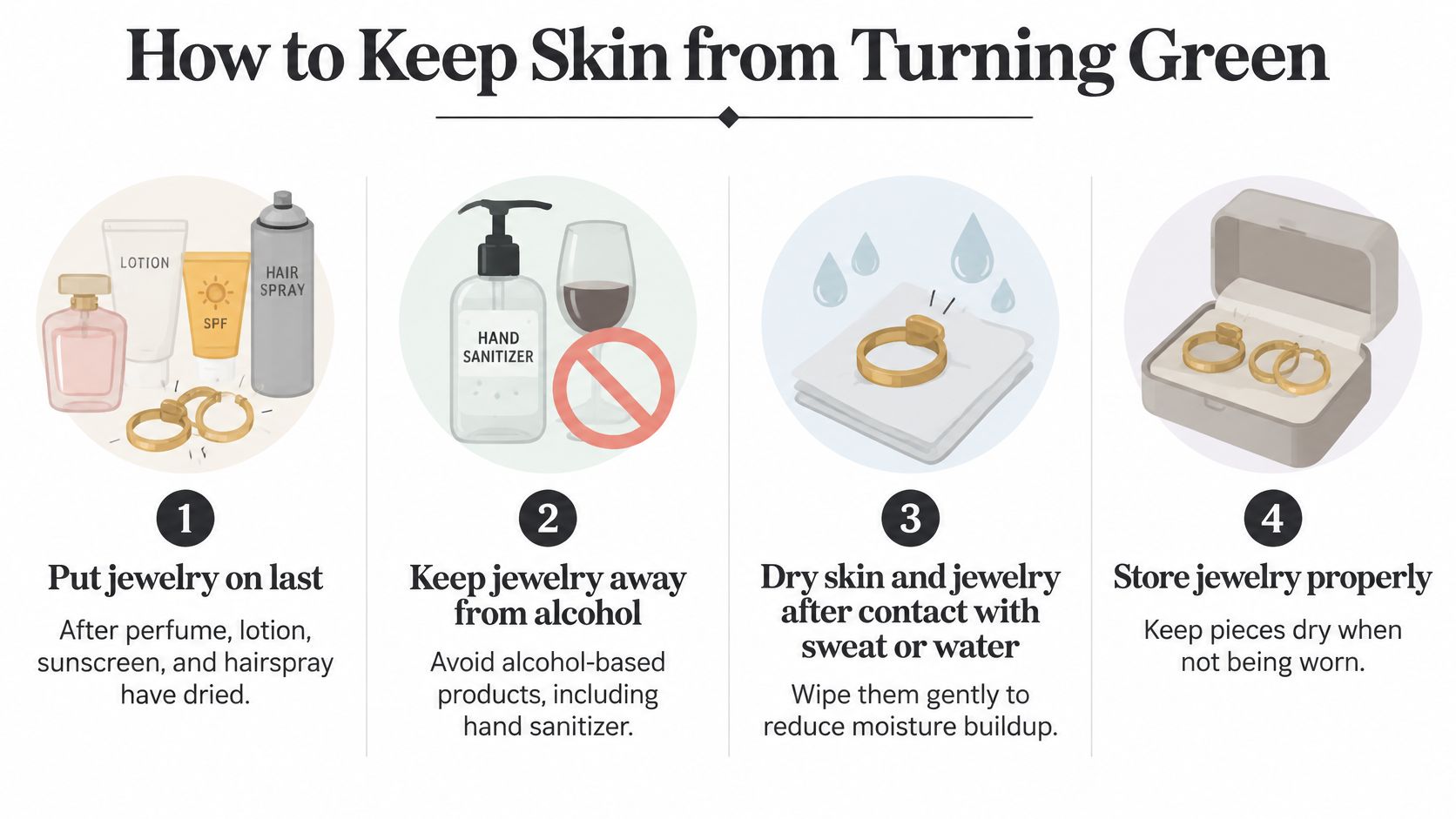
One routine, in the order you get dressed and undressed, handles almost every green mark. Each step removes moisture, chemical contact, or both.
- Put jewelry on last. Let perfume, lotion, sunscreen, and hairspray dry first. Spray settles into crevices and holds moisture there. All jewelry should be kept away from chemicals and anything containing alcohol, including perfume and hand sanitizer, because these can burn a finish.
- Take pieces off before water and workouts. Showers, swimming, washing dishes, and the gym are the highest-exposure moments of the day. Gold filled and silver jewelry can be worn in the water, and it lasts much longer if you remove it before showering, swimming, or working out. Bangles in particular should come off before showering, swimming, or working out, because getting them wet can cause the plating to fade over time.
- Wipe the contact side when you take a piece off. The inside of a ring, the back of an earring, the underside of a cuff. Ten seconds with a dry soft cloth stops sweat from sitting on the metal overnight.
- Wash the green off your skin with mild soap. A chloride film rinses away; a carbonate film takes a little more rubbing. Then dry both the skin and the piece, because a damp ring goes straight back to step three.
- Store pieces dry, away from the bathroom. Steam from a shower keeps a whole jewelry box humid. A closed pouch in a bedroom drawer does more for a finish than any polishing cloth.
- Retire a worn plate from all-day wear. If darker metal shows on the palm side or the post, the coating has opened. Scrubbing only strips more of it.
A clear barrier coat sold for costume jewelry can slow a beloved brass piece down, and it works for a while. It wears exactly where the piece rubs, which is where the mark appears first, so it needs renewing every few weeks and it never changes the metal underneath. That is also why how long gold-plated jewelry lasts depends far more on how you wear it than on what the label promised.
The one-line version. Dry metal can't form copper salts. Everything above is a way of keeping the piece dry while it's touching skin.
For pieces you want to wear every day, solid silver or higher-karat gold resists this film far better than a thin plate that will eventually wear through. None of these steps fix a rash, though. A mark that itches, swells, or blisters needs the metal gone and a clinician's opinion, not another cleaning trick.
What to Wear Next
Start with what your skin did. If the green washed off, the skin underneath looks normal, and nothing itched, keep the piece and put it on the dry-wear routine: last on, off for water and workouts, wiped at night.
If that same spot came up red, raised, or itchy, skip replacing it with another gold-colored item of unknown base metal. Stop that one and similar alloys, and ask a clinician about patch testing so you learn which metal to avoid instead of guessing at it.
For everyday wear, choose solid silver or 14K gold over a thin plate, and ask which metal sits under any coating. A product page that names the base metal and the plating tells you more than one that says hypoallergenic, because a claim describes a moment in time while the base metal describes what happens after a year of showers and hand cream.
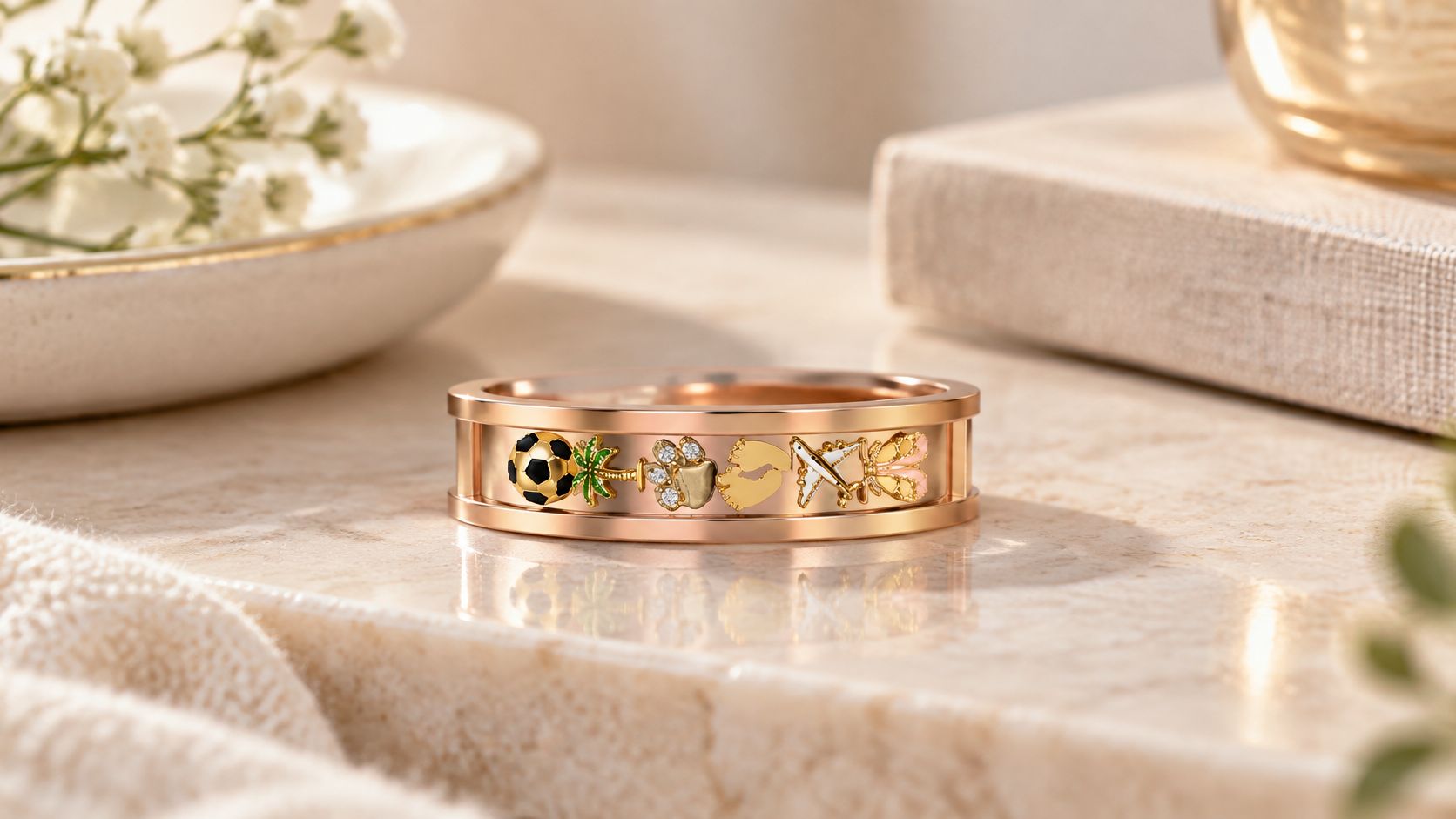
Personalized pieces make this decision concrete, since they are the ones people wear daily and rarely take off. The Personalized Glider Charm Ring ™ is a personalized charm ring, exactly the kind of piece that stays on a hand for years, so the metal you pick decides how it behaves against skin long after the first week. When a piece like this starts showing a different metal where it rubs, it moves to occasional wear, because scrubbing at the spot only strips the coating faster.
None of our jewelry contains nickel, and our fashion pieces are made in silver and 14K gold, so the base-metal question is answered before it starts for most of what we sell. A green film is a surface deposit to wash away. Ongoing inflammation is a reason to change metals and get advice.
EP Fine Jewelry offers custom and personalized options across its collections, and the Jewelry Care page explains how each finish should be worn so a green mark never catches you by surprise. If you're choosing something for daily wear, browse the Personalized collection to build a piece around a name, a date, or a symbol, then check the care notes for that specific metal before it becomes your everyday ring. Visit EP Fine Jewelry to see the collections and the care guidance in full.