
You've picked the birth months, opened a few ring pages, and found a pair of colors that looks right. Then the practical questions start: will Mom wear it every day, will one stone scratch before the other, and can you return it if the fit is wrong?
If you're searching for birthstone rings for mom 2 stones, choose for her hands and habits before choosing for the photograph. A meaningful ring should suit the way she lives day to day, not require her to protect it all day.
Table of Contents
- Birthstone Pairs by Month and Hardness
- How to Pair Two Stones That Age Well
- Design Layouts and Personalization Choices
- Choose the Setting and Metal for Two Stones
- How to Size a Two-Stone Ring
- Keep Two Stones Bright With Daily Care
- Order Your Two-Stone Ring Before the Date
Birthstone Pairs by Month and Hardness
A mother's ring can pair her birthstone with a child's, or represent two children, a marriage, or a family move. The mother's own birthstone does not have to be included.
The standardized U.S. birthstone list dates to 1912, with significant revisions in 1952, 2002, and 2016, according to Jewelers of America's birthstone guide. Choose a recognized alternative when its durability suits the ring better than the traditional stone.
The mother is represented by the ring. Each stone can stand for a family member.
Use the month as a starting point
The first stone listed for each month is a starting option, not a ranking of emotional value. Alternatives appear beneath it.
Mohs hardness measures scratch resistance, not resistance to breaking. Treat the daily-wear guidance as a practical screening tool, not a guarantee. Where a numerical hardness isn't established here, ask for the gemstone's specification.
| Month | Birthstone | Mohs hardness | Daily-wear fit |
|---|---|---|---|
| January | Garnet | 6.5-7.5 | Moderate. Protect from hard knocks |
| February | Amethyst | 7 | Good. Avoid prolonged intense light and sudden heat |
| March | Aquamarine | 7.5-8 | Good. Protect from impact |
| April | Diamond | 10 | Excellent scratch resistance, but can chip |
| May | Emerald | 7.5-8 | Inspect fractures and favor protection |
| June | Alexandrite | Confirm on gemstone specification | Confirm treatments and setting |
| June | Moonstone | 6-6.5 | Scratches readily |
| June | Pearl | Confirm on gemstone specification | Better suited to occasional wear |
| July | Ruby | 9 | Strong everyday candidate |
| August | Peridot | 6.5-7 | Protect from chemicals and heat |
| August | Spinel | 8 | Practical everyday option |
| September | Sapphire | 9 | Strong everyday candidate |
| October | Opal | Confirm on gemstone specification | Better suited to careful, occasional wear |
| October | Tourmaline | 7-7.5 | Protect exposed edges |
| November | Topaz | 8 | Scratch resistant, but vulnerable to impact |
| November | Citrine | 7 | Confirm treatment-specific care |
| December | Tanzanite | 6-7 | Favor a protective setting |
| December | Turquoise | 5-6 | Requires care for frequent wear |
A lower hardness rating calls for more protection and attention to care. A higher rating still does not prevent chips or damage to an exposed corner or loose setting.
Use this birthstone ring and charm guide to consider the symbolism before settling on a format.
Start with who the stones represent. Then compare the pair's hardness, daily-wear fit, and care needs before choosing the setting.
How to Pair Two Stones That Age Well
The prettiest pair isn't necessarily the pair that will stay attractive with the least effort. A product photograph shows color and proportion. It doesn't show the scratches, knocks, or cleaning habits the ring will encounter.
The MyBirthstone mother's ring buying guide explains that everyday dust contains quartz at about Mohs 7, and gives aquamarine a hardness of about 7.5-8, compared with garnet at about 6.5-7.5. Those ranges are useful screening information, not a promise that every specimen will wear identically.
Compare the weaker stone first
Say you're pairing aquamarine with garnet. Don't assume the garnet will definitely dull first, because their hardness ranges overlap. Instead, ask what protection the garnet receives and whether the jeweler has assessed the actual stones.
Use these checks in order:
- Compare scratch resistance. Favor stones with reasonably similar resistance to abrasion. A large mismatch means accepting that their surfaces may age differently.
- Flag breakage risks. Topaz and tanzanite need more consideration than their colors suggest. A hard surface doesn't prevent a stone from splitting or chipping.
- Match the care routine. Choose a pair you're willing to clean, store, and remove according to the more sensitive stone's requirements.
A protective bezel can make a vulnerable pairing more practical. It cannot make a soft gemstone scratchproof, and it shouldn't be used to justify wearing a delicate ring through every activity.
Decide what compromise is acceptable
If the exact birthstones matter most, keep them and adjust the wearing schedule. A carefully protected occasional-wear ring is a better purchase than a supposedly everyday ring that makes its owner nervous.
If convenience matters most, investigate the recognized alternatives for the relevant months. Don't substitute a different gem when buying a gift. Explain the choice so the symbolism remains clear.
Practical rule: Build the ring around the stone that needs more protection, not the stone that can tolerate more abuse.
Before approving any pair, ask:
- Scratch resistance: Are both stones suitable for the amount of hand wear she expects?
- Fragility: Does either stone have a breakage risk the design needs to address?
- Care compatibility: Would she willingly follow the same conservative routine for both?
If the answer to the last question is no, change the pairing or make it an occasion ring.
Design Layouts and Personalization Choices
A mother-and-two-children ring usually gets a side-by-side pair. That layout is the right call when two children, or two relationships, should carry equal weight. Matched stones stay readable on the hand after years of daily wear, because neither one shrinks into a supporting role that later feels like an afterthought.
A mother-centered idea changes the count. A mother's stone flanked by two children's stones is a three-stone design, not a two-stone ring. For exactly two gemstones, set the mother's stone beside one child's stone and use size, order, or engraving to mark the focus. Check the smaller stone's rim, corners, and mounting on their own. Those edges take the same daily knocks as the larger stone beside them.
| Layout | Best family situation | Main trade-off |
|---|---|---|
| Side-by-side pair | Two children or two equally emphasized relationships | Exposed edges need deliberate protection |
| Larger mother's stone beside a smaller child's stone | Mother-and-child symbolism | Unequal size creates an intentional hierarchy |
| Individually bezel-set pair | A pairing with a vulnerable gemstone | More visible metal, less open stone exposure |
Personalize the meaning before the appearance
Set the stone order before any decorative detail. Birth order is a clear system. Reverse the colors if that is how she wants the ring to read on her hand. Choose the order she will still accept in five years, not the arrangement that looks neat in a product photo.
Write these decisions down:
- Placement: Name which person each stone represents and where it sits when the ring is worn.
- Scale: Choose equal visual weight or one intentional focal stone.
- Engraving: Confirm spelling, date format, punctuation, and how much space the band has.
- Approval: Decide whether you receive a drawing or other design confirmation before production.
Names and dates are where layouts fail. A ring band has little room, so the date format and punctuation have to fit the metal you chose. A label can carry a longer line. McLaren Vale Cellars' guide to thoughtful wine keepsakes for Australian gift buyers shows how a keepsake handles those same name-and-date choices on a label instead of a narrow band. On a two-stone ring, shorter text wins. A crowded inscription rubs the finger and becomes hard to read.
EP Fine Jewelry offers custom and personalized options across its collections. The customized ring guide is the place to line up placement, scale, and engraving before you approve a drawing. Confirm which changes are available before the design is treated as final.
Sketch the layout on paper. A rough drawing shows whether you asked for equal representation or a clear focal point.
Choose the Setting and Metal for Two Stones
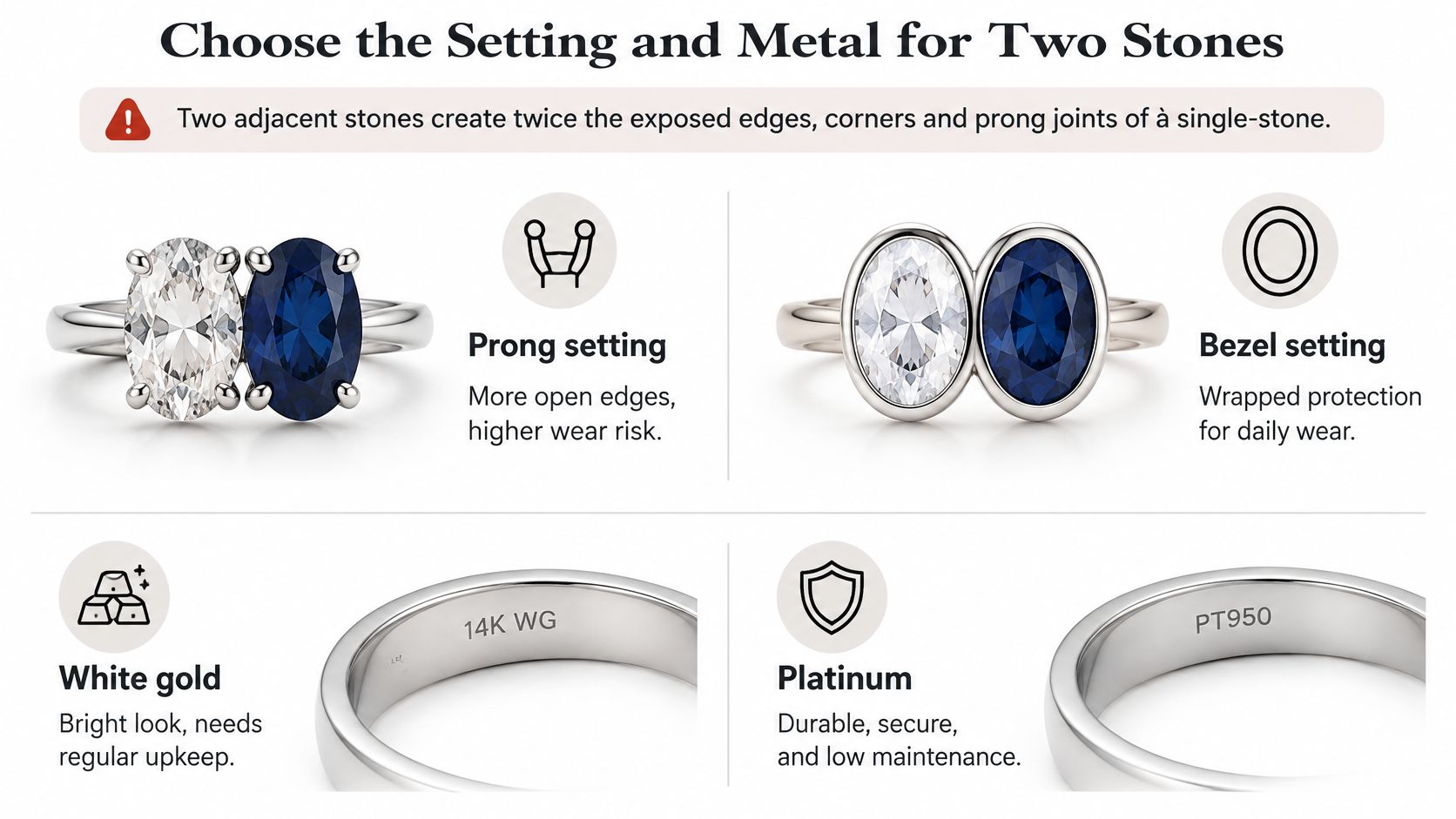
A tall, pointed birthstone in thin prongs will snag a sweater cuff the first week she wears the ring every day. The stone beside it does not cushion that corner. Two stones mean more edges and more junctions between metal and gem, and the risk lives in the design. A low, well-supported pair takes daily knocks differently from tall stones with exposed corners. Judge the pair by how both stones will wear together for years, not by how tidy they look side by side in a product photo.
The GIA guide to protecting gemstones from chipping recommends protecting vulnerable points with bezels, partial bezels, or V-shaped prongs, and notes that topaz has Mohs hardness 8 despite comparatively low toughness. Hardness alone should not pick the setting. A hard stone with low toughness still chips at a thin point.
Use the comparison below to see how much of each stone stays exposed.
Match protection to the cut
A full bezel wraps the stone's perimeter in metal. A partial bezel leaves more open space, so check exactly which edges stay bare. V-shaped prongs belong on a pointed cut that needs its corners held.
For the more fragile stone of the pair, choose a rounded outline or a cabochon when the design allows it. Do not keep sharp corners only because they photograph as a neat match. Topaz and tanzanite need the more protective setting of the two. If one stone is tougher and the other chips easily, set the weaker stone first and let that choice govern the shared mount.
Compare Metal Upkeep Over Time
Pick the metal after the weaker stone is protected. Color is the visible part. Alloy and construction decide how the band looks after years of scratches, polishing, and daily wear. Gold pieces do not all resist wear the same way. Silver can stay in daily rotation if she will polish it on a schedule.
| Metal | Wear and tarnish | Best fit |
|---|---|---|
| 14K yellow gold | Solid alloy. Can scratch and needs periodic inspection | Warm colors such as garnet and tourmaline |
| 14K white gold | Often rhodium plated. The finish can need renewal | Cool colors such as aquamarine and diamond |
| 14K rose gold | Copper-containing alloy. Surface wear remains possible | Pink-toned or warm stones |
| 10K gold | Lower gold content than higher-karat options. Assess the finished construction | Everyday pieces where budget matters |
| Sterling silver | Tarnishes and needs suitable polishing | Buyers comfortable with regular surface upkeep |
Solid gold and gold plating wear differently once the surface is polished or rubbed thin. Read the material line when two rings look alike online. Ask whether polishing or refinishing will strip a plated layer and leave a different color underneath.
The video can supplement your comparison, but the actual ring's specifications should decide the purchase.
Start with yellow or rose gold for a warm palette and white gold for a cool palette, then set that choice next to jewelry she already wears. Her preferred metal and protection for the weaker stone outweigh a rigid color-matching rule.
How to Size a Two-Stone Ring
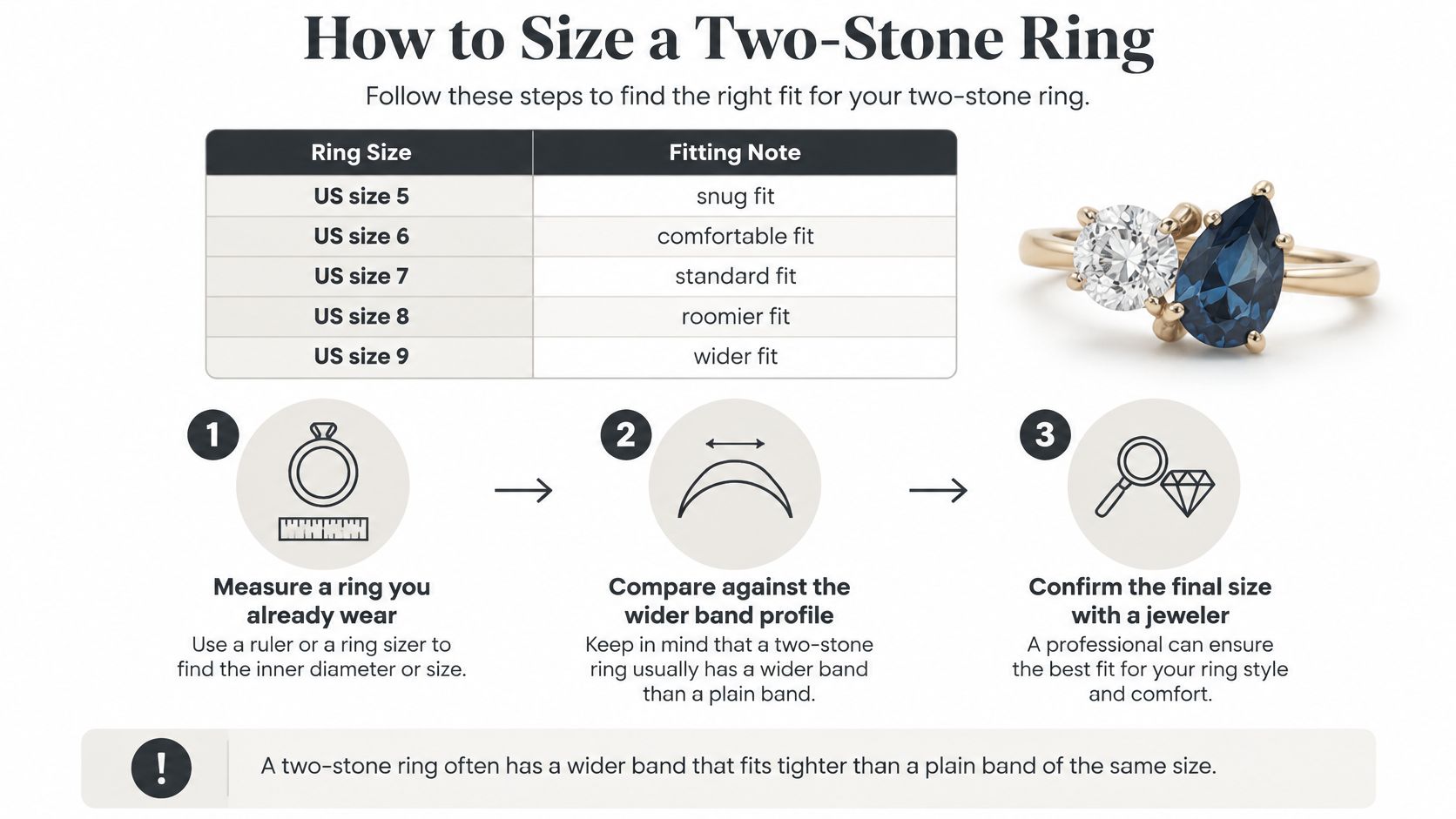
She tries the ring on for a quick photo and both stones sit level. By late afternoon the same band presses at the knuckle, or it spins so the two stones knock the next finger. Judge the fit by that daily wear, not by how the pair looks side by side online.
A ring made for another finger, or for a much narrower band, is a weak final reference. A broad two-stone design feels tighter than a slim ring with the same size label. Too tight rubs the settings over years of everyday wear. Too loose lets the pair turn and take knocks.
Use one seller's sizing chart. Do not mix a paper-strip reading with a second chart from another brand. For the common US sizes 5 through 9, stay on the single row that matches her likely size. A strip measurement belongs in that chart's inner-circumference column. An existing ring belongs in the inner-diameter column, not the outside width of the band. Without a chart for this exact ring, do not turn a home reading into an order size that only looks exact.
The visual below is a fitting reminder, not a substitute for measuring the wearer.
Measure, compare, then confirm
- Choose the finger. Start with a ring that already fits that exact finger if you have one. It should be round, not bent out of shape.
- Take a home measurement. Wrap a narrow, nonstretch paper strip around the base of the finger and mark the overlap. Check the knuckle separately. The finished ring has to pass it.
- Measure the strip. Lay it flat on a millimeter ruler. Do not pull it tighter to force a smaller reading.
- Use the correct chart. Match the marked length to the seller's circumference figures for that size. For an existing ring, measure inside diameter only.
- Test a comparable band. A jeweler's sizing set beats a guessed size bump for a wide two-stone ring. Match the approximate width and profile of the design she will wear.
- Repeat under normal conditions. Skip a reading when the hand is unusually cold, hot, or swollen. Settle conflicting numbers before you authorize personalization.
The steps in how to find her ring size keep the strip, the chart, and the knuckle check in one order.
A good fit passes the knuckle with slight resistance and stays comfortably in place. It should not pinch at the base or slide off when the hand points down. Comfort depends on her finger, her knuckle, and the band profile together. The printed size is only the starting label.
For a surprise gift, confirm resizing and return terms before you order from an estimate. Some fine jewelry, typically personalized or made-to-order pieces and some EP Fine items, may carry a restocking fee of up to $150 per item.
Keep Two Stones Bright With Daily Care
Remove the ring before gardening, exercise, household chemical cleaning, or impact-heavy work. Put a ring dish somewhere safe before starting, not beside an open drain. A consistent removal habit is more useful than trying to remember which activity poses which risk.
For cleaning, begin with lukewarm water, mild soap, and a very soft brush only when appropriate for both stones and their treatments. Work gently around the settings, rinse in a separate bowl, and dry with a soft cloth. Don't scrub a loose stone.
Get care instructions for the actual gemstones
GIA's jewelry care guidance distinguishes hardness, toughness, and stability, and identifies ruby and sapphire as Mohs 9 stones with excellent toughness. It also notes that Mohs 7 amethyst can be affected by prolonged intense light and abrupt temperature changes.
Before buying, request the treatment information for each stone. A gemstone's name alone doesn't establish whether it can tolerate soaking, heat, chemicals, or machine cleaning.
- Amethyst: Keep it away from prolonged intense light and abrupt temperature changes.
- Tanzanite: Avoid heat shocks and knocks. Treat its setting as protection, not permission for rough use.
- Topaz: Be particularly careful about impact against counters, equipment, and hard handles.
- Opal and turquoise: Use stone-specific instructions rather than assuming the same soaking routine suits every example.
Don't put a mixed-gemstone ring into an ultrasonic or steam cleaner without explicit approval for both gemstones, their treatments, and the mounting. The safest cleaning method for one stone may be unsuitable for its neighbor.
Make inspection part of ownership
Store the ring in its own soft compartment so harder jewelry cannot rub against it. Keep it separate from loose chains and pieces that can catch its prongs.
Our jewelry care instructions provide a useful ownership reference. Keep the gemstone-specific instructions with the order confirmation so they're easy to find later.
Stop wearing the ring if a stone moves, a prong lifts, or the mounting starts catching fabric.
Choose a regular cleaning and inspection schedule you'll stick to. Brush gently, look at both settings under good light, and arrange professional checks appropriate to the design and wear. Don't wait for a stone to fall out before addressing a loose setting.
Order Your Two-Stone Ring Before the Date
The celebration is already on the calendar, and the two-stone ring is still two colors in a cart. Count back from the day she needs it on her hand: design approval, production, shipping, and time to check the finished ring. Treat the stated production and shipping window as a planning estimate, and leave room to inspect the piece before the occasion.
Mother's Day is one of the biggest sales occasions for birthstone jewelry, according to Rapaport's reporting on sentimental birthstone purchases. Order around the schedule for that specific ring, not around the week you would normally buy a ready-made gift.
Finalize the details that are difficult to change
A two-stone ring has to hold up through years of daily wear, not only look balanced in a product photo. Save a written order summary before you pay:
- Meaning: Record the family member or milestone each stone represents.
- Gemstones: Confirm identities, treatments, and whether each stone is natural or laboratory-created. The more vulnerable stone sets the wear rules for the pair.
- Construction: Specify the setting, metal, finish, and approved arrangement so neither stone sits unprotected.
- Fit: Confirm the intended finger and the final size she will wear.
- Delivery: Get the production and shipping expectation for that particular piece, then leave time to inspect it.
Personalized selections are available through a dedicated Personalized collection, with custom options across the collections. The personalized jewelry gift guide for mom helps you settle who each stone represents without skipping fit and construction.
An optional gift box is available at checkout, and order notes support a gift message or special handling instructions. Say who each stone stands for. Do not leave her to decode the colors.
Read the policy before approving personalization
Some fine jewelry, typically personalized or made-to-order pieces and some EP Fine items, may carry a restocking fee of up to $150 per item. Check the terms for the specific item before ordering, particularly if the size is still an estimate.
None of the jewelry contains nickel. That answers the nickel question. Buyers with other known metal sensitivities should still review the complete material description.
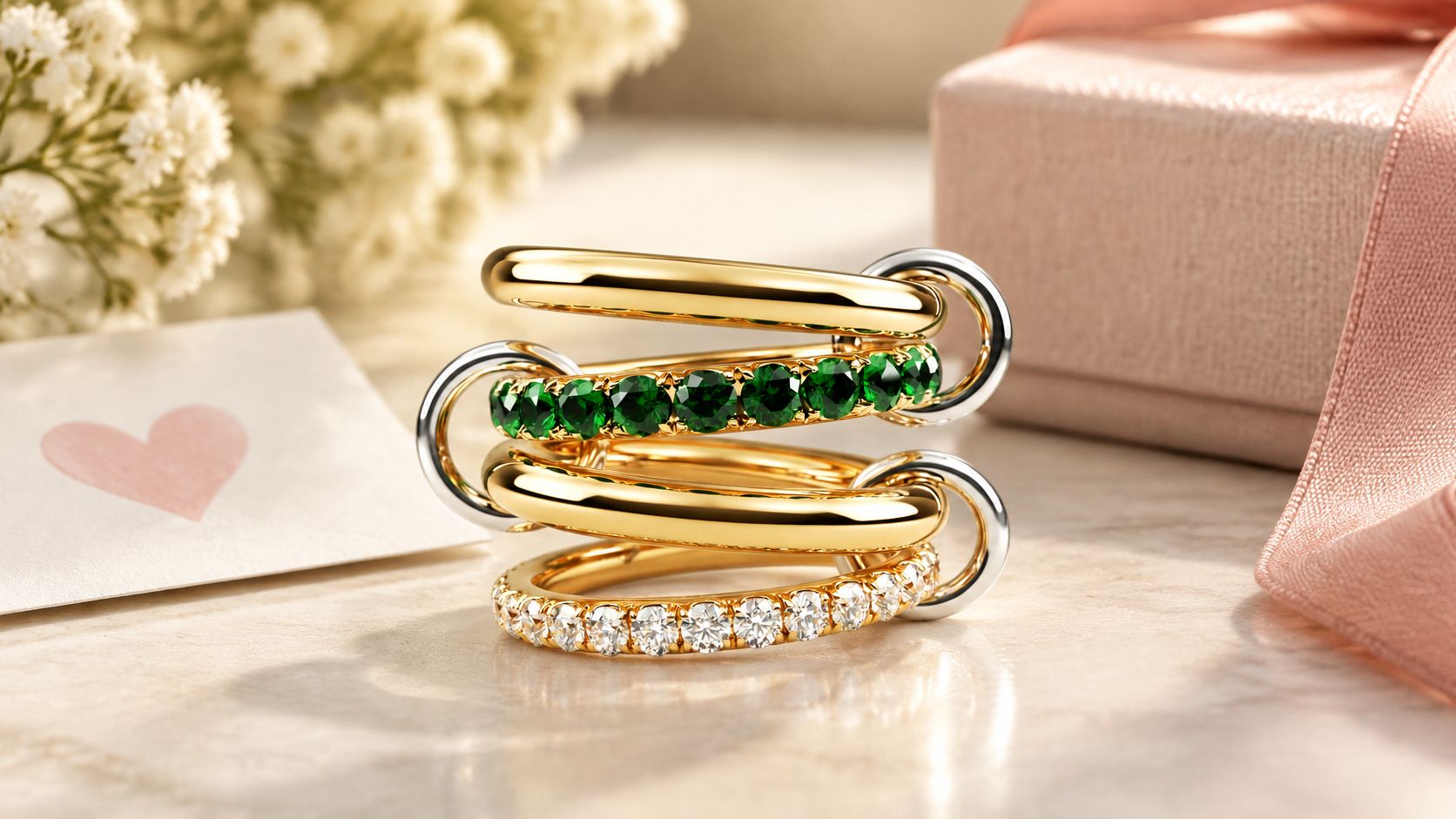
For a stacked look rather than one literal two-stone setting, the 10K Intertwining Green and Diamond Stackable Bands are a different format. The listing shows them in stock at $1,350, with four variants. Confirm the variant and current availability on that page before you treat them as the gift. They are not a stand-in for a custom birthstone pair you have not specified.
Write down the two months today. Settle protection and fit, then confirm the item-specific schedule before placing the order. The better gift is the ring she can still wear comfortably after the day has passed.
We offer personalized and fashion jewelry, with custom options across our collections and gift presentation available at checkout. Visit EP Fine Jewelry to explore a meaningful ring for Mom, then confirm the gemstones, protective setting, size, and delivery timing before personalizing your choice.