
Your friend's birthday is tomorrow, and you've found a necklace she'll love. Then you notice the packaging: a loose pouch, a tangled chain, and nowhere to put a note. The box is the first thing she'll see, so it deserves a little thought too.
A personalized jewelry box can make that opening feel more considered. But before choosing the lettering, check what's underneath it: the usable space, the lining, the way the jewelry stays put, and the rules that apply if something arrives wrong.
Table of Contents
- Why a Personalized Jewelry Box Is Worth Choosing
- Box Sizes for Rings, Earrings, Bracelets and Necklaces
- Materials and How They Protect Your Jewelry
- Personalization Methods and What Each Looks Like
- Protecting the Box During Shipping and Gift Delivery
- Returns and Final Sale Rules for Personalized Orders
- Choose Your Box and Order With Confidence
Why a Personalized Jewelry Box Is Worth Choosing
A jewelry box does two jobs at once. It protects the piece while it's waiting to be worn, and it presents the gift when someone lifts the lid. A beautiful exterior can't make up for a necklace that arrives tangled or an earring back that disappears into a loose insert.
Think of a good box like a well-made coat hanger. You barely notice it when it works, but you notice immediately when something slips, bends, or catches. Dividers keep pieces apart, fitted supports hold them in place, and a smooth lining limits rubbing against hard surfaces.
Jewelry gifting isn't a niche habit. According to Mintel's U.S. Jewelry Market Report, 49% of U.S. shoppers had purchased jewelry as a gift for someone else in 2024.
What personalization adds
A name, initials, a meaningful date, or a short message gives the recipient a reason to keep the box after taking out the jewelry. A graduation date might belong inside the lid; a simple monogram might suit something that will sit on a dressing table.
The best choice depends on the person, not just the occasion. Someone who travels may value an organizer with secure compartments more than a large display box. Someone receiving a sentimental ring may prefer a small keepsake box that gives that piece its own place.
For ideas that connect the inscription to the occasion, our guide to personalized jewelry gifts offers a useful starting point.
A plain box holds jewelry. A thoughtfully personalized box can hold jewelry and a memory.
Before buying, settle four questions:
- Fit: What size and insert will hold the jewelry properly?
- Material: What will protect it during everyday use?
- Personalization: Will the message be clear and correct?
- Delivery and returns: What happens if the gift arrives damaged or isn't right?
Box Sizes for Rings, Earrings, Bracelets and Necklaces
Box size guide by jewelry type
| Jewelry type | Typical item size | Box size to look for | Insert style |
|---|---|---|---|
| Single ring | Measure the band and raised setting | Room for the ring upright without lid pressure | Ring pillow or slot |
| Stud earrings (pair) | Measure each face, post, and backing | Space behind the tray for posts and backs | Tray with earring holes |
| Hoop earrings | Measure the outside diameter and projecting posts | Enough width for separated hoops and depth for the fastening | Post bar or hook strip |
| Bracelets and bangles | Measure the closed bracelet or bangle across its widest point | A compartment that holds its natural shape | Padded channel or cushion |
| Necklaces and chains | Measure the chain and pendant separately | A layout that supports the pendant and contains the chain | Hook bar or coiled chain space |
| Mixed collection | Several formats | Separate compartments with clearance above the tallest piece | Multi-tray insert with dividers |
Treat this table as a fit guide, not a universal sizing standard. A delicate ring and a ring with a tall setting may need very different depths. The same is true of a flat chain and a necklace with a bulky pendant.
Product listings can also cause confusion because exterior measurements don't tell you how much room remains inside. Thick walls, padding, hinges, and removable trays all take up space. Look for usable interior dimensions, especially when buying for a particular piece.
Measure the jewelry before the box
- Measure the longest or widest piece. Use a ruler on the item in its intended storage position. Don't stretch a bracelet or force a necklace into a tight curve.
- Leave room for the support. Padding should cradle the jewelry without squeezing it. Include the space taken up by a cushion, hook, or ring roll.
- Check the tallest point. Raised settings, earring posts, and chunky clasps need clearance above and below the insert.
- Check the lid and hinge. A tray that fits when the box is open may still interfere with the closing lid.
Small pieces need controlled compartments, not just a small outer box. Stud earrings should stay paired, with room for their backs. A bangle needs a channel or cushion that supports its shape rather than forcing it into an oval.
For a mixed collection, choose divided storage instead of a large empty cavity. Otherwise, the recipient may end up putting earrings beside chains and pendants against rings.
Buying for someone with an established collection? Choose additional usable compartments, rather than extra empty volume. A removable tray can make future additions easier to organize without disturbing the pieces underneath.
Fit test: If closing the lid presses on the jewelry, the box is too shallow.
Materials and How They Protect Your Jewelry
Start with the surface that touches the jewelry. A clean, smooth, non-abrasive lining matters more than an impressive-looking shell. Inspect cotton, linen, microfiber, felt, or velvet for rough seams, loose fibers, exposed staples, and adhesive near contact points.
Rigid walls help resist crushing, while the lining separates jewelry from those walls. A closed lid keeps everyday dust off, but it doesn't automatically make a box airtight or tarnish-resistant.
Box materials compared on protection and recycling
| Material | Protection | Recyclability | Best for |
|---|---|---|---|
| Rigid paperboard with cotton lining | Resists ordinary knocks; lining cushions contact | Check local paper rules after removing the lining and fittings | Gifts and everyday storage |
| Wood with felt or velvet lining | Strong walls; suitable for heavier pieces | Prioritize reuse; finishes and fittings can limit recycling | Keepsake storage |
| Faux leather over rigid board | Firm shell with a covered surface | Bonded mixed materials are difficult to separate | Gift presentation |
| Fabric pouch | Light protection from dust and surface rubbing, little crush resistance | Check textile collection rules, drawstrings, and trim | Separated pieces inside a travel case |
| Acrylic case | Rigid display surface; can develop visible scratches | Check whether local facilities accept acrylic | Shelf display |
| Fabric-lined metal tin | Strong shell; exposed metal edges can scratch jewelry | Separate the lining where possible and check metal collection rules | Small gift sets |
Presentation isn't the same as recyclability
A laminated lid, foil decoration, ribbon, magnet, and bonded foam insert can make a box attractive while making disposal less straightforward. A simpler paperboard shell with removable parts is often easier to sort.
This distinction matters to shoppers. McKinsey's global packaging survey found that recyclability was the most important packaging sustainability attribute worldwide in 2025. That doesn't mean every paper-looking box belongs in a household recycling bin.
Before disposing of packaging:
- Identify the shell: Check whether it's paperboard, wood, plastic, metal, or a bonded combination.
- Separate removable parts: Take out the lining, ribbon, and other fittings where they can be removed safely.
- Follow local instructions: Confirm which materials your collection service accepts, including coated board and textiles.
For long-term storage, inspect the inside just as carefully as the outside. Wood can make a useful keepsake shell, but an attractive old box may have a worn lining or exposed fittings. Quote My Wall's guide to caring for antique jewellery boxes is useful context when choosing or maintaining an older keepsake.
Don't assume any decorative lining prevents silver tarnish. Look for an explicit anti-tarnish specification, and keep jewelry clean and dry before storing it. Our jewelry care instructions explain the separate care needs of the pieces themselves.
Protection first, presentation second. The prettiest finish won't compensate for an abrasive seam or an exposed corner inside.
Personalization Methods and What Each Looks Like
Personalization methods compared
| Method | Look and feel | Best for | Watch for |
|---|---|---|---|
| Foil stamping | Reflective metallic text | Names and initials on the lid | Fine lettering can disappear in reflections |
| Embossing | Raised lettering without printed ink | Subtle, classic gifts | Low contrast can make lettering difficult to read |
| Printed insert or card | Color and space for a date or note | Private messages and longer wording | Keep printed surfaces away from jewelry |
| Engraved wood or acrylic plate | Cut or etched lettering on a separate surface | Long-term keepsake storage | Check attachment, added weight, and price |
| Monogram initials | Initials arranged in a set design | Coordinated gifts and personal organizers | Confirm letter order and relative size |
The example below shows how visible lettering becomes part of the case's overall appearance.
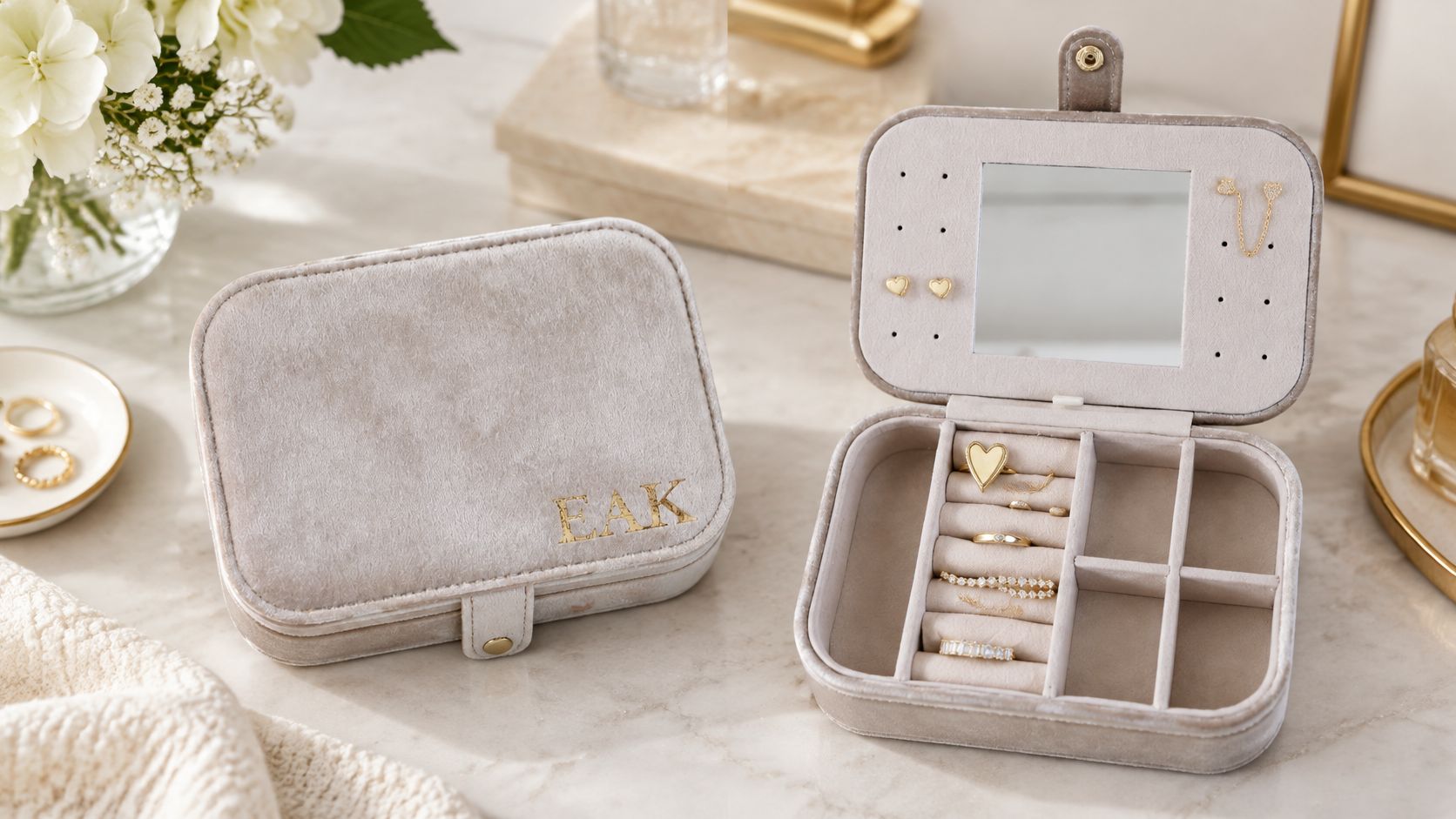
Give each message its own place
A box handed over at a birthday dinner carries personalization in three places: the exterior design, the presentation inside, and the gift message. They don't all need to repeat the same wording. A short name outside and a private note inside can feel more considered than covering every surface.
The exterior should remain legible at the actual lid size. A name in simple lettering usually needs less space than an ornate design. If you choose an engraved plate for a permanent keepsake, check that its edges and attachment won't catch during handling.
A printed insert can hold a date or explanation without crowding the lid. Give the message card its own sleeve or pocket, away from metal and exposed adhesive, and secure chains and charms so they can't rub against the printing during delivery.
In a nationally representative U.S. survey of more than 500 consumers, 51% highly appreciated a personalized message, according to PPAI's gifting survey coverage. Put your note inside the box, in that sleeve or pocket, where it stays private and arrives intact.
Verify the layout before approving it
Monograms can be confusing because decorative layouts don't always follow ordinary reading order. Farmhouse World's personalized sign guidance for rustic homes provides useful context for thinking about monogram style and placement, while the box maker's own layout should decide your final approval.
Before submitting an order:
- Write the exact text: Include capitals, punctuation, and spaces as you want them reproduced.
- Check the character limit: A longer name may require smaller lettering.
- Confirm special characters: Don't assume accents, symbols, or nonstandard punctuation are supported.
- Compare the design: Check font, alignment, placement, and whether the preview represents the finished item.
- Check the deadline: Separate design approval time from making and delivery time.
For our personalized jewelry, email us before ordering if you want something different from the online design or need a special character. We can confirm whether it can be made before you submit it.
If you're considering a handwritten message on the jewelry itself, our guide to personalized jewelry with handwriting explains how that choice differs from lettering on the packaging. Keep the lid wording short enough to read comfortably without picking up the box.
Protecting the Box During Shipping and Gift Delivery
A presentation box and a shipping box have different jobs. The first holds and displays the jewelry. The second works like the suspension on a delivery van, absorbing the knocks so the arrangement inside arrives looking the way it left.
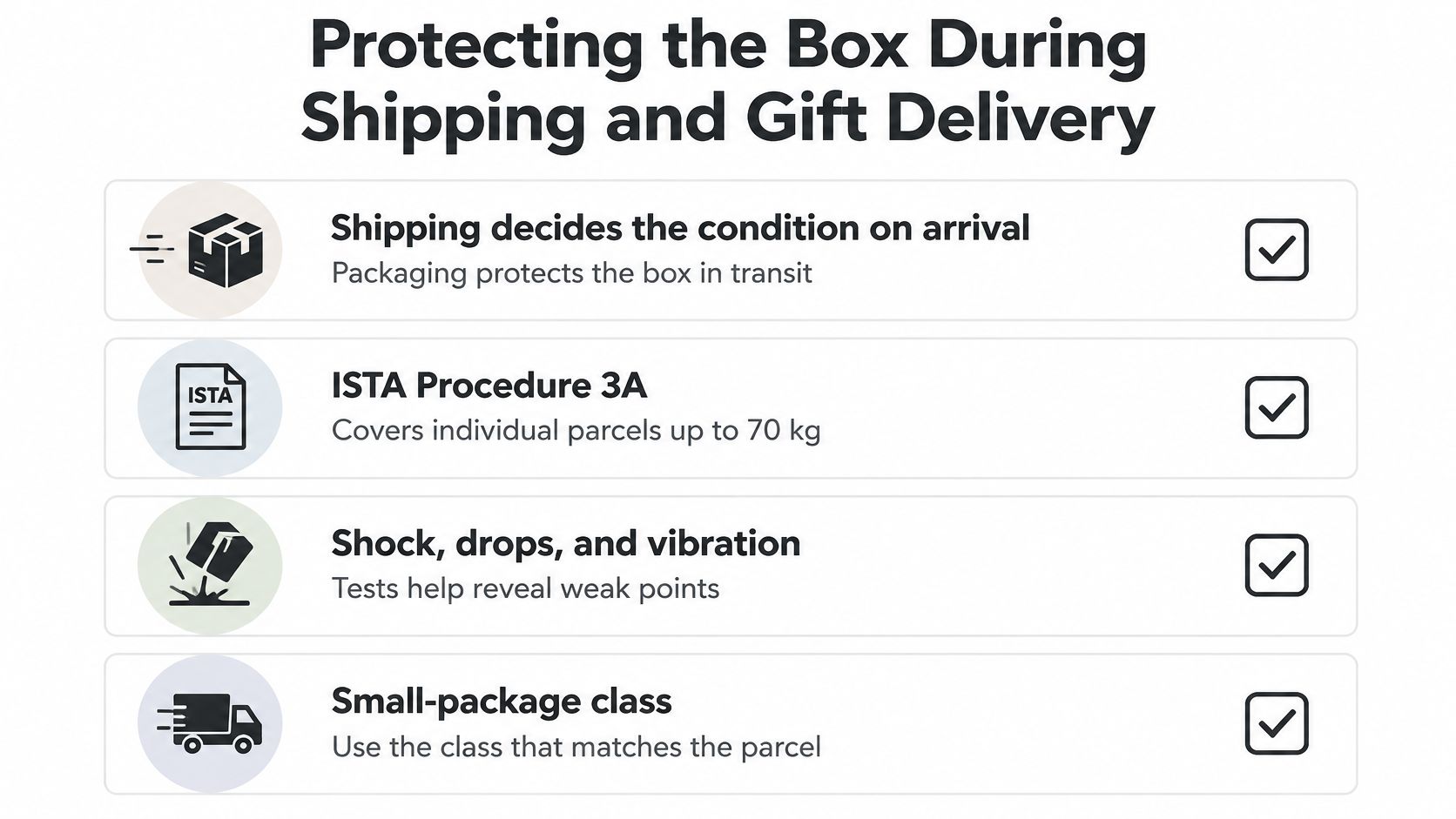
ISTA Procedure 3A evaluates individual parcel shipments up to 70 kg through hazards including atmospheric conditioning, shock, drops, and random vibration. Under ISTA Procedure 3A, the small-package class requires a longest dimension no greater than 350 mm, volume no greater than 13,000 cm³, and weight no greater than 4.5 kg.
The checklist below summarizes the transport concerns behind those tests.
Keep the complete arrangement still
Testing should assess the packed gift with its insert, lettering, and card in place. The jewelry, insert, lettering, closure, tissue, and message card all affect how it behaves in transit. A loose inner box can repeatedly strike the outer carton, stressing hinges and crushing corners.
For anyone preparing a gift for onward shipping:
- Use a rigid outer carton. Don't rely on decorative wrapping or a soft mailing bag to resist crushing.
- Cushion the presentation box. Fill gaps around it so it can't slide, while avoiding pressure that bends the lid.
- Secure the closure. Use a suitable protective wrap or sleeve if needed, keeping adhesive away from decorative surfaces.
- Separate the gift card. Place it in a sleeve where it won't rub against jewelry or move into the hinge.
- Inspect arrival condition. Look for crushed corners, a distorted lid, loose lettering, or a displaced insert before presenting the gift.
A gentle movement check can reveal obvious looseness, though it is no substitute for a laboratory transport test. Sellers should define acceptable results, such as intact corners, working closures, and jewelry remaining in its support, and reassess packaging when components change.
Our guide to gift box packaging offers more context for planning the presentation around the item, and a gift box can be added to an order at checkout.
Separate dispatch from arrival
For our Personalized Charm Bangles not on pre-order, shipping occurs within 5-7 business days, and can take up to 6 weeks if out of stock. That timing applies to those bangles; other personalized items can follow different schedules.
If stock is uncertain, allow at least that making-and-dispatch window before your deadline, plus delivery time. Ask about stock before relying on a birthday or holiday arrival. A dispatch estimate tells you when a parcel may leave, which is a different question from the day the recipient opens it.
Returns and Final Sale Rules for Personalized Orders
Who handles the problem if the recipient discovers it? The purchaser should keep the order confirmation and personalization details, because the recipient may not know what was requested. Agree who will contact the seller before sending a gift directly to someone else.
Read the store's returns and refunds policy before submitting a personalized order. These are the final-sale rules that apply.
Final-sale rules for personalized items
| Item | Policy |
|---|---|
| Personalized name necklaces | Final sale; no store credit |
| Personalized name bracelets | Final sale; no store credit |
| Personalized charm bangles | Excluded from the name-item final-sale rule |
| Charm pendants, including letter or initial charms | Final sale |
| Cuffs | Final sale |
| Personalized charm necklaces | Final sale |
| Any personalized order after submission | Final sale; production starts right away |
The charm bangle exclusion matters when a gift might need to go back. Some items may qualify for a size exchange or store credit, and where a return is accepted, personalized or made-to-order pieces and some EP Fine items may carry a restocking fee of up to $150 per item.
The steps below show what to document once the parcel arrives.
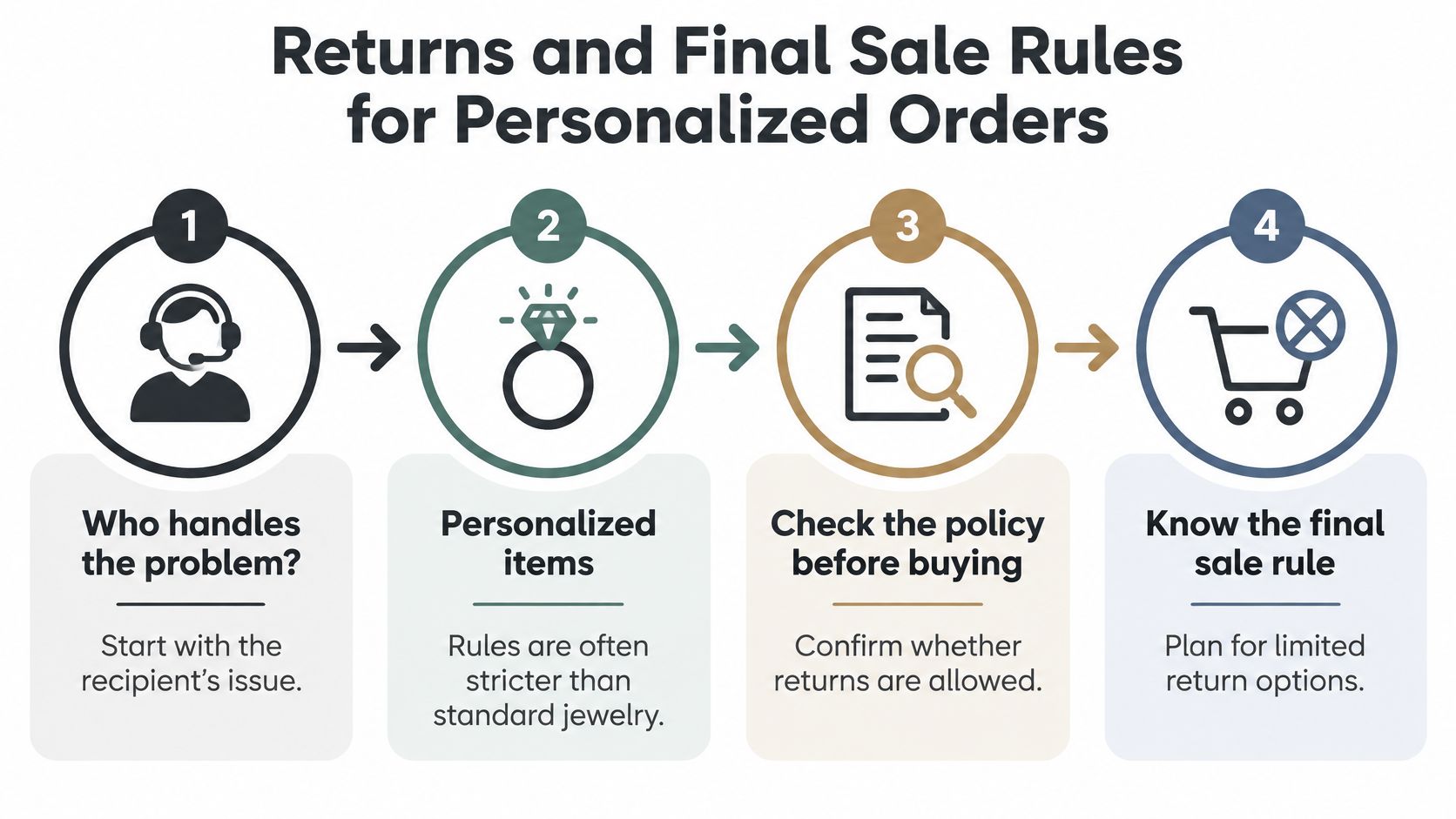
Document damage before rearranging the gift
A change of mind, an incorrect inscription, and transit damage are different problems. Describe the actual issue rather than assuming the same return process covers all three.
- Photograph the outer carton before opening, including visible damage and the shipping label.
- Photograph the packed contents and jewelry before removing or rearranging them.
- Keep all packaging, including the presentation box, insert, tissue, and gift card.
- Record the arrival date and retain the order confirmation.
- Email the seller promptly with the photographs and a clear description.
Keeping the packaging helps show how the item was protected and where an impact may have occurred. Don't discard a damaged carton just because the inner box looks reusable.
Compare the delivered piece with the order
If the recipient finds a wrong name, date, or spelling, compare the jewelry with the order notes and any approved proof. That shows whether the finished piece differs from what was requested, and a production error is a different problem from a change of mind.
Personalized orders become final sale once submitted, because production begins immediately with the manufacturer. Contact the seller as soon as an error is spotted, without assuming a correction window exists after checkout.
Choose Your Box and Order With Confidence
A jewelry box does two jobs: it protects the piece in transit, and it carries the message when the lid opens. Start with the jewelry inside it and the occasion it marks, and let those answers decide the box.
The store view below gives context for browsing jewelry alongside gift options.
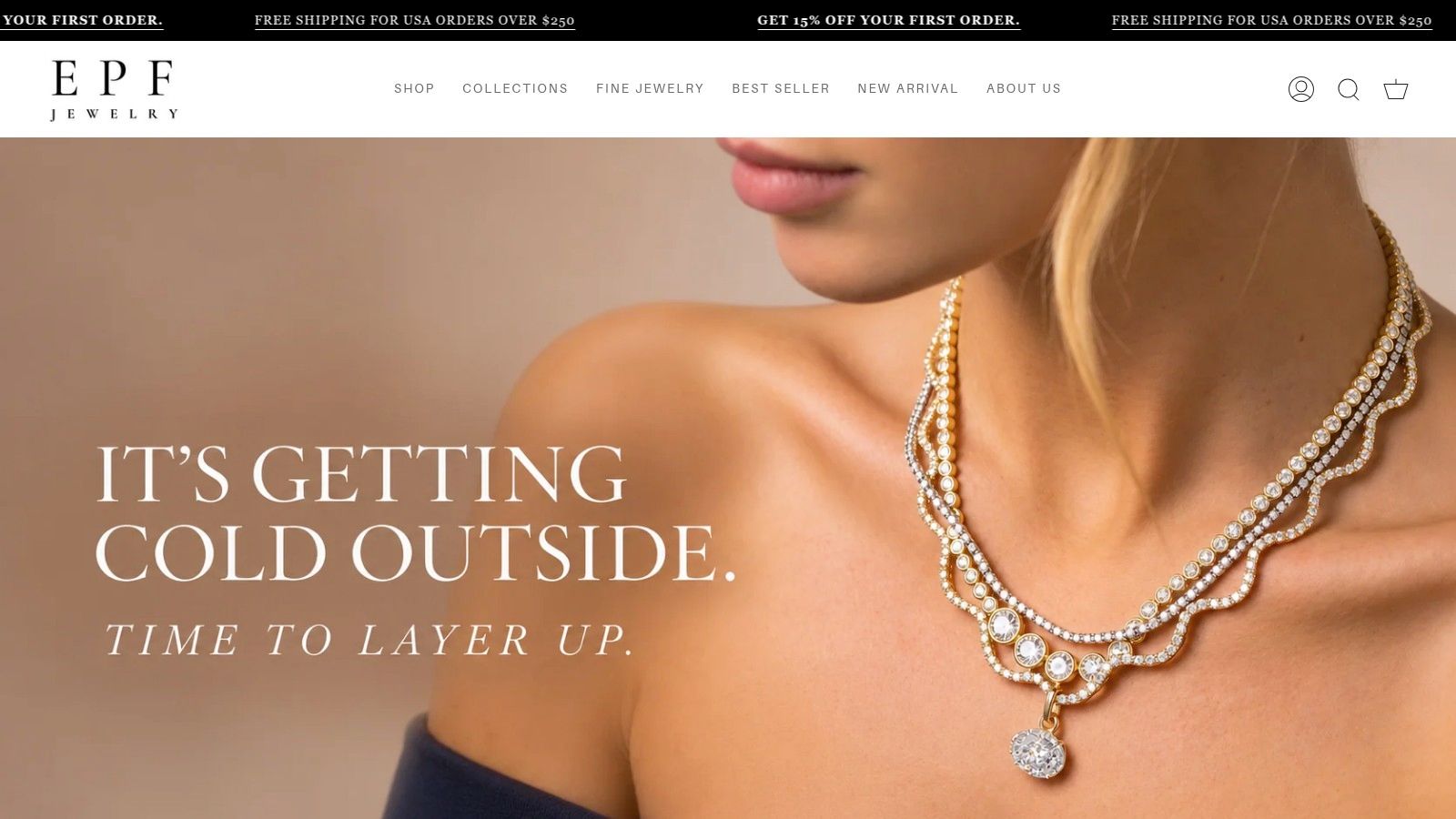
Match presentation to purpose
For birthdays, anniversaries, and holidays, the EPF Gift Box covers the presentation side of the gift, arriving ready to hand over. For ongoing organization, the Personalized Jewelry Case keeps serving the recipient long after the occasion, holding everyday pieces in one place. A gift box can be added at checkout, and the order notes field can hold a gift message.
If you're comparing packaging for a shop rather than a single gift, Packaging Panda's packaging for small jewellery businesses offers a useful point of comparison for box formats. Keep the same distinction in mind: presentation packaging still needs a suitable transport arrangement.
Use the accompanying video as another visual reference while considering the gift's overall presentation.
One final policy check matters: some fine jewelry, typically personalized or made-to-order pieces and some EP Fine items, may carry a restocking fee of up to $150 per item. Confirm whether the piece is eligible for a return at all before treating a possible fee as a return option. The store's shipping and returns policy pages list which rules apply to a given order.
The best personalized jewelry box is the one that fits the jewelry, protects it in transit and says the right thing when opened.
At EP Fine Jewelry, we offer personalized jewelry and fashion jewelry in silver and 14K gold, with a gift-box option at checkout. Visit us to choose a piece, check its personalization and delivery details, and add a message that makes the gift your own.