
You're looking at a birthday card you've kept for years. The paper is soft at the edges, but the message still stops you. It's not the words alone that matter. It's the way your mother looped her L, or how your partner's signature leans hard to the right. A typed name on a necklace wouldn't give you that feeling. Personalized jewelry with handwriting tries to keep it.
Table of Contents
- Why Handwriting Makes Jewelry Personal
- How Handwritten Personalization Works
- Prepare Handwriting Artwork That Stays Readable
- Compare Engraving Embossing and Casting
- Choose Materials and Finishes for Your Piece
- Plan Production and Shipping Expectations
- Care for Handwriting Through Daily Wear
- Choose Handwriting Jewelry for Meaningful Gifts
Why Handwriting Makes Jewelry Personal
A shopper trying to order a gift often hits the same wall. She types her father's name into an engraving box, picks a script font, and stares at the preview. It looks neat. It also looks like anyone's name. Then she finds his signature on an old letter, slightly shaky, with a tall first letter and a tail that runs under the whole word. That's him.
That's the difference this format is built on. Handwriting personalization doesn't swap your words for a decorative font. It reproduces the actual letter shapes, spacing, and irregularities from the original note, signature, or drawing. The small flaws aren't mistakes to clean up. They're the fingerprint of the person.
What Makes It Feel Authentic
Think of handwriting as an artifact, the way you'd think of a pressed flower in a book. The value is that a specific hand made it at a specific moment. A child's uneven first letters, a grandparent's careful cursive, a short note from someone who lives far away, each carries pressure, height, and flourishes no font repeats.
People have engraved names, dates, and messages on durable objects for centuries for the same reason. Handwriting jewelry extends that older custom. The purpose hasn't changed, only the capture method has. Scanning and laser work now let a jeweler move a fragile paper mark onto metal you can wear.
A font tells you what was said. Handwriting shows you who said it.
There's a limit worth naming early. A keepsake only works if you can still read it in five years. Clarity and longevity depend on how the artwork is prepared, which production method is used, what metal you choose, and how the piece is cared for. The emotional choice comes first, but the practical choices protect it.
How Handwritten Personalization Works
Follow one message through the process. You start with a note on paper, maybe three words from a card. You photograph or scan it so the jeweler has a clear digital image. That image is the raw material, and everything after this step is about protecting its shape while shrinking it to fit a pendant or ring.
The jeweler cleans the image first. Paper texture, shadows, and stray marks come out, leaving only the strokes. Then those strokes are converted into a precise digital file that can be scaled to the exact size of the jewelry. This isn't font selection. No one retypes your words. The file traces the stroke geometry of the original, including how letters connect and how far apart they sit.
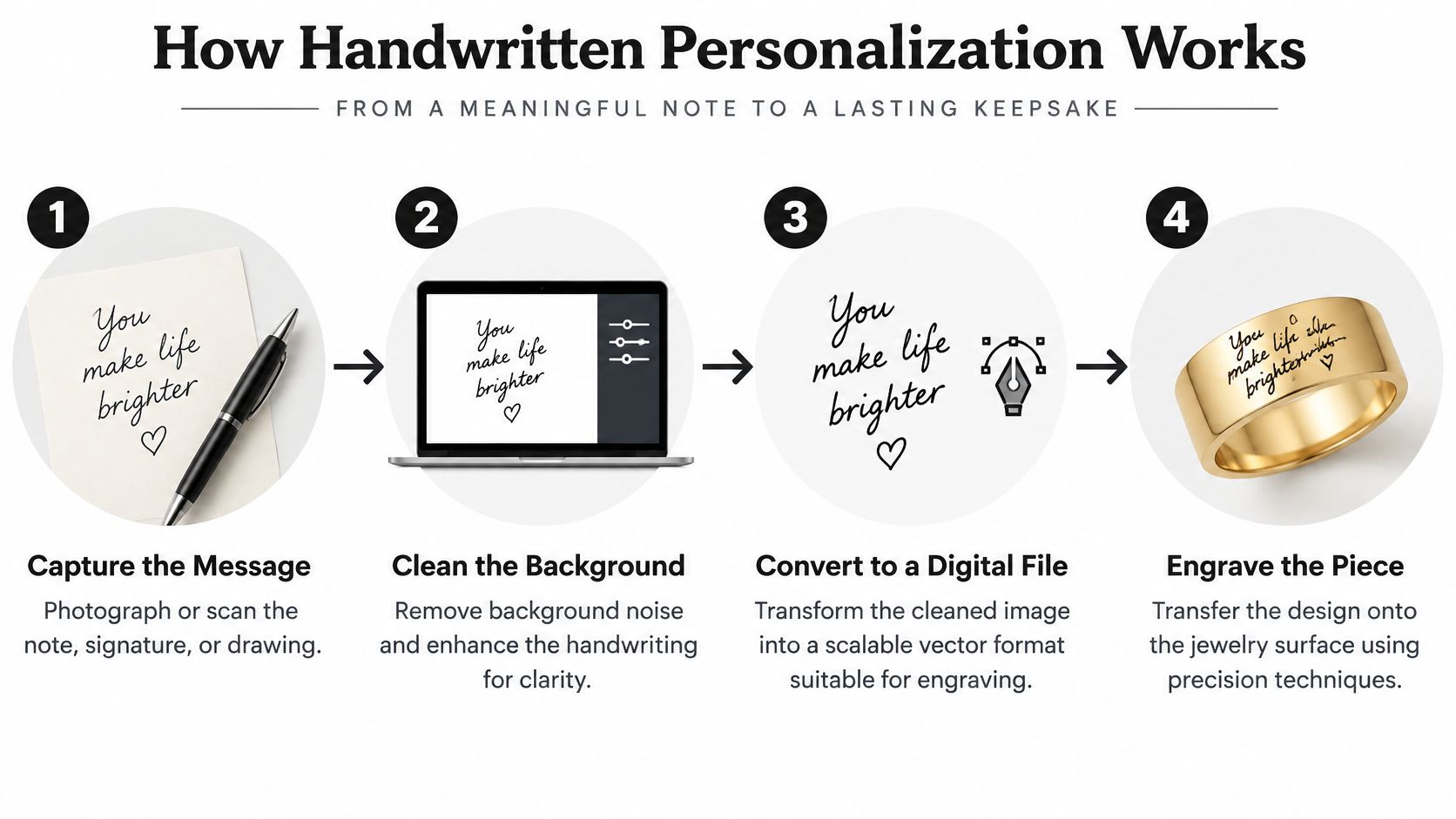
From Proof to Finished Mark
Next comes placement. A long signature might suit a horizontal bar or the inside of a bangle, while two short words fit a round charm. If you're still deciding on a format, browsing examples of personalized bracelets and other wearable layouts helps you picture how much writing a surface can hold. The jeweler checks the design at real size, because handwriting that reads well on a phone screen can crowd together at a few millimeters wide.
You then review a proof before production. Look at it as a scale test, not just a spelling check. Are the loops open? Can you tell where one letter ends and the next begins? Once you approve it, the design is reproduced on metal, most often by laser engraving.
The demand behind this is broad. The global personalized jewelry market estimate of USD 37.8 billion in 2025, projected to reach USD 58.99 billion by 2031 reflects how many buyers now want gifts tied to a specific person. Handwriting is one of the most specific options available because the visual form itself is the artifact.
Prepare Handwriting Artwork That Stays Readable
Good results start before you place the order. The clearest source image gives the jeweler the most to work with, and most disappointment traces back to a blurry or shadowed photo rather than the engraving itself.
Lay the paper flat and light it evenly. A scan is ideal, but a sharp photograph taken straight above the page works well. Avoid angling the camera, since a tilted shot stretches letters on one side. Crop close to the writing without cutting off tall strokes or underlines, and keep the proportions true to the original. High contrast helps too. Dark ink on plain, unlined paper separates cleanly from the background.
What Happens to Your File
The jeweler converts your image into clean vector paths, which are smooth outlines the engraving equipment can follow. Isolated specks and paper grain get removed during this step. Two things get checked carefully. The first is minimum stroke width, because a hairline stroke that's visible on paper may vanish when reduced. The second is spacing, since letters that nearly touch at full size can merge when small.
Research on laser marking explains why this matters. Work on Nd:YAG laser engraving of metals shows that mark quality depends on power, pulse frequency, scanning speed, and focus, and that a mark cut too deep can close the small counters inside letters like e or a. A mark that's too shallow can lose thin strokes during polishing. That's why delicate signatures sometimes need slight, controlled simplification instead of literal shrinking.
Practical rule. Judge your proof at the size the jewelry will actually be, not zoomed in on your phone.
Your Pre-Order Checklist
- Use the darkest sample. Pick the clearest version of the writing you own, not a faded photocopy.
- Photograph straight on. Flat paper, even light, no shadows across the strokes.
- Flag thin lines. Tell the jeweler if the writing was made with a fine pen or light pressure.
- Check the proof for gaps. Confirm loops stay open and adjacent letters don't touch.
- Ask what was simplified. If strokes were thickened, make sure the writing still looks like itself.
A few minutes on the source image usually saves a round of revisions later.
Compare Engraving Embossing and Casting
Three methods can put handwriting on jewelry, and they don't produce the same object. Choosing between them is less about which is best in general and more about what your artwork needs.
Engraving removes material or changes the surface to create a mark. A recessed engraving is physically cut into the metal, so the lines sit below the surface. A surface-contrast mark stays flush and reads through a color difference rather than depth. Those two behave differently over time, even though both get called engraving. Fine handwriting usually suits engraving well because the process follows detailed paths.
Embossing raises the lettering above the surrounding metal. The writing becomes something you can feel with a fingertip. Raised lines need enough width to form cleanly, so very fine or tightly looped writing can lose detail. The trade is texture and presence.
Casting forms the piece itself, or an attached element, in three-dimensional relief. Instead of marking a finished surface, the handwriting becomes part of the shape. That gives real depth, but small counters and thin connectors are harder to preserve, and the result reads more like a sculpture of the writing than a copy of it.
Handwriting Personalization Methods Compared
| Method | Surface or form | Handwriting implication | Key consideration |
|---|---|---|---|
| Engraving | Recessed cut or flush surface mark | Preserves fine strokes and exact spacing | Ask whether the mark is cut in or surface-level |
| Embossing | Lettering raised above the metal | Adds touchable texture, needs wider strokes | Tight loops may soften or fill |
| Casting | Writing formed in three-dimensional relief | Turns words into part of the object's shape | Delicate connectors may need thickening |
Viewing angle matters with all three. Recessed and raised designs catch shadows, so they often read better in changing light. Flush marks depend on contrast, which can flatten under bright, direct light. If you're weighing placement ideas, these engraving ideas for rings show how much wording different bands can hold.
Match the method to four things. Consider how complex the artwork is, whether you want flat or dimensional lettering, how much wear the piece will take, and what the jeweler's process handles well. A detailed signature points toward engraving. A short, bold word you want to feel points toward embossing or casting.
Choose Materials and Finishes for Your Piece
Metal choice is often treated as a color decision. For handwriting, it's a legibility decision too. Think of writing the same sentence with the same pen on three surfaces, matte paper, a glossy card, and textured stationery. The ink doesn't change, but the sentence looks different on each one. Metal finishes work the same way.
The base metal, finish, and any plating layer all affect how a mark appears. A polished surface reflects light sharply, which can make fine lines sparkle or disappear depending on angle. A brushed or matte finish scatters light and often gives steadier contrast. On a plated or layered piece, the visible surface isn't the same material all the way through, so wear at the surface can change how the writing reads. A piece made entirely from one precious metal doesn't have that layer boundary.
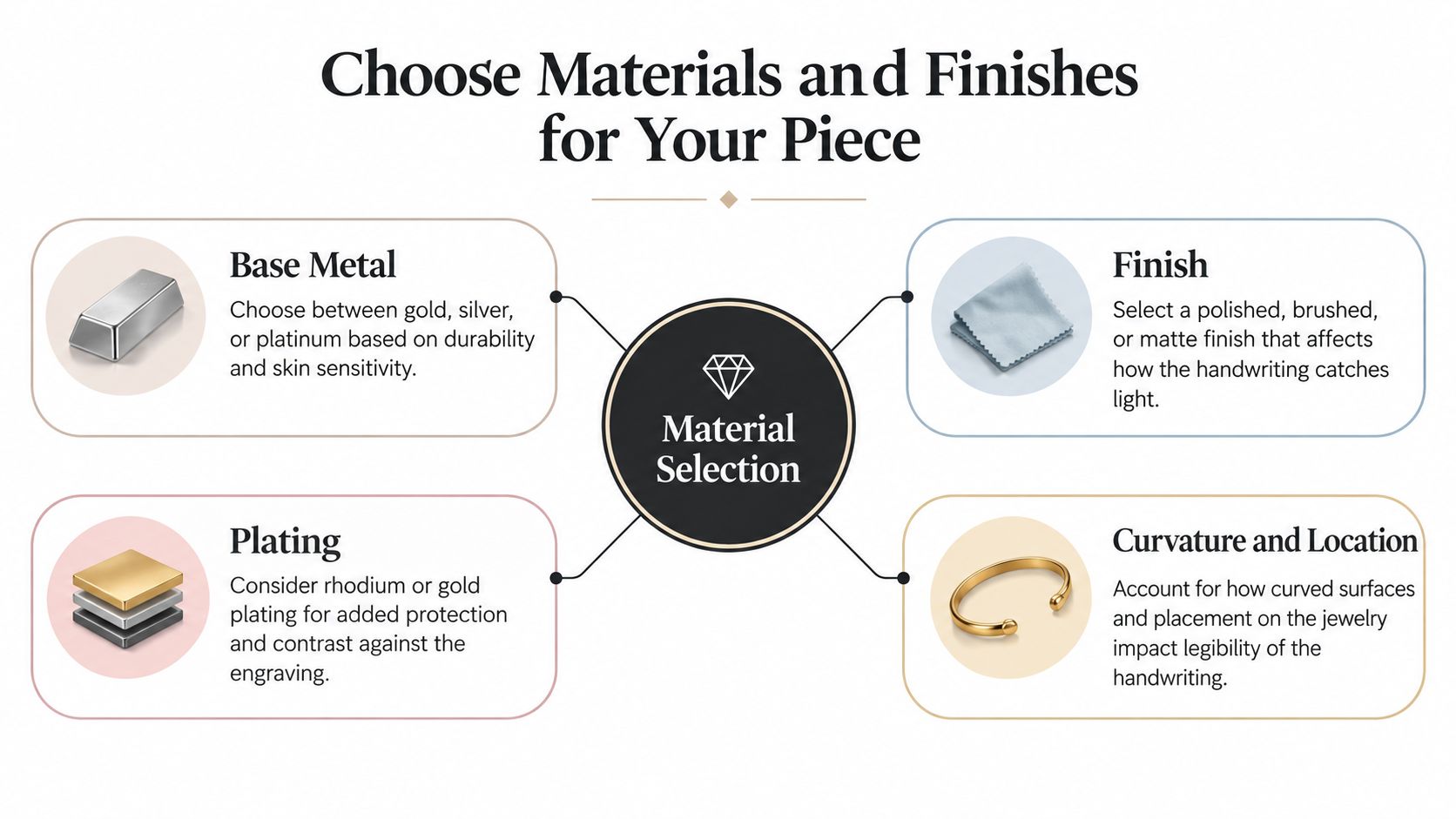
Shape and Placement Matter
Where the writing sits changes its life. Rings and bangles knock against desks, door handles, and gym equipment. Pendants and earrings mostly meet cloth and skin. So the same mark usually faces more mechanical wear on a ring than on a necklace, something worth weighing when you look at formats like a gold personalized bar necklace.
Curvature adds another wrinkle. Writing wrapped around a curved band compresses at the edges of your view, and long words may need to bend with the surface. Flat bars and discs give handwriting the most faithful proportions.
Experimental work supports asking specific questions. Research on laser engraving of steel found that engraving depth can be controlled through laser power and speed, and that surface finish and focus change the result. In plain terms, durable engraving isn't one universal specification. Before you order, confirm the base metal, the finish, and whether your mark will be recessed, raised, or surface-level. Those three answers predict more about longevity than the word engraved does.
Plan Production and Shipping Expectations
Custom jewelry doesn't move like a stocked item, and most frustration comes from expecting it to. A ready-made piece leaves a shelf. Yours has to be made, in order, after your choices are final.
The timeline usually runs in stages. Artwork preparation comes first, then proof review, then production, then quality checks, then dispatch. Your proof approval matters here. If a proof sits unanswered in your inbox for several days, the clock on the later stages hasn't started. Respond with clear approval or specific corrections so the work can move.
A Concrete Example of Custom Terms
One catalog example shows how specific these terms get. The 14k Diamond Bubble Cutout Name Nacklace from EP Fine Jewelry is personalized with a name or initials, with the name fixed to a 16 inch chain with an 18 inch extender. The lettering measures 10 mm in height, with length depending on how many letters you choose. It uses uppercase letters only, suggests a maximum of seven letters, and is made in 14k gold with diamonds.
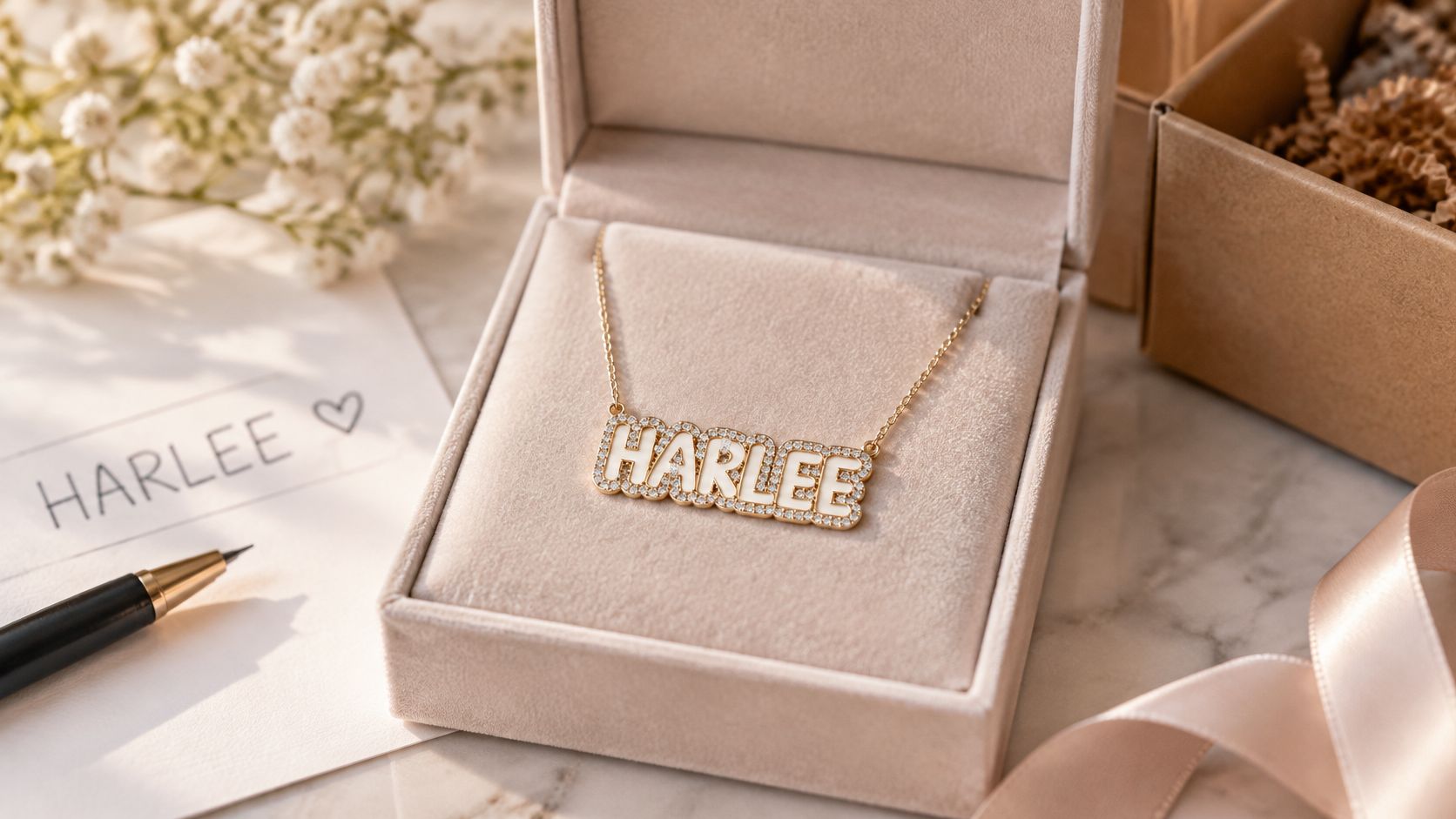
Two lines in that listing deserve your attention before ordering. It asks buyers to allow an estimated four weeks for production, and it states the product is custom and final sale. Neither is unusual for made-to-order work, but both change how you should shop. Order well before the occasion, and double-check spelling, letter count, and chain length because a final-sale piece can't be returned.
Shipping is a separate stage from production. The store states that orders of $200 qualify for free shipping, which is a checkout benefit, not a promise that production speeds up. Read the shipping and returns pages before you pay, and treat the production window and the delivery window as two blocks of time added together. If the piece is for a fixed date like a wedding or graduation, build in a buffer week for your own peace of mind.
Care for Handwriting Through Daily Wear
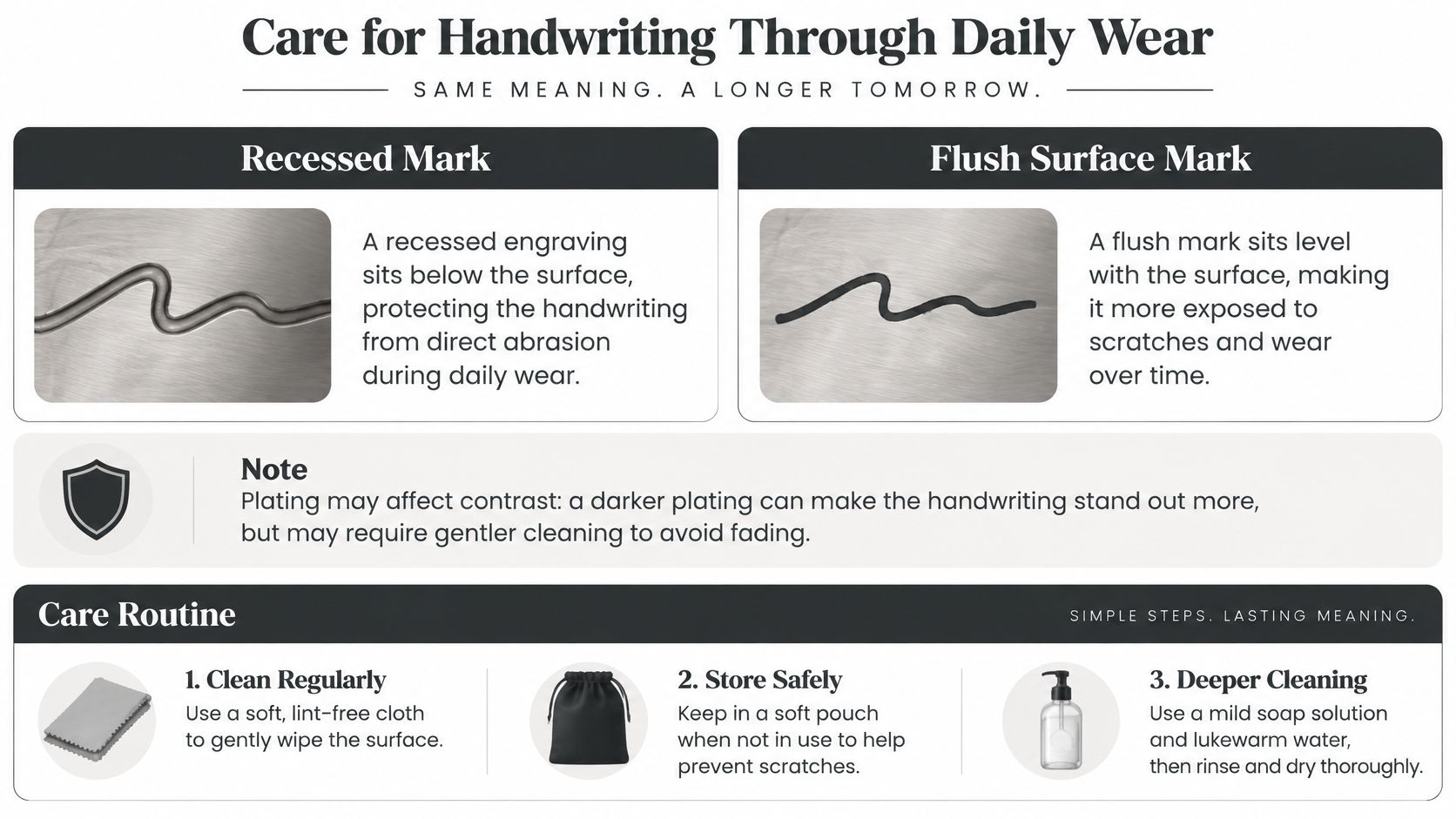
Engraved doesn't automatically mean permanent, and that surprises many gift buyers. The metal can stay perfectly intact while the contrast of fine handwriting fades, especially if the mark is shallow or flush with the surface. Care works best when it's matched to the method and material you bought.
A recessed mark sits below the surface, so everyday rubbing passes over it rather than across it. A flush surface mark has no such shelter. It's level with the metal and more sensitive to abrasion, polishing, and buildup from lotions or sunscreen. Plating adds another variable, since a surface layer that thins over time can reduce the color difference that makes writing readable, and replating may soften contrast further.
Match Care to How the Piece Is Worn
| Wearing pattern | Main risk to handwriting | Sensible habit |
|---|---|---|
| Everyday ring or bangle | Knocks, friction, frequent hand washing | Inspect monthly and remove for heavy manual work |
| Occasionally worn pendant | Tangling, perfume, storage scratches | Store flat in a pouch and put on after fragrance |
| Memorial keepsake | Over-polishing while trying to preserve it | Clean gently and rarely, handle with dry hands |
| Frequent water exposure | Surface damage from saltwater and chemicals | Remove before swimming and rinse only as advised |
Independent hands-on testing gives a directional warning here. Testing across plated, vermeil, gold-filled, and solid gold pieces found different wear behavior by material, with repeated saltwater exposure accelerating surface damage. That wasn't a standardized laboratory study, so treat it as guidance rather than a guarantee.
For routine cleaning, use a soft cloth and a mild method that suits your alloy. Don't scrub abrasive polish directly across the inscription, since that's the fastest way to blur fine strokes. Wipe off sweat and sunscreen rather than leaving it overnight. When you're unsure which products suit your metal, follow the retailer's jewelry care instructions instead of applying a universal chemical routine to every piece. Ask about inspection and repair options too, so you know what's possible before contrast becomes a problem.
Choose Handwriting Jewelry for Meaningful Gifts
The technical decisions make more sense once you picture a recipient. Different occasions call for different source material, and the right format follows from who's receiving it and how they'll wear it.
A child's drawing suits a parent or grandparent gift. The wobbly lines are the point, and a flat pendant or charm gives an irregular drawing room to sit without being squeezed around a curve. For an anniversary, a partner's signature or a line copied from a wedding card carries a private history a standard font can't fake. A short note on a pendant works well for a birthday because a few words stay legible at small size. Coordinates of a meaningful place, perhaps where a couple met, fit a bar format and read like a quiet secret. For a graduation or wedding keepsake, a date plus a brief handwritten message marks the milestone in the giver's own hand.
Why the Actual Writing Matters for Gifts
Buyers consistently treat customized pieces differently from shelf items. In one market analysis, 71% of surveyed respondents considered customized jewelry more emotionally valuable than off-the-shelf alternatives, and that same analysis puts engraving at about 28.5% of jewelry customization transactions. Handwriting pushes that emotional value further because the letter shapes belong to one person only.
That matters most for memorial gifts or for someone separated from a loved one. Preserving visible letters from a final card or an old recipe keeps a daily connection that a typed transcription loses. If you're comparing occasions and formats, these personalized jewelry gift ideas can help you match message length to piece type.
Practical Details That Support the Gift
- Start in the Personalized collection. Browsing custom-ready categories like necklaces, bracelets, rings, earrings, and charms narrows formats quickly.
- Add present-ready touches. An optional gift box at checkout and a message in the order notes field handle presentation without extra errands.
- Check support pages first. FAQs, shipping and returns policies, and care guidance answer timing and maintenance questions before they become urgent.
Your Final Decision Journey
- Identify the source. Choose the note, signature, drawing, or date with the strongest emotional tie, and capture it clearly.
- Pick the location. Match the writing's length and shape to a pendant, bar, charm, or band the recipient will wear.
- Settle the mark type. Decide whether you want it recessed, raised, or surface-level, based on detail and expected wear.
- Verify material and finish. Confirm the base metal, plating, and finish will keep the writing readable in normal light.
- Approve a scale-accurate proof. Check open loops, spacing, and any simplification at true size.
- Review the terms. Confirm production time, shipping, and any final-sale conditions before paying.
The best handwriting piece isn't the one with the most elaborate process. It's the one that preserves the intended words clearly, fits the recipient's daily life, matches what you expected when you ordered, and gets cared for realistically after delivery. When the letter shapes survive the journey from paper to metal, the piece stops being an accessory and starts being evidence of a person you can carry with you.
When you're ready to turn a saved note or signature into wearable personalized jewelry with handwriting, browse the Personalized collection and gift-ready options at EP Fine Jewelry, where you can review care guidance, shipping, and returns before you order. Bring your clearest handwriting sample, check the proof at true size, and choose the format that fits how the recipient will wear it.