
You've bought a necklace as a gift, the recipient has opened it, and one question arrives before the tissue paper has even been cleared away: can it be returned, and when will the money come back? That answer changes if the piece is personalized, made to order, an earring subject to hygiene restrictions, or a standard item that isn't the right fit.
A useful returns refunds policy should answer more than “yes” or “no.” It should tell you which rule applies, what condition the item must be in, how to start the return, who pays shipping, and what happens after the package arrives. This guide is written as a practical reference for gift buyers, personalized jewelry shoppers, and customers choosing everyday fashion pieces from EP Fine Jewelry.
Table of Contents
- Introduction to EP Fine Jewelry Returns and Refunds
- How EP Fine Jewelry Organizes Returnable Categories
- Eligibility Rules and Conditions for Returns
- Step by Step Returns and Refunds Process
- Refund Timelines Methods and Shipping Costs Explained
- Exceptions for Personalized Jewelry and Special Cases
- Related Policies and Resources for a Smooth Experience
- Quick Reference for Returns and Refunds Lookup
Introduction to EP Fine Jewelry Returns and Refunds
A birthday bracelet and a name necklace arrive in the same order. The bracelet is a standard item, while the necklace was created with the recipient's names. They may therefore follow different return rules. The bracelet can usually be assessed under ordinary change-of-mind conditions, while the personalized necklace may fall under a custom-product exception. The product's production method matters as much as its design.
That distinction also explains why retailers separate standard merchandise from pieces requiring special production or inspection. The National Retail Federation and Happy Returns return-rate summary reported substantial return activity across retail, with online purchases returning at a higher rate than overall sales. The figures provide context for category-based policies, but they do not determine whether a particular EP Fine Jewelry order qualifies for a refund.
For a gift buyer, the first practical question may be whether the purchaser or recipient receives the refund. For a personalized-order customer, the custom-product rule should be checked before the order is submitted. For someone buying a standard ring, necklace, charm, bangle, bracelet, or earring, the ordinary eligibility requirements provide the starting point.
How to use this guide
Begin with the product category. Then check its condition, timeline, and any exception that changes the normal process. This sequence works like a decision path: identifying the category first prevents a standard-item rule from being applied to a personalized piece.
Use these signposts:
- Category first: Confirm whether the item is personalized or standard.
- Condition next: Review wear, packaging, proof of purchase, and any hygiene requirement.
- Timeline after that: Keep the return-initiation deadline separate from the time needed to process a refund.
- Special case review: Read the personalized and gift guidance when someone else placed the order.
- Self-service help: The EP Fine Jewelry about page provides brand context, while the store's FAQ and Jewelry Care resources can help with ownership and maintenance questions.
A simple example shows why this order matters. If a gift recipient dislikes the style, the standard change-of-mind rule may be relevant. If the item carries selected names or other custom details, the personalized exception must be checked instead. Before purchasing, confirm the applicable rule, refund method, shipping treatment, and exception language.
How EP Fine Jewelry Organizes Returnable Categories
The catalog becomes easier to understand when it's divided into personalized collection and standard categories. That division isn't just a browsing convenience. Personalization can change whether a change-of-mind return is available because the item may have been produced for one customer's specifications.
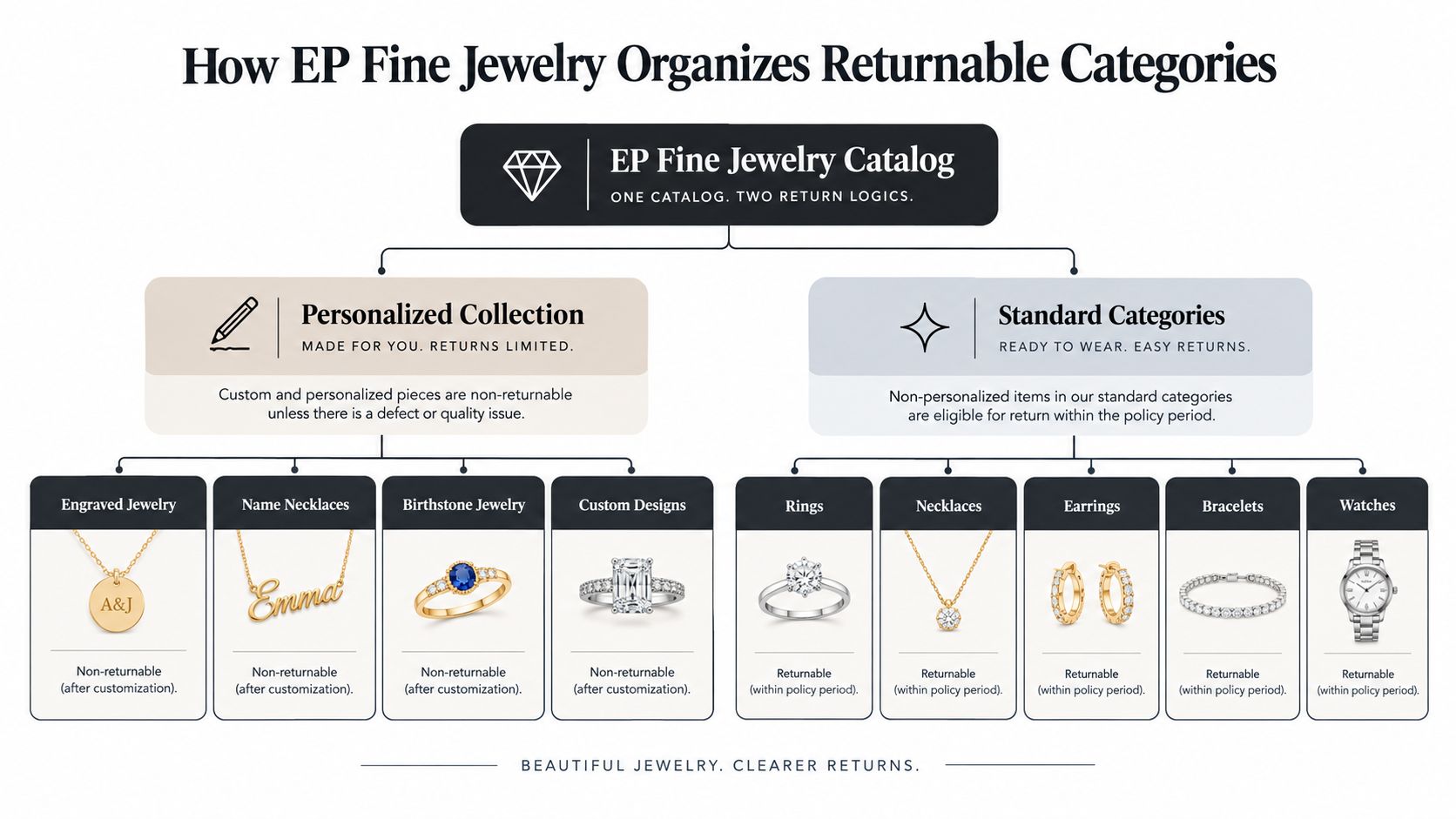
Personalized collection
A personalized item includes customer-selected details such as names or other custom specifications. For example, a necklace created with two names is not evaluated in the same way as an uncustomized necklace sitting in a standard collection. If the buyer changes their mind because the recipient prefers another style, the personalized exception may apply. If the piece is faulty or not as described, that is a different issue and may still require a remedy under applicable consumer law.
Customers considering this category can review personalized bracelet guidance before ordering. The key question is whether the product was made to the customer's specifications, not whether it happens to be worn as a gift.
Standard categories
Standard products generally follow the ordinary return logic, subject to the item's condition, applicable time window, proof of purchase, packaging, and any product-specific restrictions.
| Catalog category | Standard example | Return question |
|---|---|---|
| Charm necklaces and charms | A non-custom charm necklace | Is it unworn, complete, and within the applicable window? |
| Bangles and bracelets | A standard bangle selected from the catalog | Does it meet condition and packaging requirements? |
| Necklaces | A non-personalized necklace | Is the request change of mind or a fault claim? |
| Rings | A standard ring in the selected size | Is the ring unworn and supported by purchase information? |
| Earrings | Standard studs or hoops | Has the hygiene seal been opened, if one applies? |
The optional gift box and order notes need separate attention. A gift box is an add-on, not the same thing as the jewelry item, while an order note can communicate a gift message or handling instruction without changing the product's return classification. If the recipient is unsure what was purchased, the order confirmation or purchaser's details will usually be important when starting a request.
Eligibility Rules and Conditions for Returns
A gift recipient opens an EP Fine Jewelry package and discovers that the ring is the wrong size, the necklace has engraving, or the earrings cannot be returned after the hygiene seal is opened. The correct outcome depends on the product category and the reason for the request. Classify the item first, then check the conditions that apply.
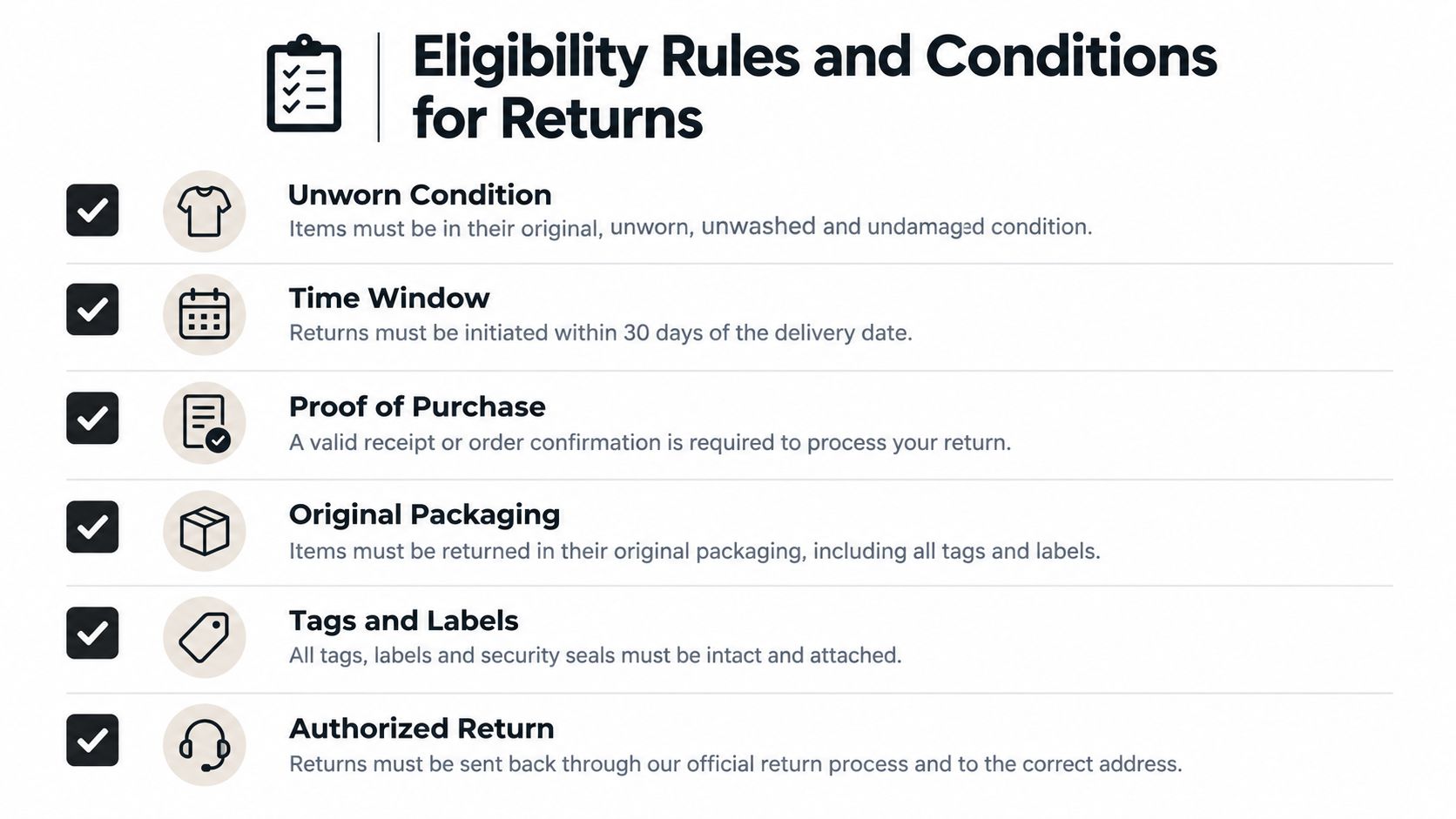
The return checklist
- Confirm the time window: Check the applicable deadline before sending the item. A request made after the stated window may not qualify as a change-of-mind return.
- Check the product type: A standard ring and a personalized name necklace can have different outcomes. Read the personalized-product exception before applying the standard rule.
- Keep the item unworn: Briefly trying on a standard necklace for fit may need to be assessed against the policy wording. Visible wear, damage, or alteration can affect eligibility.
- Gather proof of purchase: Use the order confirmation, purchaser information, or another accepted record. A gift recipient should ask the purchaser for order details instead of sending an unidentified package.
- Preserve original packaging: Keep the jewelry, presentation materials, tags, and included components together. Missing packaging can complicate inspection or affect the result if the policy requires it.
- Review hygiene restrictions: Earrings may have extra limits because opened hygiene-sealed goods can be excluded from change-of-mind returns. Keep the seal closed until the item is accepted.
These rules work like a set of gates. The time window is one gate, item condition another, and proof of purchase a third. Passing one does not automatically pass the others.
Change of mind versus a product problem
A change-of-mind return covers preference-based requests, such as choosing the wrong standard style, deciding that a gift is unsuitable, or finding that a standard ring does not meet expectations. Whether it qualifies depends on the written policy, category, condition, and timing.
A fault, misdescription, or fitness problem concerns the product itself. Under the UK and EU-style distance-selling framework described by the UK government's returns and refunds guidance, personalized goods can be excluded from a change-of-mind right. That exception does not remove the need for a remedy when the item is faulty, not as described, or not fit for purpose.
Practical rule: Apply the personalized-product exception to preference-based returns, not to genuine fault claims. First identify whether the problem is the customer's preference or the product's performance.
Gift requests need an accurate reason. “The recipient changed their mind” points to a different policy route than “the engraving does not match the order.” That distinction guides the review and shows which purchase records or product evidence may be needed.
Step by Step Returns and Refunds Process
Eligibility tells you whether a request may qualify. The process tells you what to do next. Moving through each stage in order helps prevent avoidable delays, especially when the purchaser and recipient are different people.
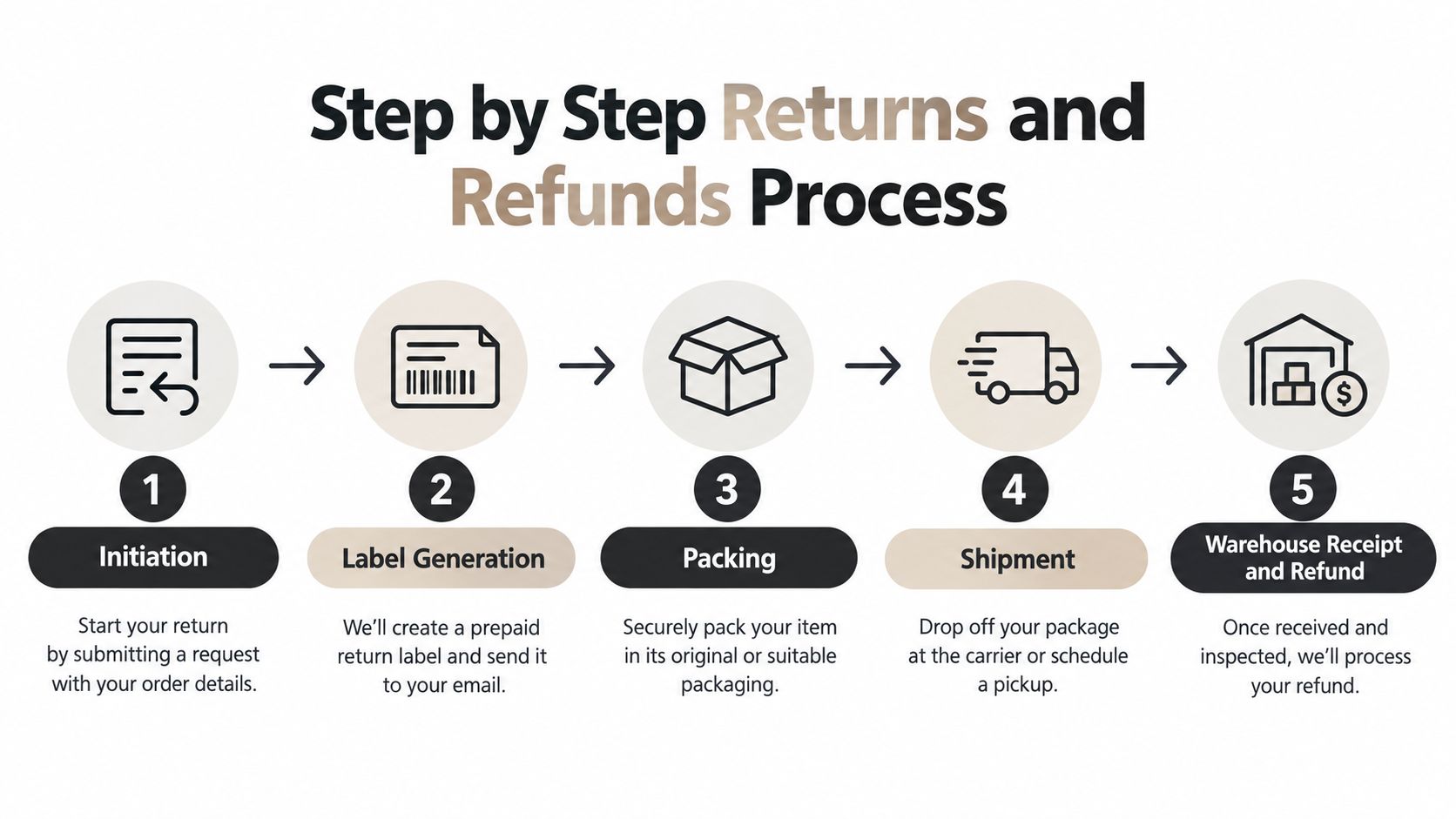
Start with initiation
Submit the return request through the approved customer-service route and include the order number, product name, reason, and whether the item is standard or personalized. A gift recipient should explain that the item was received as a gift and provide the purchaser's information where available.
The request date matters. It establishes when the process began and allows the business to compare the request with the applicable return window.
Generate the label and pack carefully
After initiation, the return label should be generated through the approved process. Industry guidance for well-run returns operations targets same-day to 24-hour label generation after initiation, according to Corso's returns-processing benchmarks.
Pack the jewelry securely in its original presentation materials where possible. Don't place loose pieces in an oversized package without protection. Include the required order information, but don't put personal notes or unrelated items inside the parcel.
Ship and retain tracking
Use the provided label or the method specified by the return instructions. Keep the tracking number and shipment receipt until the refund or final resolution appears. Tracking creates a record of handoff and helps separate a carrier delay from a warehouse-processing delay.
Receipt, inspection, and resolution
The warehouse records receipt, checks the item's condition and completeness, and determines whether the requested refund, exchange, replacement, or other outcome applies. Personalized jewelry may require more exception handling because the team must confirm the custom details and distinguish a production issue from a change-of-mind request.
The same operational guidance targets an end-to-end cycle of about seven to ten business days from initiation to resolution, with the customer seeing the refund within two to three days after warehouse receipt, as stated in the Corso source linked above. These are operational benchmarks, not a promise that every request will follow the same path.
A short process video can help customers visualize the handoffs:
For common questions about order details, gifts, and return requests, use the EP Fine Jewelry FAQ.
Refund Timelines Methods and Shipping Costs Explained
A refund follows several clocks. The return deadline controls when a request can begin. Transit time covers the parcel's journey, inspection starts after receipt, and the payment provider may need additional time to post the credit. Treating these stages separately makes the expected timing easier to understand.
EP Fine Jewelry accepts major payment methods, including American Express, Apple Pay, Discover, Mastercard, Shop Pay, and Visa. Unless the approved outcome is an exchange or store credit, the refund generally follows the original payment route. Gift buyers should check who paid for the order, because that person's payment method may receive the refund even when someone else sends the return.
For UK cancellation rights, the retailer's refund deadline is generally measured from receipt of the returned item after cancellation is exercised. Standard delivery charges may be refundable, while a premium delivery upgrade may be excluded. U.S. treatment differs because there is no general federal requirement for returns of non-defective merchandise. The retailer's published terms and applicable state rules therefore determine the result.
A made-to-order example is the 14k Multi Name Necklace With Pave &. Its catalog description specifies two names with a pave ampersand, a 16-inch chain, and 14K gold and diamonds. Production and delivery require 3-5 weeks. Since the piece is both personalized and made to order, the buyer should review the custom-product exception before purchase rather than apply the standard-item timeline.
Refund outcomes by scenario
| Scenario | Refund Method | Timeline After Receipt | Shipping Refund |
|---|---|---|---|
| Eligible standard item, approved after inspection | Original payment method, where applicable | Use the published processing expectation, then allow payment-posting time | Depends on the policy and jurisdiction |
| Personalized item with a genuine fault | Refund, replacement, or another statutory remedy, depending on the issue and applicable law | Confirm with customer service after inspection | Addressed under the applicable remedy and law |
| Change-of-mind request for an exempt personalized item | May be declined or handled under a stated alternative | Confirm before shipping | Do not assume shipping is refundable |
| Eligible gift return | Refund or gift-related credit, according to the purchase arrangement | Begins after receipt and inspection | Depends on the applicable terms |
| Premium shipping upgrade | Product refund may be separate from delivery-charge treatment | Delivery charges may be assessed separately | Standard delivery may be refundable, while the premium upgrade may not be |
A partial refund can result when the product qualifies but a separate service fee or premium delivery charge does not. That distinction should be clear before checkout, particularly for gifts, where the recipient may not know which charges were selected by the purchaser.
Exceptions for Personalized Jewelry and Special Cases
A gift recipient may love the bracelet but dislike the engraved name, while another customer may receive the wrong engraving or a clasp that does not fasten. These requests need different handling. The first concerns a change of preference. The second may indicate a fault or misdescription.
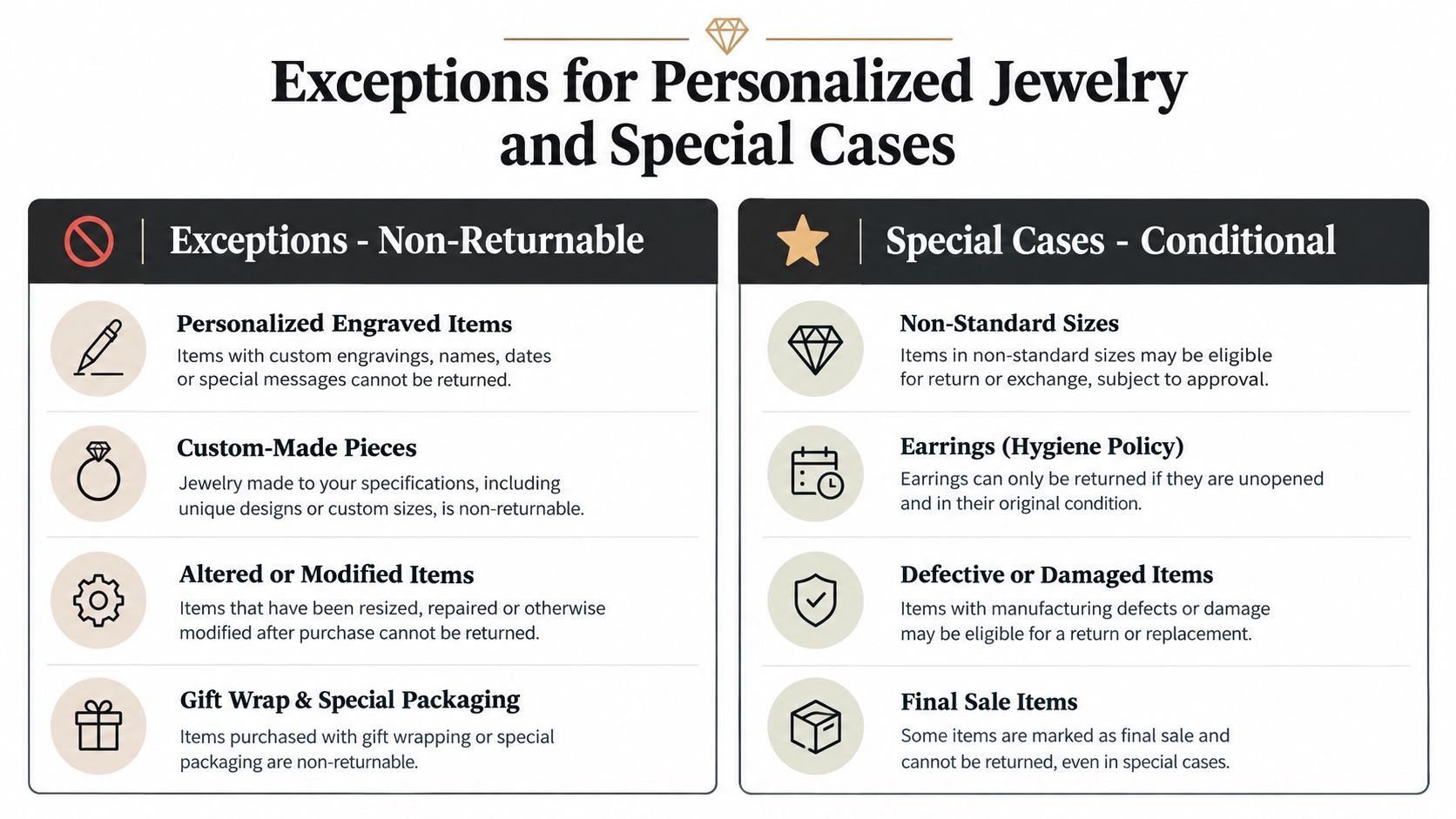
Personalized and made-to-order pieces
Items made to a customer's specifications or clearly personalized can be excluded from the ordinary change-of-mind right under the UK and EU-style framework described in the UK government returns guidance. For EP Fine Jewelry, this distinction may apply to name jewelry, engraved pieces, and other products created from the buyer's selections.
The key question is whether the request concerns the chosen design or the product's compliance with the order. If a buyer orders a personalized bracelet and later wishes they had selected another color, the item may not qualify for a discretionary refund. If the bracelet carries the wrong name because it does not match the confirmed details, report the matter as a possible fault or misdescription instead.
Before submitting a gift order, review EP Fine Jewelry's information about removing personalized products. This check helps prevent confusion when the recipient did not choose the wording, color, or other custom details.
Earrings and hygiene-sealed products
Opened hygiene-sealed earrings may be excluded from change-of-mind returns. The seal should remain intact while the recipient decides whether to keep the item. Removing it for inspection can affect eligibility.
A fault, delivery damage, or material difference from the order is a separate issue. Describe the specific problem rather than filing a generic preference return. Hygiene restrictions do not remove remedies for an item that fails to match the order or applicable consumer standards.
Gift boxes and final-sale markings
Review an optional gift box as its own checkout add-on. The result for a missing or unwanted box may differ from the result for the jewelry, so the order confirmation should show which products and extras were purchased.
Items marked final sale also require review before payment. The marking can limit discretionary returns, but it should not conceal a legitimate fault or misdescription claim.
An exchange may suit a customer who wants a different eligible item rather than a refund. The UPS returns guidance reports that 66.1% of shoppers said they'd likely accept an exchange instead of a refund when offered at the return point. Any exchange still needs clear rules for eligibility, replacement selection, and shipping.
Related Policies and Resources for a Smooth Experience
Many jewelry returns begin before the parcel leaves the warehouse. A ring may feel different from what the buyer expected, a necklace length may not suit the recipient, or a gift may arrive without the message the purchaser intended. Product information, shipping terms, care instructions, and checkout details work together to reduce those surprises.
Start with the product page and category navigation. Review measurements, materials, personalization fields, and any production information before placing an order. For a made-to-order item, production timing is part of the purchase decision, not an afterthought.
Resources that support better decisions
- Shipping policy: Check delivery methods, processing expectations, and whether an order qualifies for the store's $200 free-shipping threshold.
- Jewelry Care guidance: Follow maintenance instructions to reduce avoidable damage and preserve the condition of pieces that may later need inspection.
- FAQ support: Use the question-and-answer resource for common checkout, gifting, and order-help topics.
- Gift options and order notes: Add the optional gift box or a gift message when appropriate, and confirm that the purchaser's contact details remain available to the recipient.
- Terms and service rules: Review the EP Fine Jewelry terms of service alongside the returns and shipping pages when a request involves a special condition.
- Store communications: Instagram and the newsletter can provide product and policy updates, but the written policy connected to the order should control the return decision.
A care page can't turn an ineligible personalized item into a returnable one. It can, however, help a customer avoid tarnish, scratches, or other preventable condition issues. Likewise, a gift message doesn't change who paid for the order, so the recipient should keep the purchaser involved when a refund is requested.
Quick Reference for Returns and Refunds Lookup
Use this decision guide before opening a return request. It separates product category, reason, and next action, which are the three details most likely to change the result.
Category lookup
| Product category | First question | Likely next step |
|---|---|---|
| Standard charm, charm necklace, bangle, bracelet, necklace, or ring | Is it unworn, complete, and within the applicable window? | Check proof of purchase and start the standard return request |
| Standard earrings | Is any hygiene seal still intact? | Review hygiene conditions before opening or shipping |
| Personalized jewelry | Was it made to the customer's specifications? | Read the personalized exception before requesting a change-of-mind return |
| Personalized jewelry with a fault | Does the product differ from the order or fail to meet its description? | Report the fault or misdescription for review |
| Gift purchase | Can the purchaser and order be identified? | Gather order details and clarify where the refund should go |
| Gift box add-on | Is the request about the add-on or the jewelry? | Separate the items when describing the return |
Timeline checklist
- Before shipping: Confirm category, reason, condition, packaging, and proof of purchase.
- At initiation: Submit the request with complete order information.
- After approval: Follow the label instructions and pack the piece securely.
- At shipment: Save tracking until the matter is resolved.
- After receipt: Allow inspection and resolution under the applicable workflow.
- After approval: Watch the original payment method or approved credit route for the refund posting.
Industry guidance targets same-day to 24-hour label generation and a seven to ten business day end-to-end process, with refunds visible within two to three days after warehouse receipt, but those figures are operational benchmarks rather than a substitute for the applicable policy.
Decision matrix
| Your situation | What to do |
|---|---|
| Standard item, change of mind | Check the ordinary return conditions and deadline |
| Personalized item, change of mind | Review the custom exception before sending it |
| Any item, suspected fault | Describe the defect, incorrect personalization, damage, or misdescription specifically |
| Gift recipient seeking help | Ask the purchaser for the order details and payment information |
| Earring with opened hygiene seal | Confirm whether the product is excluded before initiating a discretionary return |
| Missing packaging | Disclose it rather than assuming the package will be accepted without review |
For legal or cross-border questions, read the full terms and the destination market's consumer rules. A customer with an uncertain case should contact EP Fine Jewelry before shipping, especially when the order is personalized, made to order, gifted, or marked final sale.
Choose your jewelry category carefully, review the applicable exceptions before ordering, and keep the order details available for any future request. Visit EP Fine Jewelry to explore personalized and standard jewelry, review product information, and make a purchase with the returns and refunds mechanics clearly in mind.