
You've found the jewelry, but the gift still doesn't feel finished. Maybe it's a delicate pendant that could tangle in tissue paper, a ring that needs to sit upright for the reveal, or a small pair of earrings that might disappear inside an oversized container. The right gift box packaging solves those practical problems while making the handoff feel personal.
For a jewelry gift, the box is more than a container. It protects the piece, controls the unboxing moment, and gives the recipient a visual cue that something meaningful is waiting inside. This guide will help you choose the right structure, insert, size, material, finish, and sustainability features without guessing.
Table of Contents
- Why the Box Around the Jewelry Matters
- The Anatomy of a Gift Box
- Common Materials and How They Feel
- Choosing the Right Size and Format for Each Piece
- Customization That Makes a Gift Feel Personal
- Sustainability Without Losing the Premium Feel
- How to Pick the Perfect Gift Box Packaging
- Wrapping Up the Gifting Experience
Why the Box Around the Jewelry Matters
At dinner, you slide a small box across the table. The recipient pauses before opening it, turns the lid in their hands, and lifts it slowly. That short pause creates anticipation, but the box has also been doing quiet work before the gift ever reaches the table.
First, it protects the jewelry during handling. A ring can rub against a hard surface, earrings can shift into each other, and a necklace chain can knot when it moves freely. A fitted insert keeps the piece in place instead of leaving it to slide around inside a box.
Second, the box frames the jewelry. A pendant placed in a shallow tray with a neat notch looks considered. The same pendant dropped into a deep, empty box may appear smaller than it is. Good packaging gives the eye a clear path to the piece, much like a picture frame helps the viewer focus on the artwork.
Four quiet jobs of a jewelry box
- Protection: The lining and insert reduce scratching, tangling, and movement during the handoff or delivery.
- Presentation: The interior positions the jewelry so the recipient sees the shape, finish, and details immediately.
- Emotional signal: A carefully chosen box communicates preparation and attention, even before the recipient touches the jewelry.
- Longer-term use: A sturdy box can remain on a dresser or in a drawer as a place to store the piece between wears.
Storage matters after the celebration, too. A recipient who keeps jewelry separated and protected is less likely to misplace a small item or allow chains to knot. Practical guidance on keeping pieces organized while away from home is available in this jewelry storage guide for traveling.
A useful test: Open the box as if you're the recipient. Does the jewelry stay centered, look easy to remove, and feel protected without requiring extra explanation?
The global category shows why these choices matter beyond one gift. The global gift packaging market was valued at USD 29.13 billion in 2025 and is projected to reach USD 44.93 billion by 2034, at a 4.99% CAGR, according to Fortune Business Insights' gift packaging market overview. Gift box packaging has become a substantial category, not a decorative afterthought. The decisions ahead are simple once you connect the box to the jewelry's shape, the recipient's expectations, and the way the package will travel.
The Anatomy of a Gift Box
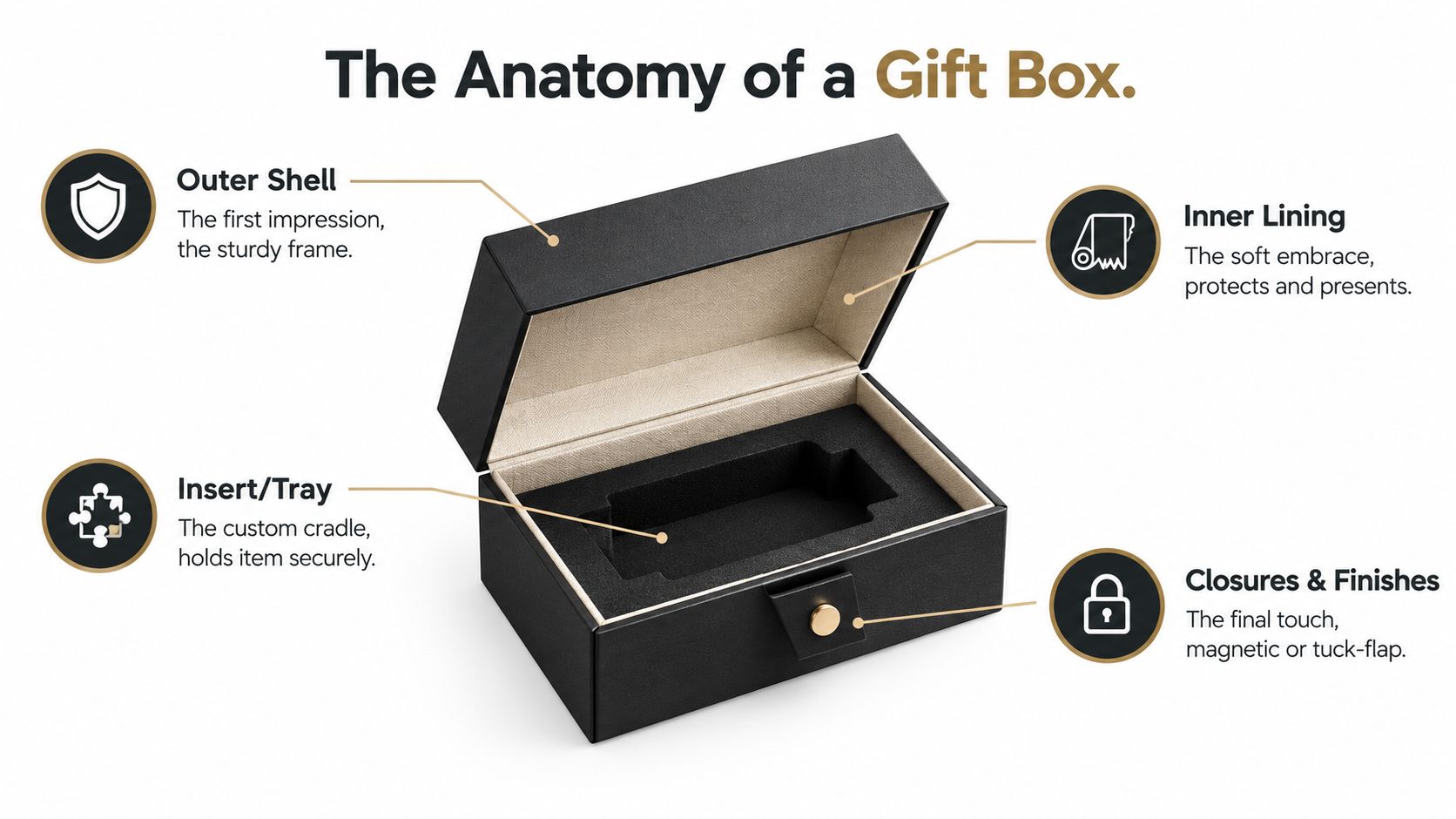
A gift box has several parts, and each one affects the experience. Think of the outer shell as the cover of a book. A rigid setup box feels like a hardcover. It holds its shape, has a firm presence, and usually creates a more substantial first impression. A folding carton is closer to a paperback. It's lighter, easier to store, and often easier to recycle, but it may feel less weighty in the hand.
Start with the outside
The lid controls how the package opens. A hinged magnetic lid behaves like a small cabinet door. It opens smoothly and closes with a satisfying click. A lift-off lid creates a slower ritual, similar to opening a traditional ring box at a jewelry counter. A tuck flap is more direct and compact, which can be useful when storage and shipping space matter more than ceremony.
The exterior can also include a sleeve, belly band, or printed panel. These layers identify the brand or occasion without changing the core structure. A sleeve can make a simple box feel seasonal, while a plain box with a carefully designed label can remain suitable for birthdays, anniversaries, and everyday gifting.
Then look inside
The insert is the box's custom cradle. A ring slot works like a small pillow that holds the band upright. A slotted tray gives earrings or a pendant a defined place to rest. A chain may need a notch, clip, or paper fold that keeps it from moving freely. For a larger or more delicate piece, foam, molded pulp, or folded paper can provide a closer fit than loose fill.
A statement design such as the Two Finger Twist Ring, which fits across two fingers and is offered in size 6/7 and size 7/8, needs an insert that respects its broader shape rather than forcing it into a narrow single-ring slot.
Ribbon pulls, tissue wraps, and small care cards add different kinds of value. A ribbon pull makes removal easier, tissue adds a layer of suspense, and a care card gives the recipient useful ownership information. You don't need every layer. Removing one changes the rhythm, so choose the combination that suits the jewelry and the occasion.
Common Materials and How They Feel
Material changes both the hand-feel and the practical behavior of gift box packaging. Paperboard and greyboard are common starting points because they print cleanly, form crisp edges, and can often enter paper recycling when the construction avoids incompatible coatings and attachments. They suit a simple pendant, a pair of studs, or a small everyday gift.
Rigid chipboard wrapped in art paper feels more substantial. The board provides a firm shell, while the wrap supplies color, texture, or a printed pattern. This format works well when you want the recipient to keep the box, but it also uses more material than a basic folding carton. A custom item such as the Pave Script Name Ring, made from 18k gold plated silver and CZ with a 5mm script design, benefits from an interior that presents its detail without crowding the ring.
Velvet and suede flocked coverings feel warm, traditional, and soft against the jewelry. Satin-wrapped boxes look smoother and more contemporary, but the lining still needs to hold the piece securely. A gold-plated pendant may sit beautifully on a cream flocked pillow, while a stainless steel chain may be more practical in a brushed metal tin if the recipient travels often.
Gift box packaging materials compared
| Material | Feel & Look | Protection | Typical Cost | Recyclability |
|---|---|---|---|---|
| Paperboard | Crisp, light, printable | Suitable for lightweight pieces with a fitted insert | Lower | Often favorable when free of mixed materials |
| Greyboard | Firm and structured | Better rigidity than thin paperboard | Moderate | Depends on wraps, coatings, and adhesives |
| Rigid chipboard with art paper | Weighty, polished, premium | Strong shell with room for custom inserts | Higher | More difficult when heavily wrapped or laminated |
| Velvet or suede flocking | Soft, classic, tactile | Cushions surfaces and supports presentation | Moderate to higher | Usually less straightforward because of mixed components |
| Satin wrap | Sleek and smooth | Depends heavily on the inner tray | Moderate to higher | Varies with fabric, backing, and adhesive |
| Metal tin | Durable and reusable | Useful for travel and sturdy pieces | Moderate | Metal may be recyclable, but the full package must be checked |
| Acrylic | Clear, modern, display-oriented | Rigid but may scratch or show fingerprints | Moderate to higher | Often less convenient than paper-based formats |
Acrylic and metal can create a memorable display, but their added weight and mixed-material construction may complicate disposal and shipping. The right choice depends on whether your priority is soft presentation, rigid protection, repeat use, or simpler recycling.
Choosing the Right Size and Format for Each Piece
The jewelry's shape should decide the box format, not the other way around. A ring needs a narrow, supportive slot. A pendant needs length for the chain and enough depth for the central piece. Earrings need separation, while a set benefits from a layout that lets the recipient understand the collection at a glance.
Match the format to the jewelry
| Jewelry Type | Recommended Box Format | Insert Style | Typical Dimensions |
|---|---|---|---|
| Ring | Compact lift-off or hinged ring box | Upright slot with a soft cushion | Sized closely around the ring and insert |
| Pendant | Longer, shallow box | Notch, clip, or slotted tray for the chain | Long enough to keep the chain arranged |
| Stud earrings | Small double-cavity box | Two separate holes or a shaped pad | Compact, with enough depth for posts |
| Hoops or drop earrings | Narrow vertical box | Foam riser or hanging card | Tall enough to prevent bending or compression |
| Bracelet | Long, shallow box | Cushion, channel, or wraparound form | Long enough for the bracelet to rest without folding |
| Jewelry set | Layered or magnetic box | Separate tray or divided insert | Large enough to show each piece without crowding |
“Typical dimensions” should be treated as a fit question, not a universal measurement. The box must accommodate the actual item, its insert, and any care card without creating empty space that lets the jewelry move.
An oversized box can make a small piece look lost and gives it room to slide. An undersized box can press against a delicate chain or distort the way earrings sit. The best fit leaves enough clearance to remove the piece easily, but not so much that the insert has to compensate with loose padding.
Make a quick mental sketch
Before buying a standard box, picture the jewelry from above. Where does the chain extend? Which part is widest? Does the item need to stand upright, lie flat, or hang from a card? That sketch usually reveals whether a standard ring slot, shallow pendant tray, or divided earring insert will work.
Multiple pieces need extra care. A cross partition can change vibration and impact performance inside a box. One packaging study found that a cross partition delivered 10.7% less vibration than a square partition and withstood 9.6% higher vibration levels than the square design, as reported in this corrugated-board partition study. For a gift set, the divider pattern isn't merely visual. It influences how forces move through the package.
Customization That Makes a Gift Feel Personal
Customization works best when it supports a specific moment. A name or short message on the lid can make an anniversary gift feel private. A hand-tied ribbon can suit a graduation or birthday. A printed interior liner can add a pattern, date, or personal note that appears only after the lid opens.
Foil stamping creates contrast and catches the light, but it doesn't need to cover the entire surface. A small monogram on a matte lid often feels more deliberate than several competing finishes. Debossing creates a quieter result by pressing the design into the material, which can suit a minimal or modern presentation.
Choose the feature before the extras
- A message on the lid works when the box itself should carry the emotional cue.
- A ribbon adds a tactile opening gesture and can introduce color without changing the box structure.
- An interior note keeps the exterior understated while making the reveal more personal.
- A magnetic closure emphasizes the opening and closing action.
- A care card gives the recipient practical information they can use after the occasion.
- A thank-you card makes more sense when the gift is connected to a shared event or personal message.
The simplest rule is often the strongest: choose one prominent custom feature, then let the rest support it. A foil name, patterned liner, satin ribbon, and metallic sticker on the same small box can compete for attention. The recipient should notice the jewelry first, then discover the thoughtful detail.
Personalized jewelry and personalized packaging don't have to repeat the same message. If the piece already carries a name, date, or symbol, a quiet box with a care note may create better balance. For ideas on matching the jewelry to the occasion, browse this guide to personalized jewelry gifts.
Sustainability Without Losing the Premium Feel
A premium box doesn't need to be glossy, oversized, or covered in mixed materials. Recycled paperboard with a matte finish can feel smooth and intentional. Soy-based inks, water-based adhesives, and undyed cotton ribbons can support a paper-first approach, provided the finished construction is assessed as a whole.
Recyclability has become a particularly important consumer signal. McKinsey's 2025 global packaging survey identifies recyclability as the top sustainability attribute across countries, while recyclable, recycled-content, and reusable features rank among the top four circular traits in almost every country surveyed. The same research reports that 40% to 80% of consumers across countries are willing to pay more for sustainable packaging, although price and perceived value still strongly shape purchases.
Keep the luxury cue tactile
Texture can replace excess. A kraft-finish box with clean typography and a simple ribbon can feel thoughtful and current. Embossing or debossing adds depth without requiring plastic lamination. A refillable drawer box can also make sense for someone who expects to store jewelry in it repeatedly.
Ask suppliers direct questions before accepting an environmental claim:
- Material: Is the box made from one main material or several bonded layers?
- Finish: Does the surface use a plastic laminate, glitter, or a coating that affects recycling?
- Insert: Can the tray be removed and sorted separately?
- Adhesive: Does the construction rely on a difficult-to-separate attachment?
- End of life: What should the recipient do with each component locally?
More recycled content isn't automatically better if the box becomes flimsy or the fit worsens. Bulky compostable materials may also compromise precision. Premium sustainability means balancing appearance, protection, material simplicity, and honest disposal guidance.
A reusable cotton element, such as the personalized cotton shopper, can extend the usefulness of the gifting presentation beyond the first opening. It should complement the box rather than add another unnecessary layer.
How to Pick the Perfect Gift Box Packaging
Start with the item, not the color. A beautiful box with the wrong insert still creates a poor experience, while a simple box that holds the jewelry securely can feel polished and considerate.
Follow the decision path
- Identify the piece. Decide whether you're giving a ring, pendant, bracelet, earrings, or a set.
- Check the movement. Ask whether the jewelry needs to stand upright, lie flat, hang from a card, or remain separated from another piece.
- Match the insert. Choose a ring slot, pendant notch, divided tray, soft pad, molded cradle, or cushion that fits the shape.
- Choose the outer format. Use a compact box for a single piece and a layered or divided format for multiple items.
- Select the material. Consider the recipient's style, whether they'll keep the box, and how easily the components can be sorted after use.
- Add one personal detail. A message card, ribbon, monogram, or textured finish is usually enough.
- Check the handoff. Open and close the package once. The jewelry should remain centered and easy to lift.
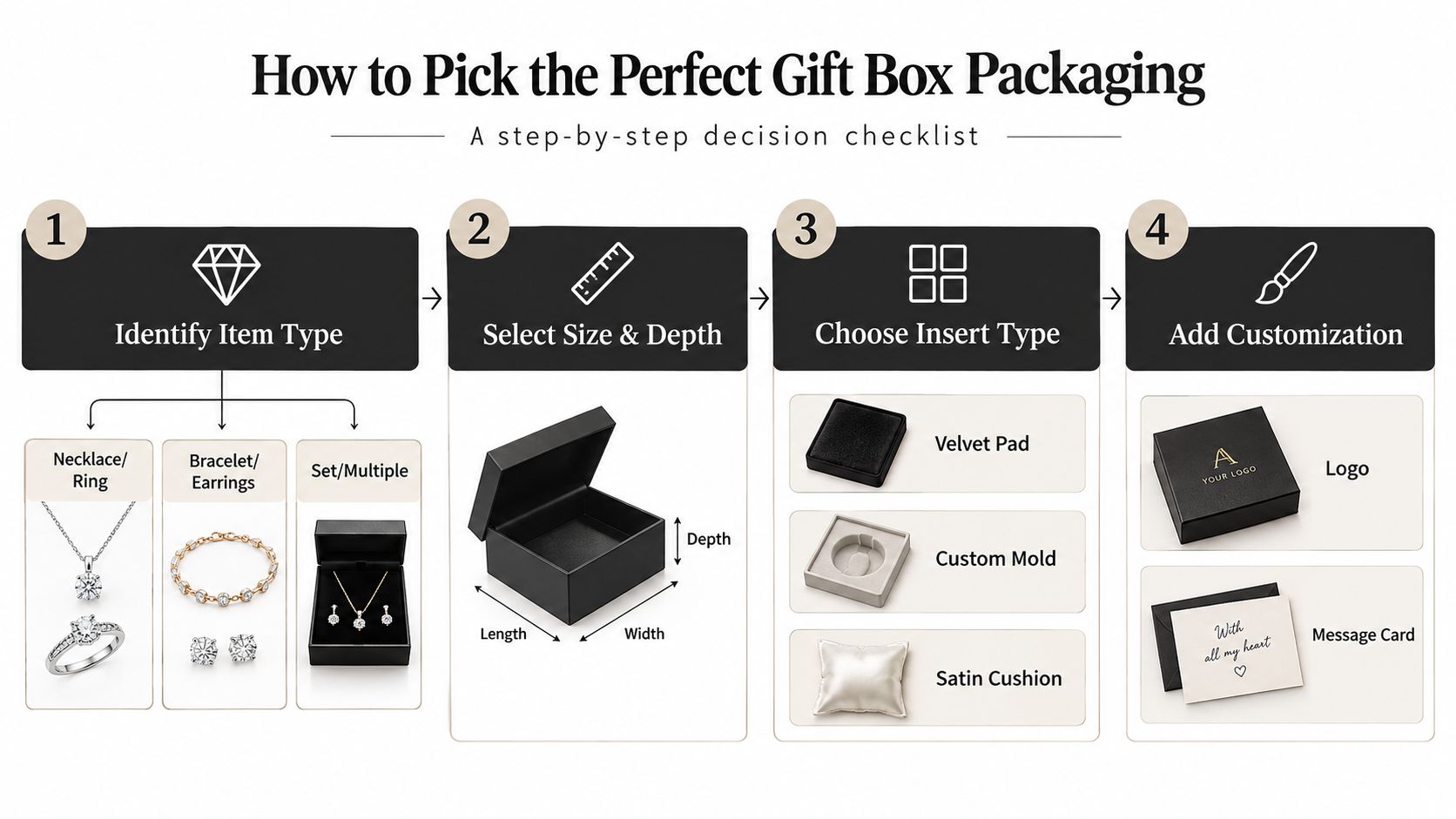
A quick checkout checklist can prevent most mistakes:
- Item type: Is it a ring, pendant, bracelet, earring pair, or set?
- Fit: Does the insert support the piece without squeezing it?
- Movement: Could the jewelry shift, tangle, or rub during transport?
- Presentation: Will the recipient see the piece immediately after opening?
- Reuse: Is the box likely to become a storage container?
- Personal touch: Would a message or finish add meaning?
- Delivery details: Have you checked the retailer's shipping information and any available threshold? EP Fine Jewelry explains its free-shipping threshold within its shopping experience.
EP Fine Jewelry offers an optional gift box add-on during checkout, so a buyer can request present-ready packaging alongside the jewelry rather than sourcing a separate box. That option can simplify the process when the recipient needs a fitted presentation and the buyer doesn't want to estimate the insert, size, or finish independently.
Wrapping Up the Gifting Experience
The box is the stage, not the star. Its job is to protect the jewelry, give the recipient a clear reveal, and make the act of giving feel considered without burying the piece under unnecessary layers.
Start with the jewelry's shape. A ring needs support from below, a pendant needs chain control, earrings need separation, and a set needs a layout that keeps each component visible. Then choose the material according to the mood you want to create. Paperboard can feel clean and practical, rigid board can feel substantial, and fabric-covered interiors can add softness where it serves the design.
The best customization carries a message without turning the package into a display of every available finish. One personal detail often feels more intentional than several unrelated decorations. Sustainability belongs in the same decision, because a premium experience can come from texture, precise fit, reusable construction, and clear material choices rather than oversized structures or difficult-to-recycle coatings.
The recipient's perspective matters most: The right box should be easy to open, satisfying to hold, protective between wears, and simple to understand when it reaches the recycling bin.
A well-chosen box also continues the gift after the occasion. The recipient may use it to keep a ring from getting lost, hold earrings together, or protect a pendant in a drawer. For more ideas on choosing jewelry for a special occasion, explore this holiday jewelry gift guide.
Choose the jewelry first, then confirm the fit, insert, material, and one meaningful finishing touch. That small amount of planning turns gift box packaging from an afterthought into part of the memory.
EP Fine Jewelry offers personalized and fashion jewelry across rings, necklaces, earrings, bracelets, charms, and bangles, with an optional gift box add-on available during checkout. Visit EP Fine Jewelry to choose a piece and arrange a polished, ready-to-give presentation.