
You've found a bangle you love, but it either won't pass over your knuckles or keeps sliding up your arm while you type. That frustration usually isn't a styling problem. It's a measurement problem, made worse when you treat every bangle like a flexible chain bracelet.
Learning how to wear bangle bracelets starts with choosing the right construction and fit. A rigid slip-on bangle must clear your hand, while a hinged or open design is sized around the wrist. Once you solve that hidden detail, styling becomes much easier, and your jewelry can work with your routine instead of competing with it.
Table of Contents
- Understanding Why Bangles Feel Uncomfortable
- Measuring Your Hand for the Perfect Bangle Fit
- Creating Bangle Stacks That Match Your Life
- Mixing Metals and Materials Without Clashing
- Avoiding Common Bangle Styling Mistakes
- Your Bangle Wearing Quick Reference
Understanding Why Bangles Feel Uncomfortable
A bangle can look perfect in a product photo and still feel completely wrong once it reaches your hand. The most common mistake is measuring the wrist, buying a piece that matches that measurement, and discovering that the closed circle cannot pass over the knuckles. The opposite problem happens too. A bangle large enough to clear the hand may rotate constantly, slide toward the forearm, or feel unstable during ordinary movement.
This happens because a rigid bangle has two separate fit points. It needs enough internal space to pass over the widest part of the hand, then it needs to rest securely at the wrist. A chain bracelet usually concerns itself with wrist circumference. A closed bangle has to accommodate the hand first.
The practical rule: A slip-on bangle must fit your hand before it can fit your wrist.
Bangles have been solving this design challenge for a very long time. The Metropolitan Museum of Art's documented Egyptian flint bangle reference describes examples from the Early Dynastic period, dated approximately 3100–2649 B.C., found mainly in burials where people often wore several pieces on one or both forearms. Those bangles were made by flaking and grinding flint, a demanding process that shows how much skill and meaning could be built into a simple circular ornament.
Why the wrist alone misleads you
If your wrist is relatively narrow but your knuckles are prominent, a wrist-only measurement will underestimate the required bangle size. If you choose a much larger piece to compensate, the bangle may clear your hand but become too loose once it reaches your wrist.
The solution is straightforward. Identify the bangle type before shopping, measure the part that controls entry, and test the piece through movement. It should slide over the hand with light resistance, rest comfortably, and avoid pinching, excessive spinning, or a loose path up the forearm.
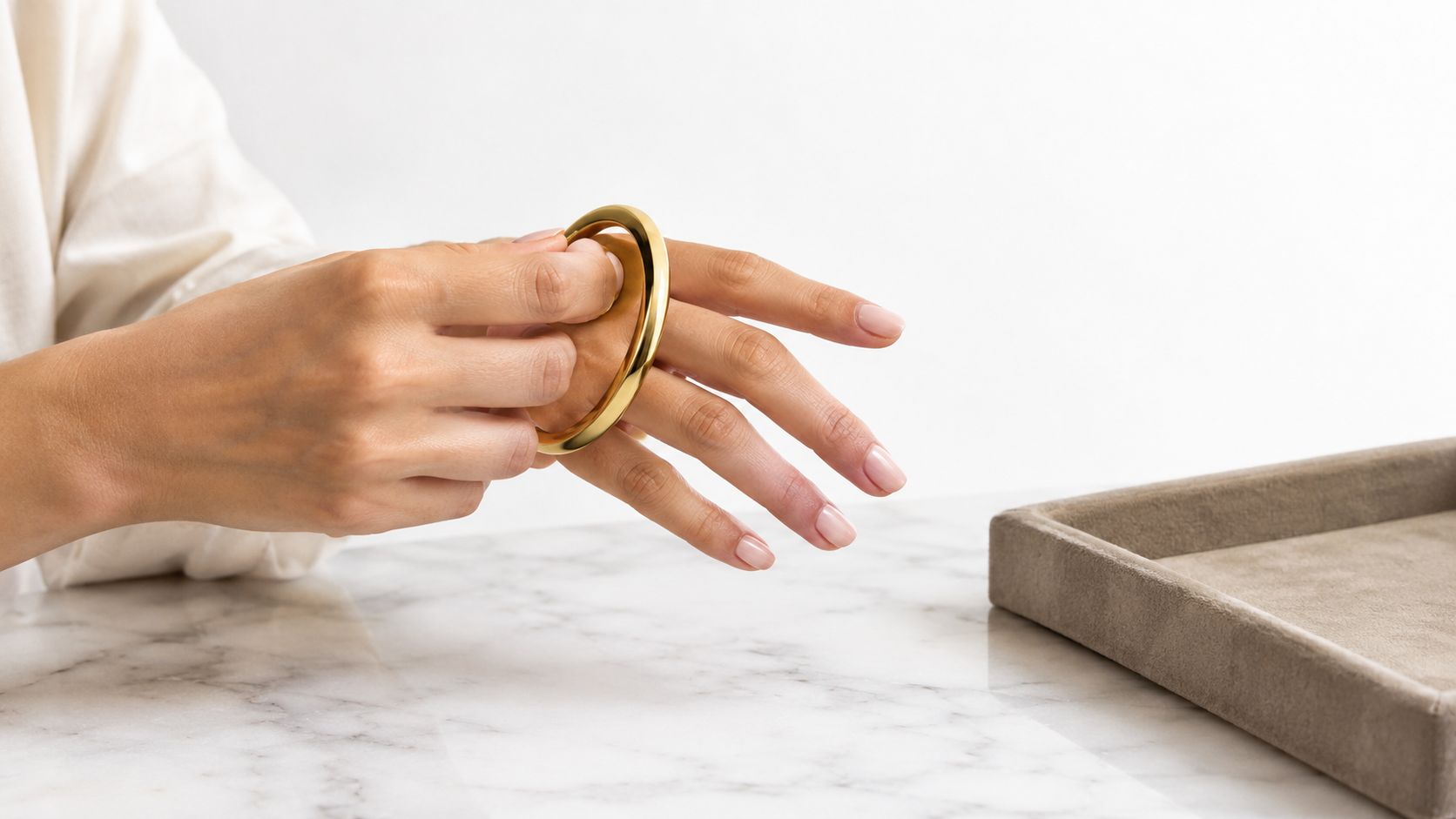
Measuring Your Hand for the Perfect Bangle Fit
For a fixed, slip-on bangle, measure your hand, not just your wrist. You can do it at home with flexible measuring tape. A piece of string and a ruler will also work.
Follow this hand measurement method
- Fold your fingers together. Bring your fingers into the shape they make when you're sliding on a bracelet.
- Tuck your thumb across your palm toward your pinky. This creates the narrowest practical entry shape and identifies the widest point the bangle must clear.
- Measure around the knuckles. Wrap the tape or string around the widest part of the folded hand. Keep it close to the skin, but don't pull it tight enough to compress your hand.
- Record the hand circumference. Compare it with the seller's stated internal circumference. If the listing gives only internal diameter, measure straight across the inside of a bangle at its midpoint and compare that dimension with the seller's chart.
- Check the wrist separately. Measure where the bangle will sit. This second measurement helps you judge whether a bangle that clears your hand will remain secure rather than sliding freely.
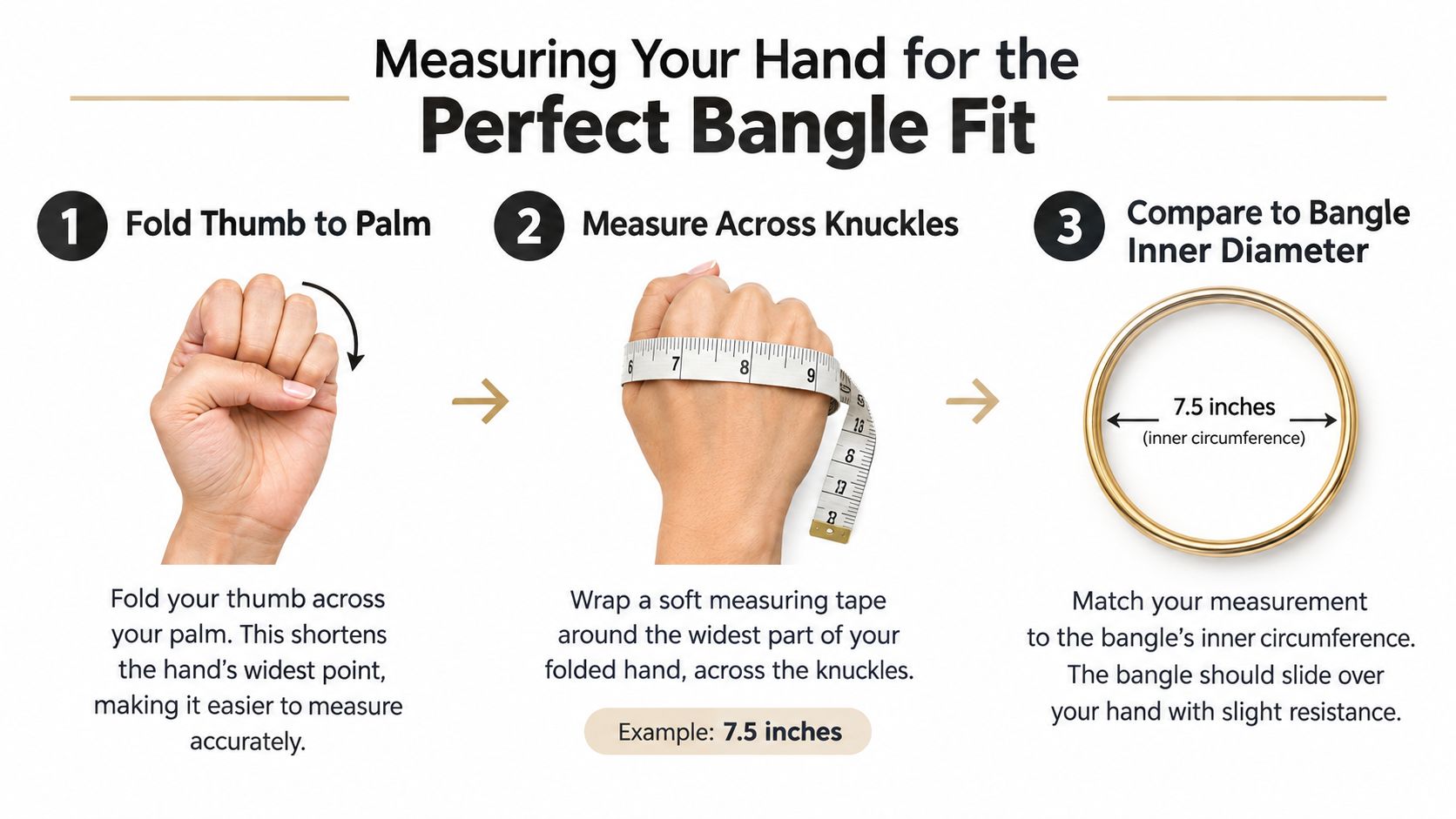
The Jewelers Mutual bracelet measuring guide recommends this closed-hand approach for fixed bangles and distinguishes it from wrist measurement for hinged or open designs. That distinction matters. A hinged bangle opens around the wrist, so your hand no longer controls entry size. An open cuff also avoids the full slip-over route.
Use the measurement as a fit test
A bangle should pass over the closed hand with light resistance. Don't force it, twist aggressively, or use lotion to push a tight piece over your knuckles. After it reaches the wrist, bend your hand, type, raise your arm, and make a few normal movements.
The sizing and comfort guidance from Cursa notes that rigid bangles require a hand-pass check, while flexible styles may use a comfort allowance of approximately 12–19 millimeters beyond wrist circumference. That allowance isn't a substitute for hand measurement on a closed bangle.
For a useful reference before an online purchase, compare your measurements with this bangle bracelet size chart. Gift buyers should be especially careful. Wrist circumference alone can't confirm that a fixed bangle will pass over someone else's hand.
Creating Bangle Stacks That Match Your Life
A beautiful stack that interferes with your keyboard, catches on clothing, or makes noise during client meetings isn't a successful stack. Choose the number, weight, and shape of your bangles according to what your day demands.
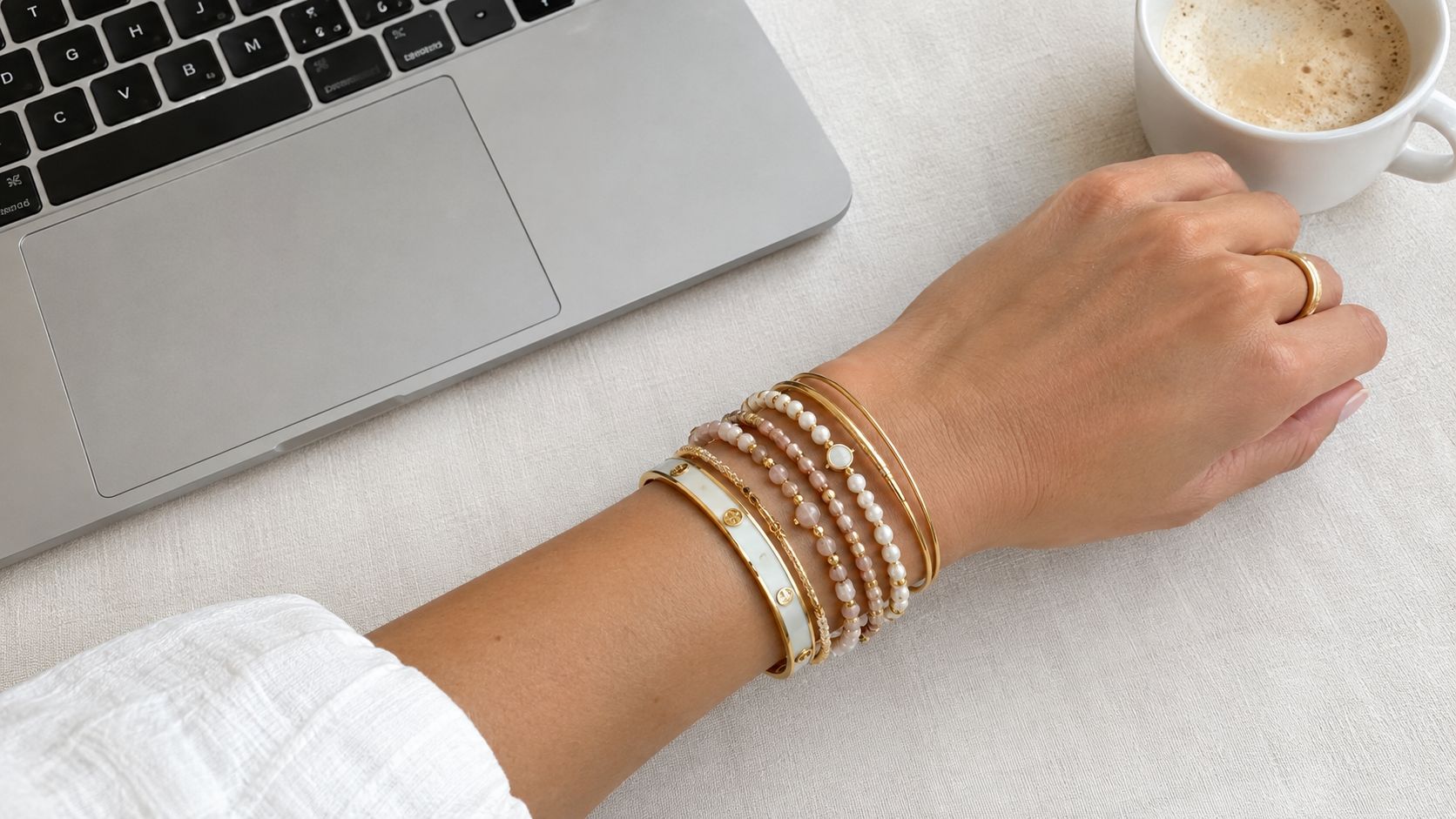
Build around your daily movements
For keyboard work, choose a quiet, close-fitting bangle with rounded edges. A single smooth piece or a restrained combination sits more comfortably near the wrist and creates less contact with a desk. If you type for long periods, avoid heavy rigid pieces that repeatedly strike the surface.
People who work with their hands should reduce the number of bangles. Caregiving, cooking, packaging, gardening, and repetitive manual work all create opportunities for jewelry to snag or press into the skin. Keep one meaningful piece for the day and save a more elaborate stack for an occasion when your hands are less active.
Travel calls for restraint too. A low-profile design is easier to keep track of, less likely to catch on a sleeve, and simpler to remove when needed. For exercise or sports, take bangles off rather than testing whether they can withstand impact, sweat, or snagging.
A stack should support your routine, not ask your routine to make room for it.
For celebrations, you can increase contrast. Pair a wider focal bangle with slimmer pieces, or combine polished and textured surfaces so every item remains visible. One strong bangle can also be more elegant than several competing pieces, especially when your earrings or necklace already make a statement.
Explore bracelets for everyday wear with your schedule in mind, not just the outfit you're wearing today. Personalization makes this approach more useful. One personalized bangle can serve as a daily signature, a coordinated set can suit celebrations, and an adjustable or open style can solve fit issues for recipients whose measurements are uncertain.
The following visual offers another way to think about proportion and layering:
Treat these as separate occasion systems rather than one permanent stack. Your work wrist, travel wrist, and event wrist don't need the same jewelry.
Mixing Metals and Materials Without Clashing
Mixing gold, silver, and rose gold works when the stack looks intentional. It fails when every piece competes for equal attention. Start by choosing one dominant tone, then use the other metals as supporting accents.
A mostly yellow-gold stack with one silver bangle feels deliberate because the warmer tone establishes the visual direction. A silver and rose-gold combination creates a softer contrast. If you own unrelated pieces, add a connector, such as a bangle that already combines two metal tones, so the transition feels planned rather than accidental.
Compare the visual effect
| Combination | Best approach | Main risk |
|---|---|---|
| One metal, mixed textures | Pair polished, hammered, engraved, or beaded surfaces | A stack can look flat if every finish matches |
| Two metal tones | Let one tone lead and use the second sparingly | Equal amounts may feel disjointed without a connector |
| Three metal tones | Keep the shapes simple and repeat one texture | Too many colors and details can create clutter |
| Mixed materials | Balance metal with beads, enamel, or other tactile elements | Uneven visual weight can make one side look accidental |
Width matters as much as color. Place a wider or more detailed bangle next to slimmer, quieter pieces so the eye has a focal point. If every bangle is wide, the wrist can look crowded. If every piece is delicate, the stack may lack definition.
Texture also changes how much a stack needs. A hammered surface already catches light, so it can pair well with a plain polished band. A heavily patterned bangle needs more visual space around it. The guide to mixing gold and silver can help if you're deciding whether your existing pieces belong in the same rotation.
The strongest combinations usually share one repeated detail, such as a similar curve, gemstone color, finish, or design era. That common element gives mixed materials a reason to sit together.
Avoiding Common Bangle Styling Mistakes
“Looser is better” sounds comfortable, but it isn't a universal rule. A bangle that spins freely can strike the wrist, slide up the forearm, catch on sleeves, and increase the chance of loss. A rigid piece that requires force to install creates the opposite problem.
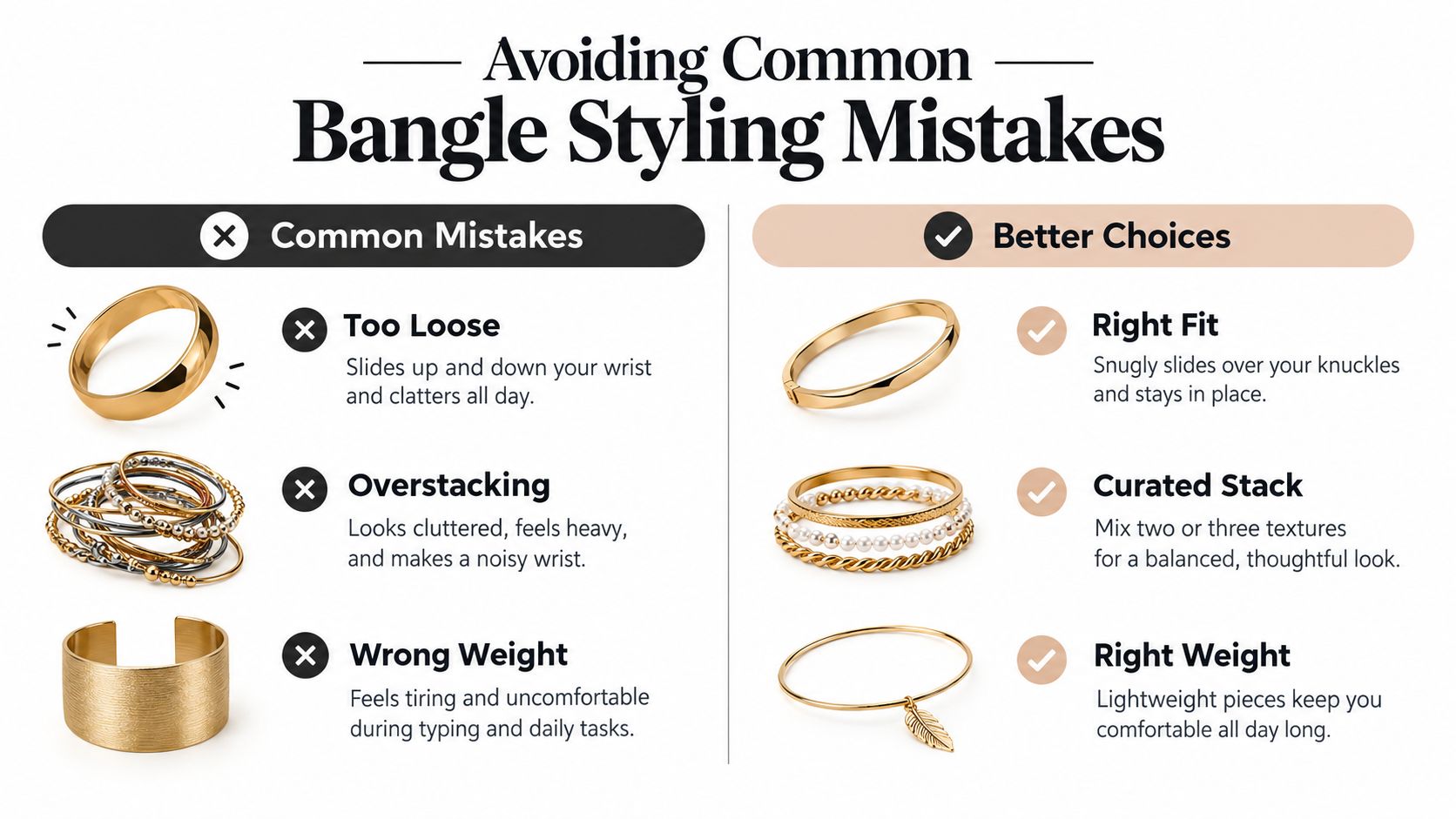
Replace these habits
- Measuring only the wrist: Use the folded-hand method for a closed bangle. Wrist measurement is more appropriate when the design opens around the wrist.
- Forcing a tight bangle: Don't use lotion, pressure, or painful twisting to install a rigid piece. Choose a larger internal size or switch to a hinged or open design.
- Overstacking without proportion: Several rigid pieces can become noisy and visually crowded. Start with a focal piece, then add quieter textures that leave each bangle visible.
- Choosing weight over wearability: A dramatic bangle may look impressive but become tiring during typing or manual work. Use lightweight, rounded-edge pieces when you need all-day comfort.
- Ignoring contact surfaces: Inspect edges, closures, and inner surfaces before extended wear. Remove the bangle if itching, redness, burning, or blistering appears.
Skin sensitivity deserves more attention than it usually gets. Nickel is a leading cause of allergic contact dermatitis. Reported nickel sensitization is around 8.6% worldwide and approximately 17% among young women, while one North American patch-test dataset recorded positive reactions in 16.2% of tested people (nickel allergy prevalence and contact dermatitis data).
Those figures describe sensitization, not the likelihood that a particular bangle will cause a reaction. Choose verified low-nickel or nickel-free materials when sensitivity is a concern, avoid prolonged contact when skin is wet or sweaty, and stop wearing the piece if symptoms continue.
Use the same proportion-first thinking when coordinating other jewelry. The advice in this guide to stacking rings applies well to the wrist too. You need variation, but you also need breathing room.
Your Bangle Wearing Quick Reference
Keep this checklist beside you when shopping online or refreshing your jewelry rotation.
Before you buy
- Identify the construction: Decide whether the piece is a fixed slip-on bangle, hinged bangle, adjustable bangle, or open cuff.
- Measure the controlling area: Measure the folded hand for a closed design. Measure the wrist for a hinged or open design.
- Read the internal dimensions: Check the seller's internal diameter or circumference rather than relying on a generic small, medium, or large label.
- Think about the recipient: For gifts, prioritize adjustable, hinged, or open designs when the hand measurement is unknown.
Before you wear it
- Test the entry: The piece should clear the hand with light resistance, never force or pain.
- Test movement: Bend your wrist, type, raise your arm, and check whether the bangle pinches, spins excessively, or slides too far.
- Inspect the finish: Run a finger along the inside and check that edges and closures feel smooth.
- Match the weight to the day: Choose quiet, close-fitting jewelry for work and fewer rigid pieces for hands-on tasks.
- Remove it for riskier activities: Take bangles off before sports, exercise, or activities involving snagging, water, or repeated impact.
Before you build a stack
Choose one focal piece, then add contrasting widths or textures. Keep the visual balance intentional, and don't assume you need multiple bangles to make an outfit look finished. A single smooth bangle can be more polished than a crowded wrist.
For long-term ownership, follow the relevant jewelry care instructions, especially if your bangle has plating, charms, gemstones, or delicate finishes. Store pieces separately, wipe away residue after wear, and give your skin a break whenever the jewelry starts to feel irritating.
EP Fine Jewelry offers personalized bangles, bracelets, charms, and gift-ready options for shoppers who want a piece with individual meaning. Visit EP Fine Jewelry to explore bangle styles, review care guidance, and choose a piece that fits both your hand and your everyday life.