
Custom jewelry is made or changed for one customer's choices, and it covers both simple personalization and fully bespoke design.
The usual advice is to choose custom jewelry when you want something special. That's incomplete. Before you pay for a meaningful piece, you need to know whether you're changing an existing design or commissioning a new one, and what the seller is promising about materials, fit, and production.
A name on a bracelet can make it personal without making it handmade, more durable, or more valuable to another buyer. The best purchase starts with a clear description of what will change, not with the word custom alone.
Table of Contents
- What Custom Jewelry Is and How the Types Differ
- Real Buying Situations
- Names Initials Birthstones and Engraving
- How a Custom Piece Gets Made
- Timelines and What Changes the Price
- Care Rules and Quality Checks
- Order a Personalized Piece with Confidence
What Custom Jewelry Is and How the Types Differ
Custom jewelry is designed or modified for one customer's preferences rather than sold only as a fixed, ready-made item. Those preferences might involve an inscription, a stone choice, a different length, or a completely new shape.
Think of a music album. A ready-made piece is a song already on the record. Personalization writes your name on the sleeve, while bespoke work involves composing a new song with you. Both can carry meaning, but they require different kinds of work.
Personalization is already a familiar shopping preference. In a 2025 industry survey, nearly 70% of respondents considered personalization important when choosing jewelry, and 64% wanted a specific message or symbol, according to The Plumb Club's personalization survey chart.
Ready-made, personalized, and bespoke jewelry
| Kind of piece | What changes | Who designs it | Time and risk | Best when |
|---|---|---|---|---|
| Ready-made | Little or no alteration | The maker supplies a fixed design | Can ship from stock; check the standard return policy | You want the piece exactly as shown |
| Personalized | Name, initials, date, message, symbol, birthstone, charm, or size | You choose details on an existing design | Requires preparation; permanent changes can restrict returns | The look is right and only the details need changing |
| Bespoke | A new design, unusual dimensions, supplied materials, or repeated approvals | You and the maker develop the design | Requires design approval and technical checks before production | The design itself doesn't exist yet |
Choose personalized jewelry when the design already exists. Choose bespoke jewelry when the design itself must be created. A ring with a date added inside its existing band belongs in the personalized row. A ring developed around an unusual family stone may need bespoke work.
For ring-specific examples, our guide to customized rings can help you identify which parts of the piece you want to change.
The diagram makes the distinction easier to recognize.
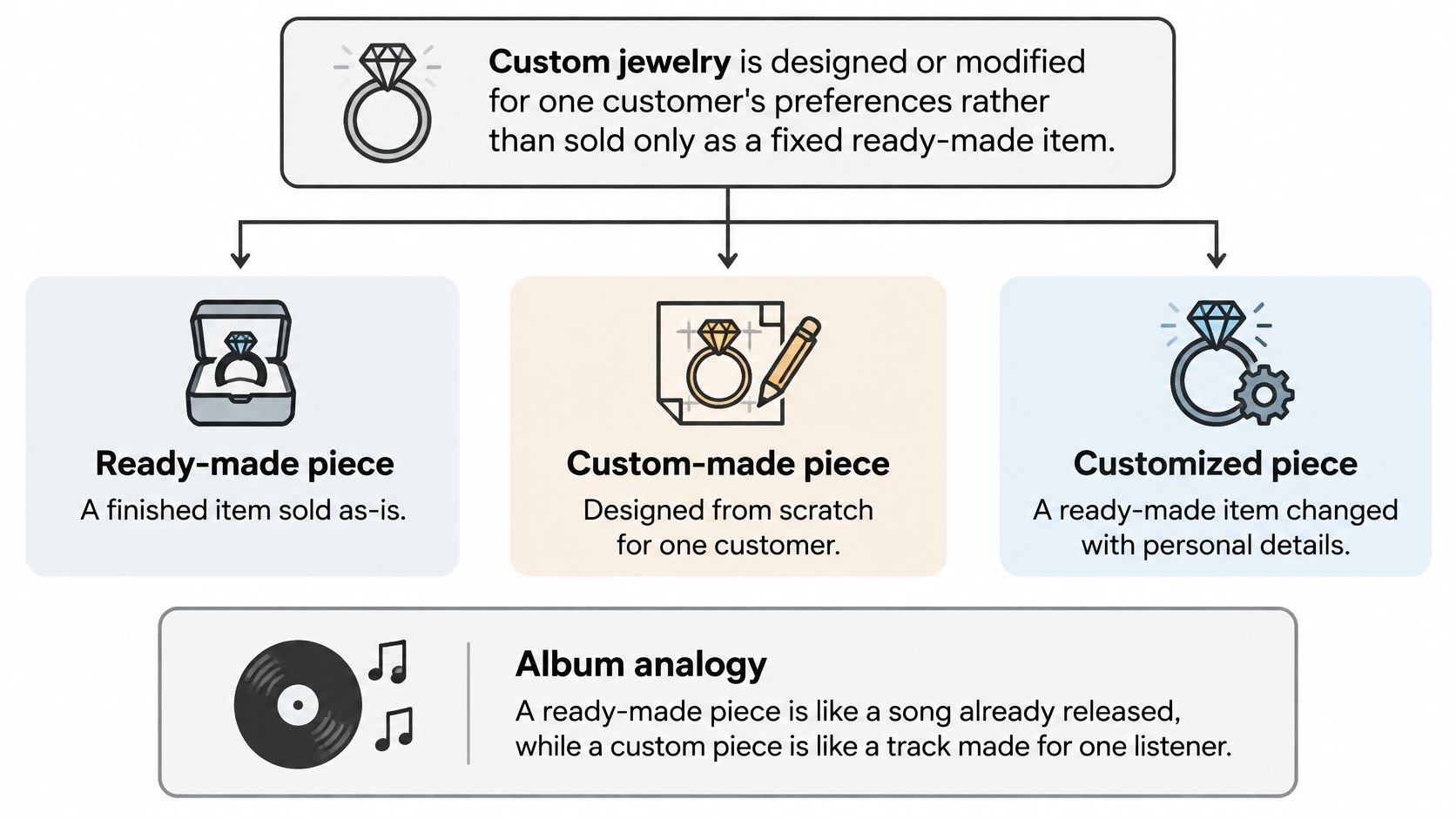
What the label doesn't tell you
The category is broad. Industry Research's jewelry-customization market report includes choices such as engraving, gemstones, metals, colors, sizing, design alterations, and bespoke commissions within customization. That breadth helps explain why different sellers use the same word for quite different services.
Custom doesn't automatically mean handmade, one-of-one, fine jewelry, or better quality. A maker can use a repeatable template and machinery to produce a personalized name necklace. A bespoke design can also use computer modeling and casting rather than being shaped entirely by hand.
For another way to think about communicating a personal design, Timebomb Tattoo & Piercing's resource on planning a custom tattoo design offers a useful parallel. A meaningful idea still needs a clear description of placement, scale, and visual style before someone can execute it.
When asking what is custom jewelry, don't stop at the label. Name your row first, then ask about the quote, delivery, approvals, alterations, and return terms.
Real Buying Situations
A parent chooses a bracelet, selects the offered chain length, and adds a child's name. That's personalization. The parent isn't asking the maker to develop a new bracelet structure.
A partner orders a band with an anniversary date inside. A friend chooses charms for a birthday bangle. These are also personal choices within established designs, even though the finished gifts may feel very different.
Match the request to the service
A buyer who wants an unusual ring shape or a family stone reset needs a different conversation. The maker must assess the stone, dimensions, setting, and wearability rather than read a checkout note.
- An approaching celebration: A stock piece with initials is worth considering only if the seller confirms engraving and delivery before the occasion. Don't assume an available item can be personalized immediately.
- A long name on a tiny plate: Choose shorter wording or a larger design if the lettering would become cramped.
- A new silhouette: Allow room for design discussion and approval rather than expecting a personalization field to communicate the whole request.
Customization also reaches beyond engagement purchases. A commercial estimate from Market Growth Reports found that more than 58% of millennials preferred custom jewelry or engagement rings. Treat that as a market-research estimate, not a guarantee of any particular shopper's preferences.
Practical rule: Start with the occasion and deadline, then decide how much design work the gift actually needs.
Online previews, engraving fields, and special instructions help when the base design is already suitable. Our guide to personalized jewelry gifts can help you connect the recipient's style with an appropriate format.
Names Initials Birthstones and Engraving
Personalization works best as a menu of choices on a design that already exists. You select the identifying details while keeping the piece's basic construction.
Personalization adds an identifying detail. It doesn't necessarily redesign the piece.
Choose the detail that fits the available space
A full name can become the main feature of a necklace or bracelet. Check the offered lettering style and character limit, and look closely at how the name connects to the chain. An unusually long name or a special character may not fit the product shown, so confirm feasibility before ordering.
Initials suit a smaller surface and require less text to arrange. Still, letter order matters: initials written in everyday order aren't always arranged like a decorative monogram. For a letter-led gift, Piercing Near Me's J necklace guide provides a focused example to consider alongside the recipient's preferred jewelry style.
A date or short message needs more than correct spelling. Count spaces and punctuation, check which date format the recipient will recognize, and ask whether the lettering will remain readable at the actual size. Deep engraving isn't automatically better, particularly where the metal is thin.
Our ideas for engraving rings can help you find wording that doesn't need to be squeezed into the available surface.
Choose color or a combination instead of text
A birthstone or another gemstone can change the color of a known design without changing its silhouette. The replacement still needs to fit the setting properly. Don't assume that stones with a similar appearance have identical cleaning requirements.
Charms and charm combinations personalize through selection and arrangement. A bangle carrying a meaningful symbol can be personal without requiring new lettering or a newly cast shape. Check how the charms attach and whether their position allows the bracelet to move comfortably.
Before choosing, consider these edge cases:
- Lettering style: A decorative capital may look different from the letter you type. Request clarification if recognition matters.
- Engraving surface: A curved or narrow area can limit placement even when the message is short.
- Stone changes: Confirm the identity of the replacement, not just its color.
- Charm movement: Projecting shapes may catch on clothing or sit differently when worn together.
A useful request reads like a specification: the chosen design, the exact detail, and its intended placement. Save the complete purchase check for the moment before payment, when you can compare those choices with the actual order.
How a Custom Piece Gets Made
A custom order turns preferences into production instructions. The maker needs enough detail to produce the intended result without guessing about dimensions, materials, or wording.
This overview shows the route from an idea to a finished piece.
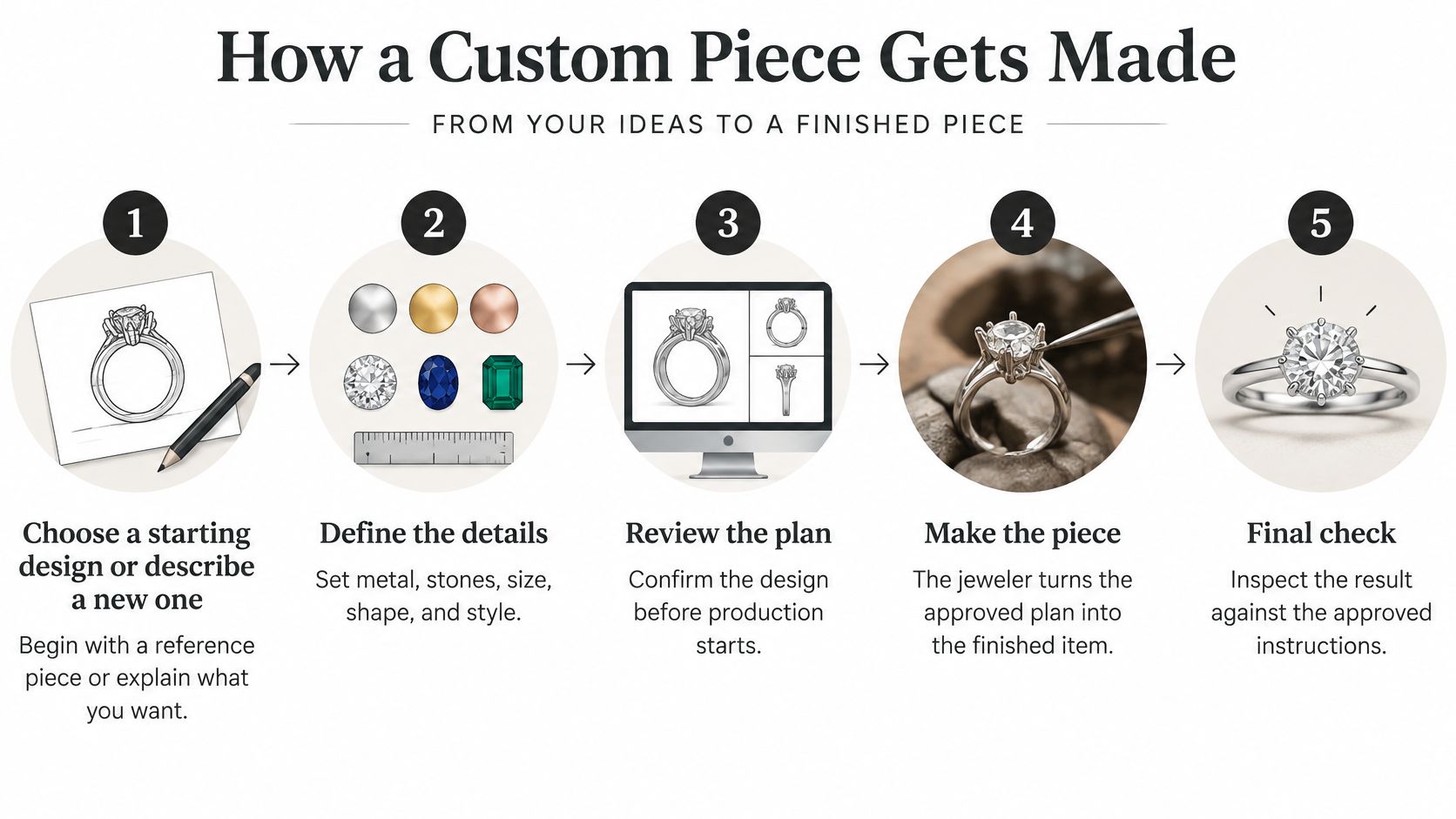
From request to approval
- Choose a starting point. Select an existing design or describe a new one. Include the intended size, metal, stone, finish, and any wording. Reference images help when you explain which feature you want, rather than asking the maker to interpret the entire picture.
- Resolve exceptions before paying. If you want a personalized piece that differs from our online photo, or you need a special character, email us before ordering. We need to confirm whether the piece can be made.
- Approve the production details. A simple order may need a text layout and placement confirmation. A bespoke commission may require computer-aided design, usually called CAD, to check proportions and construction.
GemFind's custom-jewelry design guide describes how CAD models control wall thickness, stone seats, prong geometry, undercuts, and connection points. Think of CAD as a dressmaker's pattern: it defines how the attractive idea will become a workable object.
From model to wearable piece
- Check a prototype when appropriate. A wax or resin model can reveal the ring's height, finger coverage, and visual balance. It's comparable to a muslin fitting before a dress is cut from the final fabric.
- Produce and finish the piece. Depending on the design, production may include casting, stone setting, engraving, polishing, and inspection. Not every personalized order requires every operation.
- Compare the result with the approved brief. Check the lettering, dimensions, finish, and agreed material description rather than relying on a general resemblance to the inspiration image.
A name added to an existing chain follows a much shorter route than a newly modeled ring. A handwriting request also needs a usable reference; our guide to personalized jewelry with handwriting explains that distinct kind of personalization.
The video offers another view of jewelry-making work.
A thin section, deep inscription, difficult undercut, or unusual stone position can create casting, finishing, or wear problems. A pretty drawing therefore still needs technical judgment about thickness, access, and attachment strength.
Keep the approved wording and metal description with your order. Those records give both you and the maker something specific to check.
Timelines and What Changes the Price
There's no single custom-jewelry price or delivery date. A quote reflects the materials, preparation, production work, and approvals needed for that particular request.
Price and time often move together, but not always. A costly stone doesn't necessarily require a complicated design, while a relatively simple-looking piece may require substantial work to make its proportions and connections function properly.
What changes time and price on a custom order
| Factor | What it changes | Typical effect |
|---|---|---|
| Metal | Color, strength, material cost, and finishing | Compare exact metal descriptions and metal weight, not color alone |
| Gemstone | Sourcing, setting work, and cleaning limits | A compatible replacement can avoid the work of developing a new setting |
| Complexity | Bench time and manufacturing risk | Adding a name to a known design requires less development than a new CAD model |
| Size and fit | Comfort, proportions, and potential remakes | Offered sizes are easier to specify; unusual dimensions need confirmation |
| Depth of personalization | Alteration options, repairs, and returns | Permanent lettering or a new design can restrict exchange options |
Read the factors in that order. Start with what the piece is made of, then consider the stone, the construction, the fit, and finally the extent of the personal changes.
Compare like with like
Metal is more than appearance. A gold-colored finish and solid gold aren't interchangeable descriptions. When comparing quotes, match the actual material, dimensions, and construction before deciding that one maker is charging more for the same piece.
Stone work includes the setting. A replacement that fits an existing setting presents a different job from a stone that requires new seats, prongs, or a redesigned head. Hardness alone isn't a reliable shortcut for predicting price.
Original design requires development. A new model may involve drawing, revision, prototyping, and technical checks before production begins. Adding letters to an established design doesn't carry that same development burden.
Ask for a production estimate and a delivery estimate separately. The date a piece leaves the workshop isn't the date you'll receive it.
Avoid treating a generic industry window as a promise for your order. Ask when the clock starts, whether approval is required before making begins, and what happens if you request another revision. Material sourcing and unresolved specifications can change the schedule before any metal work starts.
An event deadline should be disclosed before you commit. If the available schedule is too tight, simplify the request or choose a finished design rather than hoping the maker can compress technical checks.
Cancellation and restocking terms deserve the same attention as the quote. Some fine jewelry, typically personalized or made-to-order pieces and some EP Fine items, may carry a restocking fee of up to $150 per item. Finalize the brief before authorizing production, and don't assume that stopping an unfinished order removes all costs.
Care Rules and Quality Checks
An inscription adds meaning, not purity, durability, or resale value. Emotional importance and material quality are separate questions, so evaluate both before committing to a piece that's difficult to change.
The Federal Trade Commission's Jewelry Guides address truthful descriptions of metal content, quality, size, weight, durability, serviceability, gemstone identity, treatments, and origin. A custom label doesn't replace those disclosures.
Check the specifications before buying
- Metal and finish: Confirm the exact metal and whether the gold color comes from solid material or plating that can wear.
- Stone identity: Ask whether each stone is natural, laboratory-created, or imitation.
- Treatments and cleaning: Find out whether heat, ultrasonic cleaning, or chemicals could damage the stone or its treatment.
- Future service: Confirm whether the construction permits resizing, repair, or replacement of an engraved component.
The FTC's guidance on advertising diamonds clearly explains that laboratory-created and simulated stones need clear qualifiers rather than an unqualified gemstone name. You should be able to understand what you're buying without interpreting vague descriptions.
This checklist keeps the material questions separate from the inscription.
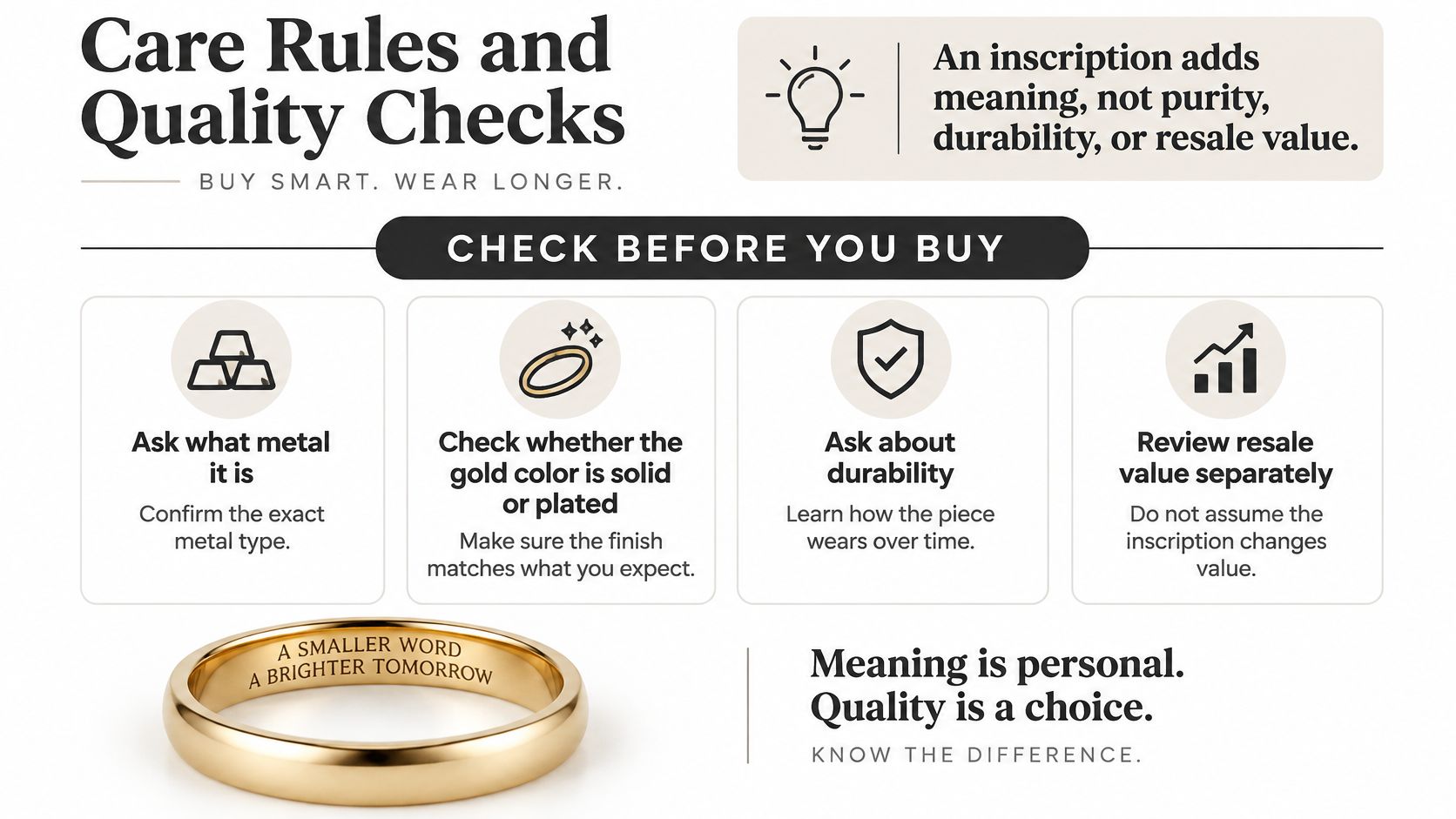
Care for the actual materials
Alloy composition affects color, hardness, corrosion behavior, and resistance to deformation. None of our jewelry contains nickel, but that fact doesn't replace checking the full material description if you have a known sensitivity.
Daily habits should protect the finish, lettering, and setting:
- Put jewelry on last: Let perfume and lotion settle before wearing it.
- Wipe gently: Use a clean, soft cloth rather than abrasive rubbing over an inscription.
- Store separately: Lay chains flat and keep engraved surfaces from rubbing against other jewelry.
- Avoid harsh cleaning: Skip chemical dips and ultrasonic cleaning unless they're confirmed as suitable for the specific materials.
Use our jewelry care instructions to guide routine maintenance, and retain any item-specific restrictions with your purchase record.
Our personalized name necklaces and bracelets, excluding charm bangles, are final sale and don't qualify for store credit. Some other items may qualify for a size exchange or store credit, so check the applicable terms before purchasing.
Order a Personalized Piece with Confidence
If the design shown already fits your idea, choose personalization and specify the details precisely. If you need something the photo doesn't show, email info@epfinejewelry.com before ordering so we can confirm feasibility.
Our custom and personalized options span our collections, including name necklaces, bracelets, and charm bangles, with fashion jewelry in silver and 14K gold. Browse the Personalized collection for a gift, and use the optional gift box and order notes for presentation and a message.
Complete the order check
- Spelling: Confirm every letter, accent, capital, and punctuation mark.
- Metal: Record the exact material and finish.
- Length or size: Compare the selected measurement with the intended fit.
- Stone: Confirm its description, if included.
- Production window: Check the item's stated estimate and allow for delivery.
Material terminology deserves its own attention. If you're also comparing steel jewelry, HonHo Wholesale Jewelry's resource on 316L stainless steel ring specifications gives you a specific material designation to investigate rather than relying on color.
Made-to-order doesn't necessarily mean newly designed. The 14k Half Gemstone Half Diamond Tennis Bracelet, for example, is a catalog design whose product listing asks buyers to allow 4–6 weeks.
The pictured bracelet is a catalog example, not a promise that every design accepts the same changes.
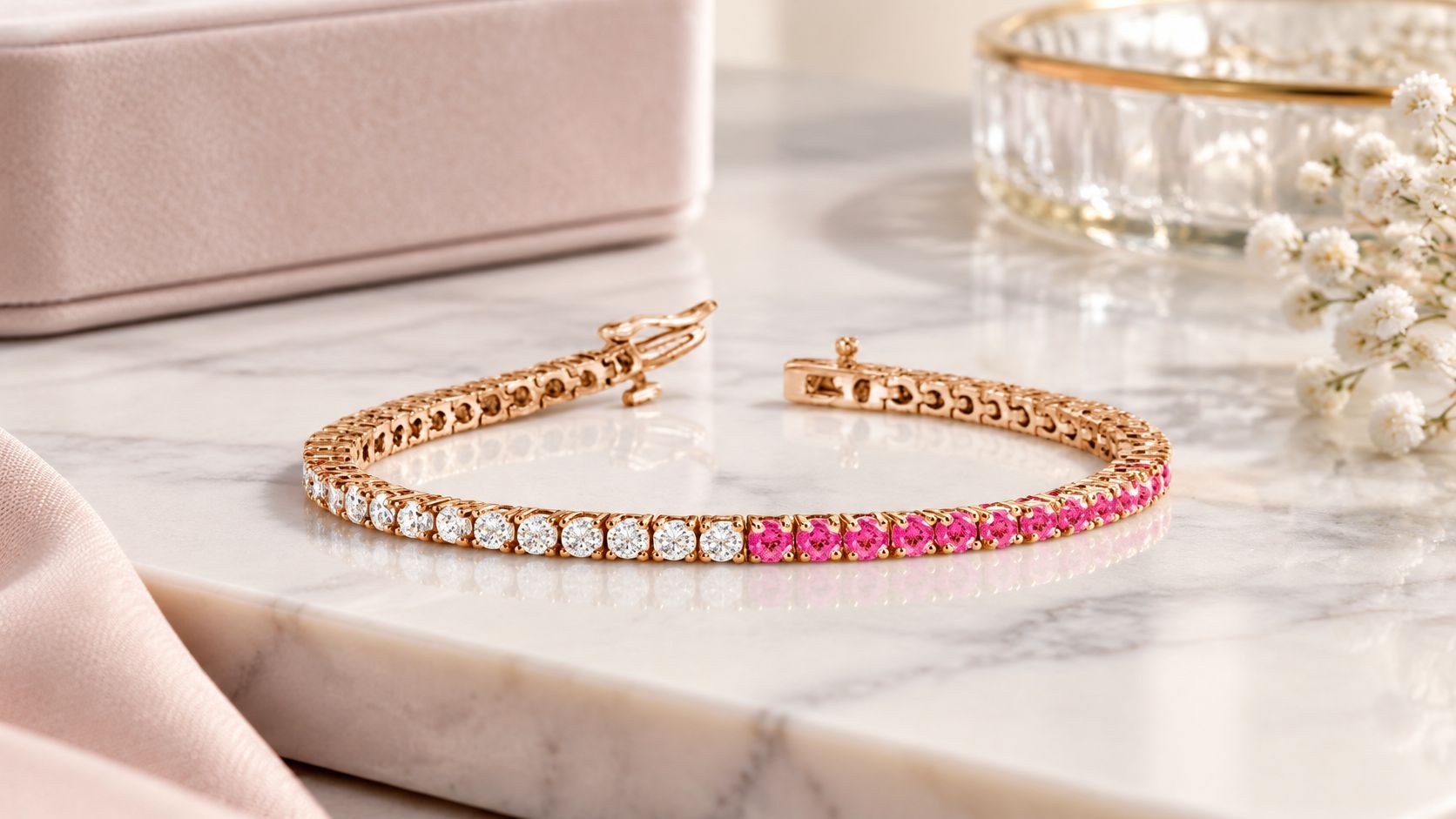
Keep your approved instructions with the order. Orders of $200 qualify for free shipping, and the care guidance remains worth reading when your piece arrives.
EP Fine Jewelry offers personalized name necklaces, bracelets, and charm bangles for gifts and everyday wear. Visit EP Fine Jewelry to choose an existing design and its personal details, or email us before ordering if your idea needs a special character or a change from the photo.