
You're scrolling rings on your phone late at night, and something keeps stopping your thumb. The slim bands look pretty, but the wider ones feel like the genuine choice, the one you'd notice on your own hand every day. Then the practical worry arrives. Will a wide ring fit like your usual size, feel comfortable by evening, or sit in a drawer because you guessed? Thick band rings reward shoppers who check fit first and style second.
Table of Contents
- What Makes a Band a Thick Band
- A Short History of the Wide Band Look
- Thick Bands Versus Slimmer Bands
- How Thickness Changes the Way a Ring Fits
- Choosing Materials and Finishes That Last
- Where and How to Wear a Thick Band
- Caring for a Thick Band So It Keeps Its Look
What Makes a Band a Thick Band
You open three product pages side by side. One ring looks like a fine line around the finger, one looks solid but restrained, and one reads clearly from across a table. Sellers may call all three bold, chunky, or statement, so those words don't help you compare them.
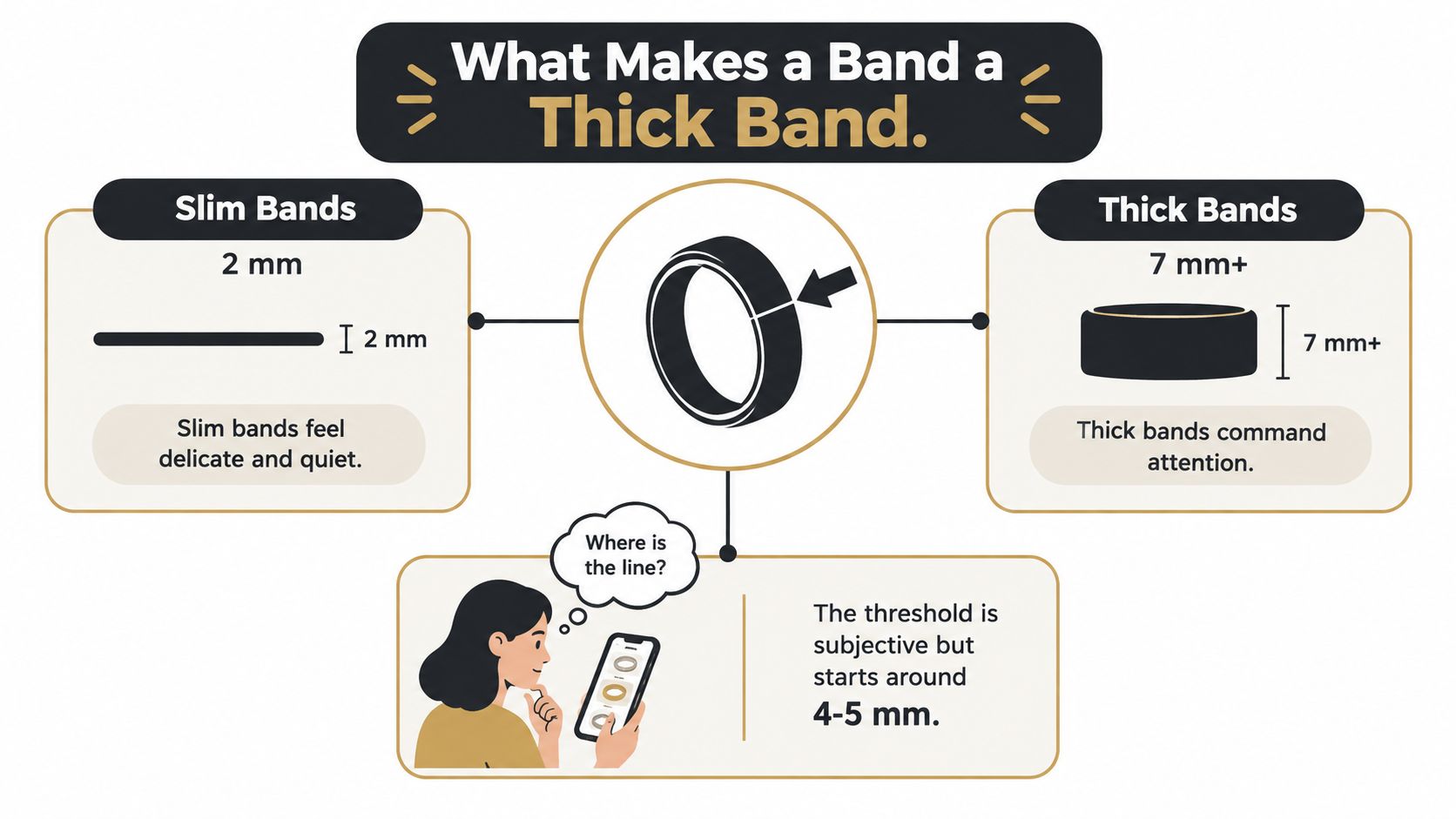
Start with the number you can verify. Band width is the measurement across the visible top of the ring, from one edge to the other, in the direction that runs toward your fingertip. Ring width guidance from Krikawa places ordinary bands at approximately 2 to 4 mm, substantial bands at 6 to 8 mm, and statement bands at 8 mm or more.
The visual below makes that gap easier to judge than a product photo taken close up.
Ring Width Categories at a Glance
| Category | Typical Width | Look and Feel |
|---|---|---|
| Everyday | 2 to 4 mm | Quiet, delicate, easy to stack |
| Substantial | 6 to 8 mm | Noticeable coverage, solid presence |
| Statement | 8 mm or more | Broad, sculptural, hard to miss |
In engagement ring terms, a band wider than the roughly 2 mm typical format counts as wide, and about 4 mm and above is commonly described as thick or chunky. Cigar bands, the flat and broad style many shoppers picture first, often measure about 5 to 6 mm. That puts most thick band rings in a practical range of roughly 4 to 8 mm, even though each jeweler draws the line a little differently.
Width Is Not Thickness
Beginners often make mistakes here. Width runs across the top. Thickness is the depth of the metal itself, from the inside surface that touches your skin to the outside surface you see.
Two rings can both measure 6 mm wide and feel nothing alike. One may be broad but low and light against the finger. The other may stand taller, weigh more, and resist bending better. When a listing gives only one measurement, you're seeing half the picture, so look for both numbers in millimeters before you compare prices.
A Short History of the Wide Band Look
The broad band on your shortlist has an older job in its past. Long before anyone wore one for fashion, a substantial ring carried a person's mark. The signet ring tradition traced by Skyjems connects wide bands to seal use reaching back more than 5,000 years.
The earliest known seal forms date to fourth-millennium BCE Mesopotamia, where cylinder seals were rolled across damp clay to authenticate tablets. By the second millennium BCE, carved hardstones such as carnelian, lapis lazuli, and hematite were mounted into gold or silver hoops, turning the seal into something you could wear.
From Scarabs to Cigar Bands
Ancient Egyptian practice from the New Kingdom onward produced scarab signet rings, including examples associated with Tutankhamun's tomb. The carved scarab or cartouche could be pressed into wax, so the ring worked as decoration on top and signature underneath. A wearer could authenticate documents, close containers, or signal family, religious, or administrative identity with one press of the hand.
That history explains why wide bands still read as personal rather than merely large. The form was built around identity and authority, around a mark that belonged to one person. Modern cigar bands and engraved statement rings keep the broad surface and strong silhouette, even though nobody is sealing clay tablets with them now.
If you're exploring what makes a piece read as a statement today, this overview of statement jewelry is a useful companion read. It helps explain why a wide, personalizable band can feel meaningful to give. You're not just choosing a bigger ring. You're choosing the modern descendant of an object people carried to say, this mark is mine.
A wide band has room for a name, a date, or a symbol because room for a personal mark is what the shape was originally for.
That lineage also calms a common gift-buying fear. A broad ring doesn't have to look oversized or trendy. In the right proportions, it looks intentional, and it carries a story the recipient can retell.
Thick Bands Versus Slimmer Bands
Hold your hand out at arm's length, the way other people see it. A slim band becomes a glint. A thick band stays a shape. That single difference drives most of the trade-offs below, so judge each row against your own hand and wardrobe rather than against a model's.
| Decision | Slim Band | Thick Band |
|---|---|---|
| Finger coverage | A narrow strip of skin covered | A broad section of finger covered |
| Visibility | Subtle at a distance | Reads clearly across a room |
| Daily feel | Light, easy to forget | Present, can limit how fully the finger bends |
| Stacking | Mixes easily with neighbors | Often needs the finger to itself |
| Rotation | Can spin when hands are cold | Tends to rotate less once seated |
Coverage is the row shoppers underestimate. A wide band sits over more skin, so it can trap moisture after hand washing and press against the crease where your finger bends. On a long finger that may never matter. On a shorter finger, the edges can crowd the knuckle and make a fist feel restricted.
What the Photos Don't Show
Product images rarely show a hand gripping a steering wheel, typing, or carrying bags. That's where slim bands win, since they flex with your routine and stack beside an engagement ring or a second band without fighting for space. Thick band rings answer differently. They give you one strong silhouette, less spinning, and a surface large enough for engraving, texture, or stones set into the band itself.
There's also a wardrobe question. A broad, high-polish band can dominate delicate necklaces or fine chains worn at the same time. That's not a flaw, but it's a styling commitment you should make on purpose.
- Choose slim if you stack daily, work with your hands, or prefer jewelry you barely feel.
- Choose thick if you want one ring to carry the whole look and you like feeling its weight.
- Choose a middle width if you're unsure, since it covers more finger than a slim band without demanding a size change in most cases.
Neither format is better in the abstract. The right answer is the one that still feels right at the end of a warm day, not the one that looked best in the first ten seconds.
How Thickness Changes the Way a Ring Fits
This map of the fit problem is worth studying before you pick a size from a dropdown menu.
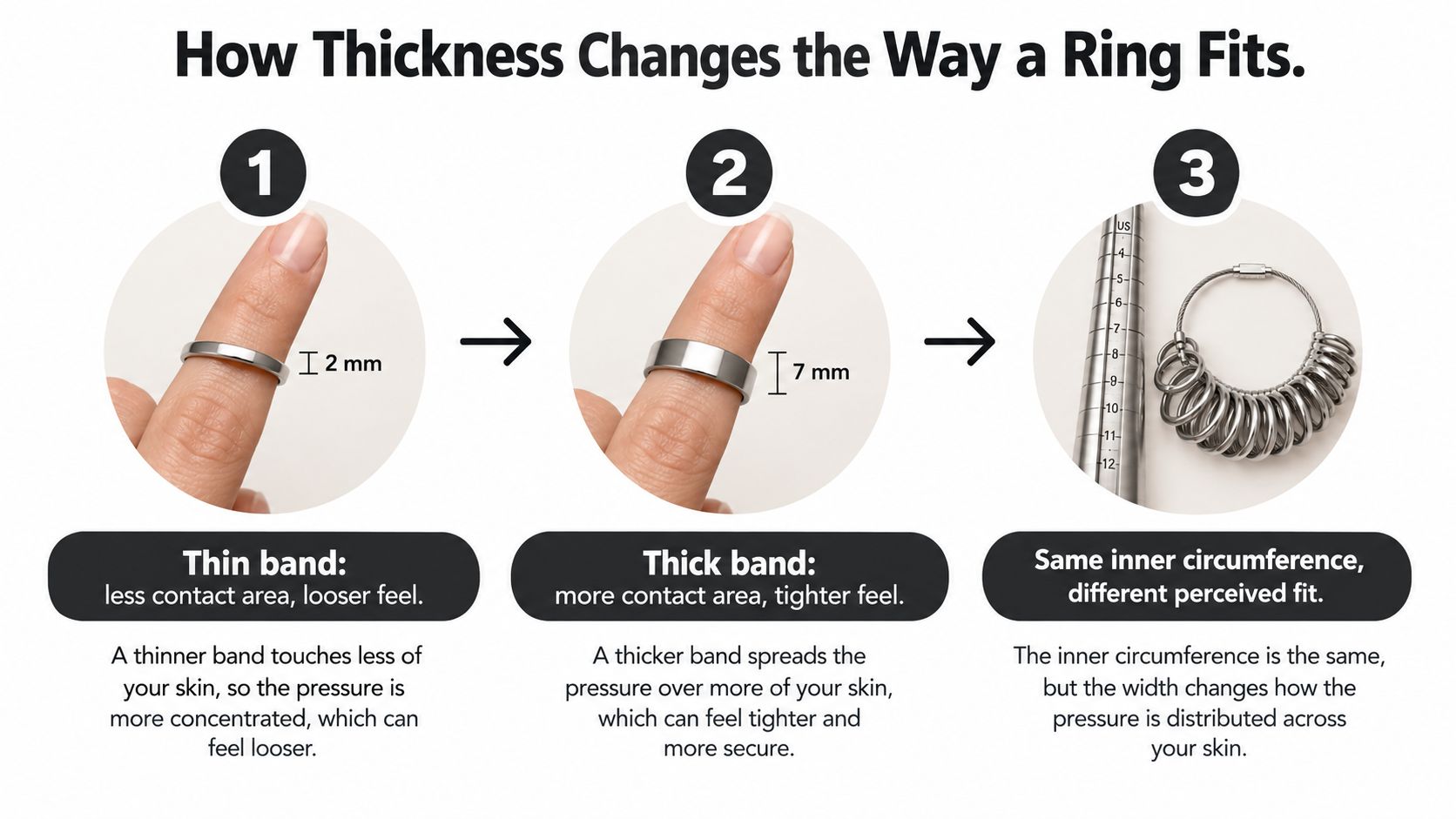
A ring size describes inner circumference, nothing more. It says nothing about how much of your finger the metal covers. A 7 mm band presses against far more skin than a 2 mm band at the same size, and it creates more friction at both edges when you slide it over your knuckle. Practical sizing guidance from Jewel Trend Pro notes that bands around 7 mm or wider may need roughly a half- to one-size increase for comfortable wear.
Treat that as a starting range, not a rule to apply blindly. Your knuckle size, finger shape, and the ring's interior profile can each change the answer. A comfort-fit interior, which is slightly domed inside instead of flat, reduces edge pressure and often passes the knuckle more easily. A flat interior grips more of the skin at once, so the same marked size can feel tighter.
Width-to-Size Adjustment Cheat Sheet
| Band Width | Sizing Adjustment | Reason |
|---|---|---|
| Under 4 mm | Start with your usual size | Contact area stays small |
| Around 7 mm or wider | Trial half to one size up | More coverage and friction |
| Any width, comfort fit | Judge by the finished profile | Domed interiors change the feel |
Measure late in the day, when your fingers are typically more expanded, and repeat the check more than once. Heat, exercise, and travel can all swell your hands, and a ring that slid on easily in a cool morning can refuse to come off by night. If you already own a wide ring that fits well, use it as your reference instead of a slim one, since the coverage is closer to what you're ordering.
The short video below walks through measuring technique visually, which helps if written steps feel abstract.
For written methods you can follow at home, this guide to finding your ring size covers the basics step by step. Gift buyers should borrow a ring the recipient already wears on the same finger, note its width, and avoid guessing from a slim band. Persistent deep marks, numbness, or a ring that needs soap and force to remove are signs the size is wrong, not signs you should push through.
Choosing Materials and Finishes That Last
A wide band puts more metal against your skin and more surface in harm's way, so material choice carries more weight here than it does on a slim ring. The comparison below frames the options you'll meet most often.
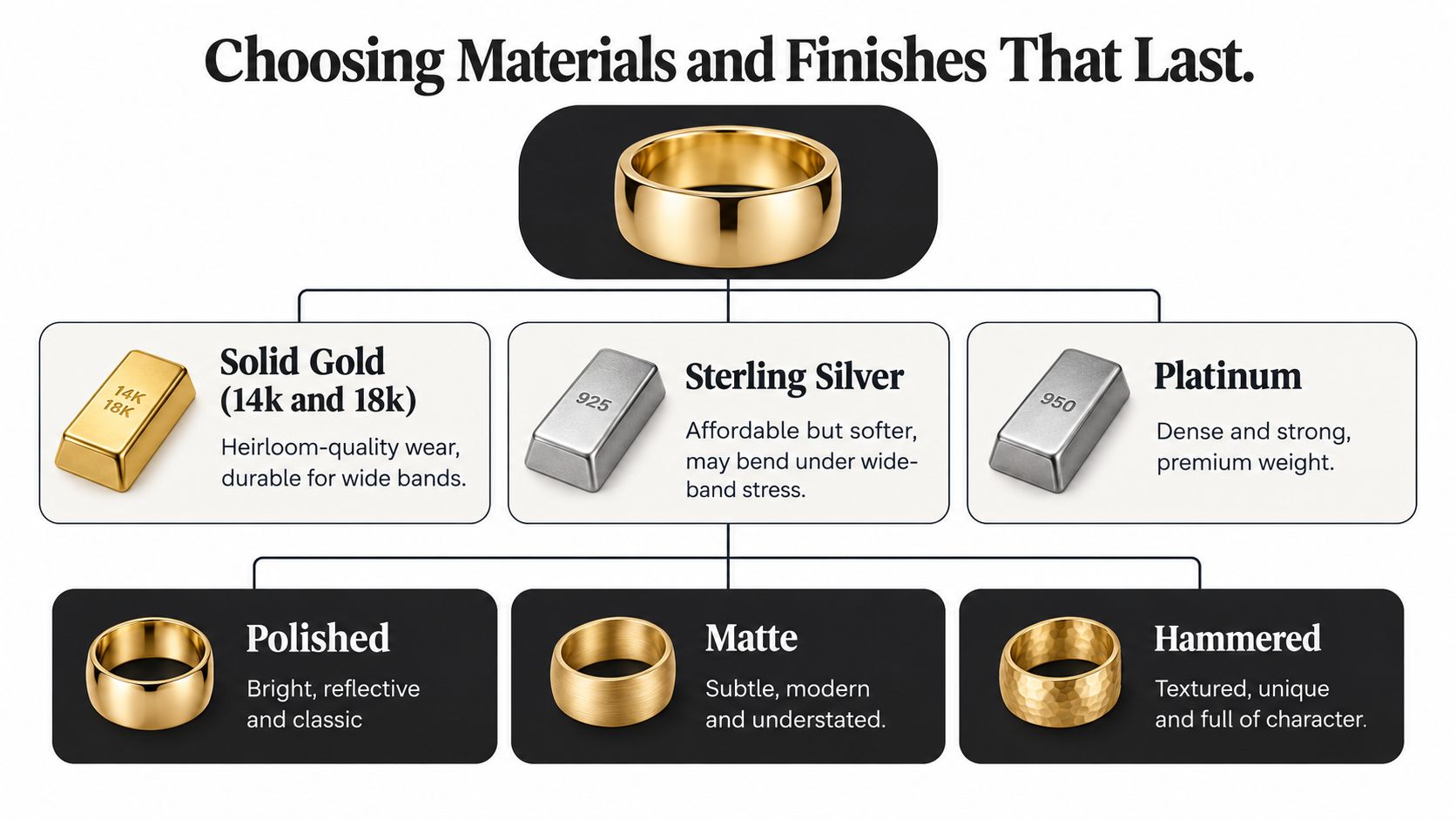
Solid gold in 14k and 18k suits a ring you plan to wear for years, since the color runs through the metal and scratches don't reveal a different layer underneath. Karat choice is its own decision, and this explanation of whether 10k gold is a good option helps if you're weighing lower karats against budget. Sterling silver costs less and looks bright, but it's softer, so a broad silver band can bend or dent sooner under daily knocks.
Platinum is dense and strong, with a naturally white color that doesn't rely on plating. Modern alternatives such as titanium and ceramic are light and hard wearing, but they can be difficult or impractical to resize, which makes your width-matched sizing work even more important before you order.
Why the Underside Decides Durability
Width alone doesn't tell you how long a ring will last. Heirloom quality guidance from Alexandria places approximately 1.8 to 2.0 mm as a practical minimum shank thickness for daily wear, with 2.0 to 2.5 mm more appropriate for men's rings, heavy use, or softer alloys. The palm side of the band takes repeated friction and bending, so a ring that's hollow, sharply tapered, or thin underneath can look substantial and still fail early.
Practical rule: Ask for minimum shank thickness, not just width. A broad ring with a thin underside is a wide ring, not a durable one.
Read plating descriptions with the same care. A gold-plated thick band and a solid gold thick band can look identical in a photo, but plating is a surface layer over a base metal. On a high-contact ring, that layer wears through faster at the edges and palm side, changing color where you grip and rub. Plated pieces make sense for occasional wear or testing a width. For daily wear, expect refinishing to become part of ownership.
Finishes follow the same logic. Polished surfaces show every fine scratch across a broad face. Matte finishes soften reflections but can polish shiny at contact points over time. Hammered textures hide wear best, since new marks blend into the existing pattern. Match the finish to how much visible wear you're willing to see each week, and among the ring collections at EP Fine Jewelry you'll find both everyday bands and statement styles organized for that kind of comparison.
Where and How to Wear a Thick Band
Styling a wide band starts with anatomy, not trends. Width decides how much of your finger the ring covers, so finger choice is a fit question before it is a fashion one: a broad band needs a long, straight base segment to sit without pressing against a joint. A quick home test helps before you buy online. Cut a paper strip to the width you're considering, wrap it around each candidate finger, and bend the finger fully. Wherever the strip pinches or buckles, a metal band will too. Interest in the look is clearly there, since 2025 fashion jewelry coverage from Gifts and Decorative Accessories reported search interest for chunky rings rising from 46 in July 2024 to 80 in January 2025, but popularity doesn't tell you which finger to choose.
Finger by Finger
- Index finger: The natural home for statement pieces, since it frames gestures and usually offers a long base segment.
- Middle finger: Balanced and centered, good for a daily wide band that shouldn't compete with rings beside it.
- Thumb: Suits bold, minimalist bands, but the thumb flexes constantly, so check comfort while gripping.
- Pinky: A lower-commitment option that reads as personality rather than a full statement, in the spirit of the old signet placement.
A shaped band shows how a broad format can still feel playful rather than severe.
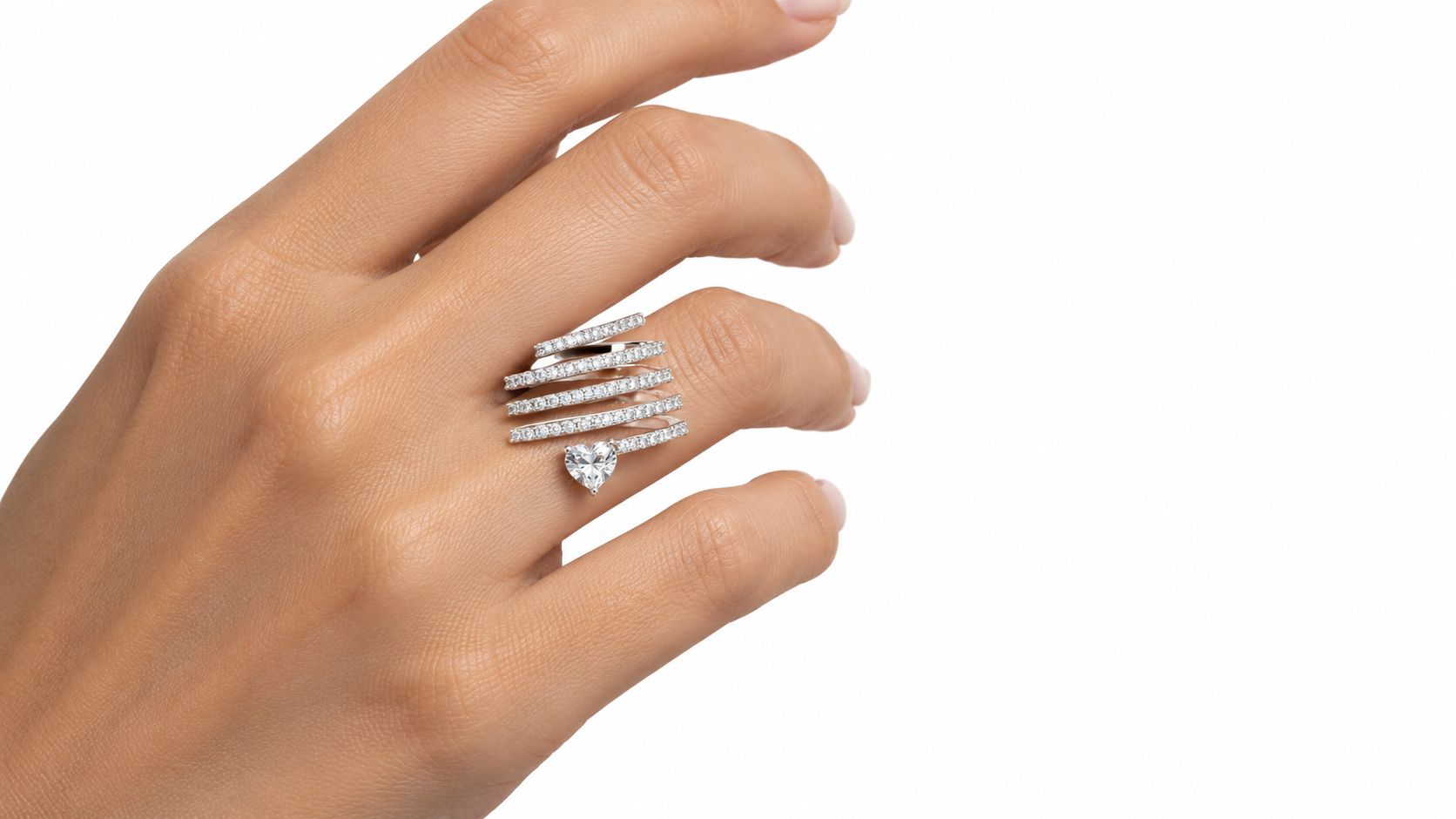
The Pave Heart Spiral Ring is one example: a spiral band with a 4mm heart, offered in six variants across gold-plated, rhodium, gold, CZ, and silver finishes. A shaped band like that works best solo, where the silhouette stays readable.
Stacking Without the Squeeze
Two slim bands usually stack more comfortably than two thick ones, because combined width behaves like one very wide ring on your finger. Two 4mm bands side by side occupy the same finger real estate as a single 8mm band, and your knuckle will notice. If you love layered looks, these ring stacking ideas show combinations that keep proportions in check. Pair one thick band with one slim band rather than doubling the width, and repeat each metal tone at least twice across your hands so the mix looks planned.
For office and casual days, a single matte or brushed band reads polished without catching light in every meeting. For evenings, a high-polish or stone-set wide band can replace several smaller pieces at once. Shorter nails tend to suit broader bands visually, since the ring doesn't compete with nail length, while longer nails often balance better with a slightly narrower width. Watch stacks and hand tattoos follow the same principle. Give the widest element room, and let everything else support it.
Caring for a Thick Band So It Keeps Its Look
A wide band collects more of daily life than a slim one does. Soap, lotion, and sweat settle under that broad surface and stay damp longer, so your routine needs to include drying, not just cleaning. The store's own jewelry care instructions are worth saving before your ring arrives.
When to Take It Off
Remove thick band rings at the gym, in the pool, and during household cleaning, where grips, chlorine, and chemicals punish both metal and finish. Take a snug band off before sleep as well, since hands can swell overnight. After washing your hands with the ring on, slide it up, dry the skin underneath, and slide it back. That ten-second habit prevents most of the dullness and irritation owners blame on the metal.
Clean by material. Solid gold and platinum tolerate warm water, a drop of mild soap, and a soft brush along the edges. Sterling silver needs the same gentle wash plus dry storage to slow tarnish. Plated finishes should skip soaking and abrasive cloths, since friction thins the surface layer you're trying to preserve. Color showing through at the edges, a shank that feels thinner on the palm side, or a band that's gone out of round are jobs for a jeweler, not harder polishing at home.
Allergy or Simple Irritation
Because a thick band touches more skin continuously, material labels matter here. Dermatology guidance on jewellery allergy from DermNet explains that nickel is a frequent cause of allergic contact dermatitis and that rings can trigger reactions on the fingers, including itching, redness, blistering, dryness, or thickened skin. Symptoms may appear after delayed exposure rather than right away, which is why a ring can seem fine for days before trouble starts.
A hypoallergenic label alone doesn't guarantee a match for your skin. The exact alloy and what sits under any plating matter more than the label.
Don't confuse allergy with irritation. Redness that fades once you remove the ring, wash, and dry the finger often points to trapped soap or moisture. Blistering, spreading redness, or symptoms that return every time you wear the piece point the other way. Stop wearing it and seek medical guidance, since patch testing can confirm the allergen.
Finish with storage. Keep wide bands in separate slots or pouches so broad faces don't scratch each other, and rotate which ring you wear daily so each piece rests. A quick seasonal check of fit, edges, and finish takes minutes and catches wear while it's still cheap to fix.
If you're ready to compare widths with your new sizing notes in hand, EP Fine Jewelry offers rings that range from everyday bands to personalized statement pieces you can make your own. Browse the ring collections, pick the width that fits your finger and your routine, and add a gift box at checkout if the ring is headed to someone else.