
You're comparing bangles online, and the product page gives you a choice between S, M, and L, while another seller lists an inner diameter in millimeters and a third uses numbered sizes. Your wrist measurement seems clear, yet you still can't tell whether the bangle will pass over your hand, sit comfortably, or become an expensive return.
The problem isn't that you're bad at measuring. Bangle sizing uses different reference points, units, and naming systems, and rigid designs create less room for error than flexible bracelets. This guide treats the process like a jeweler would: measure the hand first, translate the result carefully, then adjust for the construction and the fit you want.
Table of Contents
- Why Bangle Sizing Feels Harder Than It Should
- What Makes a Bangle Different From Other Bracelets
- How to Measure Your Hand for the Right Bangle
- The Core Bangle Bracelet Size Chart in Inches and Millimeters
- How Size Bands Map to Numbered Sizes Across Brands
- Snug Versus Loose Fit and When to Size Up
- Matching Bangle Styles to the Right Fit Strategy
- Converting Between Regional Size Charts Without Guessing
- Common Sizing Mistakes and Quick Fixes
- Caring for Bangles So the Fit Stays Right
Why Bangle Sizing Feels Harder Than It Should
You are buying a bangle as a gift. One seller offers S, M, and L, another lists inner diameter in millimeters, and a third uses numbered sizes. The recipient's wrist may be easy to estimate, yet the bangle can still fail at the hand or feel uncomfortably loose.
The confusion comes from overlapping chart systems. Some charts describe wrist ranges, while others use inner diameter, hand circumference, letters, or numbered labels. Tiffany's guide lists seven wrist ranges, beginning at 4.76 to 5.25 inches and extending to 7.76 to 8.25 inches, showing why a single “standard” size cannot cover every wearer (Tiffany's bracelet size guide).
For a closed bangle, sizing starts with the hand. The wrist is the destination, but the hand is the doorway. A narrow wrist does not guarantee that a rigid circle will pass over the widest part of the hand, so wrist-only sizing can produce a piece that looks suitable yet cannot be worn.
This guide will help you:
- Measure accurately: Use your hand, a paper strip, or a well-fitting bangle as a reference.
- Read multiple charts: Compare inches, centimeters, millimeters, letters, and numbered systems without assuming the labels match across brands.
- Choose fit tolerance: Allow differently for rigid, hinged, cuff, charm, and stacked designs.
- Fix a poor fit: Separate measurement errors from construction limits and chart mismatches before requesting an exchange.
If you are buying a rigid bangle, begin with the hand measurement. If you already have hand circumference, use the core chart. Gift buyers should also check regional conversions and borderline sizes before ordering.
What Makes a Bangle Different From Other Bracelets
A bangle is usually a rigid, circular bracelet that must slip over the hand. A chain bracelet wraps around the wrist and closes with a clasp. A stretch bracelet expands over the hand and then contracts around the wrist. A cuff has an opening, so the wearer doesn't need to pass the entire hand through a closed circle.
That physical difference changes the measurement point. For a chain or clasp bracelet, wrist circumference is the starting measurement. For a solid bangle, the important passage is the hand's widest shape, usually around the knuckles when the thumb is tucked toward the palm. The bangle's inner diameter, not its outside length, determines whether that passage is possible.
Ring sizing is different too. A ring measures the circumference of a finger, while a bangle must clear a hand that changes shape as the fingers and thumb come together. A bangle can therefore be the right size for your wrist and still fail at the hand.
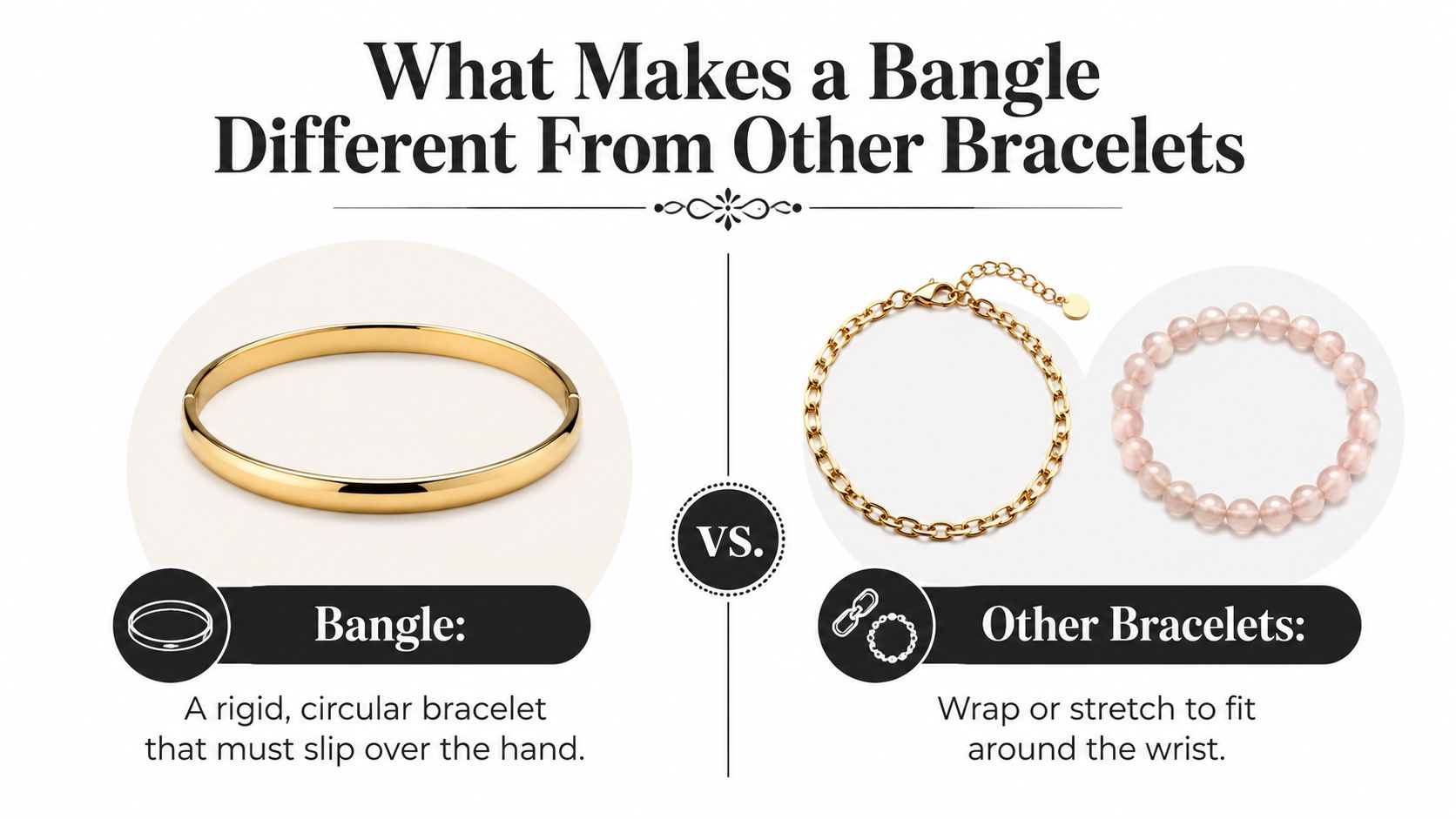
The three styles to identify
- Solid rigid bangles have no opening. They need enough clearance to pass over the hand.
- Hinged bangles open with a clasp, so they can fit closer to the wrist because the hand doesn't pass through the full circle.
- Charm or openwork bangles may have interior decoration, spacers, or charms that reduce practical clearance even when the listed diameter looks generous.
The rest of your decision depends on which of these constructions you're buying. A closed bangle needs the most attention to hand width. A hinged design shifts attention toward wrist comfort, while a charm style needs room for both the hand and the decorations.
How to Measure Your Hand for the Right Bangle
You can measure at home with a flexible tape. If you don't have one, use a narrow strip of paper or ribbon and a ruler. Measure the hand that will wear the bangle, because the dominant and non-dominant hands may not have identical contours.
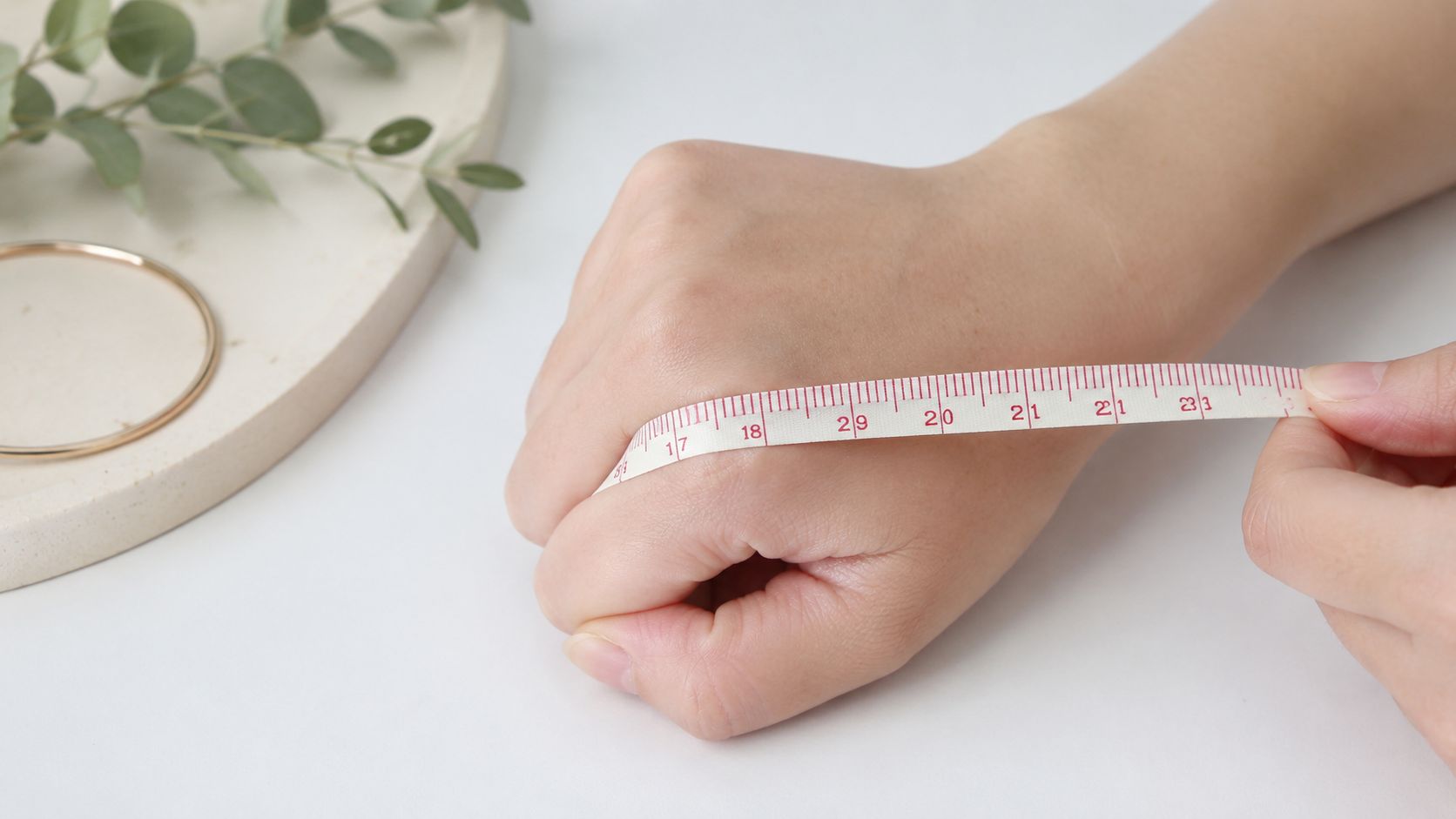
Method one measures the hand directly
- Shape your hand as if putting on the bangle. Tuck your thumb across the palm and bring the little finger inward toward the base of the thumb. Don't spread your fingers.
- Wrap the tape around the widest part. Keep it around the knuckles and the folded thumb area, not around the wrist.
- Keep the wrap firm but not compressed. The strip should touch the hand without digging into the skin.
- Mark the overlap. With paper or ribbon, mark where the end meets the wrapped section.
- Read the result. Measure the strip in inches, centimeters, or millimeters. Round consistently, ideally to the nearest eighth inch or whole millimeter.
- Repeat once. If the second result differs noticeably, reshape the hand and measure again rather than averaging a careless wrap.
The reason this works is mechanical. The hand must fit through the bangle's opening, so the circumference around that folded shape gives you a more useful starting point than the narrow wrist.
For a second method, lay an existing bangle that fits well on a flat surface and measure its inside diameter across the center. Measure from inside edge to inside edge, not from the outside of the metal. If the seller lists circumference instead, compare that figure with the chart rather than comparing it to a ring size.
A bangle-sizing reference from A1 Jewellers pairs 2.00 inches, or 51 mm, of internal diameter with 6.28 inches, or 160 mm, of circumference, and gives further diameter-to-circumference examples for larger openings (A1 Jewellers bangle size guide). Use these relationships as a comparison aid, but still check the hand's widest passage for a rigid design.
The video below demonstrates the hand-measurement process visually.
The Core Bangle Bracelet Size Chart in Inches and Millimeters
You have measured a folded hand in inches, but the product page lists only millimeters. Use the chart below as a translation tool. It places hand circumference, inner diameter, centimeters, and millimeters side by side, so a gift buyer can compare measurements even when regional chart systems overlap.
| Size | Hand Circumference (in) | Inner Diameter (in) | Inner Diameter (cm) | Inner Diameter (mm) |
|---|---|---|---|---|
| XS | 6.28 | 2.00 | 5.1 | 51 |
| S | 6.68 | 2.13 | 5.4 | 54 |
| M | 7.06 | 2.25 | 5.7 | 57 |
| M Plus | 7.85 | 2.50 | 6.4 | 64 |
| L | 8.24 | 2.63 | 6.7 | 67 |
| XL | 8.63 | 2.76 | 7.0 | 70 |
These rows are reference points, not a universal brand standard. A seller may label the same opening with a letter, a number, or a direct diameter. Match the measurement itself before trusting the label.
Which column matters most
For a solid rigid bangle, read the hand-circumference and inner-diameter columns together. Hand circumference represents the folded shape that must pass through the opening. Inner diameter represents the opening's width, like comparing a doorway with the object moving through it. Both checks help prevent a bangle that looks correct on paper but cannot pass over the knuckles.
For a hinged bangle, the hand usually does not pass through the closed opening. In that case, inner diameter is less decisive. Check wrist comfort, the hinge, and where the clasp rests instead.
Unit systems create another source of confusion. US listings may use inches, while European and Asian listings often use millimeters. Convert the actual measurement, not the size letter. Near a boundary, even a small millimeter difference can change the fit.
If you are checking ring measurements too, keep that reference separate. A ring size guide explains finger circumference, but ring size does not determine the opening needed for a closed bangle.
How Size Bands Map to Numbered Sizes Across Brands
Bangle sellers commonly use letter bands, product-specific numbers, or direct diameter measurements. A letter such as Medium may describe a range, while a number may refer to an internal diameter, a circumference, or a regional convention. Without checking the measurement definition, the same label can point to different physical openings.
A useful starting comparison is the fit-band system published by Dubai Jewellers. It lists Very Small at 54.0 mm and 6.67 inches, Small at 57.0 mm and 7.06 inches, Medium at 60.0 mm and 7.45 inches, Medium Plus at 64.0 mm and 7.85 inches, Large at 67.0 mm and 8.24 inches, and X-Large at 70.0 mm and 8.63 inches (Dubai Jewellers bangle size chart).
| Size Band | US Numeric | EU/UK Numeric | Typical Diameter (in) | Typical Diameter (mm) |
|---|---|---|---|---|
| Very Small | 6.5 | 54 | 2.13 | 54 |
| Small | 7 | 57 | 2.25 | 57 |
| Medium | 7.5 | 60 | 2.36 | 60 |
| Medium Plus | 8 | 64 | 2.50 | 64 |
| Large | 8.5 | 67 | 2.64 | 67 |
| X-Large | 9 | 70 | 2.76 | 70 |
This table is a cross-reference, not a promise that every brand uses these numbers. Designer and artisan sellers may define S, M, and L around their own molds. Some stackable bangles also use a diameter-based number, while cuffs may use wrist measurements and opening dimensions instead.
When a listing shows only one system, look for the product's actual inner diameter or circumference. If the seller provides neither, ask before ordering. For a known bangle that fits, measure its inner diameter and request the closest physical match rather than assuming another brand's Medium will be equivalent.
Snug Versus Loose Fit and When to Size Up
A good bangle should feel secure without trapping the hand. A snug fit rotates slightly at the wrist without pinching. A loose fit passes over the knuckle with little resistance and moves more freely after it reaches the wrist. A tight bangle requires force, catches at the hand, or leaves uncomfortable pressure.
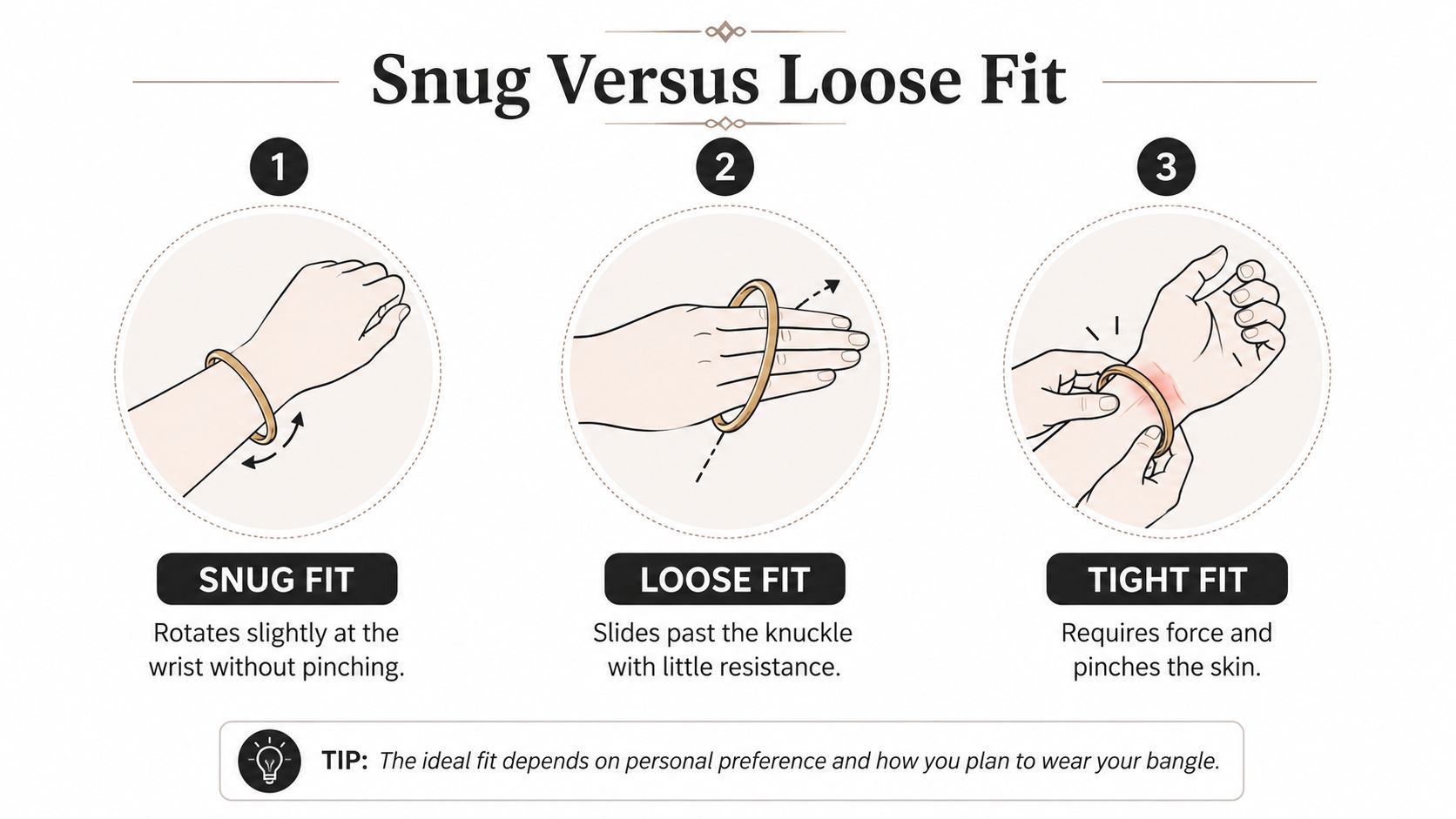
The right choice depends on construction. A rigid closed bangle needs enough opening to clear the hand. A hinged bangle can sit closer to the wrist because its clasp provides access. A charm bangle may need extra room because charms add bulk and can pull the piece toward the hand.
A practical decision rule
Measure the widest part of the hand in the shape used for putting on the bangle. Then compare that measurement with the seller's listed internal circumference or diameter.
- If the result sits comfortably within one band, choose that band and select the fit the design permits.
- If the result falls between two bands, choose the larger opening for a rigid bangle.
- If the wearer has swelling, prominent knuckles, arthritis, or a dominant hand that measures larger, avoid choosing the smaller borderline size.
- If a charm-heavy design will be worn with additional pieces, allow more interior movement so the decorations don't crowd the wrist.
Borderline rule: For a rigid bangle, the safer choice is generally the next size up when your measurement falls between chart bands. A slightly loose bangle can move, but a closed bangle that can't pass over the hand can't be worn.
A hinged bangle is the exception to the hand-clearance rule, not because fit stops mattering, but because the hinge changes how the piece is put on. You can use the wrist as a comfort reference after confirming that the clasp opens wide enough and doesn't press into the skin.
For style context, a diamond bezel tennis bracelet guide addresses a flexible bracelet format, which should not be sized using the same logic as a rigid closed bangle.
Matching Bangle Styles to the Right Fit Strategy
The phrase “bangle size” doesn't describe one construction. Before choosing a row from a chart, identify how the bracelet opens, where its decoration sits, and whether you'll wear it alone or with other pieces.
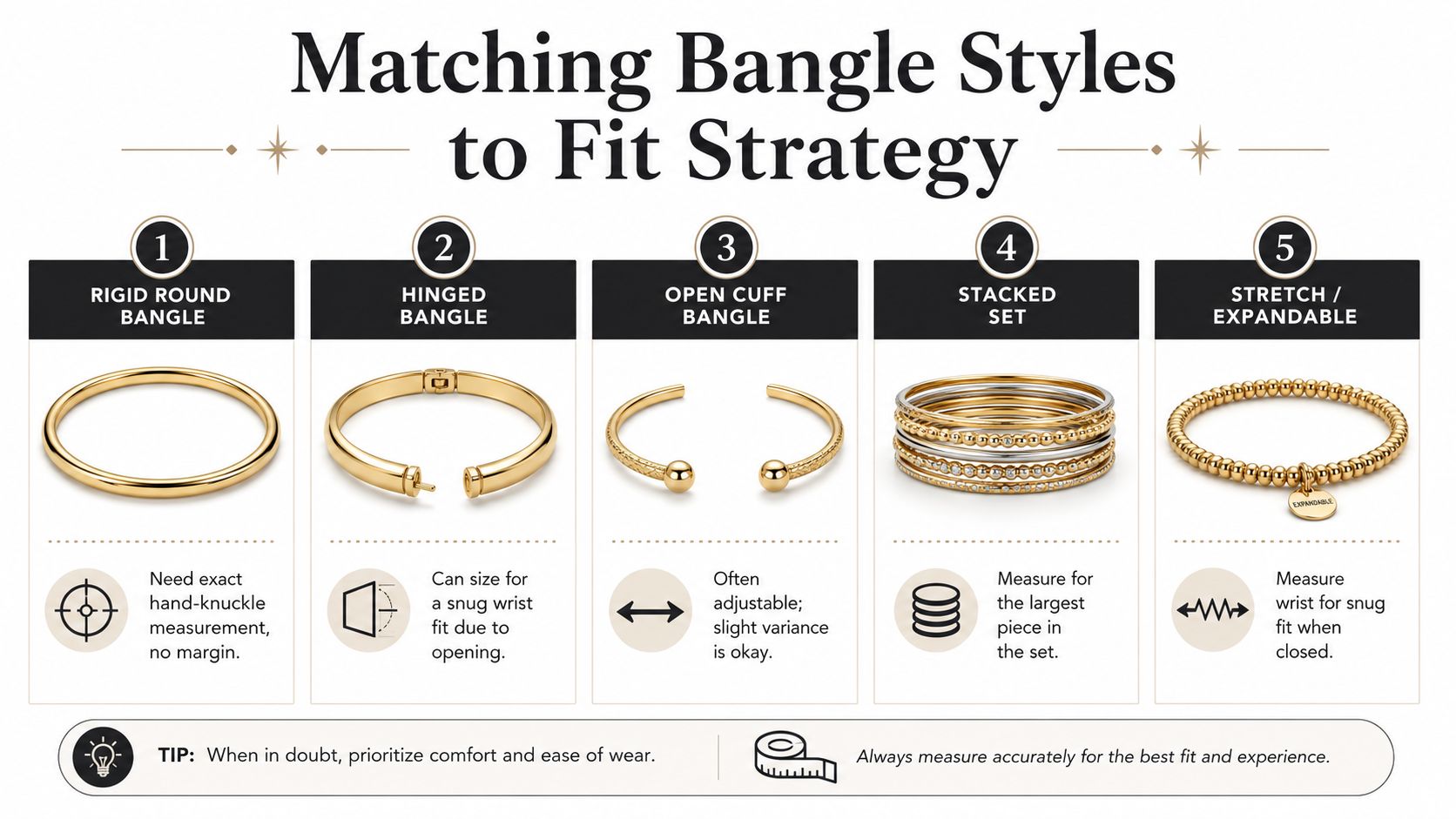
Solid round bangles
A solid round bangle has no hinge or opening. Match the hand-knuckle measurement to the closest internal diameter, then check that the opening won't catch on the widest part of the folded hand. Don't add a wrist-based allowance, because the critical test happens before the bangle reaches the wrist.
Hinged bangles
A hinged piece opens, so it can be selected for a closer wrist fit. Check the closed inner diameter, clasp security, and hinge movement. The bangle should close without pressing into the wrist, and the hinge shouldn't pinch when the hand moves.
Open cuffs
An open cuff can usually tolerate more variation because the gap changes access. Start with the wrist, then check the opening and the metal's adjustment limits. Avoid repeatedly forcing the cuff wider or narrower, since frequent bending can weaken the form.
Charm bangles
Charm styles need room for the hand and the decorations. Charms can catch at the knuckles, add thickness inside the circle, or pull the bangle off-center. Choose the larger option when the charm arrangement makes the interior feel crowded.
Stacked sets
Measure for the largest or least flexible piece in the intended stack. A group that fits one piece at a time may become difficult to put on if the widest component catches on the hand. If the seller gives measurements for each piece, compare all of them rather than relying on the set's shared size label.
The same principle applies when you're choosing a personalized design. If an engraved piece is part of your plan, review the engraved bangle information alongside the sizing details, because the decoration and construction may affect how the bangle rests.
Converting Between Regional Size Charts Without Guessing
A gift buyer may receive three different answers for the same bangle: a letter band, a numbered size, or a measurement in centimeters. These systems can overlap, but they do not always measure the same place. A reliable conversion starts with the hand measurement used for a rigid bangle, then checks the seller's definition of “size.”
One independent guide lists hand and wrist-related ranges from 13 to 13.9 cm through 19 to 19.9 cm, alongside fit options of 15, 16, 17, 18, 19, 20, and 21 cm (The Jewellery Room bangle size guide). Treat those figures as that guide's system, not as a universal code. Another brand may describe a band by inner diameter, while a marketplace may use hand circumference or a named mold size.
Use this translation order:
- Identify what the listing measures: hand circumference, inner diameter, wrist circumference, or a regional label.
- Convert units before comparing. Centimeters describe a distance around the hand; millimeters describe a straight measurement across the opening.
- Compare the hand measurement with the bangle's inner opening. A wrist figure alone cannot confirm that a rigid circle will pass over the knuckles.
- Ask the seller which chart the label follows if the listing gives only a number.
| US/UK Band | Indian/Asian Size | Inner Diameter (mm) | Inner Diameter (inches) | Wrist Circumference (in) |
|---|---|---|---|---|
| Very Small | 2 | 54 | 2.13 | 6.67 |
| Small | 2.25 | 57 | 2.25 | 7.06 |
| Medium | 2.5 | 60 | 2.36 | 7.45 |
| Medium Plus | 2.75 | 64 | 2.50 | 7.85 |
| Large | 3 | 67 | 2.64 | 8.24 |
| X-Large | 3.25 | 70 | 2.76 | 8.63 |
This comparison uses Dubai Jewellers' fit-band measurements. Its Indian or Asian column illustrates a diameter-style relationship, not a universal regional standard. For a closer check, measure a bangle the recipient already wears across its inside, then match that result to the new seller's units.
Gift buying and borderline results
If borrowing a bangle is impossible, ask for a folded-hand measurement rather than the recipient's usual bracelet size. A rigid style should generally be rounded up when the result sits between bands, because the opening must clear the knuckles. Hinged and open designs follow different fitting rules, so confirm the construction before converting.
A necklace length chart measures a different part of the body and should not be used to calculate bangle size. If the regional label remains unclear, choose a seller with an exchange policy and keep the original packaging until the fit is confirmed.
Common Sizing Mistakes and Quick Fixes
Most sizing problems come from using the right tool at the wrong location. Use this quick diagnostic list before ordering or returning a piece.
- Measuring the wrist: If you wrapped the tape only around the wrist bone, you likely measured the narrowest point. Repeat the test around the folded hand and knuckles.
- Measuring over clothing: Fabric adds space that the bangle won't have on bare skin. Measure directly on the hand.
- Using a flexible bracelet chart: Chain and stretch charts describe wrist fit. A rigid bangle needs hand clearance and inner diameter.
- Ignoring the construction: A hinged bangle and a solid circle don't go on the same way. Check whether the piece opens before selecting a size.
- Trusting a recipient's guess: People often know their bracelet size but not their bangle size. Ask for a measurement around the folded hand or borrow a well-fitting bangle.
- Skipping the tolerance check: A number can match a chart and still feel wrong if the wearer has swelling, prominent knuckles, or a preference for movement.
If the bangle arrives too tight, don't force it over the hand. Test the listed inner diameter against a paper circle or a rolled paper tube that matches the opening. If it's too loose, check whether the style is designed to move freely before assuming the size is incorrect. A rigid piece that slides excessively may need an exchange, while an open cuff may be adjusted according to the maker's instructions.
Caring for Bangles So the Fit Stays Right
Care affects how a bangle feels over time. Water, sweat, lotion, and perfume can tarnish metal, stiffen hinged joints, or weaken elastic in expandable designs. Remove bangles before showering, swimming, applying lotion, or doing heavy manual work.
Wipe the surface with a soft cloth after wearing it, and store rigid bangles flat rather than forcing them into a crowded stack. Check hinge pins and clasps periodically for looseness, and stop wearing a piece if the closure no longer feels secure.
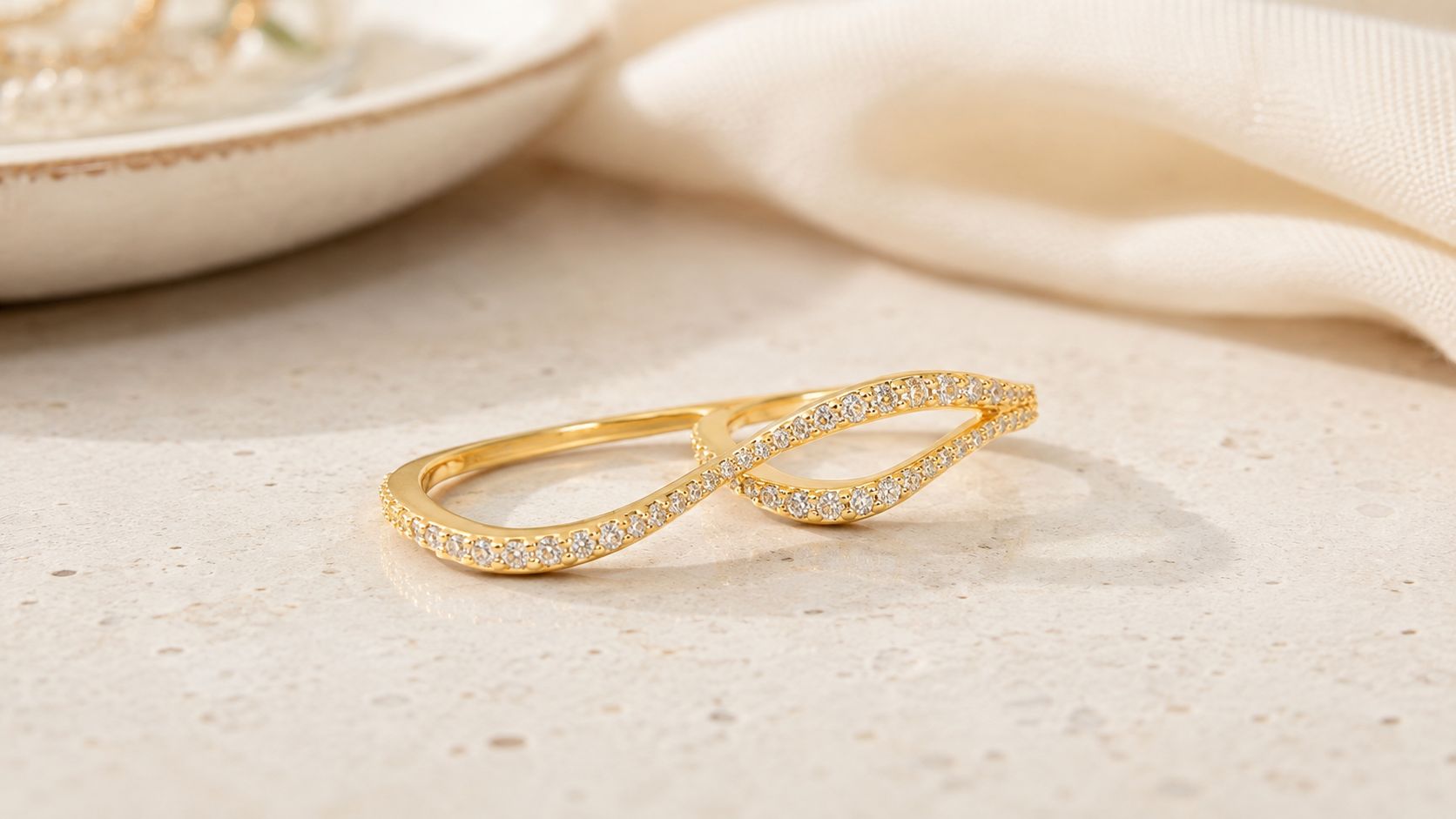
For cleaning guidance, use EP Fine Jewelry's at-home jewelry cleaning guide. A different fit problem applies to the Two Finger Twist Ring, which fits on two fingers and should be chosen using the smaller size; its listed options include size 6/7 and size 7/8, with 18K gold-plated and CZ materials.
When a hinge, clasp, or rigid frame changes shape, professional inspection or resizing is safer than bending it at home. A well-maintained bangle should continue to match the hand measurement and fit tolerance you selected.
For a bangle that matches your measurements, explore the bracelets, bangles, personalized jewelry, and gift options at EP Fine Jewelry. Use the product measurements and care guidance to choose confidently, and contact the store before ordering if a design's opening or sizing label isn't clear.