
You're standing in front of a jewelry display, drawn to a pair of polished hoops with tiny charms that move whenever the light catches them. They look easy to wear, but a few practical questions quickly appear. Will the charm pull on your earlobe? Is the connector strong enough for daily use? Could the metal irritate sensitive skin?
Hoop earrings with charms combine a familiar silhouette with a personal detail, so the best pair has to do more than look attractive. Weight, attachment, alloy composition, and nickel release all affect whether the earrings remain comfortable after the first outing. The style also has a surprisingly deep history, which makes its appeal feel less like a passing novelty and more like a modern version of an enduring jewelry idea.
Table of Contents
- Introduction to Hoop Earrings with Charms
- Materials, Alloys, and Durability
- How Charms Attach to Hoops
- Choosing the Right Size and Style
- Styling and Layering with Other Jewelry
- Skin Safety and Nickel Release
- Caring for Your Hoop Earrings with Charms
Introduction to Hoop Earrings with Charms
A simple hoop already gives an outfit movement and shape. Add a small pendant, bead, initial, gemstone, or symbolic charm, and the earring becomes more expressive without abandoning the clean circular form. You can wear one charm for a quiet personal reference, change charms to match an outfit, or choose a pair whose meaning matters as much as its color.
The design relationship is ancient. The Brooklyn Museum's gold hoop earring from the Early Dynastic IIIA period dates to approximately 2600–2500 BCE, making the form more than 4,500 years old. The piece measures only 1.1 cm in diameter, a useful reminder that early hoops weren't limited to dramatic, oversized silhouettes.
The same museum discusses ancient Egyptian amulets as miniature magical objects associated with protection, fertility, childbirth, or devotion to deities. That context creates a meaningful precedent for modern charm hoops. The hoop supplies the visible structure, while the attached element carries identity, symbolism, or sentiment.
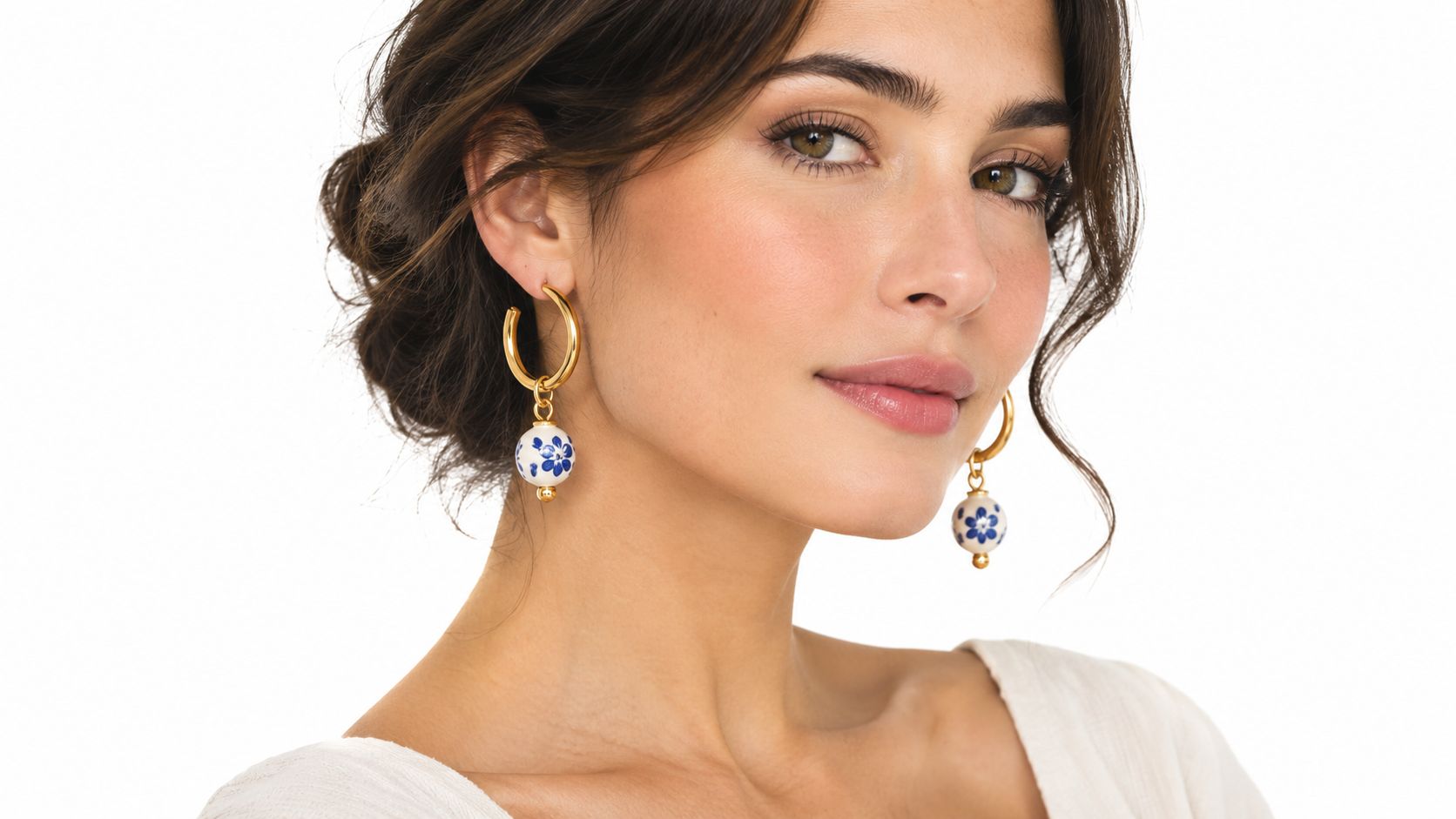
Decorated hoops also developed through later jewelry traditions. The Metropolitan Museum of Art's Ostrogothic examples date to the fifth and sixth centuries CE and show hoops with distinctive fourteen-sided terminal beads. Some used gold or silver, while others included semiprecious stones or glass.
That history helps explain why charm hoops feel so versatile today. They're not just hoops with something dangling from them. They're a framework for adding material, color, movement, and meaning. Before choosing a pair, though, look closely at what holds that decorative element in place.
You can also compare charm hoops with other formats in this guide to different types of earrings.
Materials, Alloys, and Durability
A charm hoop has a structural job that a plain hoop doesn't. The circular wire must support its own shape while the hinge, soldered joint, and connector handle the repeated movement of a suspended charm. The central trade-off is durability versus weight. A charm that swings or catches on clothing places extra stress on the parts that open, close, and connect.
Why alloy composition matters
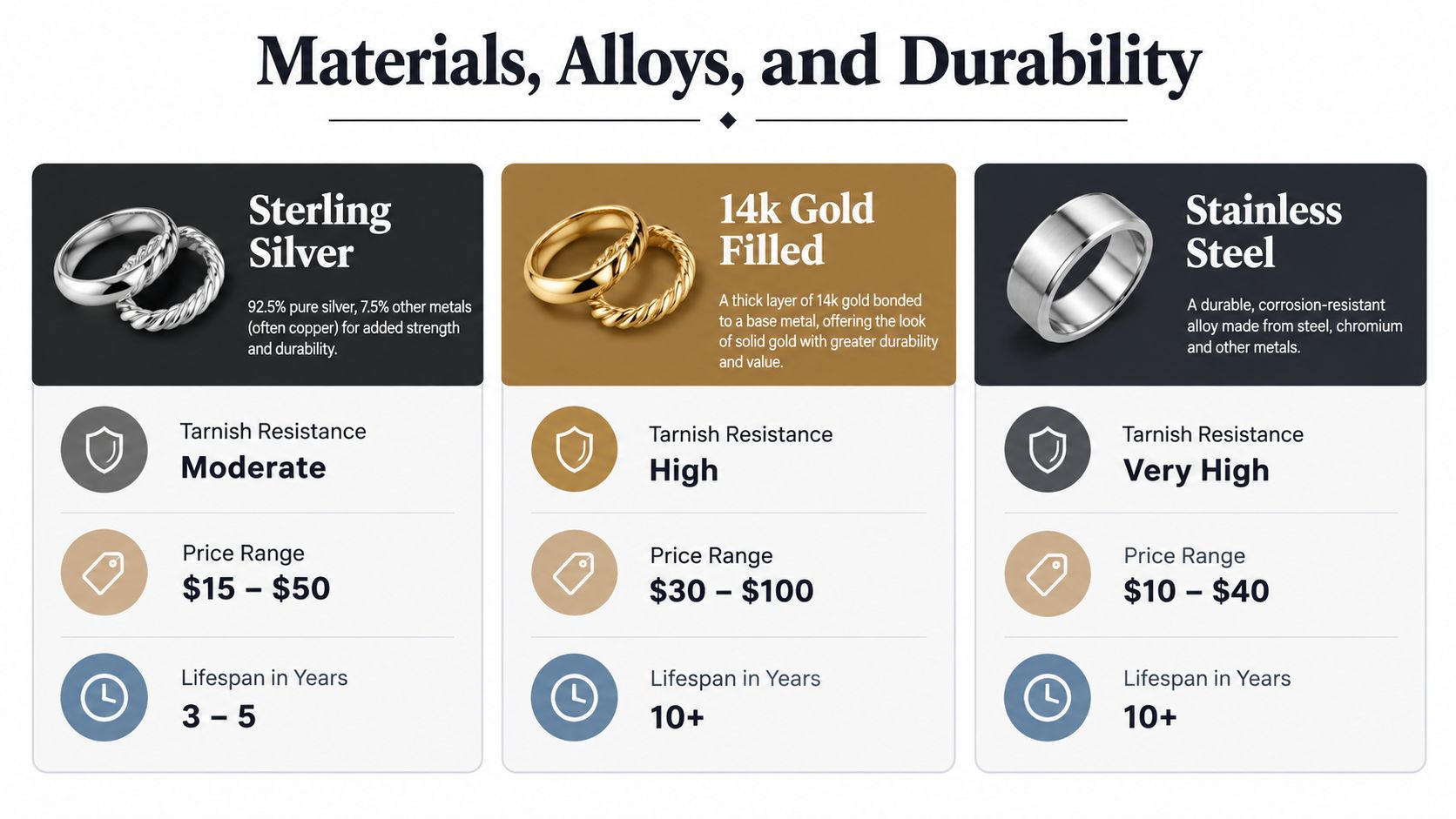
Nearly pure gold is soft. Reported Vickers hardness for 99.99% gold is approximately 25–30 HV, while many 14K and 18K alloys measure about 150–250 HV according to engineering data on gold alloys. Vickers hardness is a measure of resistance to indentation, but it also helps explain everyday behavior. A harder alloy is generally better suited to components that repeatedly rub, flex, or meet one another at a closure.
That doesn't make a harder alloy automatically better for every wearer. The finish, construction, thickness, and alloy ingredients all matter. A product page that says only “gold” leaves out information you need for a sensible comparison.
What to check before buying
Look for the karatage and alloy type, especially if the earrings will be worn often. A thicker hoop can resist bending better than an extremely fine one, but added thickness may also increase total weight. The charm and connector should be proportionate to the hoop diameter and wire size rather than treated as separate design decisions.
Practical rule: Choose a hoop with a secure connector, smooth edges, and enough structural strength for the charm you actually plan to wear.
A removable charm offers another durability advantage. If the charm is damaged, lost, or no longer suits your outfit, you may be able to replace that element without discarding the hoop. This makes modular construction useful for both styling and long-term ownership.
For plated or coated finishes, inspect areas exposed to friction first. Hinges, posts, jump rings, and the inner surface of a hoop experience more handling than the decorative face. Guidance on rhodium-plated sterling silver can help you understand why the visible finish isn't the whole durability story.
How Charms Attach to Hoops
The attachment method determines whether a charm feels like a dependable part of the earring or a fragile accessory waiting to separate. Most designs use a jump ring, a small metal ring that passes through a loop on the charm and either around the hoop or through a dedicated attachment point.
Inspect the connection
Start by looking at the jump ring from the side. Its ends should meet cleanly, without a visible gap or misalignment. A slightly open ring can catch on hair and fabric, and repeated movement can enlarge the gap until the charm slips free.
A soldered loop offers a more permanent connection. It can be strong when properly made, but it gives you less flexibility if you want to change the charm. Clip-on or hinged attachments are convenient for removable styling, yet they need a closure that stays shut during ordinary movement.
Match the attachment to your routine
A charm that you'll wear occasionally can use a lighter, more decorative attachment if you handle it carefully. For everyday wear, prioritize a closed or securely soldered connector with no sharp edges. The connector should also be large enough for the charm to move freely without pinching the hoop.
Use this quick inspection before purchase or first wear:
- Check the closure. Open and close the hoop gently. It should align without forcing the post or latch.
- Examine the ring. Look for a clean join and a connector that doesn't wobble excessively.
- Run a fingertip around the charm. Sharp edges can snag hair, clothing, or skin.
- Test removability. If the charm is intended to be interchangeable, confirm that you can detach it without bending the hoop.
- Watch the movement. The charm should swing without striking the closure repeatedly.
Different closures suit different designs, so this guide to earring clasp types can help you compare the hardware more confidently. A beautiful charm can't compensate for a weak connection.
Choosing the Right Size and Style
Size affects both appearance and comfort. A small hoop with a compact charm can look refined and stay close to the ear, while a large hoop with a moving pendant creates a more noticeable outline around the face. Diameter, wire thickness, and charm mass work together, so don't choose any one measurement in isolation.
The most important surprise is that movement changes perceived weight. A light charm hanging far from the ear can tug more noticeably than a heavier charm that sits close to the hoop. A freely swinging pendant also creates more pull as you walk, turn your head, or catch it on a scarf.
Compare the combinations
| Hoop Diameter | Charm Weight Range | Best For |
|---|---|---|
| Small | Very light | Workdays, commuting, subtle personalization, and first-time charm wearers |
| Medium | Light to moderate | Versatile everyday styling, casual outfits, and controlled layering |
| Large | Light to moderate, with careful balance | Statement looks, evening outfits, and occasions when the earrings are the focal point |
The table gives you a starting framework, not a universal rule. An ergonomics paper on everyday earrings reports a general recommendation of staying below roughly 7 g per ear, while other guidance cited in the same paper places discomfort around 10 g. The paper also identifies pendulum earrings as more vulnerable to movement-related trauma and cautions against them for people with thin or previously torn earlobes. Read the design-focused ergonomics research on earring comfort for the underlying discussion.
Match the pair to your day
For commuting or desk work, choose a small or medium hoop with a compact charm that doesn't swing widely. For exercise, remove dangling earrings rather than relying on a secure clasp alone. Sleeping in charm hoops can increase snagging and pressure, particularly if the charm moves behind the ear.
If you're shopping online, look for separate hoop weight, charm weight, and total per-ear weight. A transparent product description makes it much easier to compare a quiet everyday combination with a dramatic statement pair. You can also use this hoop earring size guide to think about diameter and proportion before adding the charm.
Styling and Layering with Other Jewelry
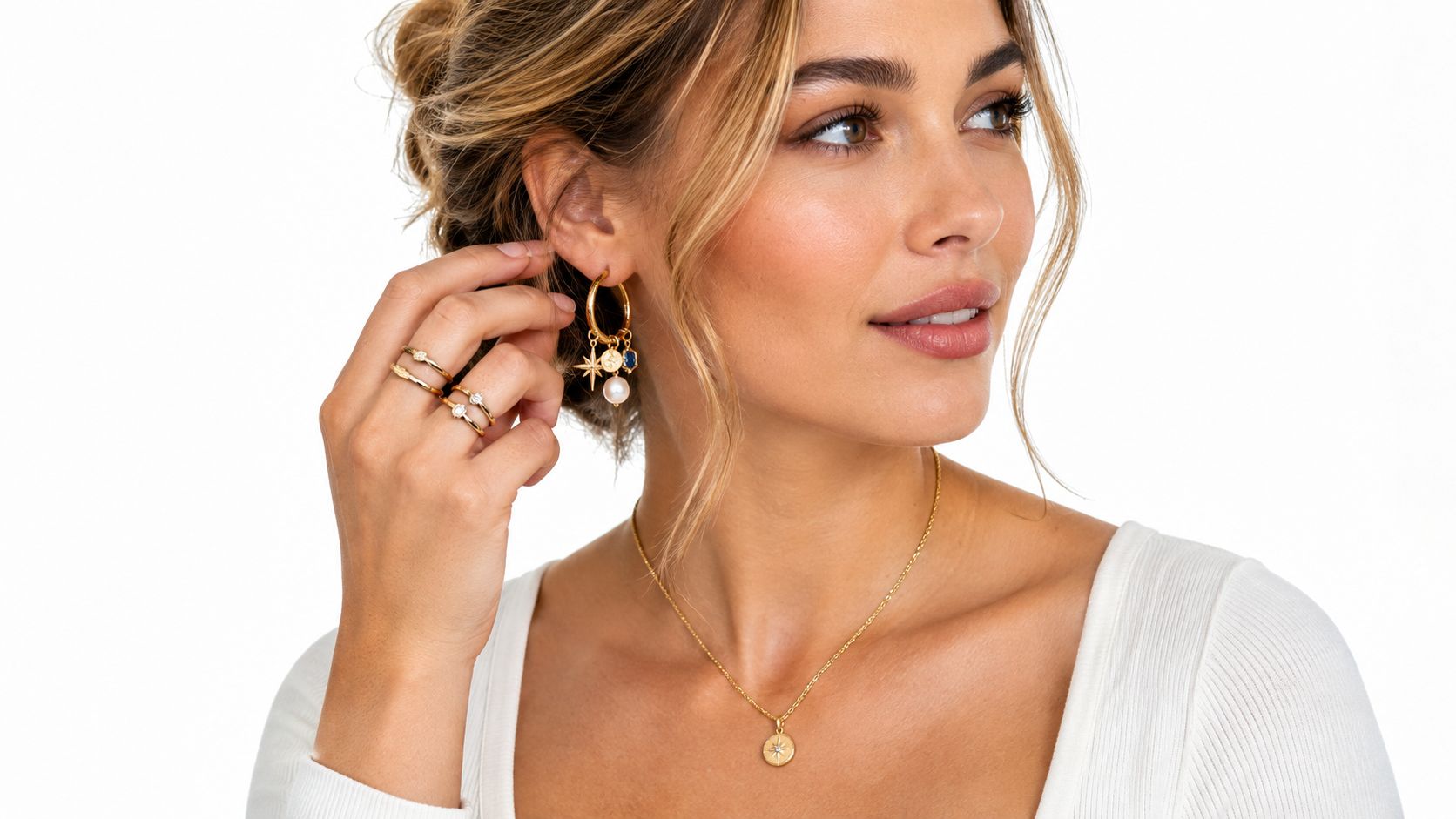
Charm hoops work best when they have a clear role in the outfit. They can be the focal point, a small repeated motif, or a personal accent that supports the rest of your jewelry. The trick is to manage movement and visual density. A pair with active, swinging charms already adds energy near the face, so the necklace and rings don't all need to compete.
Build around one focal detail
For a minimalist outfit, let the charm supply the personality. Pair small gold hoops with a single symbolic pendant and keep the necklace delicate or skip it altogether. A plain knit top, open collar, or clean blazer gives the charm room to show without making the look feel busy.
For casual layering, repeat one visual idea instead of matching everything exactly. A blue enamel charm can work with a cool-toned ring or a small colored stone in a bracelet. Repetition creates cohesion, while identical shapes across every piece can look overly planned.
Adjust the balance by occasion
At work, medium hoops with restrained charms pair well with a jacket, simple chain, and smooth band rings. Keep the charm close to the hoop if you want movement without a dramatic silhouette. For an evening outfit, a larger hoop can carry more visual weight, especially when the neckline and hairstyle leave the ears visible.
Mixed metals can look deliberate when one finish leads and the other acts as an accent. For example, warm gold hoops with a small silver-toned charm can connect to a two-tone watch or a restrained stack of rings. If every piece uses a different metal, finish, and texture, the charms may disappear into general clutter.
The most polished combinations usually give the eye one main detail to notice, then use the other jewelry to support it.
Layering multiple earrings calls for the same restraint. If the first lobe has a charm hoop, keep a second piercing simple with a tiny stud or narrow huggie. This preserves the hierarchy of the look and prevents the moving charm from competing with several other dangling pieces.
Skin Safety and Nickel Release
“Hypoallergenic” sounds reassuring, but it isn't a complete materials specification. People with sensitive piercings need to know what touches the skin at every point, including the hoop, post, backing, connector, and charm. A gold-colored surface doesn't prove that the underlying alloy is nickel-free.
Understand nickel exposure
Nickel is a common jewelry allergen, and earrings and their backs are frequent exposure points. Reactions may include itching, redness, blistering, dryness, or thickened skin around the earlobe, as described in the American Academy of Dermatology's nickel allergy guidance.
Finnish product-safety guidance referencing EN 1811 states that jewelry intended for pierced body parts should release less than 0.2 micrograms of nickel per square centimeter per week. Jewelry intended for direct and prolonged skin contact has a limit of 0.5 micrograms per square centimeter per week, according to Finnish guidance on chemicals in jewelry.
A surface coating doesn't remove the concern. Abrasion, sweat, and repeated handling can compromise that barrier, allowing contact with material beneath it. This matters especially at closures and connectors, where rubbing occurs during ordinary use.
Read the product description critically
Look for component-level disclosure rather than a broad promise. A useful listing should identify the hoop, post, clasp, charm, and connecting ring separately where their materials differ.
- Solid gold: Karatage matters, and lower-karat or white-gold alloys may contain nickel.
- Gold-plated: The outer layer may wear at points of friction, so the base metal remains relevant.
- Gold-filled: The bonded gold layer can be more substantial than ordinary plating, but you still need the seller's material details.
- Stainless steel: The exact grade and nickel-release information are still useful for a person with a known sensitivity.
- Nickel-free materials: This is more actionable than “hypoallergenic,” but compliance or material disclosure is preferable when available.
The nickel-free jewelry guide offers useful language to look for while comparing products. Don't assume that one safe-looking charm makes the whole earring safe. Your skin contacts the entire assembly.
Remove earrings before swimming, bathing, or applying cosmetics, then dry them thoroughly. If irritation persists, stop wearing the pair and ask a dermatologist for guidance. People with newly pierced ears should follow professional aftercare advice rather than treating healed-piercing jewelry as automatically suitable.
Caring for Your Hoop Earrings with Charms
Care protects both the finish and the small connections that make charm hoops work. Moisture, cosmetics, friction, and repeated bending can affect different materials in different ways, so a short routine is more useful than an occasional aggressive cleaning.
A simple care routine
- Remove them before exposure. Take off the earrings before swimming, bathing, exercising, or applying perfume, hairspray, lotion, or cosmetics.
- Wipe after wearing. Use a soft, lint-free cloth to remove skin oils and residue from the hoop and charm.
- Clean gently. If the material allows it, use mild soap and water, then rinse carefully and dry completely. Avoid abrasive cloths on plated or polished surfaces.
- Inspect the hardware. Check the hinge, post, backing, and jump ring for looseness, gaps, sharp edges, or unusual movement.
- Store separately. Keep each pair in a dry pouch or compartment so charms don't scratch other jewelry or tangle around chains.
- Handle removable charms carefully. Open the connector only as much as necessary, and don't twist the hoop itself to force a charm into place.
Pay special attention to the attachment after cleaning. A charm that no longer hangs evenly, a clasp that feels loose, or a connector with a visible gap deserves repair before the next wear.
If you're ready to choose a personalized pair, browse EP Fine Jewelry for hoop earrings, individual charms, and other customizable jewelry. Use the materials, weight, attachment, and care checks in this guide to select a piece that feels personal while remaining practical for your everyday routine.