
A hammered surface looks like proof of solid gold, but it isn't. The dents only change how light hits the hoop. They say nothing about purity, weight, or how long the colour will last. If you shop for gold hoop earrings hammered by texture alone, you can pay a fashion price for a piece that fades, or overpay for a thick hoop you will barely wear.
Table of Contents
- Hammered Gold Hoops Compared by Gold Type
- What Hammering Does to the Metal
- Choosing the Right Hoop Size
- How to Style Hammered Gold Hoops
- Caring for Hammered Hoops Over Time
- Checking Hammered Hoop Listings Before You Buy
Hammered Gold Hoops Compared by Gold Type
What should you rank first when every pair looks hammered in the photo?
Hammering is a surface treatment that can be applied to any gold construction. Solid gold, a thick bonded layer, or a whisper of plating can show the same dents online. Rank the gold type first for cost, wear, and skin comfort. Treat the texture as a separate choice.
| Construction | Gold content or layer | Durability and upkeep | Best for |
|---|---|---|---|
| Solid 14K gold | 58.3% gold by weight | Durable, resists tarnish, highest cost per gram | Daily wear, sensitive skin |
| Solid 18K gold | 75% gold by weight | Richer colour, softer and dents more easily | Special pieces, deeper colour |
| Gold-filled | Gold layer bonded to base metal, at least 1/20 of weight | Lasts for years; layer can thin with heavy friction | Everyday wear on a budget |
| Vermeil | Sterling silver base with at least 2.5 micrometres of gold | Gold wears through over time, exposing silver | Occasional wear, gifts |
| Gold plated | Thin electroplated layer over a base metal | Wears off faster; plating thickness often not listed | Trend buys, occasional wear |
| Gold-plated stainless steel | Stainless steel base with gold plating on top | Resists corrosion; plating thickness often not listed; colour can fade | Budget fashion pieces |
Karat means the gold share in 24 parts. 14K is 14 of those parts, about 58.3% gold under the FTC jewelry guides on karat fineness and misrepresentation. 18K is 18 parts, 75% gold under the same FTC jewelry guides on karat fineness and misrepresentation, so the colour reads richer and the metal bends more easily. Sellers must not misrepresent gold content, plating thickness, or the method used to apply a coating, and a karat mark should be as easy to see as the word gold.
How to read a label
Look for a stamp such as 14K or 18K on solid pieces. Gold-filled means a real gold layer bonded to a base metal, at least one-twentieth of the item's weight under the FTC jewelry guides definition of gold-filled, so normal wear can last for years. Vermeil is sterling silver under at least 2.5 micrometres of gold under the FTC jewelry guides definition of vermeil. That layer will thin with friction.
Gold plated is a thin electroplated coat. Listings often skip the thickness, so ask for it in microns before you buy. Gold tone and gold look usually mean no real gold is present.
A lower cost build is not automatically a bad buy. Plated hoops suit a season or a party. Daily wearers get more from solid or gold-filled construction, because those stand up to hard wear and, in many cases, allow repair. If you are still weighing 10K against 14K for skin and budget, this 10 karat gold versus 14 karat gold comparison is the next stop.
Practical rule: Choose solid or gold-filled for daily wear. Choose vermeil or plating for occasional wear and trend buys.
What Hammering Does to the Metal
Each hammer strike leaves a shallow dent. Those dents become tiny facets, small flat faces that scatter light, so the hoop looks textured and sparkly instead of mirror-smooth.
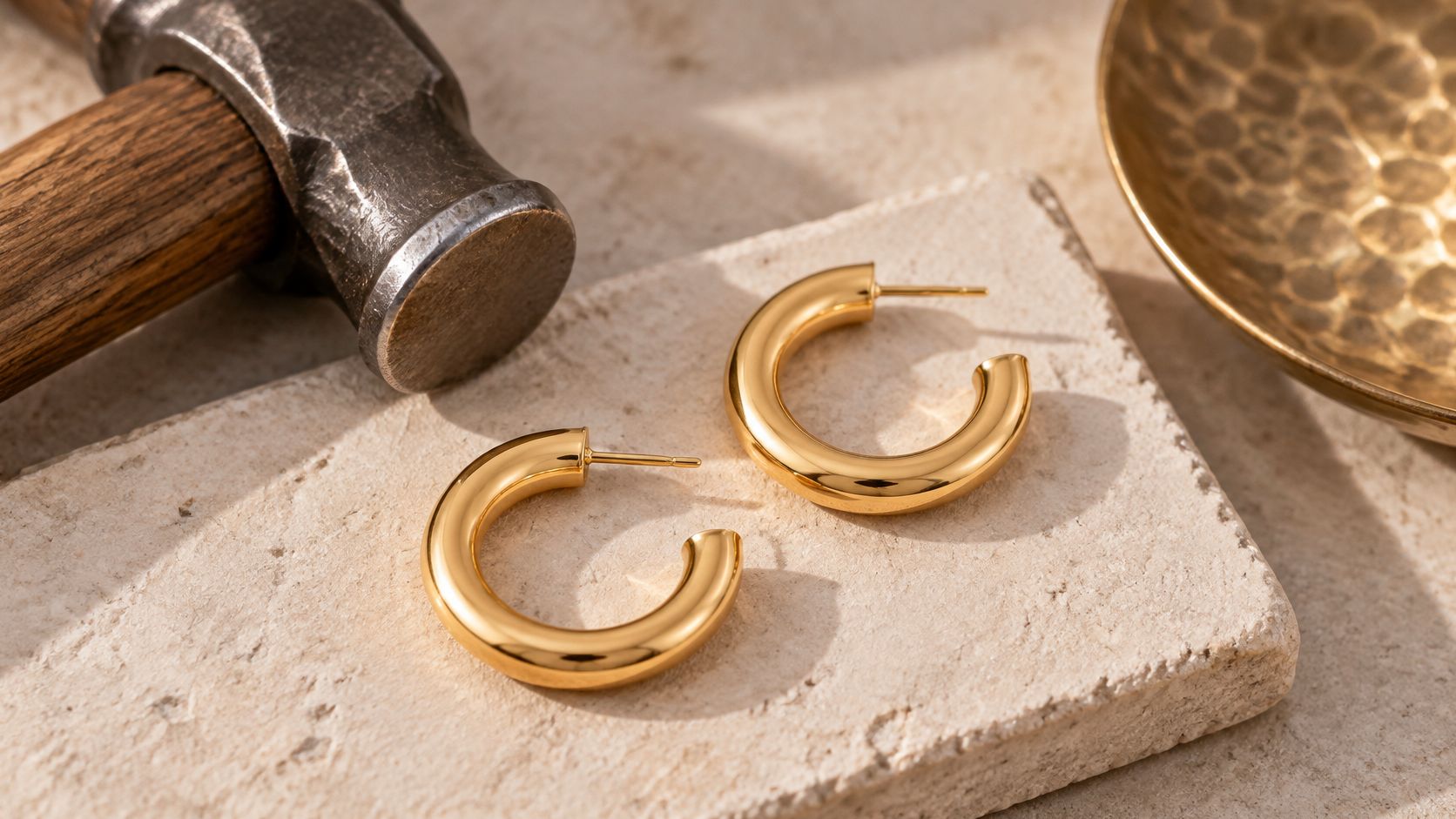
The same blows change the metal, not only the look. Hammering creates plastic deformation: the gold moves and stays moved. That movement blocks tiny slips inside the alloy, which is work hardening. Harder wire resists flattening and keeps its circle.
Published mechanical data on gold and gold alloys show that 18K gold with about 12.5% silver and 12.5% copper rises from about 150 HV in an annealed, meaning softened, condition to 212 HV after working. A higher-copper 18K composition rises from about 165 HV to 227 HV. HV is the Vickers hardness scale. A higher number means the surface resists a dent from a test point.
Why two 18K hoops can feel different
Two earrings can both say 18K and still bend differently. Alloy mix and whether the hoop was hammered after it was formed both change how it holds its shape. The texture you see is not a hardness guarantee.
Heavy hammering near the clasp, a weld, or a sharp curve is the limit. Too much cold work cuts ductility, the metal's ability to bend without cracking. That hoop is harder to resize and harder to solder later.
Ask whether the maker formed the circle first and hammered it afterward. That order hardens the finished shape without beating the joint into a brittle spot.
Texture also does not make a thin plate last longer. A hammered coat of gold can chip at the high spots just as a smooth coat can. Finish and metal type stay separate questions.
Choosing the Right Hoop Size
Do you measure across the middle hole or across the whole circle when you shop for hoops?
Size is the outer diameter, the full width across the outside edges of the circle, in millimetres. Outer diameter means edge to edge. Lay a ruler across a hoop you already like and read that number. Photos mislead, because a close crop makes a small hoop look large.
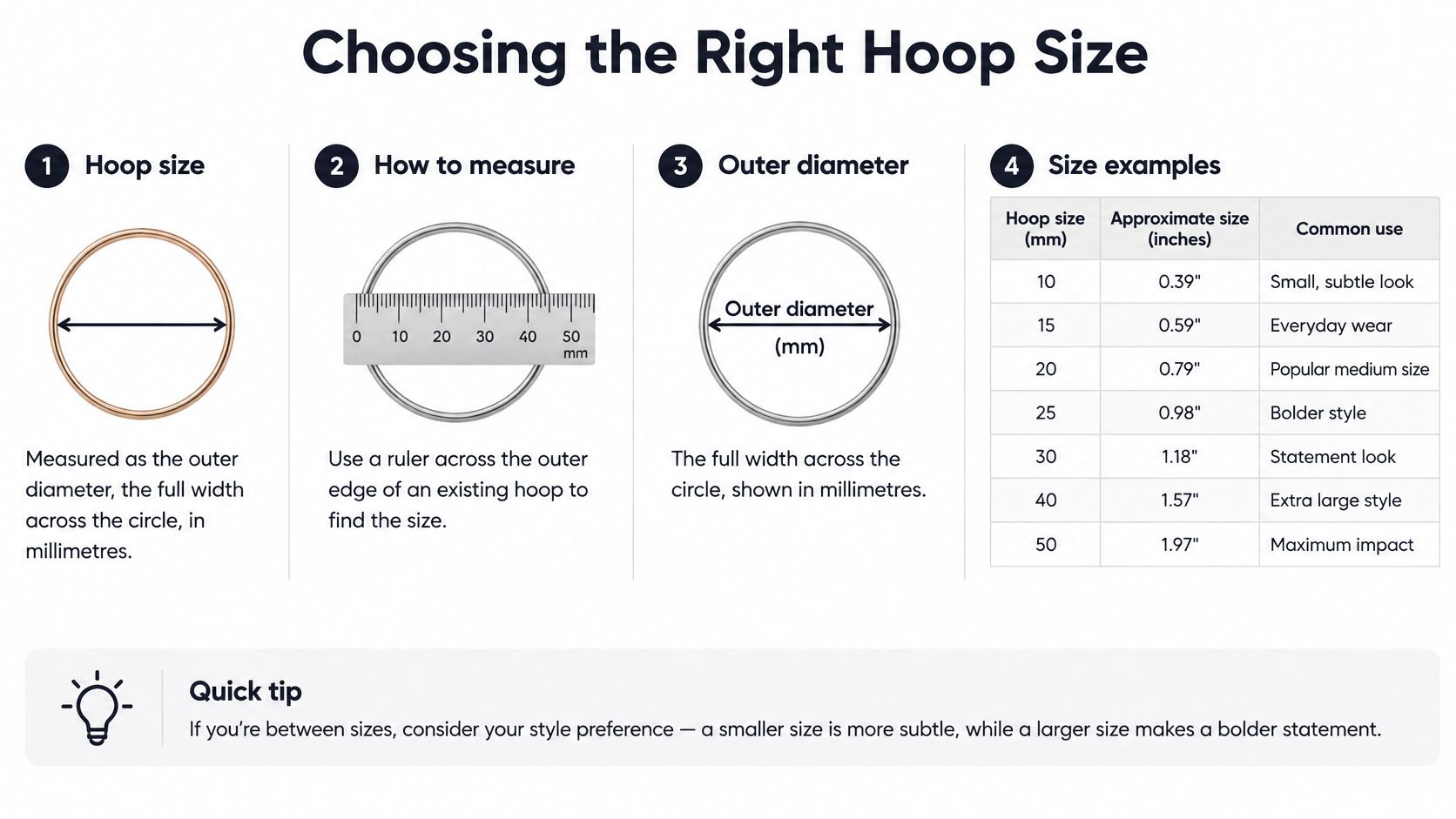
| Size band | Outer diameter | Visual effect | Best for |
|---|---|---|---|
| Small | 15-20 mm | Subtle texture close to the lobe | Everyday wear, work, first hoop |
| Medium | 20-30 mm | Hammered pattern clearly visible | Daily to dressy looks |
| Large | 30-45 mm | Bold statement that catches light | Evenings, statement styling |
| Oversized | Above 45 mm | Dramatic silhouette; heavier on the lobe | Occasional wear, special events |
Small hoops hold the facets near the ear. That reads neat at a desk, and the weight stays light through a full day.
Medium hoops are the point where most buyers first see hammer marks from across a table. The circle stands away from the lobe, so light hits more facets. Large and oversized circles throw still more light and hang farther from the piercing, which also means more pull by evening.
Band width is not the same as diameter
Band width, sometimes called thickness, is how fat the tube or wire itself is. Diameter is the size of the whole circle. A narrow tube on a large circle can look delicate. A wide tube on a small circle can look bold.
Weight follows construction. Hollow hoops are tubes with air inside, so a larger size can still feel easy. Solid wire of the same outer size weighs more. If your lobes are small or your piercings get sore, stay in the small or medium band.
For a starting point, compare options such as Small Chunky Gold Hoops and Tube Hoops by their listed diameter first, then check width and weight separately. Face shape and stacking add another layer, and a separate hoop earring size guide walks through those choices without mixing them up with the hammered finish.
How to Style Hammered Gold Hoops
Match the hoop to the day, then keep everything else quieter. The facets already do the visual work.

Work. Small or medium hammered hoops in the same metal tone as your watch or a plain band look finished without pulling focus in a meeting. Skip oversized circles with a logo tee or a loud print under a blazer.
Casual days. Medium hoops sit well with knits, denim, and a plain tee. The texture supplies the detail those clothes leave out, so you do not need a second statement piece.
Evenings. Large hoops suit a simple neckline. A smooth, sleek chain balances the rough light on the hoops. If you want a bolder earring story for a dinner, look at statement earrings in gold and then bring the rest of the look back down.
Pairing rules that keep the look clean
- Match the metal when you can. Gold next to gold reads intentional. Mixing gold and silver can work, but only if one metal clearly leads.
- One textured piece per look. A hammered cuff plus hammered hoops fights for the same sparkle.
- Pull hair back when the hoops should lead. A low bun or a tuck behind the ear shows the facets. Loose hair turns them into a soft accent.
- Skip the busy combo. A large hoop, a loud print, and a chunky necklace at the same neckline cancel each other out.
Let the hoops carry the texture. Keep necklaces and bracelets smooth, and the hammer marks stay the point of the outfit.
Caring for Hammered Hoops Over Time
The dents that make the hoop sparkle also hold soap, lotion, and skin oil. Cleaning has to lift that film without sanding the facets flat.
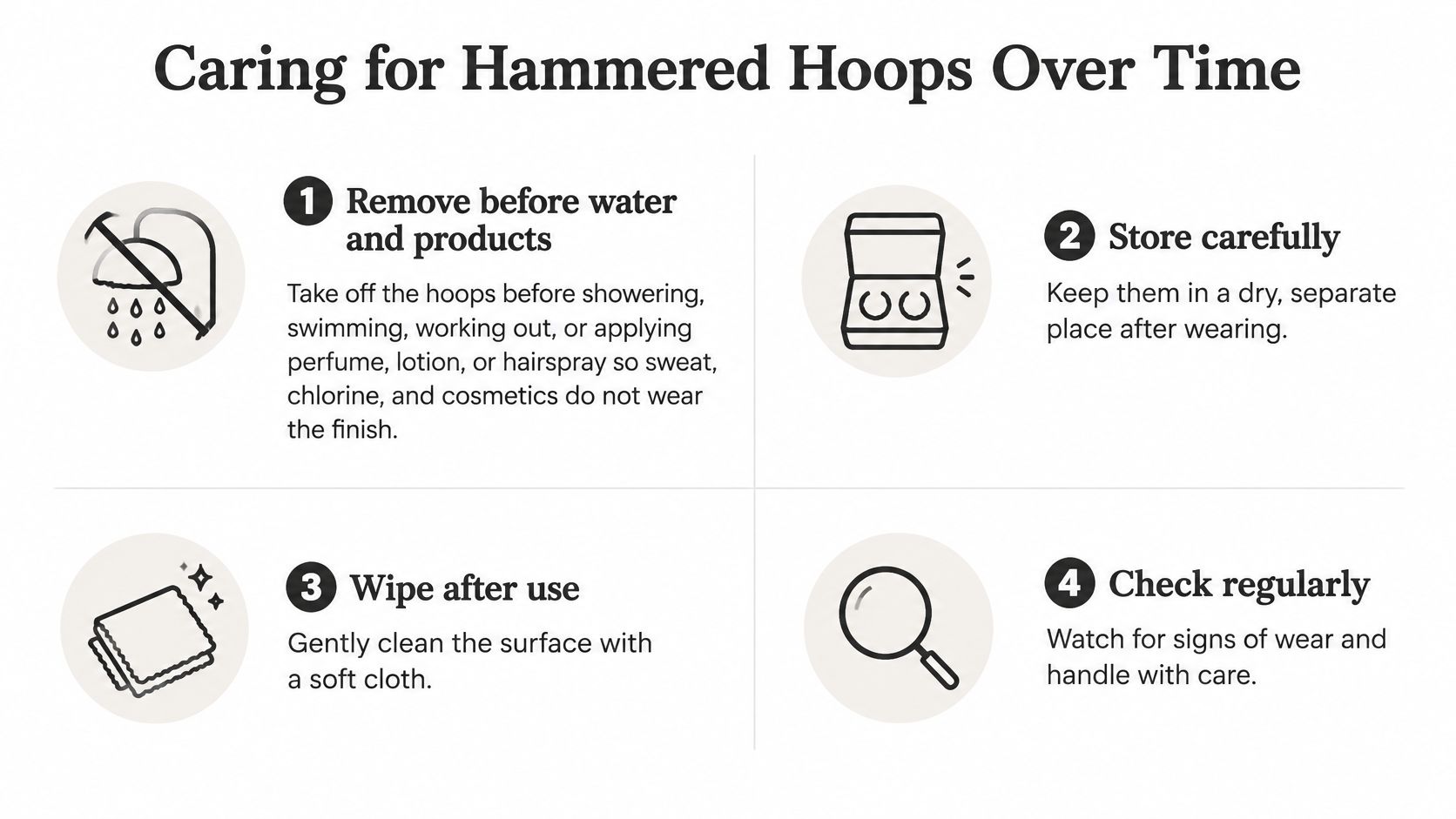
- Take them off before water and products. Showering, swimming, workouts, perfume, lotion, and hairspray put sweat, chlorine, and cosmetics on the high spots, and those wear a finish faster. Gold-filled and silver jewelry can be worn in the water, and it lasts much longer if you remove it before showering, swimming, or working out.
- Wipe after each wear. A soft dry cloth lifts skin oils before they sit in the recesses.
- Wash only when the cloth is not enough. Warm water and a drop of mild soap, then a soft brush in the dents, is enough. Jewelers Mutual's hammered-finish guidance points to a soft cloth or mild soap and water, and it warns against harsh chemicals and abrasive polishing cloths.
- Rinse and dry all the way. Trapped water in a hollow tube or under a clasp dulls the finish and can mark the post.
- Skip abrasives. Polishing cloths made for mirror shine flatten hammer marks and can thin a plated layer.
- Store each pair alone. A soft pouch stops chains and harder stones from scratching the raised facets. Our home jewelry cleaning steps cover the sink routine in more detail.
When the dents look dark
A dark line inside the texture is usually product sitting in the low spots. The soft-brush wash above should clear it. A patchy, brassy, or silver-showing area on a plated or vermeil hoop is the coating wearing through. Soap will not put that gold back. At that point you wear it as-is or retire it, rather than polishing harder.
Checking Hammered Hoop Listings Before You Buy
Will this pair still make sense after ten wears, not just ten minutes in the mirror? Price alone will not answer that. The metal type sets how long the hoop lasts, and the hammered surface only sets how it catches light.
Read the words, then the millimetres
Confirm the metal words first. You want solid, gold-filled, vermeil, or plated, plus a karat stamp when the piece is solid. Phrases like gold look and gold tone describe color. They do not promise gold content.
Split the parts next. The hoop, the post, and the clasp can be different metals, and a gold-colored hoop on an unknown post is a common reason ears feel irritated. If nickel is a worry, read how nickel-free gold hoop earrings are labeled before you assume the whole earring matches.
Then match the size to a band you already chose. Listings should give millimetres, and a photo on an ear or next to a coin helps more than a cropped product shot. We make fashion jewelry in silver and 14K gold, so a listing from us should name which of those you are getting, not a vague gold colour.
Compare published prices
Similar tags can hide different builds. Use the construction table, not the dollar figure, to judge value.
| Listing | Finish | Price | Measurements |
|---|---|---|---|
| Hammered crescent hoops (Nordstrom) | 18-karat-gold plated | $45.00 (2024) | Size not published |
| Hammered gold-tone teardrop hoops (Boden) | Gold-tone | $59.00 (2026) | 6 cm drop, 11.6 g each |
| Hammered gold-plated stainless-steel hoops (Stylr) | Gold-plated stainless steel | $49.00 (2026) | 15 mm outer, 12 mm inner diameter |
The Nordstrom crescent is an 18-karat-gold-plated finish at $45.00 in 2024, with no size on that listing. The Boden gold-tone teardrops were $59.00 in 2026, about a 6 cm drop and 11.6 g each, and gold-tone is not a karat. The Stylr plated stainless hoops were $49.00 in 2026, with a 15 mm outer diameter and a 12 mm inner diameter, which lands in the small band.
Three prices within about fifteen dollars. Three different materials. The plated and gold-tone pieces fit occasional wear. They are not substitutes for a solid or gold-filled hoop you plan to live in.
Gifts and the return window
If you do not know the wearer's size, a medium hoop in the 20-30 mm band is the safest default. It reads clearly as a hoop, yet it stays light enough for most days and most faces.
We can add a gift box at checkout, and the order-notes field can carry a short message. Read the return terms before you personalize anything. Some fine jewelry, typically personalized or made-to-order pieces and some EP Fine items, may carry a restocking fee of up to $150 per item. Keep the receipt and the packaging until the recipient has tried the fit.
Make the call in three answers
- How often will they be worn? Daily points to solid or gold-filled. Occasional points to vermeil or plating.
- Which size band fits the ear and the outfits? Small for work and first hoops, medium for most days, large or oversized for events.
- What can you spend and still be glad in two years? A forty-to-sixty-dollar plated pair is a fair trend buy. It is a poor stand-in for a hoop you want to repair and keep.
Write those three answers down and check the listing against them before you pay. If the words, the millimetres, and the wear plan do not line up, leave it.
EP Fine Jewelry makes fashion jewelry in silver and 14K gold, including hoops you can match to how often you wear them. Start with the metal, then the size, and use a hammered finish only when you want that light. Visit EP Fine Jewelry to compare hoop styles and choose a pair that fits the wear you have in mind.