
Could a hoop labeled 14k gold still bend easily or irritate your ears? Yes. The karat tells you how much gold is in the alloy, but it doesn't tell you everything about the metal mix, the hoop's thickness, its closure, or how it was made.
A good choice starts with the details behind the label. Check whether the piece is solid or plated, choose a diameter and thickness that suit how you'll wear it, and inspect the closure and return terms before ordering.
Table of Contents
- What 14k Gold Means for Hoop Earrings
- Hoop Sizes and Thickness That Suit Your Face
- Styling 14k Hoops for Everyday and Special Occasions
- Is 14k Gold Safe for Sensitive Ears
- Caring for 14k Hoops So They Last
- Check a Solid 14k Hoop and Its Return Terms
What 14k Gold Means for Hoop Earrings
14k gold contains 14 parts gold and 10 parts other metals, or about 58.3% pure gold by mass. The other metals are mixed throughout solid 14k gold, rather than forming a surface layer, as explained in the Federal Trade Commission's guide to buying gold jewelry.
A simple comparison helps: solid 14k gold is like a brick made from the same material all the way through. Gold-plated jewelry is more like a painted wall, with a thin gold layer over a different base. The gold surface can wear away and reveal the metal beneath it.
| Karat | Gold content | Typical hoop use | Durability for daily wear |
|---|---|---|---|
| 10k | 41.7% | Budget solid gold hoops | Hard, with less gold in the alloy |
| 14k | 58.3% | Everyday hoops and earrings | Alloy hardened for daily handling |
| 18k | 75% | Richer colour, special occasions | Softer, scratches more easily |
| 24k | 100% | Rarely used for hoops | Soft, bends and scratches easily |
The percentages for 10k, 18k, and 24k follow from the karat scale: the karat number represents parts of gold out of 24. For a closer comparison of lower-karat options, see this guide to 10-karat gold versus 14-karat gold.
Why alloy matters
Pure 24k gold is relatively soft. Repeated handling, bending, and rubbing can change the shape of a hoop or scratch its surface. Adding other metals makes gold harder, which helps a hoop hold its round shape during everyday wear. 14k sits between lower-karat gold and higher-purity gold: it has more gold than 10k, while its alloy is generally better suited to daily handling than softer 18k or 24k pieces.
“Solid,” “gold-filled,” and “gold-plated” describe different constructions. A solid 14k hoop has a 14k alloy throughout its gold components. Gold plating is a surface layer bonded to a base metal, so wear can expose the material underneath. Gold-filled jewelry also has a gold layer over a base metal, but the construction differs from plating. Don't treat either term as another way to say solid gold.
Check the material description: Look for “14k gold” or “14 karat gold” in the title and material details. “Gold-tone” and “gold-colored” describe appearance, not solid-gold composition.
Hoop Sizes and Thickness That Suit Your Face
Measure a pair you already wear. Check the inside diameter across the opening with a ruler. That number predicts how a new pair will sit far better than a product photo.
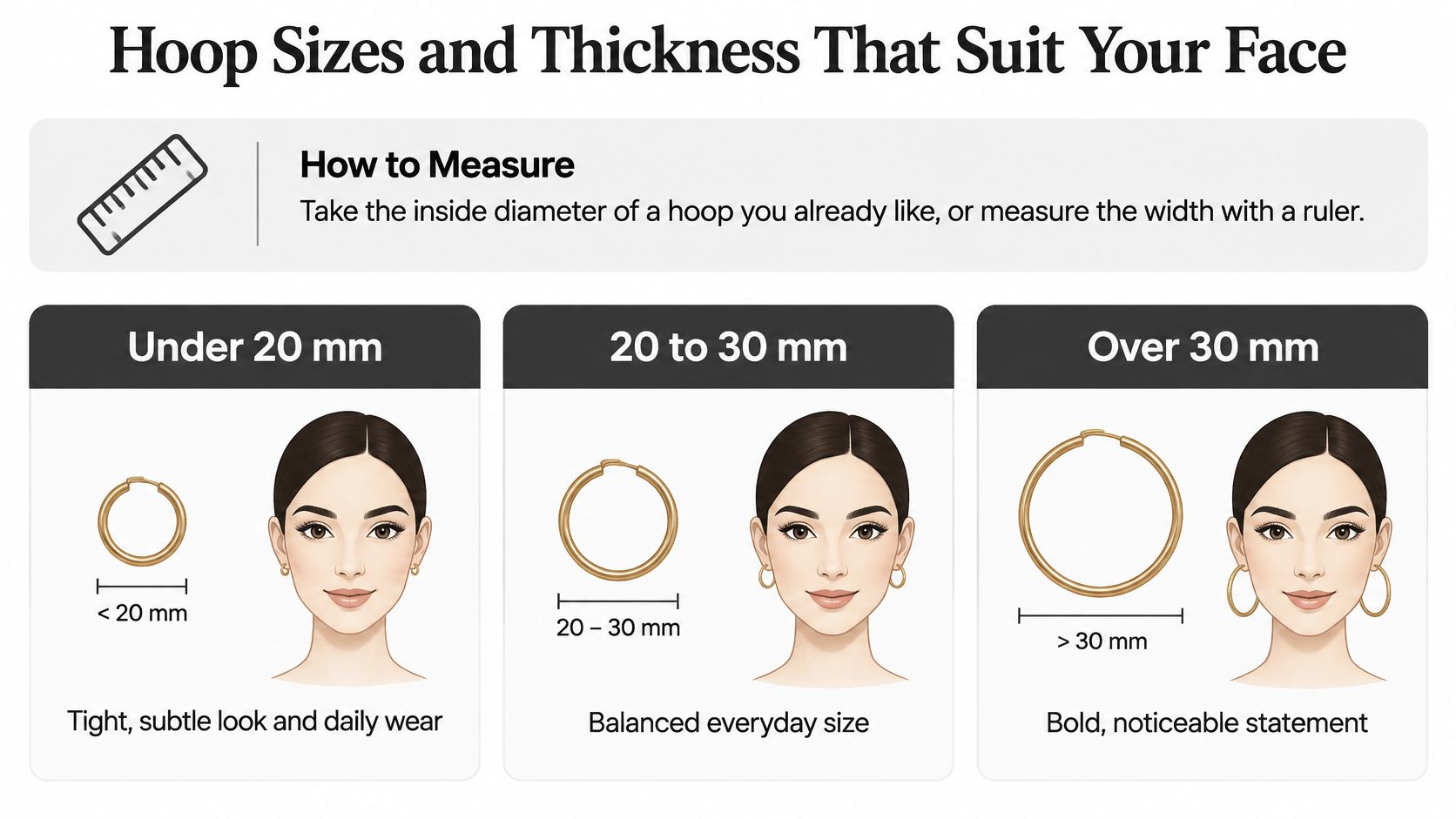
| Diameter | Look | Best for | Thickness note |
|---|---|---|---|
| Under 20 mm | Tight and subtle | Daily wear, small lobes | Thin wire bends more easily |
| 20 to 30 mm | Classic all-day size | Most face shapes, work and casual wear | Balanced weight and hold |
| 35 to 50 mm | Bold and noticeable | A statement look | Check that the closure feels secure |
| Over 50 mm | Dramatic statement | Evening or occasional wear | A thicker tube may feel heavier |
These ranges are starting points, not rules. The 14k stamp tells you the alloy mix, not how a hoop will fit or hold up. If you have a square jawline, a 25 to 35 mm round hoop softens angles because the curve contrasts with straight lines. If your face is long, a 20 to 30 mm width adds side volume because it draws the eye outward.
Pick diameter, then thickness
Thin wire keeps weight down. It bends faster if it snags a sweater or gets crushed in a box.
Thicker tubing holds its circle better and feels more solid in hand, but weight rises quickly as diameter grows. Compare both numbers on the listing before you buy, especially for daily wear. Closure type matters too. A hinged post with a secure click resists pulling open better than a thin wire hook.
Processing changes strength. A jewelry metallurgy reference lists annealed 14k yellow-gold alloys at about 190 HV and age-hardened versions at about 270 HV. Age hardening raises resistance to deformation, which helps a well made hoop keep its shape at the hinge and latch.
Hardness measures resistance to denting. Toughness measures resistance to cracking or fatigue under repeated bending. A thin section can still fatigue even when the alloy tests hard, so read size, thickness and closure together. For more ideas on choosing a larger, more noticeable style, explore these gold statement earring styles.
Choose diameter first, then thickness, then inspect the closure.
Styling 14k Hoops for Everyday and Special Occasions
What makes the same hoop look polished at work and sharp at dinner? Fit and finish decide more than the 14k stamp. The stamp names gold content. It does not promise comfort or strength.
For meetings, errands, or classes, a classic medium hoop adds polish without competing with clothes. A brushed or satin finish hides small surface marks better than high polish. Pair hoops with a simple top, or wear one hoop with a small stud in the other ear for a less matched look.
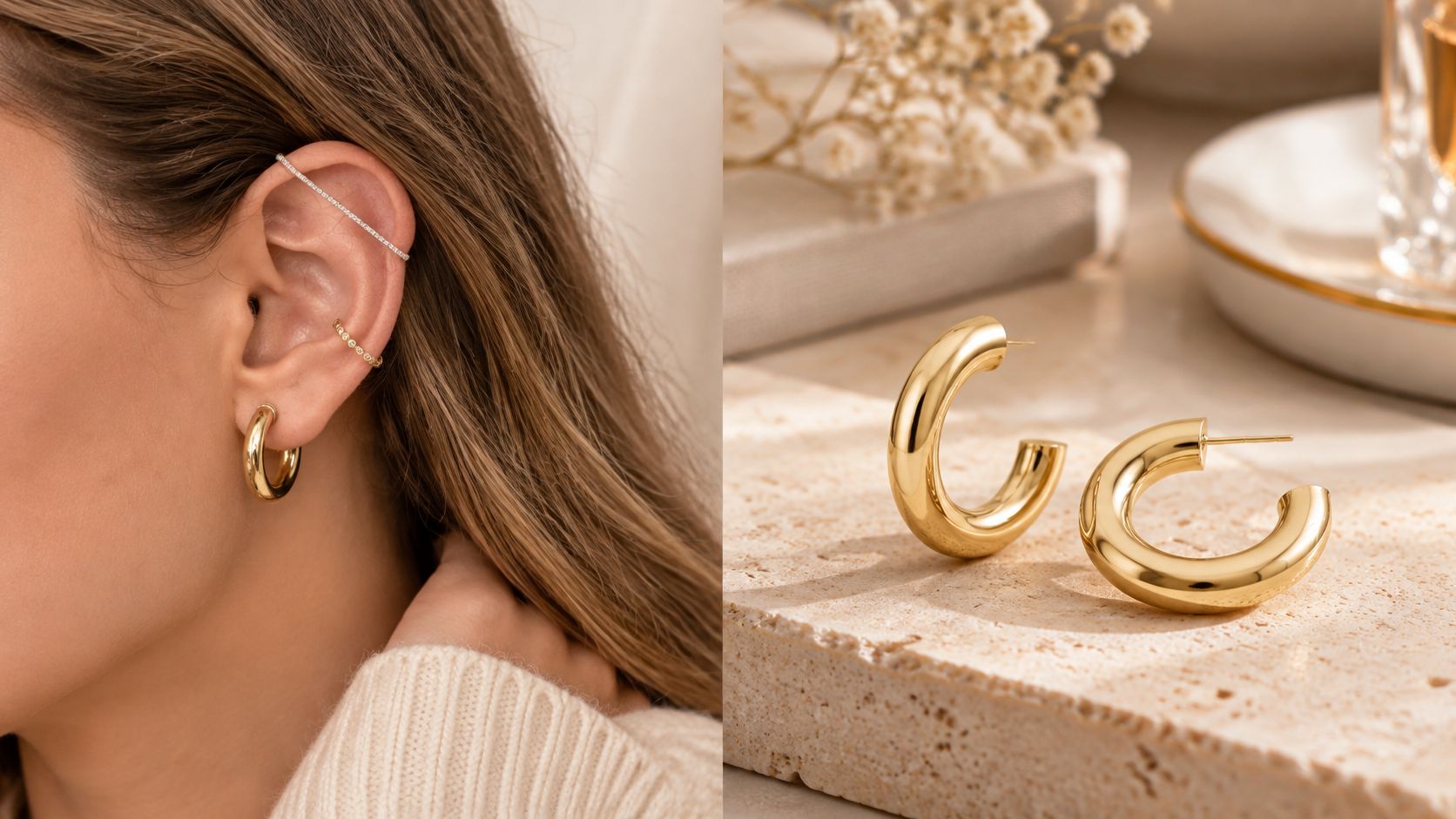
Small Chunky Gold Hoops suit a lighter everyday look.
For everyday wear, keep two habits in mind:
- Avoid snags: Choose hoops that sit close enough to avoid catching on a collared shirt or scarf edge.
- Rotate pairs: Give one pair a break while you wear another, which spreads wear across closures.
For dinner, a wedding, or a photo, a larger hoop frames the face more clearly. Pull hair back or tuck it behind the ears so the full circle shows. Keep other jewelry simple if hoops are the main detail. Match metal tone to the rest of the outfit.
Yellow gold reads warm. Rhodium-finished white gold needs its own care, covered below. If you are also coordinating jewelry with a sharper outfit, these straightforward menswear tips offer practical guidance on putting clothes and accessories together.
Is 14k Gold Safe for Sensitive Ears
Does 14k stamped on a hoop mean it will feel comfortable in sensitive ears? The number answers a different question. It tells you the share of pure gold in the mix, about 58.5% gold with the rest made up of other metals. Those other metals decide comfort as much as the gold does.
A government-hosted nickel-release study found that some 14k earrings released nickel below detection limits, while others released measurable nickel within the European regulatory limit of 0.5 µg/cm²/week in this government-hosted document on nickel release and sensitivity. The same government-hosted nickel-release study also reported reactions to nickel sulfate concentrations as low as 0.0001% in this government-hosted document on nickel release and sensitivity, which shows how much tolerance varies from person to person. A result inside a regulatory limit still leaves room for a reaction in a highly sensitive wearer.
Check the alloy details before you buy, since karat alone does not list the full metal mix. For help reading content claims versus release claims, see this guide to what nickel-free jewellery means.
Allergy or irritation?
A metal allergy causes a skin reaction where the metal touches the ear. Friction, sweat, cleaning products, or a post that fits poorly can also cause soreness. Redness alone does not identify the cause. Watch when symptoms start. Note where the skin is affected.
Ask the seller three direct questions:
- Does the piece contain nickel? Ask about the alloy, not just the karat.
- What alloy is used for white gold? The colour does not reveal the full metal mix.
- Are nickel-release test results available? A test gives useful information, but it cannot predict every person's response.
If a hoop causes a reaction, take it out and rinse the skin gently. Switch to a pair you know you tolerate. Wait until the area calms before trying that hoop again. If a rash lasts or spreads, seek medical advice.
Caring for 14k Hoops So They Last
Soap, sweat and pool chemicals collect in small spaces. On hoops, that means the hinge, the latch and the seam where the post meets the tube. Remove hoops before showering, swimming or working out. You lower the chance of bending the circle and you keep residue from dulling the finish.
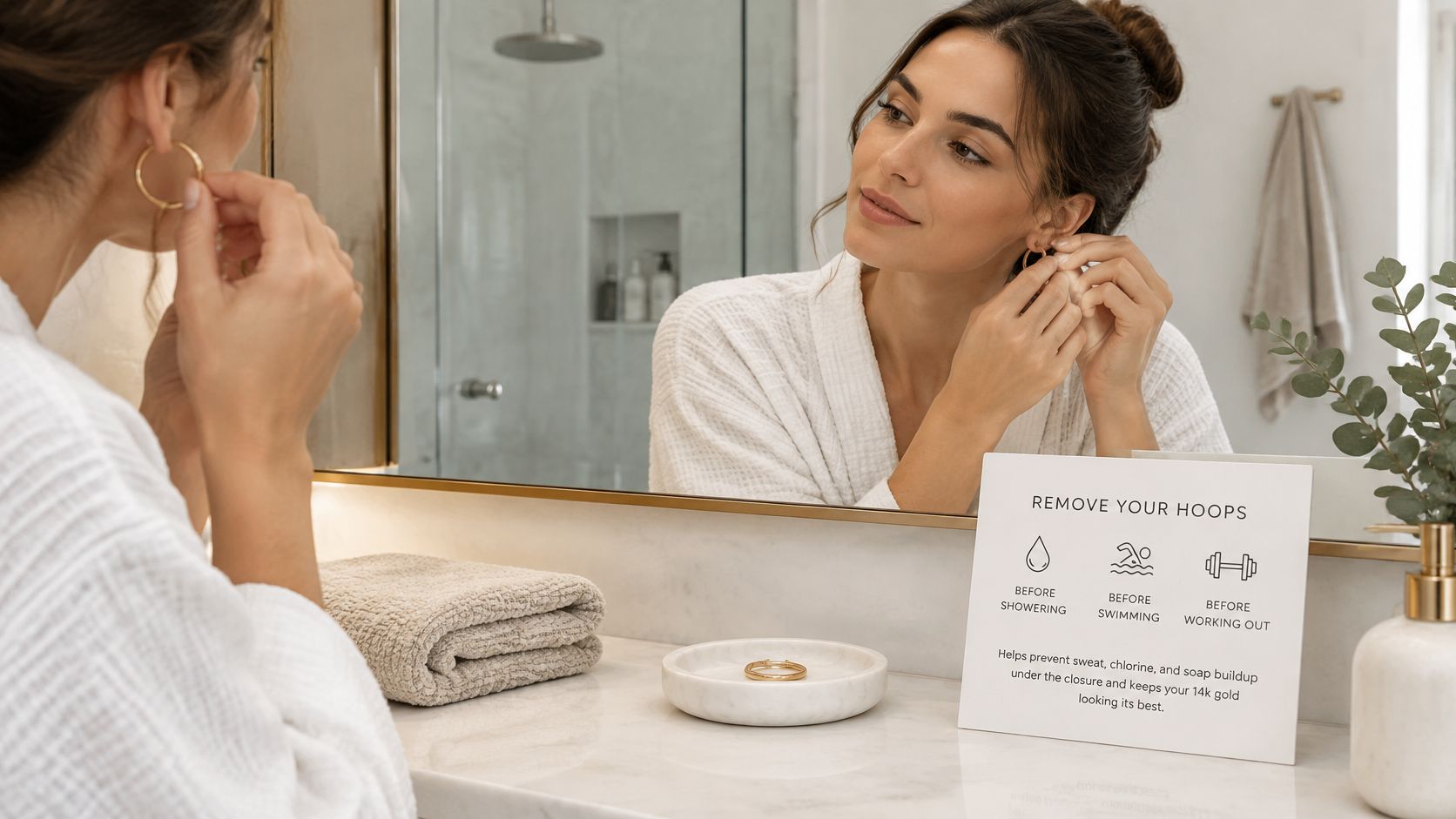
After wear, wipe each hoop with a soft, dry cloth. For a deeper clean, use warm water with a drop of mild soap and a soft brush around the hinge and clasp. Rinse well. Dry fully before storage. This routine for cleaning gold jewellery from EP Fine Jewelry can help you build a simple routine.
Give each pair its own soft pouch or a lined slot in a box. Hoops rub and scratch when they share space. Keep bleach and strong cleaners away from the box. White gold hoops may carry a thin rhodium layer that wears with friction. When it thins, the surface can look warmer. A jeweler can replate it.
Check the closure with a light touch. Press it shut and watch that both ends meet evenly. Feel that the hinge swings without grit.
If a hoop has lost its round shape or the closure feels loose, don't force it shut. A jeweller can assess it without adding strain to the hinge.
If the hinge sticks after cleaning, dry it fully and test again in 24 hours before wearing.
Check a Solid 14k Hoop and Its Return Terms
Use the product listing to confirm that a hoop matches the way you plan to wear it. Start with the size that feels right, then compare the material, construction, closure, and return conditions. A clear listing should let you evaluate those details without guessing.
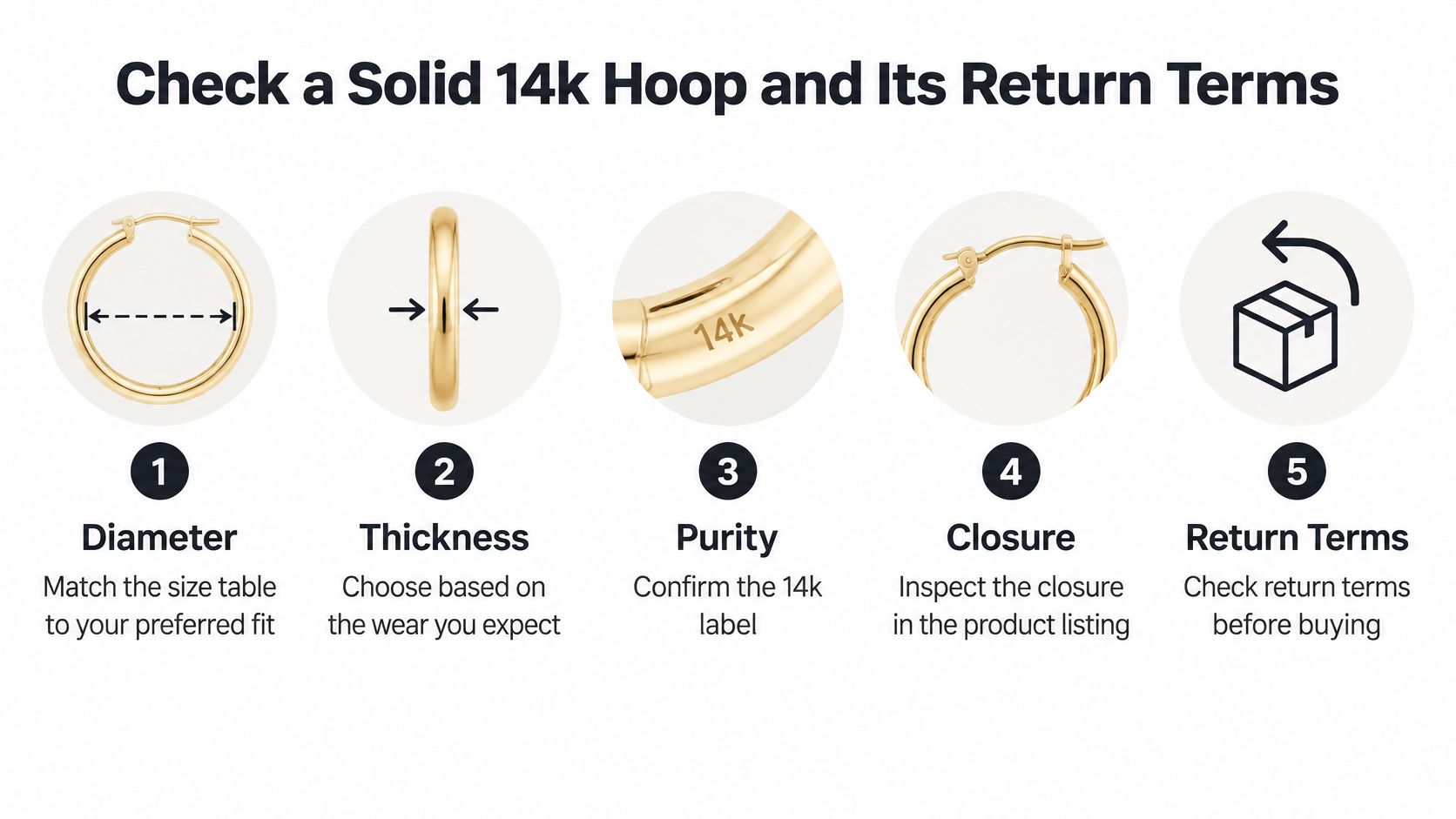
- Confirm the gold construction. Look for “solid 14k gold” or “14 karat gold” in the title or material details. If the listing says plated, filled, gold-tone, or gold-colored, read that as a different construction, not as another phrase for solid gold.
- Check the parts that touch your ear. See whether the post and clasp are also listed as 14k gold. If the listing doesn't say, don't assume all components use the same metal.
- Inspect the closure. The listing should identify the closure type, such as a click-top, latch, or hinge. A hoop that doesn't fasten securely can open during wear, especially if it's large or catches on clothing.
- Compare the measurements. Check both diameter and wire or tube thickness. A width alone doesn't tell you how the hoop will sit or how substantial it will feel.
- Compare weight with size. Hollow hoops are designed to be lighter than solid ones of similar dimensions. A light hoop with thin sections may need more careful handling, so look at the material and construction together.
- Compare like with like. Two 14k listings may differ in dimensions, shape, or build, so price alone isn't a fair comparison. In 2024, Nordstrom listed LANA 14K gold thin oval hoops for $850, while Sam's Club listed elongated oval 14K gold hoops for $349. Those Nordstrom earrings and Sam's Club hoops are examples of different listings, not evidence that the pieces have identical specifications.
- Read the return terms before checkout. Check the policy for exclusions, fees, and any conditions that apply to made-to-order or personalized items. Some fine jewellery, typically personalized or made-to-order pieces and some EP Fine items, may carry a restocking fee of up to $150 per item. The store's policy page explains its returns and refunds terms. For a general example of how consumer return rules can be discussed, see this overview of RA 11967 return requirements.
EP Fine Jewelry makes fashion jewellery in silver and 14K gold. Before placing an order, confirm that the listing describes the material you want, check that the closure suits the size, and read the return terms so you know what to expect if the pair isn't right for you.
EP Fine Jewelry offers fashion jewellery in silver and 14K gold, including earrings and other jewellery categories. If you're comparing materials and construction, visit EP Fine Jewelry to browse the listings and check their product details and care information before choosing a pair.