
You're staring at a calendar and doing the math twice. Sixty years. Whether you're buying for a spouse, parents, or grandparents, a diamond wedding anniversary gift feels too important to get wrong, and the price range doesn't help. You don't need the biggest stone. You need a piece that says something clear about the marriage, fits how they'll wear it, and fits a budget you choose on purpose.
Table of Contents
- Diamond Gift Ideas by Budget Tier
- Why a Diamond Marks the 60th Anniversary
- Choosing the Right Piece of Diamond Jewelry
- Stone Quality to Check Before You Buy
- Choosing Between Natural and Lab-Grown Diamonds
- Personalize, Confirm and Order the Gift
Diamond Gift Ideas by Budget Tier
Start with the tier, not the stone. That order keeps you from falling for a piece first and stretching your budget to match it.
| Budget | Gift type | Typical diamond content | Best for |
|---|---|---|---|
| Under $300 | Diamond-accent pendant or charm | Small accent stones | A thoughtful token or add-on gift |
| $300 to $1,000 | Single-stone stud or small pendant | One featured small stone | Daily wear with personal meaning |
| $1,000 to $2,500 | Diamond bangle or flex band | Row or scattered stones | A substantial everyday piece |
| $2,500 to $5,000 | Tennis bracelet or larger pendant | Larger or multiple stones | A milestone centerpiece gift |
| Above $5,000 | Ring or necklace with featured stone | Featured stone with laboratory report | An heirloom-style purchase |
How to Read a Tier
The same money buys very different amounts of diamond, and that's normal. Carat weight, cut, and origin all change what you get for your budget. A smaller, well-cut stone often looks brighter and more present than a larger stone that's poorly proportioned, so don't judge a tier by size alone.
For context on what other buyers spend, average U.S. consumer spending on natural diamond jewelry increased 25% year over year to $4,063 in 2025, according to De Beers' U.S. 2025 Diamond Acquisition Study. Treat that as background, not a target. A $250 charm with the wedding date can say more than a $4,000 piece chosen in a hurry.
Say you're in the lowest tier. A 14k Diamond Date Charm can be personalized with a date you hold near to your heart, measures 6mm in height with length depending on how many letters you choose, and uses 14K gold and diamonds. It's made to order, so allow 3 to 5 weeks for production and delivery. That lead time matters as much as the price when an anniversary date is fixed.
Simple rule: Choose the tier first, then the piece, then the stone quality. Reversing that order is how budgets slip.
If you're still deciding between jewelry and an experience, both can work for different couples. Some families pair a small keepsake with a shared outing, and options like choosing to give a Captain Cook snorkel tour suit couples who'd rather make a new memory than add another object. For seasonal timing and other occasions, this holiday jewelry gift guide helps you plan ordering and presentation around busy periods. What matters is picking one clear main gift, not splitting a modest budget across several half-chosen items.
Why a Diamond Marks the 60th Anniversary
The sequence builds slowly. Silver marks 25 years, gold marks 50, and diamond marks 60. The anniversary tradition overview explains that the diamond wedding anniversary is traditionally the 60th anniversary, commonly linked to Queen Victoria's Diamond Jubilee in 1897, which commemorated her 60 years on the British throne and helped associate diamonds with longevity, strength, and rarity.
That history changes what a good gift looks like. Six decades call for permanence and personal meaning, not an ordinary seasonal purchase. You can express that with an engraved pendant carrying the wedding year, a bangle with the couple's initials, or a short message inside a ring band. If you want to compare milestones, you can explore gifts for each anniversary year before you commit.
A 14k Diamond Script Name On A Link Chain Bracelet shows one format. It personalizes a link chain with a name, offers 6, 6.5, and 7 inch chain lengths, uses 14K gold and diamonds, and is made to order with 3 to 5 weeks allowed for production and delivery. Before you shop further, decide what your gift should say about this marriage. That answer drives every choice that follows.
Choosing the Right Piece of Diamond Jewelry
Use this comparison to narrow the format before you look at individual designs.
| Piece | Daily wear | Sizing needed | Personalization | Care level |
|---|---|---|---|---|
| Pendant or necklace | High | Chain length only | Engraved disc, initials or dates | Low |
| Stud or drop earrings | High | None | Limited, matched pairs or engraved backs | Low |
| Bangle or flex bracelet | Medium to high | Wrist size | Engraved inside, charms | Low to medium |
| Tennis bracelet | Medium | Wrist size | Name or date plate | Medium, can catch on clothing |
| Eternity or band ring | Medium | Ring size | Inside engraving | Medium |
| Statement ring | Low to medium | Ring size | Limited | Higher, prone to knocks |
The trade-off is simple. Pendants and studs suit daily wear and need little or no sizing, so they're safer surprise gifts. Rings feel symbolic, but they need an accurate ring size and they take more knocks from hands, counters, and door handles.
Practical Checks Before You Pick
- Check ring size discreetly: Borrow a ring the recipient already wears on the same finger and have it measured, rather than guessing.
- Match their usual jewelry: Notice metal color, scale, and whether they favor simple or decorative pieces.
- Confirm wrist size for bangles: Measure a bracelet they wear comfortably, since a bangle that's too tight won't be worn.
- Think about hands and habits: Gardeners, cooks, and anyone working with their hands will be harder on rings and tennis bracelets.
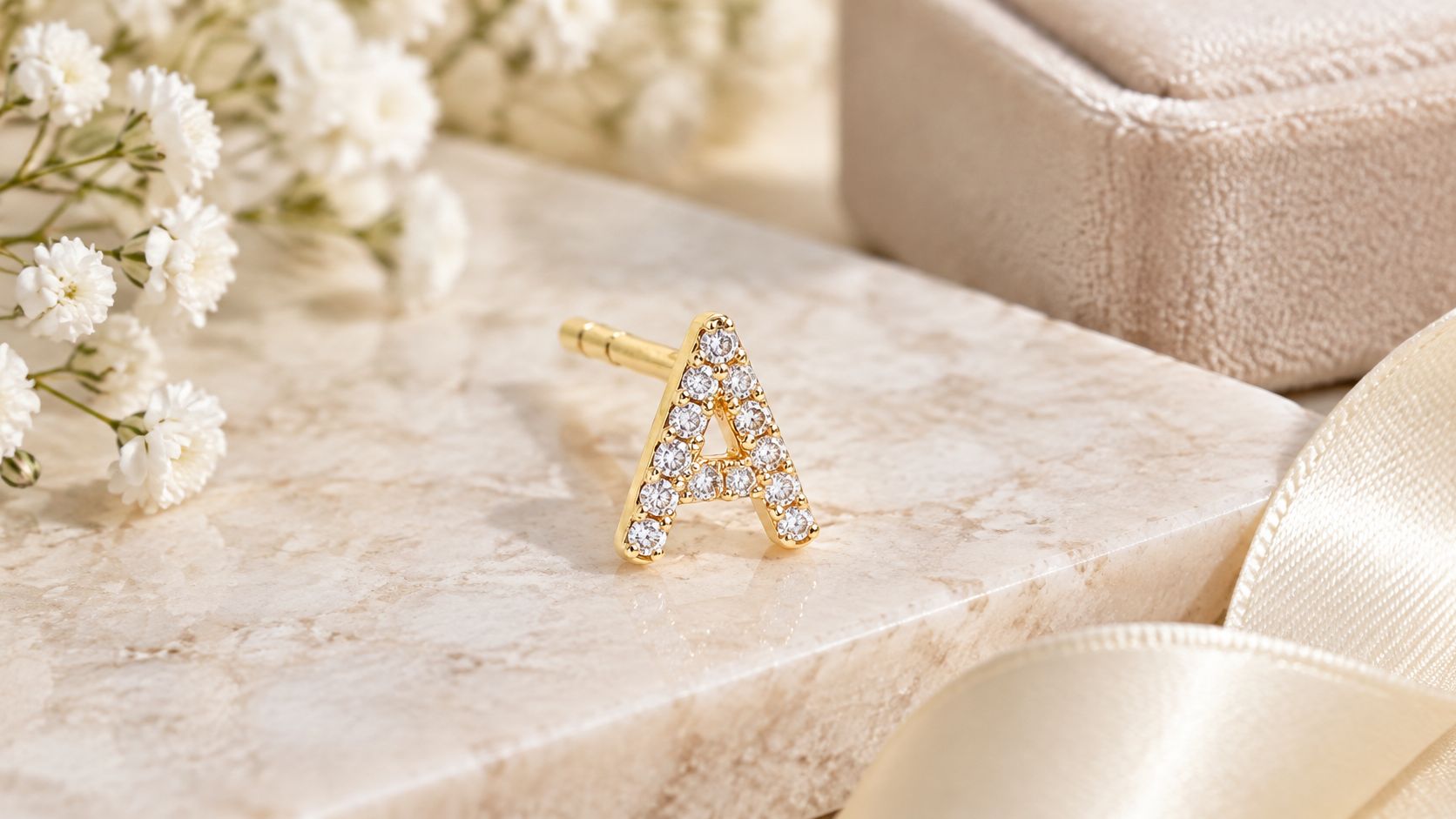
Letter jewelry is one way to personalize earrings without engraving. The 14k Diamond Letter Earrings are sold as a single, measure 6mm, and use 14K gold in yellow, white, or rose. They're custom, take 3 to 5 weeks for delivery, and are final sale, so check the letter and metal twice. This guide to diamond studs is useful if you're weighing studs against drops.
For basic care, store diamond pieces separately so they don't scratch other jewelry, remove them before cleaning or swimming, and avoid sudden temperature changes. Then apply the simple test. If the recipient wears jewelry every day, pick a pendant, bangle, or stud. If they save jewelry for special occasions, a statement piece makes sense.
Stone Quality to Check Before You Buy
Put cut first. Cut controls how efficiently a stone returns light to your eye, so it shapes brightness more than weight does. A heavier diamond that's cut too deep or too shallow can look dull, while a lighter, well-proportioned stone can look lively and larger than you'd expect.
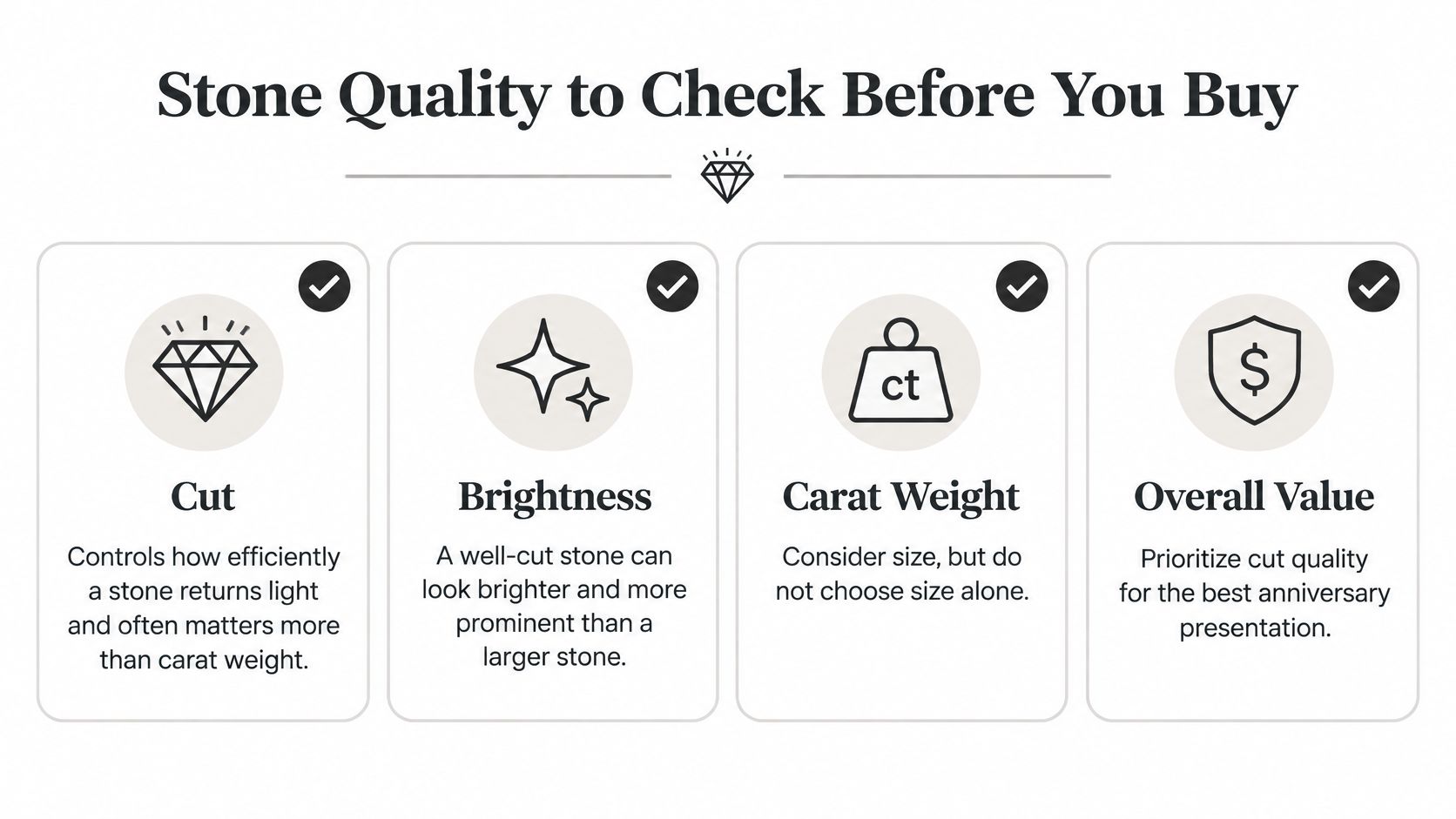
The FTC guide to buying gemstones, diamonds, and pearls supports a practical approach, and the Gemological Institute of America system evaluates standard round-brilliant diamonds using proportions, symmetry, and polish, assigning five overall cut grades. You don't need to memorize the grading math. You need to request the laboratory report and compare stones under neutral lighting, not only under bright store displays designed to make everything sparkle.
Your Buyer Checklist
- Pick the highest cut grade within budget: Do this before you chase extra carat weight.
- Request the laboratory report: Don't rely on a verbal description or a product photo alone.
- Get the details in writing: Confirm carat weight, color, clarity, cut grade, treatments, origin, and care requirements on the purchase record.
- Compare under neutral light: Step away from spotlights and look at the stone at arm's length, the distance typical viewers will see it.
A well-cut stone can appear brighter and more visually prominent than a heavier but poorly proportioned diamond. Brightness is what the recipient will notice every day.
After cut, balance color and clarity against the setting and viewing distance. In pavé or halo designs, matching the small melee diamonds by color and clarity keeps the piece visually even, because mismatched small stones draw the eye for the wrong reason. In a solitaire, there's nowhere for cut quality to hide, so spend your attention there. If you're considering a charm style, this look at the charm bangle shows how small stones work across a wider piece. Save detailed maintenance questions for the care instructions that come with the piece, and keep your buying decision focused on documented quality.
Choosing Between Natural and Lab-Grown Diamonds
Many buyers assume one origin makes a better gift. That assumption creates the stress. Origin is a values decision, not a test of how much you care.
This short consultation image shows the conversation worth having before you order, with both options on the table.
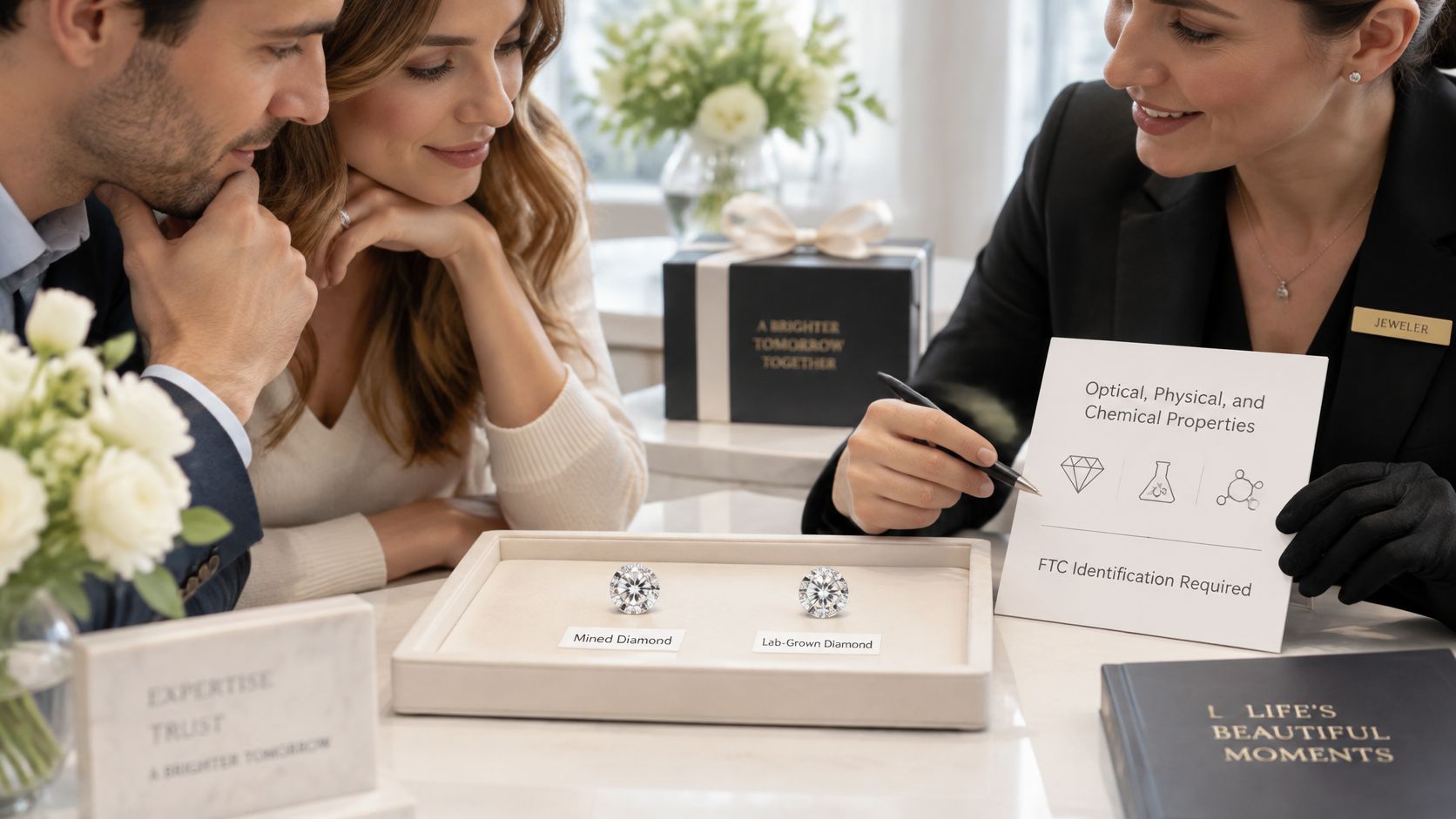
Lab-grown diamonds may have the same optical, physical, and chemical properties as mined diamonds, but they are not mined stones. The FTC guidance on advertising diamonds states that laboratory-created diamonds should be identified with terms such as "laboratory-grown" or "laboratory-created" immediately before or equally conspicuously with "diamond," and sales documentation should record origin, weight or size, treatments, and special care requirements.
Consumer feelings are split, which is why you shouldn't guess for your recipient. Reporting on U.S. consumer acceptance of lab-grown diamonds notes that 74% of respondents are open to receiving a lab-grown engagement diamond and 83% are open to receiving lab-grown diamonds in non-bridal jewelry, yet only 33% prefer lab-grown diamonds over natural ones, while 37% say they lack enough information to choose. Among equal-quality stones, 49% prefer natural diamonds, compared with 17% preferring lab-grown stones.
Match Origin to Priority
| Couple's priority | Lean toward | Why |
|---|---|---|
| Larger stone within budget | Lab-grown | Same optical and chemical properties at a lower price |
| Geological origin and rarity | Natural | The mined-stone story is the reason for the choice |
| Heirloom or family symbolism | Natural | Fits the permanence and history of the gift |
| Identical stone, decided by meaning | Either | Both match physically, so decide on symbolism |
| Sustainability concern | Ask for sourcing details | Generic claims do not settle energy or production impact |
Don't assume lab-grown automatically means more sustainable. Energy sources and production conditions affect that comparison, so ask for specific sourcing information instead of accepting a generic claim. This comparison of lab versus natural diamonds can help you prepare questions.
Watch this explanation together if you're deciding as a couple, then talk about values rather than price alone.
When you explain your choice, say what guided it. For example, "We chose the larger stone so you'd see it clearly every day," or "We chose a mined stone because its long formation felt right for sixty years." Don't call either option more romantic or more ethical. Confirm the origin wording matches on the product page and invoice, especially for personalized pieces where exchanges can be harder. An engraved date or message anchors meaning whichever origin you choose.
Personalize, Confirm and Order the Gift
Personalization is where a nice piece becomes a diamond wedding anniversary gift that couldn't belong to anyone else. It's also where avoidable errors happen, so follow a routine and don't rush the proofing.
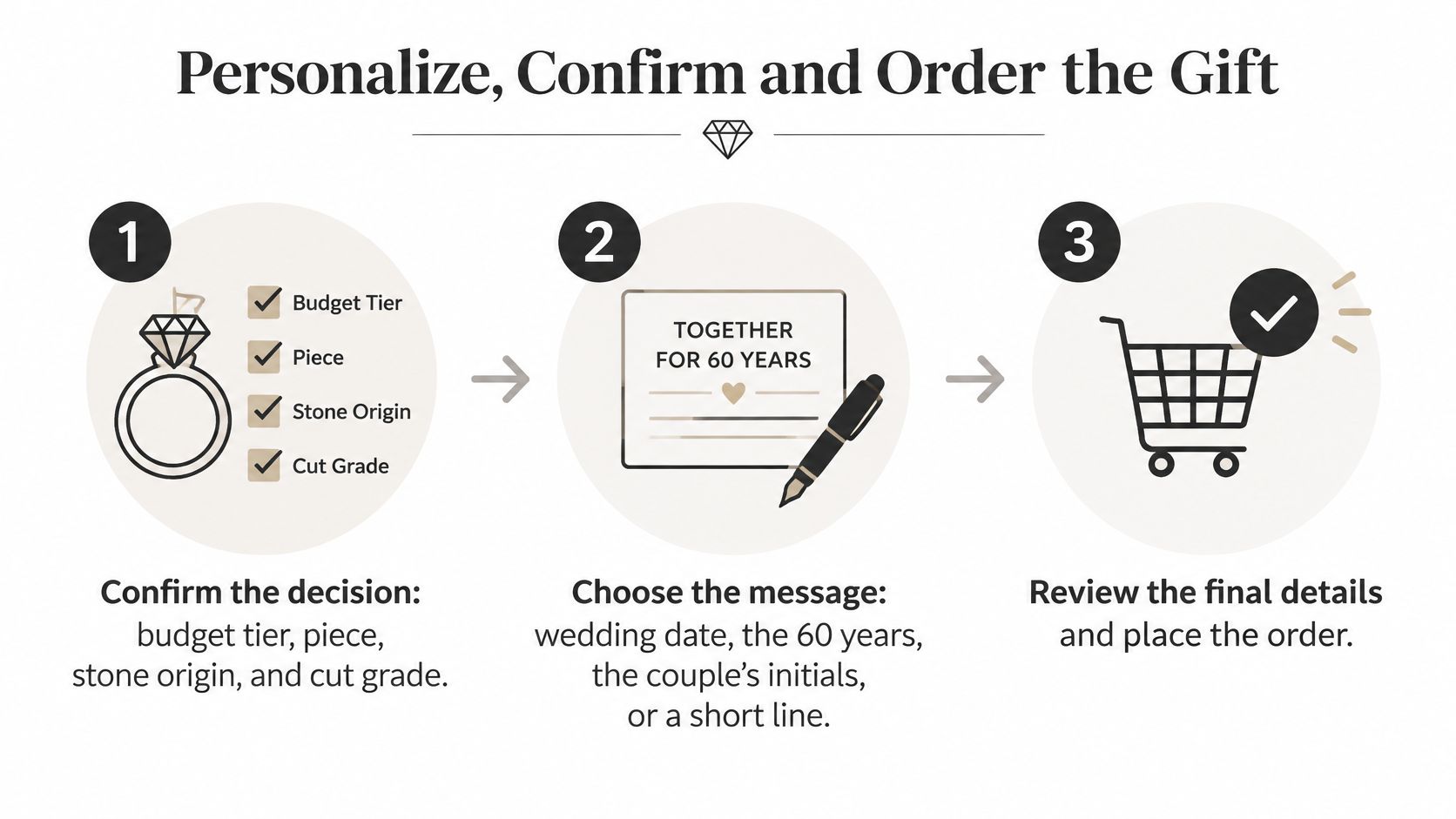
The Nine-Step Routine
- Confirm the decision: Write down your budget tier, piece type, stone origin, and cut grade before you open the personalization fields. This prevents last-minute upgrades that break your tier.
- Choose the message: Pick one clear idea, such as the wedding date, the number 60, the couple's initials, or a short line from their story. One idea reads better than three crowded onto a small surface.
- Pick engraving placement and check character limits: Bangles and rings have less room than pendants, so shorten the message rather than shrinking letters until they're hard to read.
- Proof spelling and date against the marriage certificate: A wrong date is a frequent engraving error, and a message submitted with the order often can't be changed once production starts. Read it aloud, digit by digit.
- Confirm origin wording, documentation, and size in the order notes: The maker, product page, and invoice should match, so there's no mismatch between what you intended and what arrives.
- Work backward from the anniversary: Order several weeks ahead and use the lead time shown on the product page for made-to-order pieces. Add buffer for shipping and for checking the finished piece.
- Check return, exchange, and warranty terms before paying: Don't assume personalized items follow standard rules. We carry a 90-day warranty, and plating is not covered under warranty. Some fine jewelry, typically personalized or made-to-order pieces and some EP Fine items, may carry a restocking fee of up to $150 per item, and some items may qualify for a size exchange or store credit.
- Add presentation packaging and plan the reveal: Choose a gift box that suits the piece's size, then plan a dinner, vow renewal, or letter placed with the box. If you're making a keepsake video for the celebration, the Photo for Video anniversary guide offers a useful starting point for gathering photos and clips.
- Keep the seller's care instructions with the gift: Put them in the box or an envelope so the recipient isn't guessing about cleaning, storage, or when to remove the piece.
What a Finished Gift Should Look Like
A date format shows why proofing matters. The 14k Diamond Date Ring consists of a six number date with small diamonds in between, with numbers measuring 7mm, in sizes 5, 6, 7, 8, and 9, using 14k gold and diamonds. You type the date to read from left to right, for example 062017, and it's made to order with 3 to 5 weeks allowed for production and delivery. One transposed digit changes the whole meaning, so step 4 earns its place.
If you're buying from us, use the personalization fields and order notes as described on the product page, and browse these personalized jewelry gift ideas if you're still choosing a message. Custom and personalized jewelry options are available across our collections, but availability and fields differ by product, so the product page is your source of truth.
Finished standard: Legible engraving, a clear message card, documentation that matches the order, and packaging that protects the piece. If any one of those is missing, you're not done yet.
Before the day, inspect the piece under ordinary light. Check that the clasp or closure works, the engraving matches your proof, stones sit securely, and the size matches your notes. Photograph the invoice and care card for your records. Then stop second-guessing the origin or the carat weight. If the message is clear, the fit is right, and the piece suits how they'll wear it, you've chosen a gift that says what sixty years deserves to hear.
Visit EP Fine Jewelry to browse personalized pendants, bangles, rings, and diamond pieces you can tailor with a date, name, or message for a 60th anniversary. Choose your budget tier, confirm the stone details and lead time on the product page, and order early so your gift arrives ready to present.