
“Gold” doesn't automatically mean safe for sensitive ears. A gold-colored hoop may contain a nickel-bearing alloy, and a gold-plated hoop can expose its base metal as the finish wears. Even “hypoallergenic” is a useful starting label, not proof that the earring will suit your skin.
The better question is: what metal touches the piercing, and how much nickel can it release? Once you understand nickel release, karat purity, plating, and the physical design of a hoop, shopping becomes much less confusing.
Table of Contents
- The Truth About Hypoallergenic Gold Jewelry
- Understanding Gold Karats and Alloy Chemistry
- Solid Gold Versus Plated and Vermeil Options
- How to Read Labels and Verify Metal Safety
- Hoop Design and Closure Mechanics for Comfort
- Daily Care and Maintenance for Sensitive Ears
- Shopping for Hypoallergenic Hoops at EP Fine Jewelry
The Truth About Hypoallergenic Gold Jewelry
A gold hoop can look luxurious and still cause itching, redness, or soreness. The visible color tells you almost nothing about the alloy underneath. Gold plating may cover brass, copper, or another undisclosed metal, while a solid gold piece can still include alloying metals that matter to nickel-sensitive wearers.
The issue is usually not the mere presence of metal. Allergic contact dermatitis develops when metal ions, especially nickel, reach the skin and trigger an immune response. That's why a technical nickel-release test gives shoppers more useful information than a vague “safe for sensitive ears” claim.
Nickel release is the practical safety benchmark
For jewelry intended for direct and prolonged skin contact, the European Union limits nickel release to 0.5 micrograms per square centimeter per week. For post assemblies inserted into pierced ears, the stricter limit is 0.2 micrograms per square centimeter per week, according to STUDEX's explanation of jewelry material standards.
These limits matter because an earring post sits inside a piercing for extended periods. A hoop may be labeled gold, but if its post or closure releases nickel above the relevant threshold, the surface color won't protect your skin.
Practical rule: Treat “hypoallergenic” as a prompt to investigate, not as a substitute for alloy information or nickel-release evidence.
Testing under EN 1811 is used to verify nickel-release compliance. The result is more meaningful than a product photograph, a gold-tone finish, or a karat reference that applies only to the decorative front of the earring.
Why “nickel-free” still needs context
A clear nickel-free statement is helpful, but severe sensitivities may justify asking further questions. Does the claim cover the hoop, post, hinge, and backing? Is the item solid gold, vermeil, plated, or made from another alloy? Can the seller identify the exact composition or provide compliance documentation?
Nickel allergy is common enough to influence jewelry design and labeling. DermNet's guidance on jewelry allergy cites more than 18 million Americans with nickel allergy and estimates that nickel allergy affects 10% to 15% of the global population. Those figures explain why buyers shouldn't rely on the word “gold” alone.
The safest mindset is simple: evaluate the metal's performance at the skin, not its appearance in the display case.
Understanding Gold Karats and Alloy Chemistry
Pure gold is soft, which makes it poorly suited to a hoop that must hold its shape and survive regular handling. Jewelers mix gold with other metals to increase strength, adjust color, and create a practical piece of jewelry. That mixture is called an alloy, and it's where sensitivity questions begin.
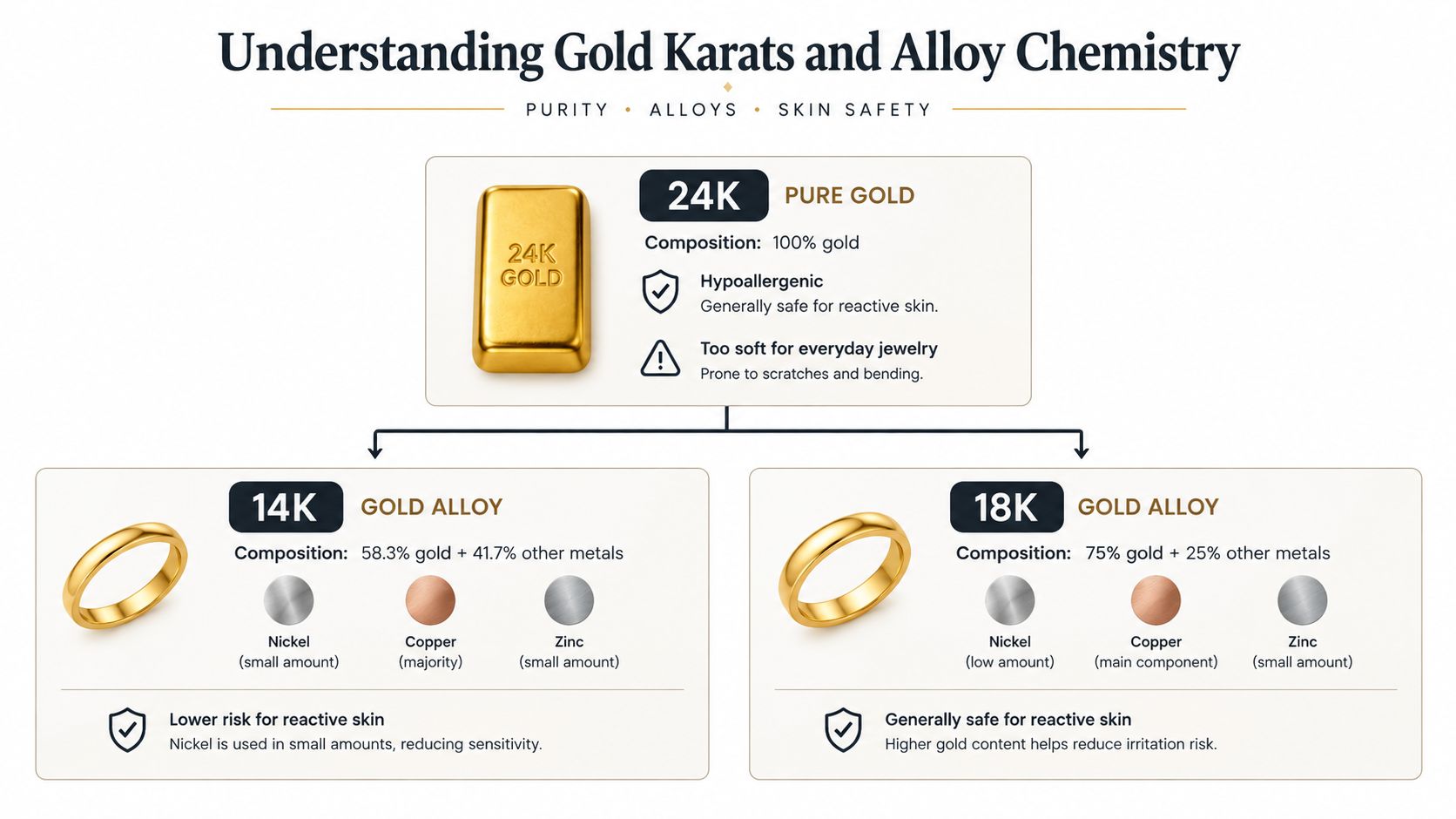
24K gold is described as 100% pure gold and is completely hypoallergenic, but its softness can make it impractical for many durable hoop designs. 18K gold contains 75% gold, leaving a smaller non-gold fraction for strengthening metals. 14K gold contains 58.3% gold, so a larger portion of the piece comes from the alloy blend. These compositions are summarized by Brilliant Earth's guide to hypoallergenic jewelry metals.
Higher karat usually means less alloy uncertainty
A higher karat doesn't automatically prove that a hoop is nickel-free. It does, however, reduce the proportion of non-gold material and is generally the more cautious choice for reactive skin. Dermatology guidance commonly recommends materials such as stainless steel, sterling silver, platinum, or at least 18K gold, with 18K considered safer than lower-karat gold for people prone to reactions.
That makes solid 18K yellow gold a practical balance for many sensitive-ear shoppers. It offers more gold than 14K while remaining more suitable for everyday jewelry than very soft pure gold. If you're comparing options, the guide to whether 10K gold is suitable can help clarify why lower karat levels require closer attention to alloy composition.
White gold deserves a separate check
Yellow, rose, and white gold are not interchangeable from a sensitivity perspective. White gold achieves its pale appearance by combining gold with whitening metals. Some formulations use nickel, while others use alternatives such as palladium. You can't determine the formula from the color alone.
If you prefer white-gold hoops, ask whether the alloy is nickel-free and whether the post and closure use the same composition as the hoop itself. A white-gold item can be suitable for sensitive ears, but the listing should make the alloy choice clear.
Rose gold also contains additional metals to create its warm color, commonly including copper. Copper isn't the same concern as nickel, but people with a history of metal reactions should still seek full composition details rather than assuming every rose-gold alloy behaves identically.
The useful comparison isn't simply 14K versus 18K. It's disclosed alloy versus undisclosed alloy.
Solid Gold Versus Plated and Vermeil Options
The phrase “gold earrings” can describe very different constructions. Solid gold means the gold alloy runs through the piece. Gold vermeil means gold plating over a sterling silver base. Gold-plated jewelry has a gold layer over another base metal, which may be brass, copper, silver, or an unspecified alloy.
That distinction becomes important at the post, hinge, and closure. A beautiful gold surface may provide little protection if friction removes the coating where the earring touches the piercing.
Compare the construction, not just the finish
| Construction Type | Base Metal | Durability | Safe for Sensitive Ears |
|---|---|---|---|
| Solid gold | Gold alloy throughout | The material doesn't have a separate plating layer to wear away | Often the most dependable option when the alloy is nickel-free |
| Gold vermeil | Sterling silver beneath gold plating | The gold surface can wear, while the silver base remains | Potentially suitable, if the post, backing, and base are sterling silver and nickel-free |
| Gold-plated | Brass, copper, silver, or another base | The outer layer can wear through at contact points | Depends on the base metal and the composition of every skin-contact component |
Solid gold offers the clearest long-term construction for severe sensitivities, but it still deserves an alloy check. An 18K solid gold hoop with a nickel-bearing white-gold formula isn't the same choice as an 18K nickel-free yellow-gold hoop.
Vermeil can be a reasonable alternative when the seller clearly identifies sterling silver as the base. Don't assume every item using the word “vermeil” follows the same standard, especially when the product page doesn't identify the post or backing.
For a concise explanation of how bonded gold layers differ from ordinary plating, see EP Fine Jewelry's guide to gold-filled and gold-plated jewelry. The key shopping question remains unchanged: what sits underneath the gold, and what touches your piercing?
Why plating changes the risk over time
A plated hoop may feel comfortable at first because the gold layer separates your skin from the base metal. Repeated friction from insertion, removal, a hinge, or a backing can gradually expose another alloy. That's why a pair that worked initially may become irritating later.
If a listing describes only the visible finish, treat it as incomplete. Look for the base metal, the post metal, and the backing material. A lower-cost hoop with complete disclosure may be a more rational choice than a premium-looking piece with no construction details.
How to Read Labels and Verify Metal Safety
Online jewelry descriptions often use reassuring words without explaining the part that matters most. “Hypoallergenic metal,” “gold tone,” and “sensitive-skin friendly” can sound precise while leaving the alloy completely unknown.
Use the product page as a checklist. If the information isn't there, contact the seller before ordering.
Start with the exact metal description
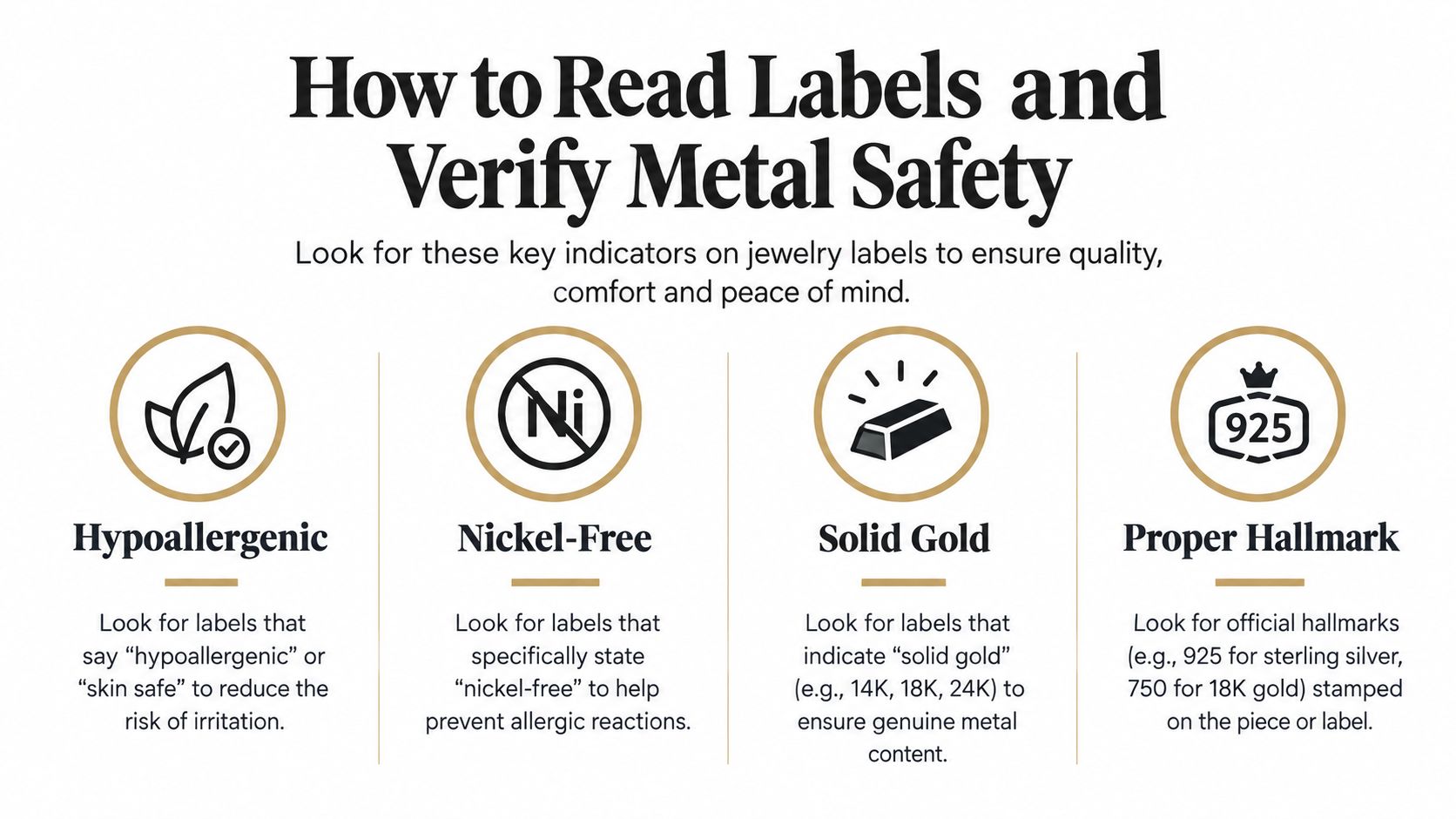
Search for a karat designation such as 14K, 18K, or 24K, then check whether it applies to the entire hoop or only a component. A product that says “14K gold post” gives you more useful information than one that says “gold finish.”
Look for these details:
- Post and backing: Confirm the metal inserted into the piercing and the metal resting behind the lobe.
- Alloy disclosure: Check for an explicit nickel-free statement, especially with white gold.
- Construction type: Identify whether the hoop is solid gold, vermeil, gold-filled, or plated.
- Hallmark information: Look for a relevant karat mark, while remembering that a stamp alone doesn't reveal every alloying metal.
- Testing evidence: Ask whether the item meets the applicable nickel-release limits and whether EN 1811 testing supports that claim.
A seller's use of “hypoallergenic” should lead to a specific answer. The guide to nickel-free jewelry is useful background, but your purchase decision should rest on the actual item's composition.
Ask questions that produce usable answers
Instead of asking, “Is this safe for sensitive ears?” ask:
- What metal is used in the post, hinge, closure, and backing?
- Is the gold alloy nickel-free?
- Is the item solid gold, vermeil, or plated?
- Does the nickel-free statement cover every component that touches the ear?
- Can you provide nickel-release compliance information?
A clear answer names the metal. A vague answer repeats the marketing label.
Be particularly cautious with “gold-colored,” “gold-toned,” and “hypoallergenic alloy” when no base metal appears. Those descriptions may be adequate for style, but they don't give a sensitive-ear shopper enough information to assess risk.
Hoop Design and Closure Mechanics for Comfort
Metal chemistry isn't the only source of discomfort. A hoop can use a suitable alloy and still irritate the ear if it pulls, rubs, presses, or moves excessively. Mechanical irritation can resemble an allergic reaction, especially when soreness follows long wear.
A large or thick hoop places more strain on the lobe. A heavy design may tug at the piercing, while a rigid edge can rub against the front or back of the ear. Lightweight, thin, or hollow constructions can reduce physical stress, although they still need a safe skin-contact metal.
The post assembly deserves close attention
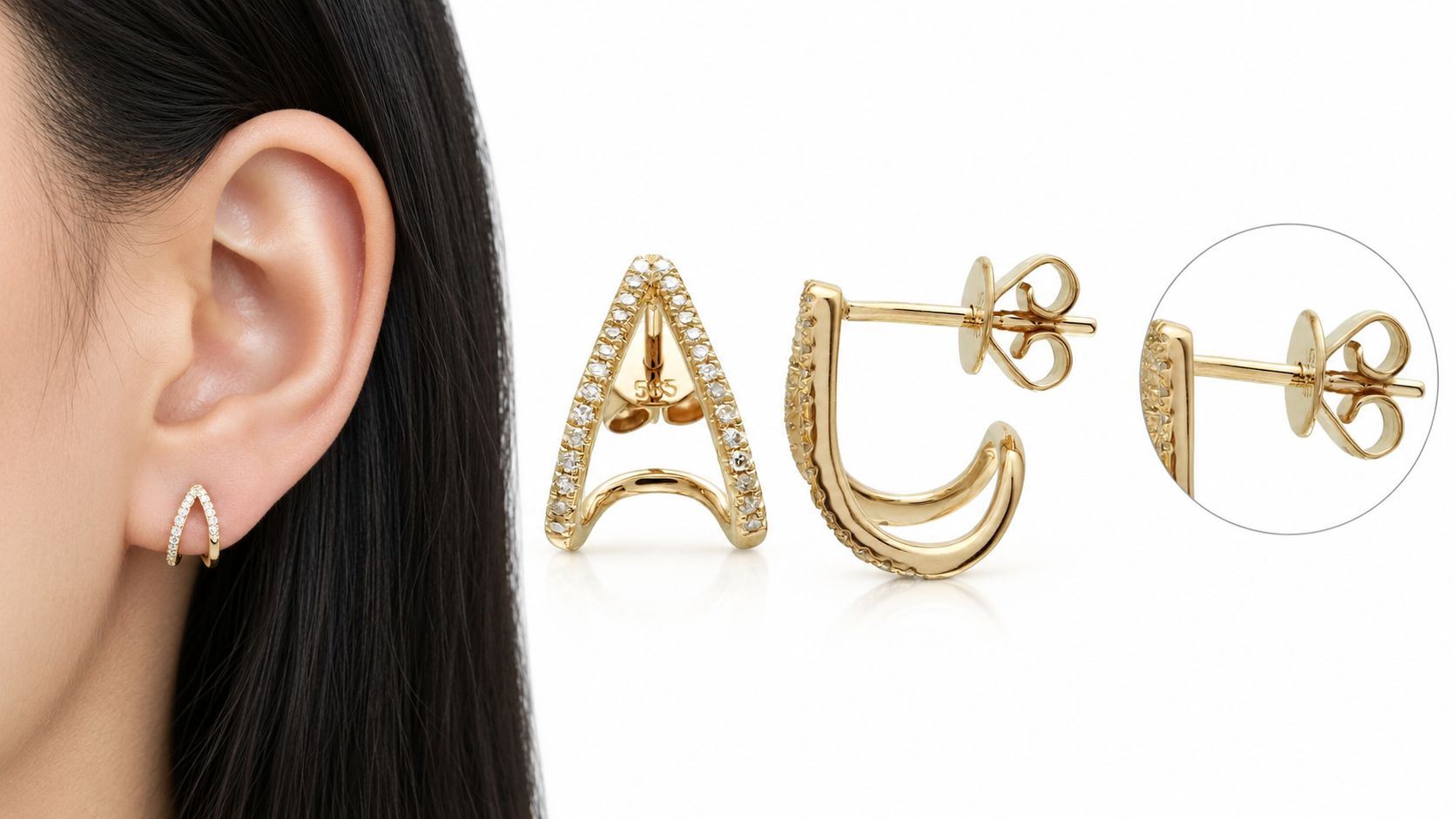
A hinge closure can be convenient because it avoids a separate butterfly back, but the hinge, latch, and post may use different components. A post-and-clutch design gives you another piece to inspect, since the clutch sits against the back of the lobe for long periods.
Read this overview of earring clasp types with one question in mind: which parts remain in contact with your skin throughout the day? The answer may include more than the visible hoop.
Smaller huggies often sit close to the lobe and move less than a broad, swinging hoop. That can improve comfort for some wearers, but a snug fit may create pressure if the inner diameter is too small or the closure pinches. Fit is personal, so don't trade metal safety for a shape that feels tight.
The 14k Split Huggies are listed as a pair, measure 6mm, and are described as 14K gold in yellow, white, and rose options. The listing also states that delivery takes 3-5 weeks and that the item is final sale. Because 14K gold can use different alloy formulas, confirm the nickel content before choosing them for highly reactive ears, particularly in the white-gold option.
Separate allergy clues from friction clues
Itching, rash, or blistering may point toward contact dermatitis. Tenderness from pulling, pressure, or a hoop catching on clothing may be mechanical. Both can happen together, and neither should be ignored.
Remove the earrings if your ear becomes painful or inflamed. Once the skin settles, try a lighter design made from a clearly disclosed material. If symptoms persist or appear severe, seek medical advice rather than repeatedly testing new metals.
Daily Care and Maintenance for Sensitive Ears
Care won't change an unsuitable alloy, but it can reduce residue, friction, and premature wear. Sweat, cosmetics, hair products, and moisture can collect around the post or hinge. Cleaning also gives you a chance to notice rough edges, loose closures, or worn plating before they become a bigger problem.
A gentle routine protects the finish
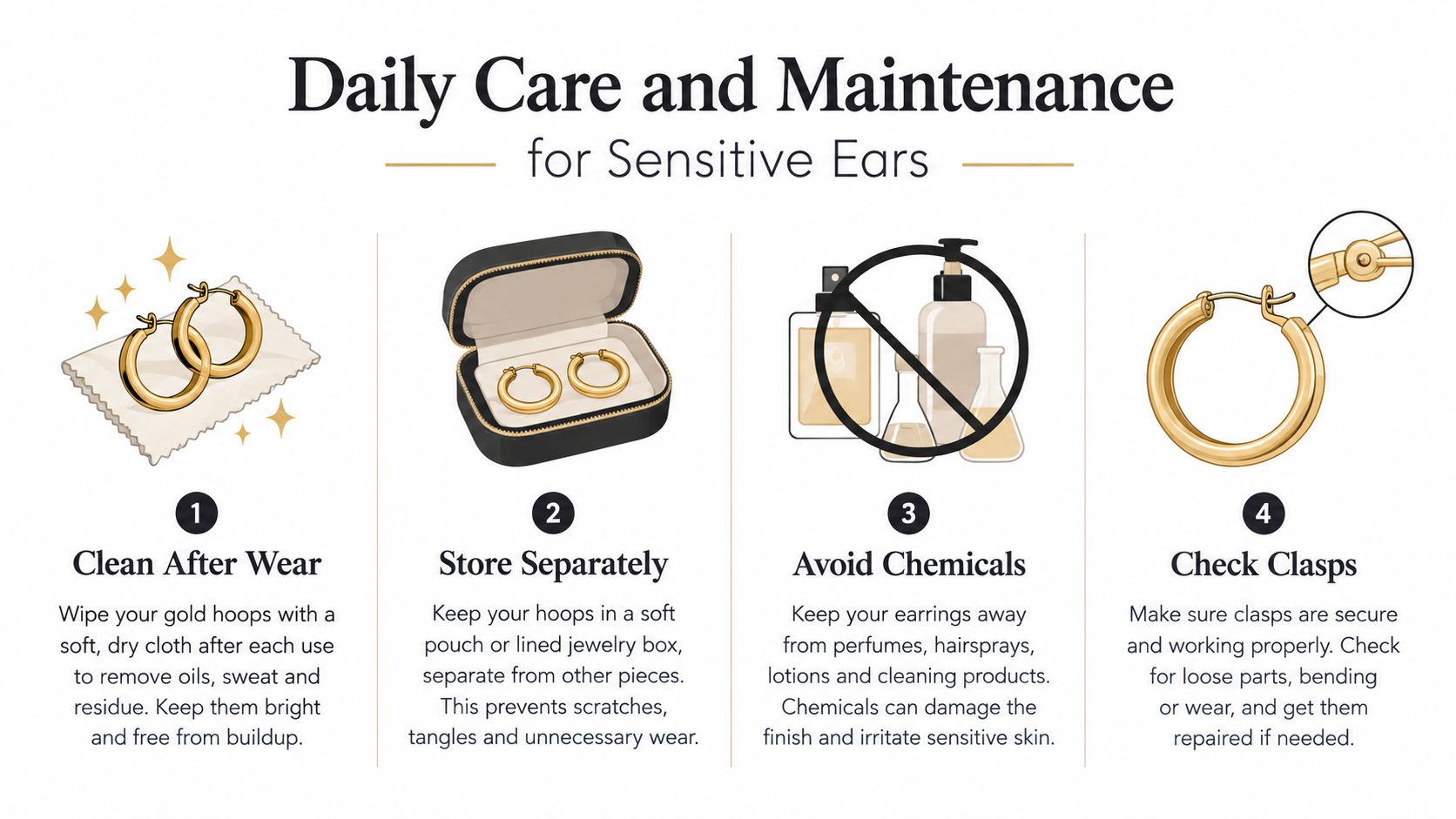
After wearing your hoops, wipe them with a soft, lint-free cloth. For a more thorough clean, use a mild method appropriate for the jewelry's construction, then dry the piece completely before storage. The at-home jewelry cleaning guide can help you choose a suitable approach.
Avoid treating every hoop like solid gold. Plated and vermeil surfaces can respond poorly to abrasive polishing, harsh chemicals, or aggressive scrubbing. Don't use chlorine, strong cleaners, or perfume directly on the earrings, and remove them before activities that expose them to excess moisture or chemicals.
Inspect the points that wear first
Pay attention to the post, latch, hinge, and backing rather than only the decorative front.
- After cleaning: Check that the post remains smooth and that the closure clicks or fits securely.
- Before storage: Dry the hoop fully so moisture doesn't remain around the mechanism.
- During regular wear: Look for discoloration, roughness, flaking, or a change in comfort at the piercing.
- When storing: Keep each pair in a separate soft compartment to limit scratches and contact with other jewelry.
If a plated surface has worn through at the post, stop wearing the pair until you know what metal is underneath. A clean appearance on the front doesn't prove that the piercing-contact area remains protected.
Shopping for Hypoallergenic Hoops at EP Fine Jewelry
A careful shopping process starts with filtering by style, then checking the construction details before checkout. On EP Fine Jewelry, shoppers can browse earrings by category, compare hoop formats, and use the site's Jewelry Care and policy resources when they need information about ownership or returns.

Suppose you're choosing a gift for someone who reacts to some earrings. Start by asking whether they prefer yellow, rose, or white gold, then confirm the karat and alloy details. Next, inspect the post and closure information, because the part through the piercing may not be identical to the visible hoop.
EP Fine Jewelry also lists personalized jewelry alongside earrings, so a buyer can consider a custom gift rather than choosing only from standard designs. An optional gift box and order notes can support present-ready packaging and a personal message, while the site's care, shipping, and return pages provide information to review before completing an order.
Use product facts, not assumptions
The product page should answer the questions that affect comfort: What is the material? What size is the hoop? Is it sold as a pair? Are there delivery or final-sale conditions? If a sensitive-ear concern remains unanswered, contact the retailer before purchase.
For example, a shopper may choose a small hoop because it reduces movement, but size alone doesn't establish hypoallergenic performance. A 14K hoop may be comfortable for one person and irritating for another, depending on the alloy and the individual's sensitivity. A clearly disclosed 18K or nickel-free option may be the more suitable choice when the wearer has a known reaction history.
The embedded video offers another way to explore earring selection and styling before you decide.
Before checkout, save the product details and verify the metal touching the ear, the closure construction, and the return conditions. That small check helps prevent an attractive gold finish from becoming an uncomfortable purchase.
EP Fine Jewelry offers categorized earrings, personalized jewelry, gift-box options, order notes, and care and policy resources for shoppers comparing gold hoops for sensitive ears. Visit EP Fine Jewelry to review hoop designs and confirm the metal details before choosing your next pair.