
A charm bracelet is a wearable record of identity, affection, protection and memory, and each charm's meaning comes from the person who wears it or gives it.
If a heart always means romance, how could the same charm belong on a bracelet celebrating a grandmother, a friendship or a fresh start? Familiar symbols give us a starting point, but they don't tell the whole story. The most useful way to understand charm bracelet meaning is to look at both the symbol and the life attached to it.
Table of Contents
- What a Charm Bracelet Means
- Common Charm Symbols and Their Usual Meanings
- Why the Same Charm Can Mean Different Things
- Reading a Charm Bracelet Someone Gave You
- How Charm Bracelets Became Keepsakes
- Choosing Charms for Milestones, Memories and Yourself
What a Charm Bracelet Means
A charm bracelet holds the people, beliefs and experiences its owner wants to keep close. Some charms communicate something recognizable, such as affection or achievement. Others make sense only when the wearer explains them.
Think of the bracelet as a photo album on a chain. Each charm is a page added for something worth remembering. A tiny book might stand for a love of reading, but it could also recall the novel someone read aloud during a difficult time.
The symbol and the story
There are two useful layers to consider:
- Traditional symbolism gives a charm a familiar reading, such as a horseshoe associated with luck.
- Personal meaning connects that shape to a particular person, experience or intention.
The distinction helps explain why choosing meaningful jewelry isn't a matter of matching shapes to definitions. A symbol can communicate a broad idea while holding a much more specific memory.
The fashion reference entry on bracelets in Encyclopedia.com describes the sentimental tradition behind bracelets carrying personal keepsakes. The ability to add individual pieces makes a charm bracelet especially suited to recording a life that's still unfolding.
Personalization doesn't require a secret code
You don't need to memorize a dictionary before starting a bracelet. You need a connection between the object and the person who'll wear it. Understanding what custom jewelry is can help distinguish choosing an existing symbol from creating a more individually specified piece.
A bracelet also doesn't need a single theme. Family memories, hobbies and achievements can sit together, just as different experiences belong in the same album.
The central rule: The owner has the final say in what a charm represents, and that meaning can deepen over time.
Common Charm Symbols and Their Usual Meanings
Use these common readings as starting points, not rules that override the wearer's background or intentions.
Common charm symbols and their usual readings
| Charm | Commonly Read As | Other Common Uses |
|---|---|---|
| Heart | Love and affection | Family bonds, friendship, self-love |
| Star | Hope and guidance | Achievement, a child or a loved one |
| Key | New beginnings and opportunity | A home, a new job, a move |
| Horseshoe | Good luck | Protection, tradition |
| Four-leaf clover | Good luck | Hope, a fresh start, heritage |
| Anchor | Stability and steadiness | Sea travel, faith, grounding |
| Elephant | Memory and wisdom | Family lineage, strength |
| Evil eye | Protection from harm | Personal safety, cultural tradition |
| Graduation cap | Learning achievement | Milestone, career step |
| Initial or letter | A named person or identity | Partner, child, pet, self |
| Book | Learning or a life story | Writing, a life chapter |
Choose the reading that fits the occasion
A heart is a straightforward choice for affection, but the relationship determines its message. A gift between friends doesn't become romantic just because it includes a heart. The same distinction applies to other heart-shaped jewelry, including a heart diamond necklace.
A star, graduation cap and book can all celebrate achievement, but they emphasize different things. A star can recognize effort or aspiration. A graduation cap points more directly to completed education, while a book can suit someone who values learning outside formal study.
Keys and anchors make another useful comparison. A key can mark stepping into something unfamiliar, while an anchor can recognize the person or belief that helps someone feel secure. For a moving-away gift, either could work, but they'd communicate different wishes.
Treat cultural symbols with care
Protective and spiritual symbols deserve more thought than a quick label. An evil-eye charm represents a protective belief or tradition, not a guarantee that nothing harmful will happen. An elephant or clover may connect to a recipient's heritage, but don't assume that connection from appearance alone.
When you don't know someone's background, begin with a familiar reading and confirm that it feels right to them. A direct question can prevent an otherwise thoughtful gift from carrying an unintended message.
Practical rule: Choose a symbol you can explain in a sentence, rather than one you hope the recipient will decode correctly.
The table is a starting point for choosing a charm, not a test with a correct answer.
Why the Same Charm Can Mean Different Things
A charm bracelet works like a diary its owner writes in metal. The entries use a shared alphabet of shapes, but each one records something only the wearer fully knows. A butterfly charm can mark recovery after a long illness for one wearer, honor a relative who collected them for another and celebrate a fresh start for a third.
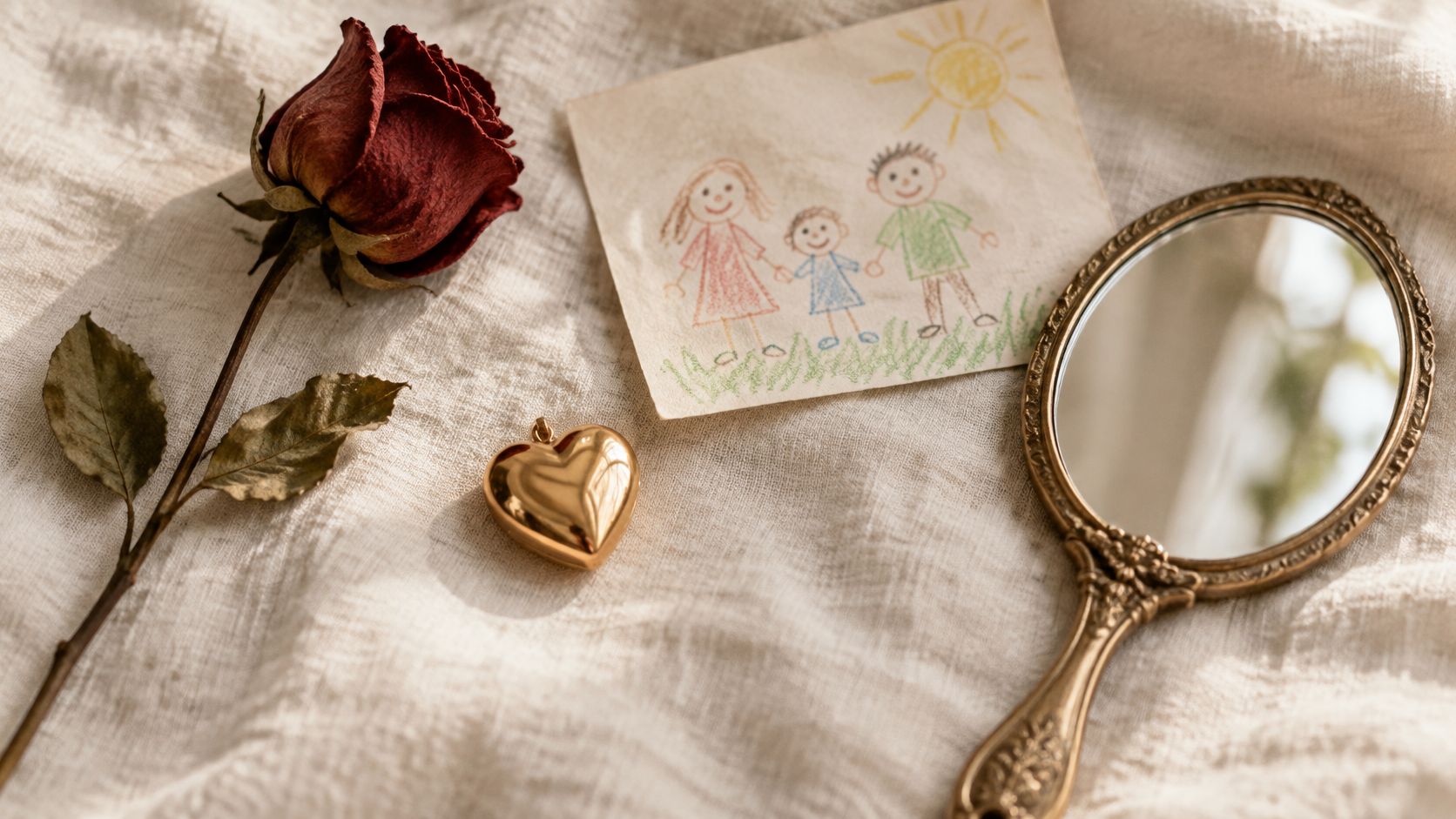
Mementos like these show how a single charm can sit beside very different personal histories.
A fixed symbol dictionary misses this distinction. Jewelry commentary in Forbes on personalization and charms discusses personal significance alongside interchangeable elements, hidden details and pieces that evolve with their owners. Those design choices give wearers room to say more than a publicly recognizable message.
Public symbols and private memories
Private symbolism is the association only the wearer or giver may know. Say someone chooses a star after a parent helped them through evening classes. Other people might see ambition; the wearer remembers the person who stayed awake to offer encouragement. Both readings live on the same charm, which is why two identical bracelets can tell entirely different stories.
Before choosing, ask:
- Memory: What experience should this represent?
- Purpose: Is it about the recipient's identity, an achievement or a relationship?
- Lasting relevance: Will the meaning still feel relevant as their life changes?
These questions also leave room for the meaning to grow after the gift arrives. You might give a compass for a first solo trip, and its owner may later read it as the confidence that trip built.
Let the meaning keep growing
A charm's meaning settles on the day it is given only if the wearer wants it that way. As new charms join the bracelet, older ones pick up fresh context, the way an early diary entry reads differently once later pages exist. A feather chosen during one chapter can come to stand for the whole period of life around it.
You can preserve the original intention without restricting what comes later. Write a sentence about why you chose the charm, then let its owner add their own understanding. Keep that note with a photograph of the bracelet so the private details don't disappear from memory.
Reading a Charm Bracelet Someone Gave You
What did this charm mean to the person who picked it? That's usually a more helpful question than asking what the shape means in isolation.
Start with the bracelet's known history. Which charm arrived first, which was added recently, and which seems deliberately set apart? Physical position alone isn't proof of sequence, especially when charms slide or have been rearranged.
Read combinations as possibilities
A horseshoe beside a portrait locket might express a wish for luck alongside family remembrance. An initial added after a move could refer to a partner or child, but it could just as easily represent the wearer. A graduation cap given after a demanding course is a clearer clue because the occasion narrows its meaning.
Relationship-specific examples, such as mother-and-daughter charms, can help you consider who a gift celebrates. Still, the giver's note is stronger evidence than resemblance to another bracelet.
Try this approach:
- Find the specific clues. Initials, recognizable places and engraved dates are more useful than a general decorative shape.
- Compare the likely reading with the occasion. Ask whether the symbol fits what was happening when the gift arrived.
- Ask about a particular charm. Tell the giver which piece caught your attention and invite them to explain why they chose it.
For thinking about the care behind a present, the Ecuadane guide to intentional gifting offers a useful companion perspective. The aim is to understand the connection, not to prove you guessed correctly.
A gifted bracelet's meaning belongs to the giver and recipient together.
You can appreciate the original intention and continue adding your own chapters. Receiving a bracelet doesn't mean its story is finished.
How Charm Bracelets Became Keepsakes
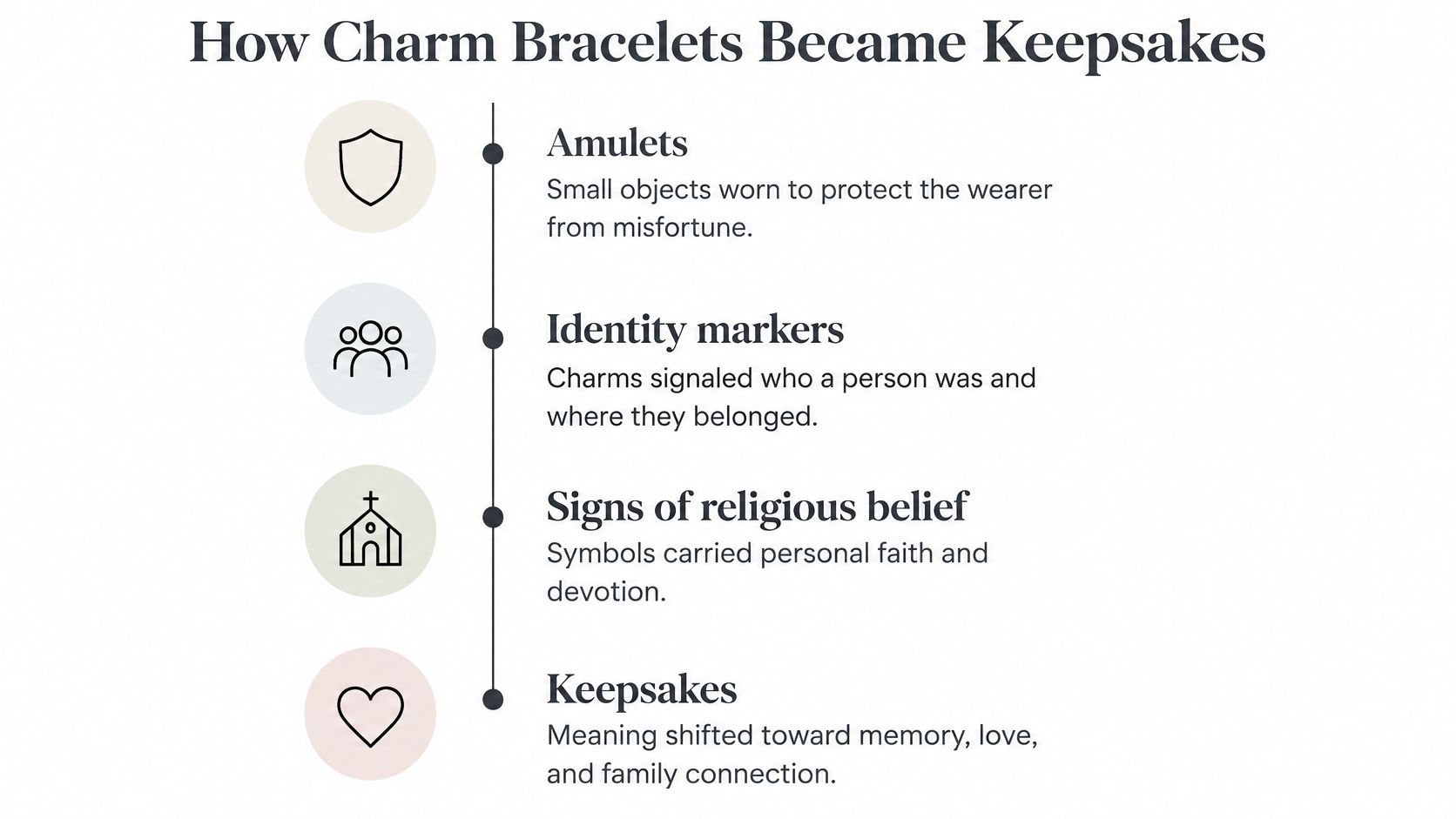
Before charms became miniature souvenirs, people wore small symbolic objects as amulets, identity markers and expressions of religious belief. These purposes could overlap. An object might communicate belonging while also expressing a wish for protection from misfortune.
Later European sentimental jewelry placed greater emphasis on preserving relationships and memories. A portrait locket offered something different from a protective object: a way to carry a particular person close to the body.
The Victorian turn toward remembrance
In its account of charm bracelet history, Encyclopedia.com describes Queen Victoria's family-portrait lockets, the emotional significance of mourning jewelry after Prince Albert's death in 1861, and an established British charm-bracelet tradition by the 1870s and 1880s, with surviving examples holding more than 30 charms.
Those collections included miniature books, locks, religious objects, horseshoes and portrait lockets. The variety matters because it shows that sentimental meaning didn't replace older protective or devotional associations. Wearers could keep several kinds of meaning together.
The timeline below summarizes these overlapping uses, rather than suggesting that every culture followed an identical path.
From protective object to personal archive
Consider a bracelet with a horseshoe beside a portrait locket. The wearer might attach a wish for good fortune to the horseshoe and a specific family memory to the portrait. Neither object needs to lose its meaning for the other to belong.
Modern keepsakes can preserve equally distinctive traces of a person. For example, personalized jewelry with handwriting connects remembrance to the familiar shape of someone's written words.
- Preserve the object's story. Record who wore it and why a particular charm mattered.
- Keep the context nearby. Photograph the bracelet alongside a short description of its associations.
Life Calendar's ideas for adding context to your phone photos offer a practical way to approach that second task. A photograph records the object's appearance; your notes preserve the memories someone else couldn't recover by looking alone.
Choosing Charms for Milestones, Memories and Yourself
Use the occasion to narrow your choices, then select the detail that feels most specific to the wearer. A charm bracelet works like a diary you write one entry at a time: the occasion gives each entry its context, and the small detail you chose is what brings the memory back.
Charm ideas for life moments
| Moment | Charm Idea | Meaning It Often Carries |
|---|---|---|
| Birthday | Birthstone or number charm | Another year lived, a yearly record |
| Graduation | Graduation cap or book | Completed study or training |
| Wedding or engagement | Ring or paired hearts | A commitment shared with a partner |
| New baby | Footprint, initial or stork | Arrival and family growth |
| Travel | Plane, compass or city shape | Places visited and trips taken |
| Career milestone | Briefcase or star | A promotion, first job or new business |
| Memorial | Initial, paw print or birthstone | Remembering someone who has died |
| Self-purchase | Charm for a hobby or goal | A personal goal or interest |
| Everyday mood | Simple shape or color | A season, hobby or place with no deep meaning |
A charm you buy yourself counts
A runner adds a tiny shoe charm after her first marathon. A student buys a book charm the week she finishes a course she nearly quit. Nobody handed them these pieces, and the meaning holds anyway. Your own recognition of progress is reason enough to mark it.
Gifting is still the more common habit: 72.8% of surveyed jewelry buyers purchase jewelry as a meaningful gift, according to the Theo Grace 2026 consumer-insights report. The survey reflects buyers' habits; it does not set a rule for who should choose a bracelet.
Some additions carry no deep symbolism, and that is fine. Forcing a major life lesson onto a holiday souvenir or a favorite color can make choosing feel performative. Enjoying a charm is a sufficient reason to wear it.
Match the keepsake to the memory
For a graduate, think about what deserves recognition: finishing the course, persevering through it or beginning a career. These graduation charm bracelet ideas can help narrow that choice.
Memorial gifts call for more sensitivity. An initial may comfort one person, while another would prefer to choose their own keepsake. For someone considering a pet memorial that holds cremated remains, Heartstrings Pet Hospice & In-Home Euthanasia explains pet cremation jewelry options, which are distinct from a purely symbolic paw-print charm.
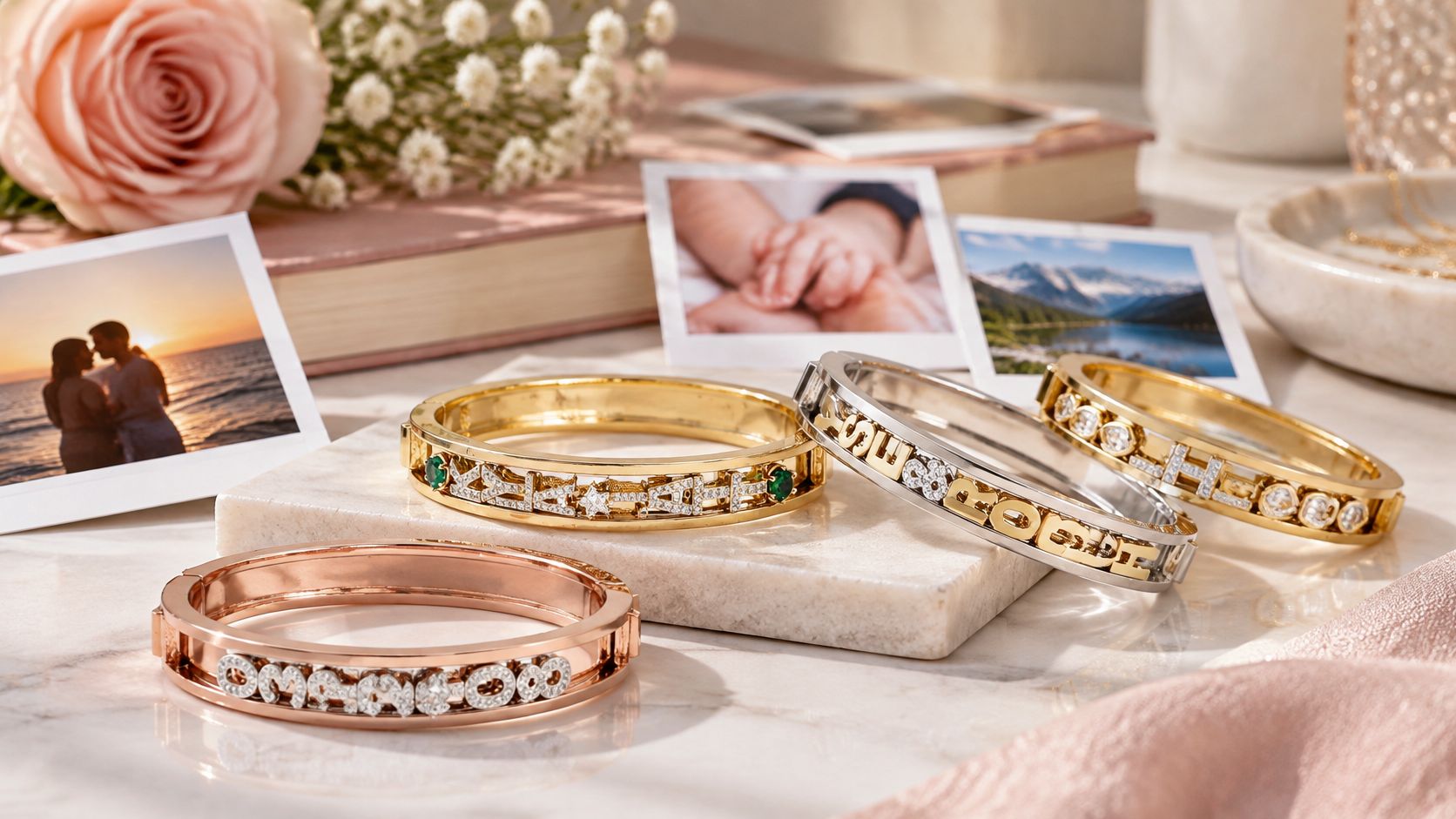
A charm bangle is one format for collecting these details. Our Personalized Charm Bangle is priced at $150.00 and made of brass with heavy 18 karat gold plating plus a coating that helps prevent tarnishing. For sizing, choose the size matching your wrist measurement for a snug fit or size up one for a looser fit: a 6.5-inch wrist takes a small (6.5 inches) snug or a medium (7 inches) loose. If the fit is off, the bangle can be exchanged for a different size.
The image below shows this bangle format.
Build a bracelet you can continue
- Name the story. Choose a starting focus, such as family, travel, a goal or someone's memory.
- Choose a compatible base. Consider comfort, attachment style and room for future additions. Charms aren't interchangeable across every bracelet system.
- Select a small starting group. Pick pieces that each contribute something distinct rather than filling the bracelet immediately.
- Record the intention. Write a short explanation of what each addition marks.
- Add charms securely. For our charm bangles, open the latch on the side opposite the closure, slide the charms in and make sure the latch is closed properly. Use the appropriate attachment method for other bracelet styles.
Additional charms for our bangle are under Shop, in the Charm Bangle/Pendant Charm section. Choose a charm that marks something real in your life this year, then write down its meaning while the details are fresh.
EP Fine Jewelry offers personalized jewelry, charm bangles and individual charms for building a wearable record of the people and moments that matter to you. Visit EP Fine Jewelry to explore a starting bracelet or choose a meaningful addition to one you already own.