
You've found a small gift that needs to carry a large feeling. Maybe you're slipping a silver charm into your daughter's birthday card, choosing a keepsake for a graduation, or looking for something you can both wear without looking exactly alike. The right piece should feel personal today, but it should also leave room for new memories, changing style, and future milestones.
Mother and daughter charms work especially well because they turn a relationship into something tangible. A name, birthstone, engraved date, or shared symbol can become part of an evolving necklace or bracelet instead of remaining a one-time present. This guide will help you choose the meaning, construction, styling, and care approach that gives the gift a long life.
Table of Contents
- Understanding Mother and Daughter Charms
- The History Behind Sentimental Charm Jewelry
- Popular Charm Styles and Their Meanings
- Personalization Options That Make It Yours
- How to Style Mother and Daughter Charms
- Gifting Ideas for Every Occasion
- Caring for Your Charms Over Time
- Choosing the Right Charm to Start With
Understanding Mother and Daughter Charms
A mother and daughter charm is a coordinated or shared jewelry piece created to represent the bond between a parent and child. The most familiar format is a matching set, such as two hearts, initials, or mother-and-child silhouettes worn by both people. Another option is a split or interlocking design, where two pieces connect to form one symbol when placed together.
The emotional appeal is straightforward. A charm lets someone wear a reminder of a person, place, promise, or milestone close to the body. It can be subtle enough for daily use while still carrying a private meaning that only the family fully understands.
Consider a mother giving her daughter an initial charm for a birthday. At first, the daughter might wear it alone on a short chain. Later, she could add a birthstone, a graduation symbol, or a second charm marking a move to a new city. The original gift remains useful because the jewelry can grow with her life.
Matching does not have to mean identical
Matching jewelry can be touching, but identical pieces aren't the only way to express connection. A mother may prefer a delicate gold necklace, while her daughter chooses a silver bracelet. The designs can still share an initial, finish detail, stone color, or shape.
A mother-focused jewelry collection from EP Fine Jewelry can help gift-givers compare sentimental formats before deciding whether the relationship is best represented by one shared motif or two coordinated pieces.
Think of the charm as a keepsake system
Birthdays, graduations, weddings, births, and family changes can each add another layer. This approach makes the charm a living keepsake, not a decorative object that reaches its final form on the day it's opened.
Practical rule: Choose a first charm that feels complete on its own, but can also accept another meaningful addition later.
The History Behind Sentimental Charm Jewelry
Charm jewelry has a long history of connecting decoration with personal meaning. Some historians trace charm bracelets to the Neolithic period and to early wearable charms used by Assyrians, Babylonians, Persians, and Hittites around 600–400 BC. The details and materials changed across cultures, but the central idea remained familiar, people wore small objects close to themselves because those objects represented something beyond appearance. The history of charm bracelets describes this longer arc and its connection to personal symbolism.
The Victorian era, from 1837–1901, helped make personalized charms a mainstream fashion statement among Europe's elite, with Queen Victoria playing an important role in that shift. Sentimental jewelry became a way to communicate affection, remembrance, identity, and social connection through objects that could be worn and displayed.
Why the Victorian tradition still matters
Victorian jewelry often treated a piece as a message. Lockets could hold photographs or hair, while stones and engraved details could refer to a person or event. The important lesson for today's shopper is that sentimental jewelry has never depended on one universal symbol. Its value comes from the relationship between the wearer and the detail chosen.
That makes an initial, a birthstone, or a small engraved word just as relevant as a traditional heart. The design provides the format, while the family supplies the meaning.
From keepsake to modular jewelry
By the 1950s, charm bracelets had become especially popular as gifts for teenage girls and as keepsakes connected to life events and family memories. That history helps explain why modern mother-and-daughter pieces feel familiar across generations. A charm is both a gift and a record of change.
Today's buyer can use the same principle in a more flexible way. Start with one charm, add pieces when important moments occur, and allow each wearer to style the collection differently. A heart diamond necklace guide offers another example of how a classic sentimental shape can remain personal through material and design choices.
Popular Charm Styles and Their Meanings
The best charm begins with the message you want to preserve. A locket says, “Keep this memory close.” An initial says, “This represents you.” A birthstone marks identity and family history without requiring a long inscription.
Use the table below as a starting vocabulary, then consider the wearer's age, routine, and existing jewelry.
| Charm Style | Symbolism | Best For |
|---|---|---|
| Locket | A private photo, note, or memory | Mothers and adult daughters who value intimate keepsakes |
| Initial or monogram | Identity, family name, or a personal connection | Children, teenagers, and adults |
| Birthstone | Birth month, family members, or a milestone | Birthday gifts and growing collections |
| Heart | Love, affection, and emotional closeness | Mother's Day, birthdays, and relationship-focused gifts |
| Infinity symbol | Enduring connection and continuity | Long-distance relationships or milestone occasions |
| Handprint or footprint | Early childhood, new motherhood, and remembrance | New mothers and family keepsakes |
| Tree of life | Lineage, growth, and family roots | Multi-generational gifts |
| Mother-and-child figure | Protection, care, and the parent-child bond | A direct symbolic statement of family connection |
Choosing for a younger daughter
Younger wearers often benefit from simple shapes with smooth edges and limited movement. An initial or small heart can communicate the relationship without adding a complicated cluster that catches on clothing. If the piece is intended for regular use, comfort and secure fastening should take priority over visual detail.
Choosing for an adult daughter
An adult daughter may appreciate a locket, engraved coordinate, or understated birthstone that fits professional and evening clothing. Complementary designs can also feel more natural than identical pieces. For instance, the mother could wear a small tree-of-life charm while the daughter wears a leaf or initial from the same visual theme.
A charm holder necklace collection can be useful when the recipient wants to change charms instead of committing every symbol to one permanent arrangement.
Combining symbols without clutter
Choose one main emotional anchor, then add supporting details sparingly. A birthstone paired with an initial usually feels intentional. An initial, multiple stones, a long phrase, several dangling symbols, and mixed motifs may make the piece harder to read and less comfortable to wear.
Personalization Options That Make It Yours
Personalization works best when each choice has a job. Engraving can identify the person or event, a stone can mark birth or memory, and a removable charm can create room for future milestones. You don't need every option on one piece.
Engraving and the limits of small surfaces
Possible engraving choices include initials, full names, dates, coordinates, and short phrases. Small charms have limited space, so a brief detail often looks clearer and remains easier to read than a long sentence. An initial may be the right choice for a child, while coordinates or a date may mean more to an adult daughter marking a place or transition.
Before ordering, check whether the engraving appears on the front, back, or both sides. Confirm the character limit and proofread every letter, number, and punctuation mark.
Comparing metals and finishes
Metal affects color, maintenance, skin comfort, and long-term expectations.
- Sterling silver offers a bright, cool appearance and pairs naturally with casual jewelry. It can tarnish, but regular wiping and proper storage help manage that change.
- Gold fill or plated finishes can provide a warm gold look, though the surface may need more careful handling because wear can affect the finish.
- Solid gold offers a durable precious-metal option in yellow, white, or rose tones. Ask about fineness and the composition of small findings.
- Platinum has a naturally pale appearance and is often selected for a substantial, long-term keepsake.
Precious-metal descriptions should be clear. UK hallmarking guidance lists fineness standards including 950/900/850 for platinum, 999/750 for gold, 999/958/925/800 for silver, and 999/950/500 for palladium. UK hallmarking guidance can help shoppers understand why metal content matters. India's BIS explains hallmarking as the official recording of precious-metal content and identifies standardized gold grades including 14K, 18K, 22K, and grades up to 24K in its hallmarking FAQ.
Matching or complementary design
Matching pieces create a clear visual connection. Complementary pieces allow each wearer to express her own style while sharing a motif. Removable dangles, connector pieces, and interchangeable drops make it possible to add meaning later.
A personalized bracelet collection can help you compare how names, initials, and symbols work on a bracelet format. Choose one or two details that will still feel emotionally true years from now, then leave visual space for the relationship to keep developing.
How to Style Mother and Daughter Charms
Styling starts with placement. A charm should sit where it can be seen without swinging excessively or catching on fabric. For a younger daughter, choose an adjustable chain or a bracelet designed to fit securely as she grows. For a teenager or adult, let her usual jewelry habits guide the choice, especially if she already prefers short necklaces, longer pendants, or stacked bracelets.
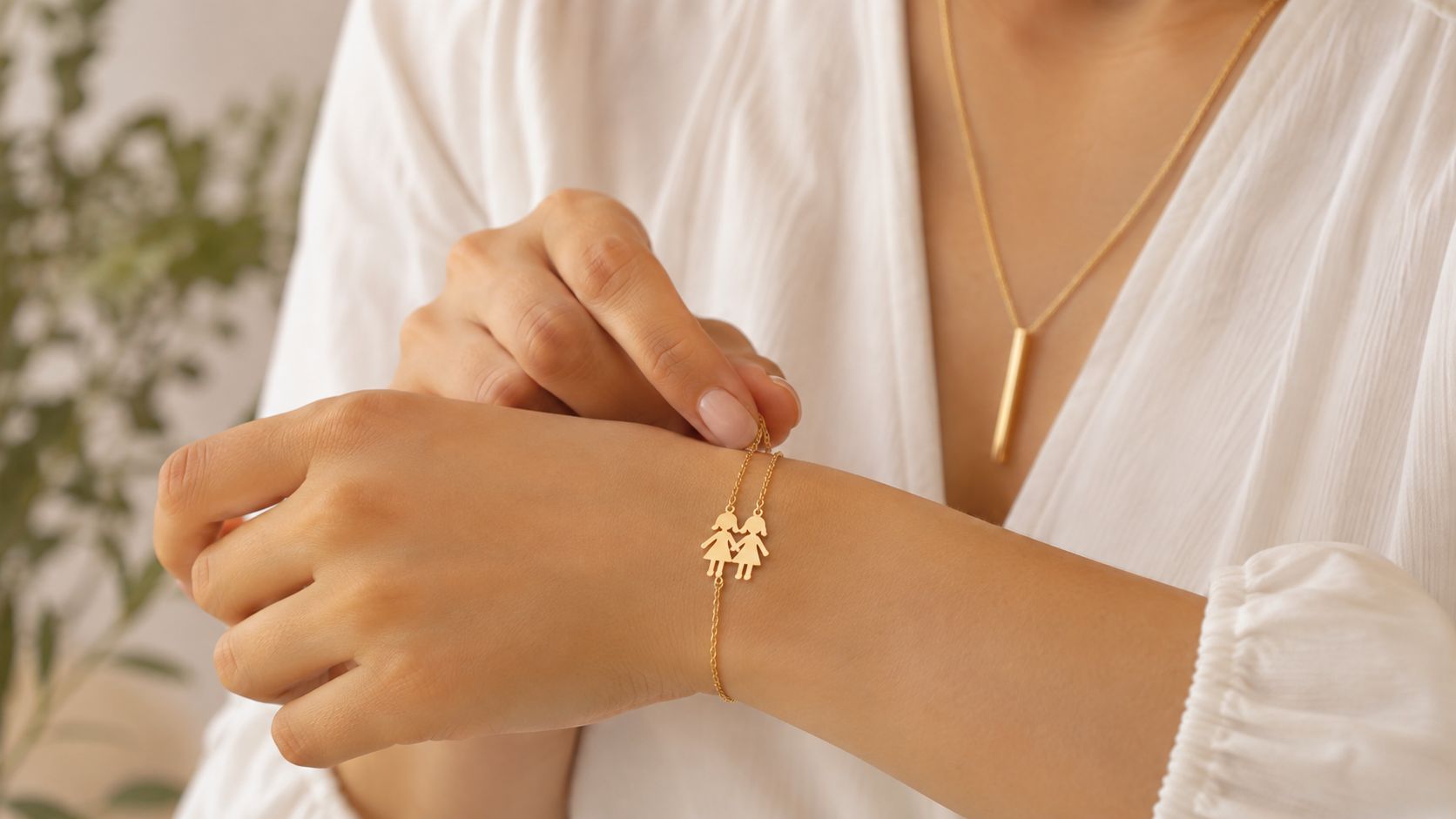
A delicate charm necklace can stand alone with a crisp blouse or a simple dress. For casual wear, pair it with a plain chain and a T-shirt, keeping the companion chain free of pendants so the charm remains the focal point. On the wrist, one meaningful charm can sit beside a watch, while a larger collection may work better across two bracelets rather than one crowded strand.
Build a coordinated look
Mother and daughter don't have to wear the same number of charms. Instead, coordinate through one shared element:
- Use one common motif: Both pieces might include a heart, initial, or birthstone color.
- Repeat the finish selectively: Yellow gold on both pieces creates continuity, even when the shapes differ.
- Vary the scale: A smaller version can suit a young wearer, while the mother wears a larger, more detailed interpretation.
- Separate the symbols: One person can wear the initial and the other can wear the matching heart.
Mixed metals can look deliberate when one tone clearly dominates and the second appears as a small accent. If you want a cleaner appearance, keep both pieces in one finish. A charm bracelet selection can help you compare single-charm styling with a fuller modular arrangement.
For younger daughters, smooth surfaces, modest proportions, and secure clasps matter more than elaborate movement. Teens and adults may enjoy bolder charms, layered chains, or mixed textures.
A short demonstration can also help you judge how a charm moves while worn.
Gifting Ideas for Every Occasion
The occasion should guide the charm's emotional volume. A quiet Mother's Day present may call for a small initial or heart, while a graduation can support a symbol of direction, place, or achievement. The recipient's age matters just as much. A design that feels playful for a child may feel too young for an adult daughter.
Milestone birthdays
Birthstones are a natural starting point because they connect the jewelry to the recipient's identity. An initial can make the piece unmistakably hers, while a small engraved date can mark the birthday itself. For a younger recipient, one charm on a simple bracelet leaves room for later additions. For an adult, a more refined locket or stone may work with an existing jewelry wardrobe.
Mother's Day
Mother's Day gifts don't need a large symbol to communicate appreciation. Consider a small heart, a daughter's initial, or a removable charm that reflects a shared interest. A handwritten note can explain why you chose the detail, especially when the symbol isn't immediately obvious to anyone else.
Graduations and transitions
A graduation charm can represent a school, a future destination, a field of study, or a personal phrase. Coordinates may be especially meaningful when a daughter is leaving home, while a simple star or compass-style motif can mark a new direction without tying the piece to one institution.
Weddings and new motherhood
A mother-of-the-bride gift can carry a discreet family symbol or engraved date. A bride may also give her own daughter a charm that begins a new mother-daughter tradition. For new motherhood, handprint or footprint shapes, a child's birthstone, and gentle nature symbols can acknowledge the arrival without making the piece difficult to wear.
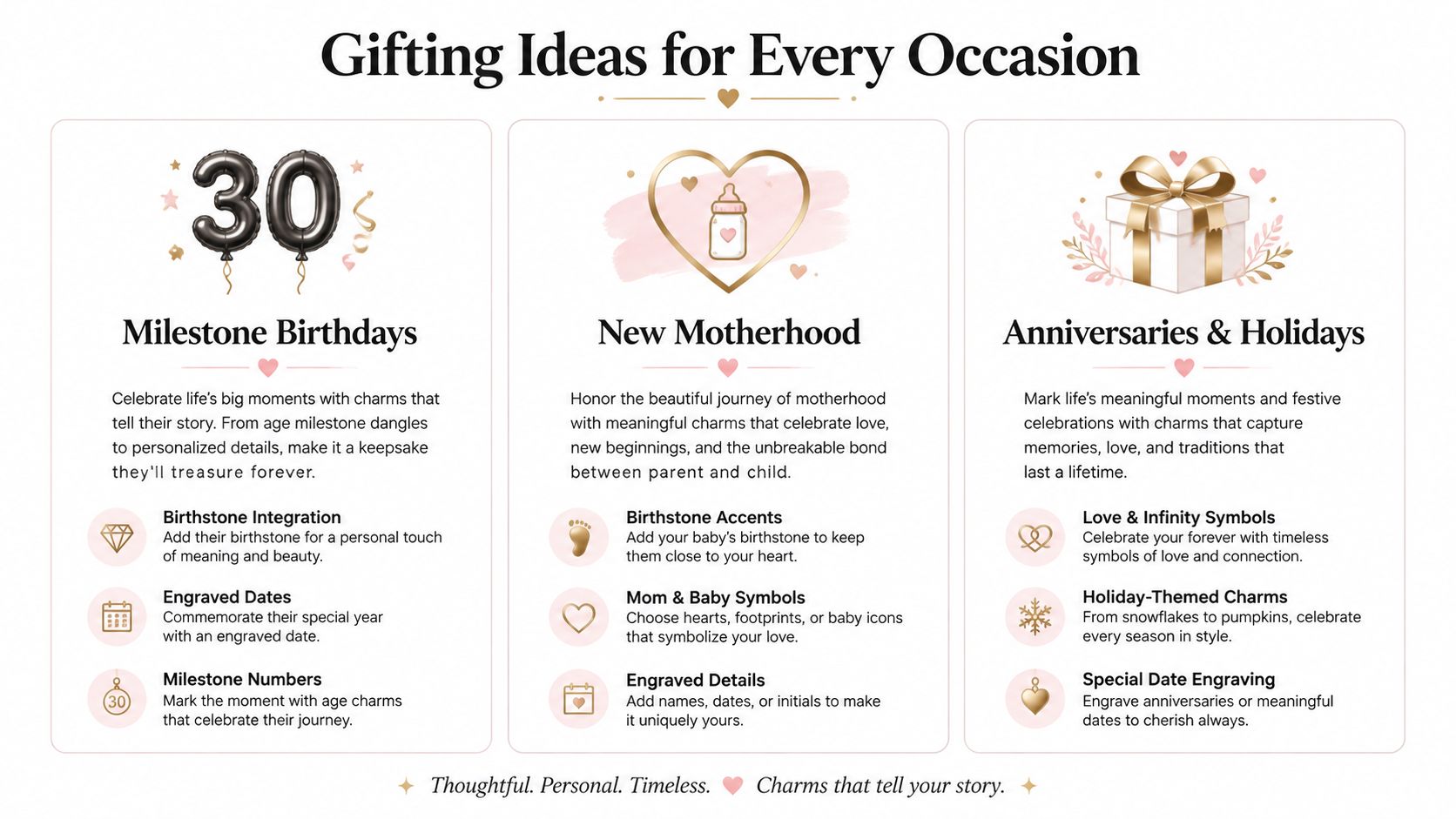
Long-distance relationships and blended families benefit from symbols that offer reassurance without requiring identical jewelry. A shared initial, linked shape, or removable charm can create connection while giving each person freedom to wear it differently.
Presentation completes the gift. Select a protective box, add a personal note through the order process when available, and explain the meaning in your own words. The note often becomes part of the keepsake.
Caring for Your Charms Over Time
A charm lasts longer when you treat it as jewelry, not as an indestructible token. Daily contact with perfume, lotion, sweat, water, and rough surfaces can affect both the metal and the clasp. Children and active wearers may need a simpler piece that can be removed easily before sports, swimming, or messy activities.
A gentle maintenance routine
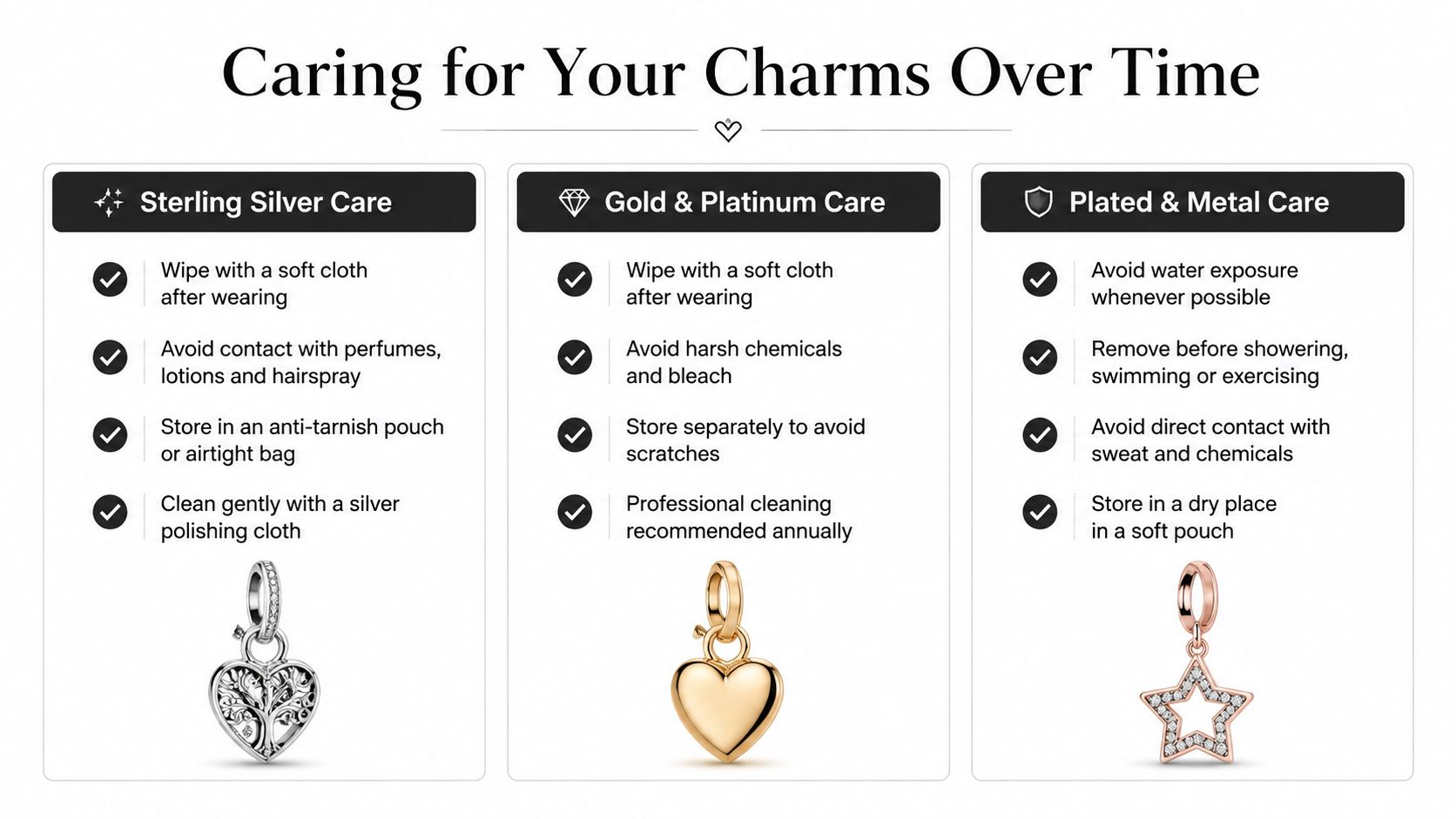
Wipe the charm with a soft, clean cloth after wearing it. For non-porous stones and suitable metal surfaces, use mild soap and lukewarm water, then rinse carefully and dry completely before storage. Don't soak a piece when the manufacturer warns against water exposure, or when it contains delicate finishes, porous materials, glued components, or electronic features.
Sterling silver can tarnish through exposure to air and household chemicals. Gold and platinum generally need less polishing, but they can still scratch, collect residue, or suffer damage at weak joints. Plated jewelry needs the gentlest approach because aggressive polishing can remove its surface finish.
Protect the structure
Remove charms before swimming, showering, sleeping, applying lotion, or using cleaning products. Check the jump ring and clasp periodically. If the charm starts twisting, the ring looks open, or the closure no longer clicks securely, stop wearing it until a jeweler can inspect it.
Store each piece in a separate soft compartment or pouch. Anti-tarnish pouches can help with silver, while individual storage prevents charms from rubbing against one another. Keep chains fastened loosely so they don't knot, and avoid placing heavy objects on top of delicate pieces.
A small repair is usually easier than a lost charm. Treat a loose ring or worn clasp as a prompt to pause wear, not as a minor inconvenience.
For stubborn tarnish, use a product approved for the specific metal rather than a rough household abrasive. A professional cleaning is sensible when the charm includes stones, intricate engraving, fragile connectors, or a finish you don't want to risk damaging.
Choosing the Right Charm to Start With
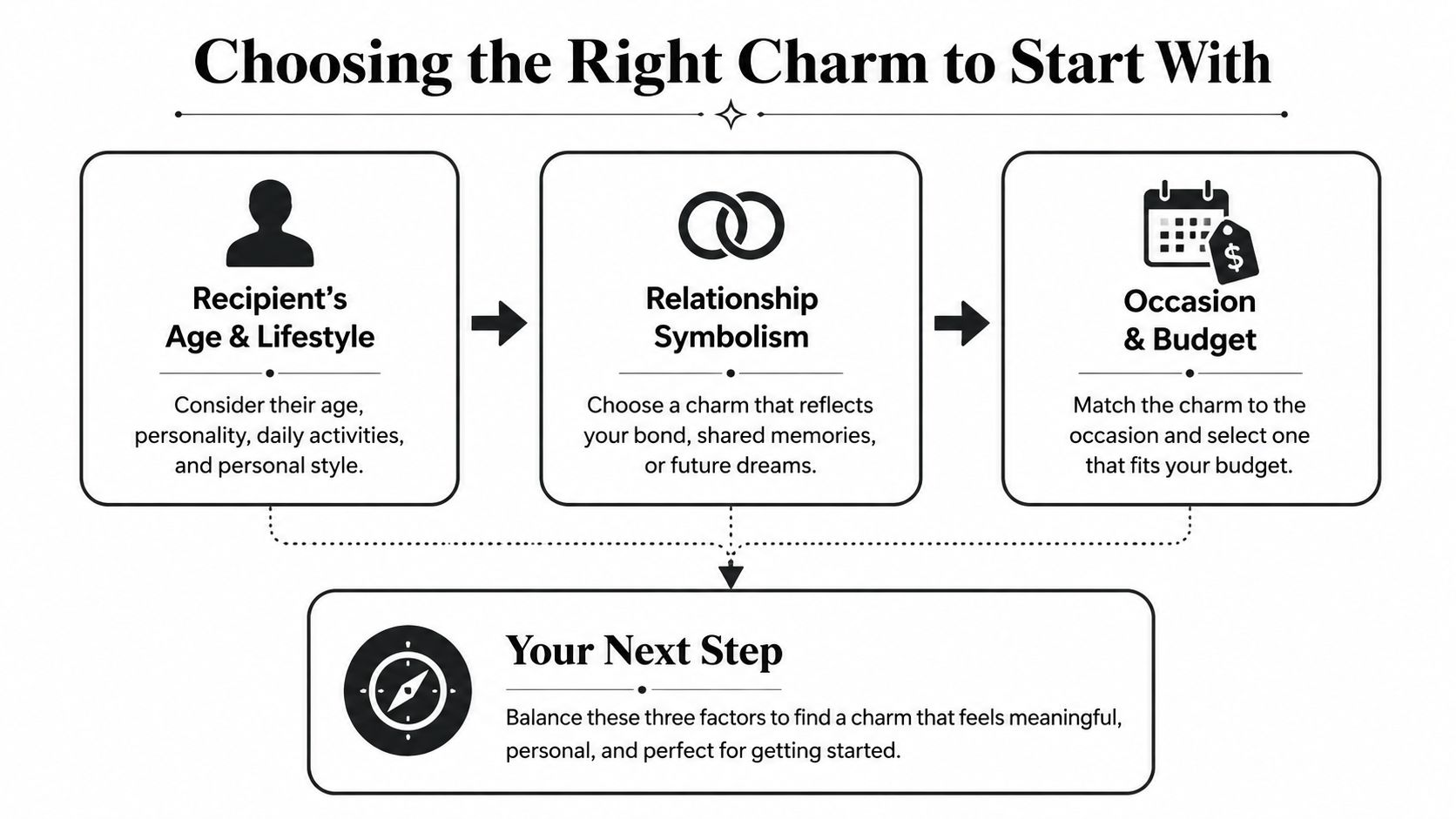
First-time buyers often get stuck because there are too many possible symbols. Reduce the decision to three questions: Who will wear it, what should it mean, and how will it fit into her life?
Start with age and lifestyle. A younger daughter may need a smooth initial on a secure bracelet. A teenager might prefer a birthstone or letter charm that works with casual outfits. An adult daughter may connect more strongly with an engraved date, a locket, or coordinates tied to a shared home or memorable trip.
Next, choose the emotional anchor. Initials identify the person. Birthstones connect the piece to birth and family. Hearts communicate affection directly. Tree-of-life designs emphasize roots and continuity. A private engraving can carry a message that doesn't need to be visible to everyone.
Decide how much to build now
A matched pair gives both wearers an immediate connection. A modular starting point offers more flexibility and avoids forcing every future meaning into the first purchase. One shared motif on two different pieces can be enough, especially when each person has a distinct taste in metal, chain length, or bracelet style.
Budget should guide complexity, not sentiment. Choose one well-considered detail rather than combining every available option. Then add a charm when another meaningful occasion arrives, allowing the collection to document the relationship naturally.
Before ordering, confirm the chain or bracelet measurements, clasp style, metal fineness, engraving details, and care instructions. If the piece is made to order, review production and delivery information carefully so the gift arrives when you need it.
The strongest starting charm usually has one clear meaning, suits the recipient's daily routine, and leaves room for the next chapter.
EP Fine Jewelry offers personalized jewelry, charm necklaces, individual charms, bracelets, and gift-ready options that can support an evolving mother-and-daughter keepsake. Visit EP Fine Jewelry to explore a first charm or begin building a collection that can grow with your family's milestones.