
A signet ring is a ring with a broad, flat face engraved with a personal device, originally pressed into warm wax as a seal and now mostly worn as jewelry. The engraving is the working part. It turns a band of metal into a portable mark of identity, whether it carries initials, a monogram, a crest or a symbol the wearer chose.
Here's the question most explanations skip. If you never seal a letter, is the ring on your finger still a signet, or just a ring shaped like one? That distinction matters, because both versions sit next to each other in the same display case, often photographed the same way and labelled the same way. Wearable identity is a serious business, too: the global signet-ring market was valued at $5.2 billion in 2025, according to MarketIntelo.
The way through the confusion is to separate what the ring does from what it looks like. A sealing tool, an identity piece and a fashion ring share one silhouette but do three different jobs, and once you can name which one you're looking at, choosing and wearing it gets much simpler.
Table of Contents
- What a Signet Ring Is and Its Main Parts
- How a Signet Seal Left Its Mark
- Where Signet Rings Came From
- Common Signet Designs and What They Mean
- Signet Ring Types and Whether They Still Count
- How to Wear a Signet Ring Comfortably
- Choosing a Signet Ring You Will Keep
What a Signet Ring Is and Its Main Parts
The shape is easy to read once you know the vocabulary. Three parts do all the work.
The bezel is the flat or slightly raised top that carries the design. The engraving is the device cut into that face, whether that's initials, a monogram, a coat of arms, an animal or a date. The band, also called the shank, is the loop that wraps the finger and holds the face steady, and on a signet it's usually heavier than on a plain ring so the top doesn't swing around to the palm side.
Those parts support three jobs at once. The ring is jewelry you wear, an identity mark you carry, and a small security device. A survey of the signet ring's history describes personal seals as legal safeguards used to witness wills, deeds of gift, loans, commercial documents, personal letters, and land indentures.
Think of it as a stamp you always have with you. A stamp's power comes from being recognizable and hard to copy, not from being made of expensive material, and the same was true of the ring. Authority lived in the uniqueness of the engraved design. A plain gold band with no engraving is a ring, not a signet, however much it cost.
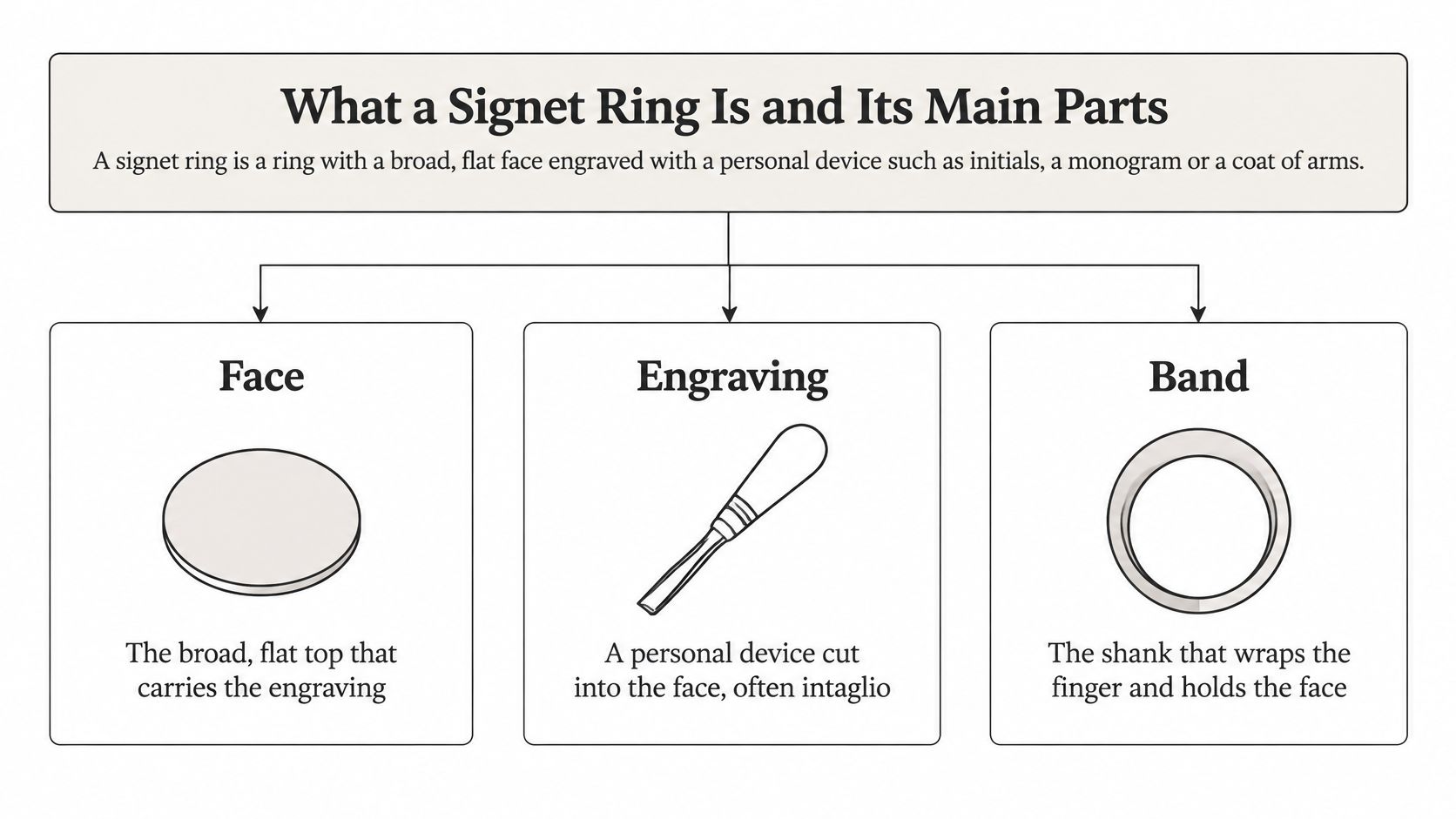
Size is a useful reminder of how personal these objects were. A bronze signet ring in the Kovelskyi History Museum's collection has a diameter of 2.2 centimeters, with a 1-centimeter measurement also recorded by the museum, small enough to sit on a finger and still leave a legible mark.
So here's the test to apply to any ring you pick up. Does it have an engraved personal face that stands for the wearer, a family, an institution or a chosen symbol? If yes, it belongs to the signet family, whether or not anyone ever pressed it into wax. Metal choice comes later, and if you're weighing alloys, this comparison of 10 karat and 14 karat gold covers the hardness and color trade-off.
How a Signet Seal Left Its Mark
Working seals are cut as an intaglio, which means the design sinks below the surface of the face instead of sitting on top of it. That's counterintuitive until you picture a cookie cutter. The shape is a hollow in the metal, and what comes out is a raised shape in the dough. A stamp pressed into soft clay behaves the same way. The ring is the hollow, and the wax takes the relief.
That looks like this in practice, on paper rather than on a letter.
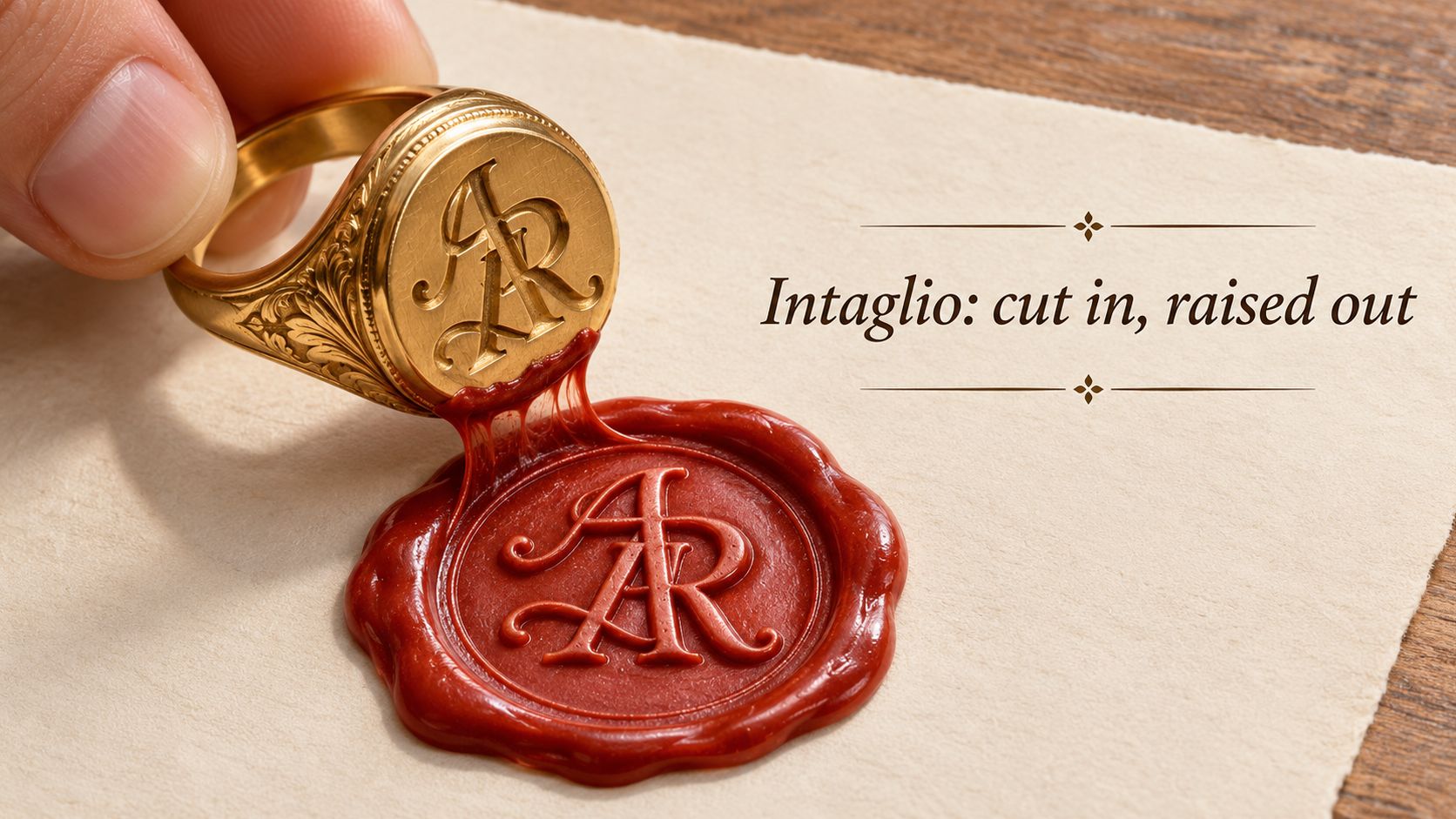
The routine is short, but the order and the timing decide whether the result is crisp or smudged.
- Warm the wax until it's soft, not runny. Wax that's too hot spreads into a thin puddle and swallows the design before it can take an impression.
- Press the bezel firmly and evenly onto the wax. Even pressure matters more than force, because a tilted press produces a deep edge on one side and nothing on the other.
- Hold for a moment, then lift straight up. Rocking the ring sideways drags the cooling wax and leaves a double outline.
- Check that the impression reads correctly. If the letters and symbols come out the right way round, the seal did its job.
That last step is where beginners get caught. The engraving is cut in mirror image, so the design looks backwards on the ring and reads normally in the wax. That isn't a quirk or a manufacturing error. It's the whole engineering trick, and it's the fastest way to tell a working seal from a decorative one.
Hard stones such as sard and chalcedony were historically favored for seal faces because they resist abrasion better than softer decorative materials, and the Victoria and Albert Museum's record of a signet ring notes gold examples with carved sard or chalcedony intaglios and describes signet impressions as legally recognized signatures.
The one-second rule: press while the wax is soft, lift while it's still soft.
Where people go wrong is timing. Press onto wax that has already begun to cool and the surface skins over, so the design only half transfers and the outline blurs. The ring gets blamed; the wax was the problem. If you want to watch the press, hold and lift motion before trying it at a desk, this short clip shows the sequence clearly.
Where Signet Rings Came From
The ring has been in continuous use long enough that its meaning has shifted several times, and the surviving objects show each shift.
Start in Rome. The Victoria and Albert Museum's catalogue record documents a Roman signet ring inscribed "Vivas," a phrase associated with wishes such as "May you live in God." Personal devices on these rings carried messages as often as they carried names.
By the thirteenth century the ring was a tool of administration as well as a personal mark. The same record describes a thirteenth-century ring that pairs a medieval gold hoop with a reused Roman intaglio from the third century AD, which tells you two things at once: older engraved stones were worth recycling, and they were valued as signs of learning, prestige or continuity. The practice stayed active through the fourteenth and fifteenth centuries, with the British Museum cataloguing a late-medieval signet-ring setting and a late-Roman intaglio mounted in a later ring.
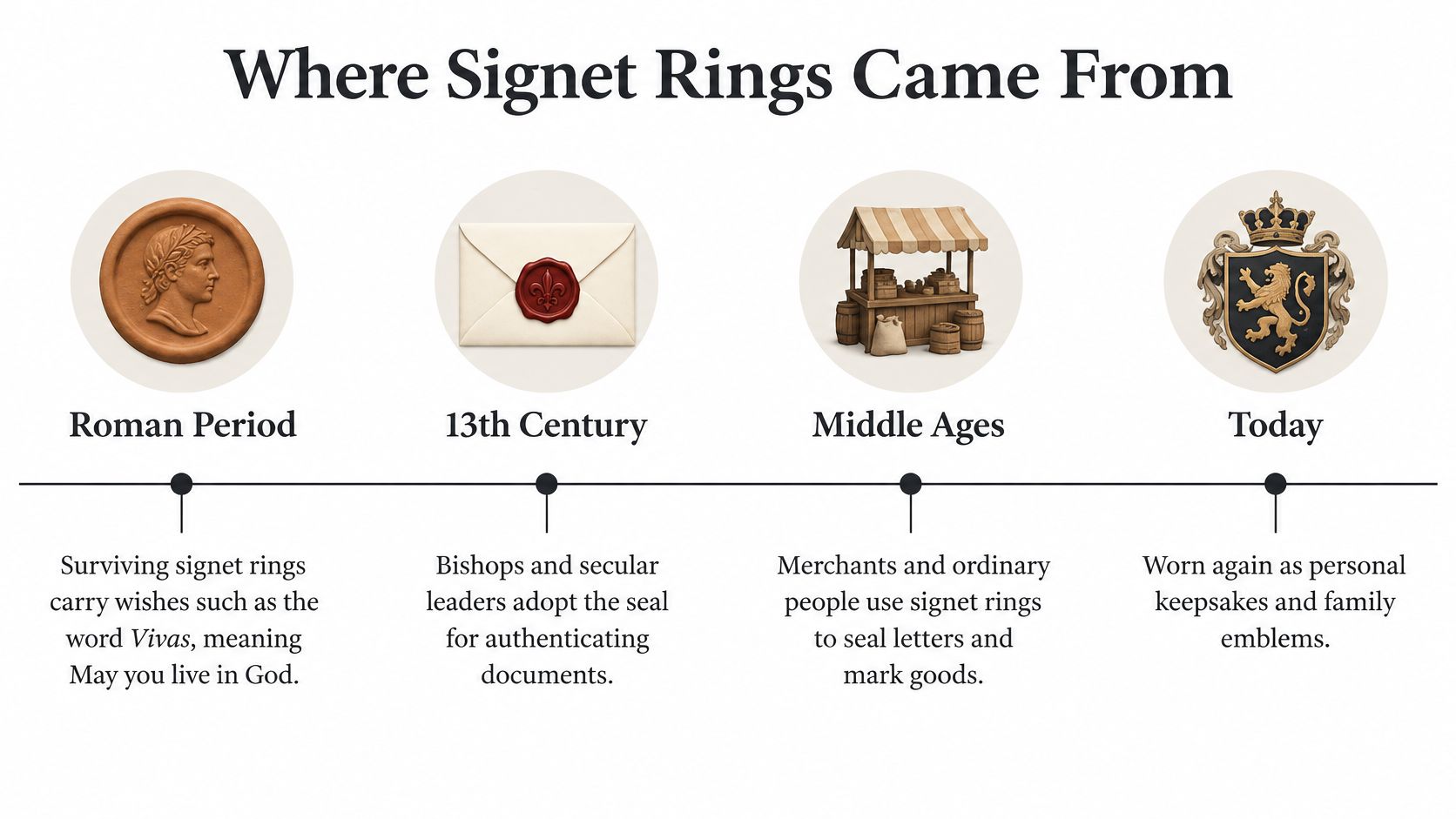
Then the practical job faded. As other forms of authentication became common, fewer people needed a ring to close a deal, and the engraved face stayed on the hand as a marker of identity and self-presentation. The tool turned into a signature in the social sense rather than the legal one.
Signet ring milestones by period
| Period | Documented example | What it shows |
|---|---|---|
| Roman period | Ring inscribed "Vivas" | Inscriptions expressed wishes for the wearer |
| Thirteenth century | Medieval gold hoop with a reused third-century Roman intaglio | Older engraved stones were valued for prestige and continuity |
| Fourteenth and fifteenth centuries | Late-medieval signet setting and a late-Roman intaglio in a later ring | Signet rings stayed in active legal and personal use in Europe |
| Modern era | Engraved bezel rings worn as jewelry | Sealing is largely commemorative; the design communicates identity |
Common Signet Designs and What They Mean
A small engraved face works like a stamp: a clear mark is easier to recognize than a crowded one. Initials or a monogram suit the limited space, while a long name can become difficult to read on the curved surface.
Historic signets carried many kinds of marks. The National Museum Wales guide to signet rings describes designs that included symbols and lettering, conveying social role and personal meaning as well as ancestry. A merchant's mark or trade emblem could identify its owner without referring to a family line.
Common signet ring designs and their meanings
| Design | Typical meaning | Who chooses it today |
|---|---|---|
| Initials or monogram | Personal identity or family line | Individuals and couples |
| Full name | Personal ownership or a gift | Gift buyers |
| Coat of arms | Family or heraldic heritage | People with documented arms, or wearers drawn to heraldic imagery |
| Religious symbol | Faith or devotion | Wearers who want to mark belief |
| Animal or emblem | A trait, role or affiliation | People linked to a club, profession or interest |
| Date or abstract symbol | A milestone or personal meaning | Commemorative and modern buyers |
A few practical choices can keep the design legible:
- Keep it simple. Each extra detail competes for space on the ring's face.
- Choose a short inscription. A monogram often stays clearer than a full name on a small, curved surface.
- Select a symbol you can explain. Its meaning may be personal, as long as you know what it represents.
Treat a crest as a design choice, and claim ancestry only when you can document it. If you want a mark that feels personal without suggesting a family connection, consider initials, a date or a symbol tied to an interest. These ideas for engraving rings offer examples of ways a simple mark can carry meaning.
Signet Ring Types and Whether They Still Count
A signet ring can still count as a signet even if it no longer makes an impression in wax. The original sealing role is less common today; the broad face remains a recognizable feature. To tell what kind of ring you have, look at how its face is engraved and what it can do.
A traditional seal is engraved in reverse so its mark reads correctly when pressed into wax. It can be used to seal a letter or document.
An engraved identity ring has a face meant to be read while the ring is on the hand. It may carry initials, a name, a date or a symbol, chosen for personal meaning or as a gift.
A fashion signet borrows the broad-faced shape but has no sealing function. It may have a stone, a pattern or a blank face. The silhouette is the signet reference; the ring is designed for decoration.
Three types of signet-style ring
| Type | Engraving | Used for sealing | Typical wearer |
|---|---|---|---|
| Traditional seal | Cut in reverse so the impression reads correctly | Yes, pressed into wax | Collectors, historians and people using a working seal |
| Engraved identity ring | Reads normally on the hand | Usually no | People choosing a personal, gift or memorial piece |
| Fashion signet | Often decorative, sometimes none | No | People choosing a signet-style ring for everyday wear |
Two details help distinguish them. First, check the direction of the engraving: letters that appear backward when viewed on the ring may be cut to read correctly in wax. Letters that read normally are intended to be seen on the hand. Then check whether the face has a mark at all. A blank, flat face is a canvas for future engraving, not a working seal.
When describing a ring to a jeweler, seller or gift recipient, name its function as well as its shape. For example, “an identity ring with initials that read normally” is clearer than “a signet,” which could mean a working seal or a decorative style. A broad band can also affect how a ring feels; this guide to thick band rings explains how width and weight relate to comfort.
How to Wear a Signet Ring Comfortably
Two rings marked the same size can feel completely different, and everything besides the size explains why. The ring is sized for the finger opening, while comfort also depends on the face, the shoulders, the shank width, the thickness and the weight distribution, as a guide to signet ring shapes points out. A broad face that looks balanced in a photograph can rotate, catch on fabric or crowd the fingers beside it.
That's why fitting a signet isn't the same process as measuring for a plain band.
- Choose the finger before you measure. Sizing applies to the finger the ring will live on, not the one you happen to have measured for a different ring.
- Measure when your hands are at their normal temperature. Fingers swell in heat and shrink in the cold, so a ring sized on a freezing morning can feel tight by afternoon.
- Decide whether the face should stay put. A heavy face on a narrow shank will rotate toward the palm, so you need either a snugger fit or a wider band.
- Slide it over the knuckle without force. If it needs a push to pass the knuckle, go up a size, because a wide face makes an already tight ring harder to remove.
- Pick daily wear or occasional wear. A ring worn every day needs more room and a lower profile than one brought out for evenings.
Fit before face: a ring that rotates or catches never gets worn, however good the engraving looks.
The traditional finger is the little finger of the non-dominant hand, with the ring finger a common alternative, and the habit varies by culture and by family. There's no rule here worth obeying for its own sake.
One practical warning: a wide face catches on knitwear, bag straps and pockets in a way a slim band never does. If you wear several rings close together, leave a gap beside the signet so the two bands don't grind against each other all day.
The final test costs you nothing but a little time. Wear the ring for a full day, ideally one that includes typing, driving and putting on a coat, before you commit to it. If you're ordering online and can't try before you buy, this guide to how to find ring size walks through measuring at home.
Choosing a Signet Ring You Will Keep
A signet ring can preserve a personal mark or serve as a decorative reminder of one. Start by deciding what you want the ring to do: seal wax, carry initials, mark a memory, or complete an outfit. That choice helps narrow the face design and the engraving.
For a personal mark, initials or a monogram are direct choices. A name, date, or meaningful symbol can make the ring a more personal gift. If you want a custom design, explore personalized ring options and compare the details with your intended use.
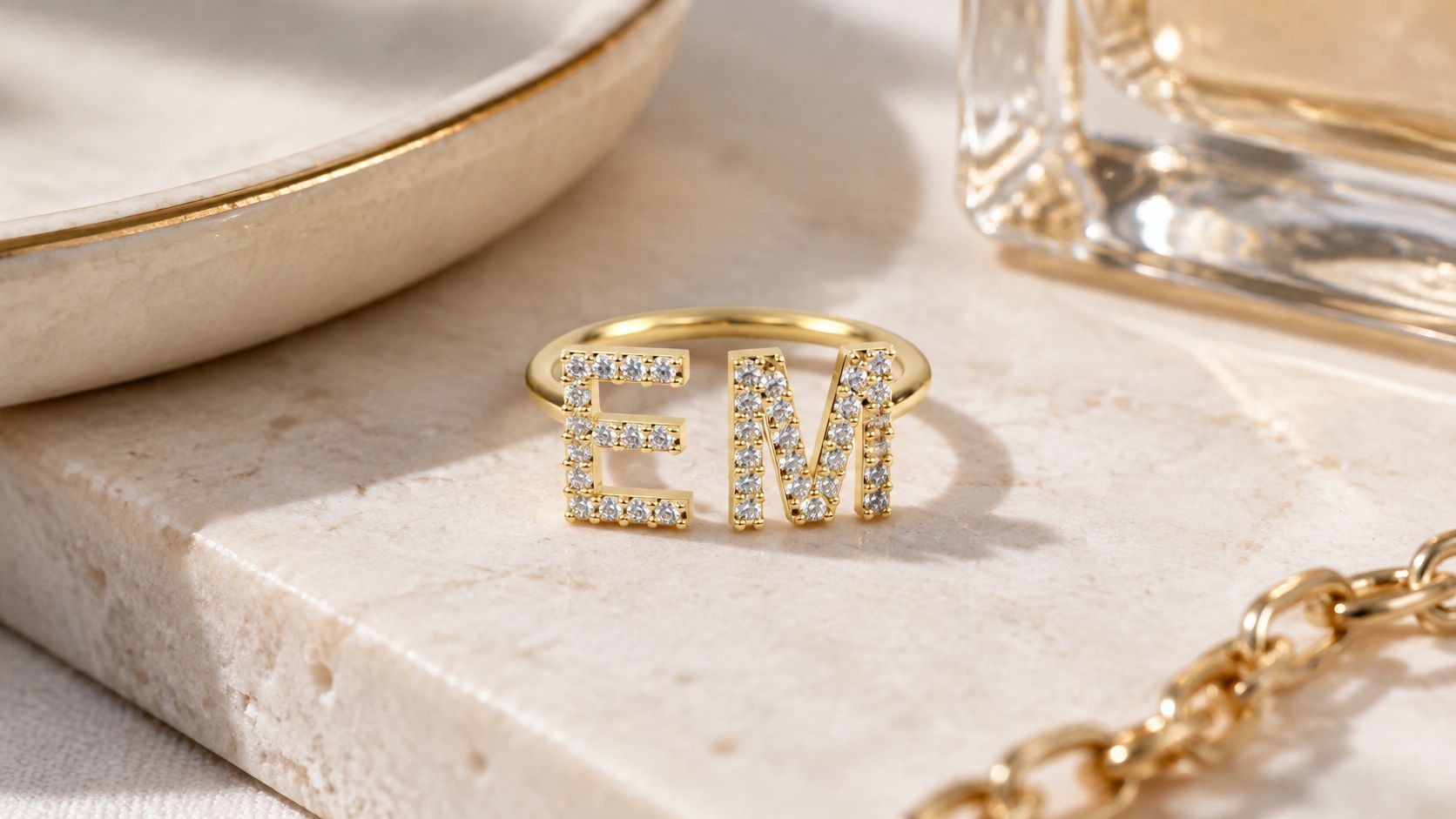
Next, decide whether the face should read like a handwritten signature on your hand or be cut in reverse to leave a readable impression in wax. A decorative ring can use the same initials or motif without functioning as a seal. The listing for the Double Initial Ring gives its price as $150.00; check the current listing for availability and options.
Read the terms before ordering personalized or made-to-order jewelry. Some fine jewelry, typically personalized or made-to-order pieces and some EP Fine items, may carry a restocking fee of up to $150 per item. EP Fine Jewelry offers fashion jewelry in silver and 14K gold, and its catalog includes personalized options.
Write down the purpose, design, and preferred finger. Then compare a few listings against that short list, paying attention to the engraving and the terms for the specific piece.