
Two cultured freshwater pearl necklaces can sit in the same case, at similar prices, and look identical under the lights. Five years later one still glows and the other has gone chalky around the edges. What separates them?
Not size. Not the word cultured, which tells you only that a person started the process instead of a random irritant. Not the shine you see in the first thirty seconds either, because a thin layer of nacre can throw a brilliant reflection on day one and wear through long before the decade is out.
What separates them is how the pearl was built, layer by layer, and how the finished strand is put together. That's the whole argument of this guide, and it's easier to learn than the jewelry counter makes it sound.
Table of Contents
- What a Cultured Freshwater Pearl Necklace Is
- Choosing Necklace Length and Pearl Size
- How to Judge Pearl Quality at a Glance
- Styling Your Pearl Necklace for Any Occasion
- Daily Care, Storage and Fixing Common Pearl Problems
- Confirm Quality, Origin and Returns Before You Buy
What a Cultured Freshwater Pearl Necklace Is
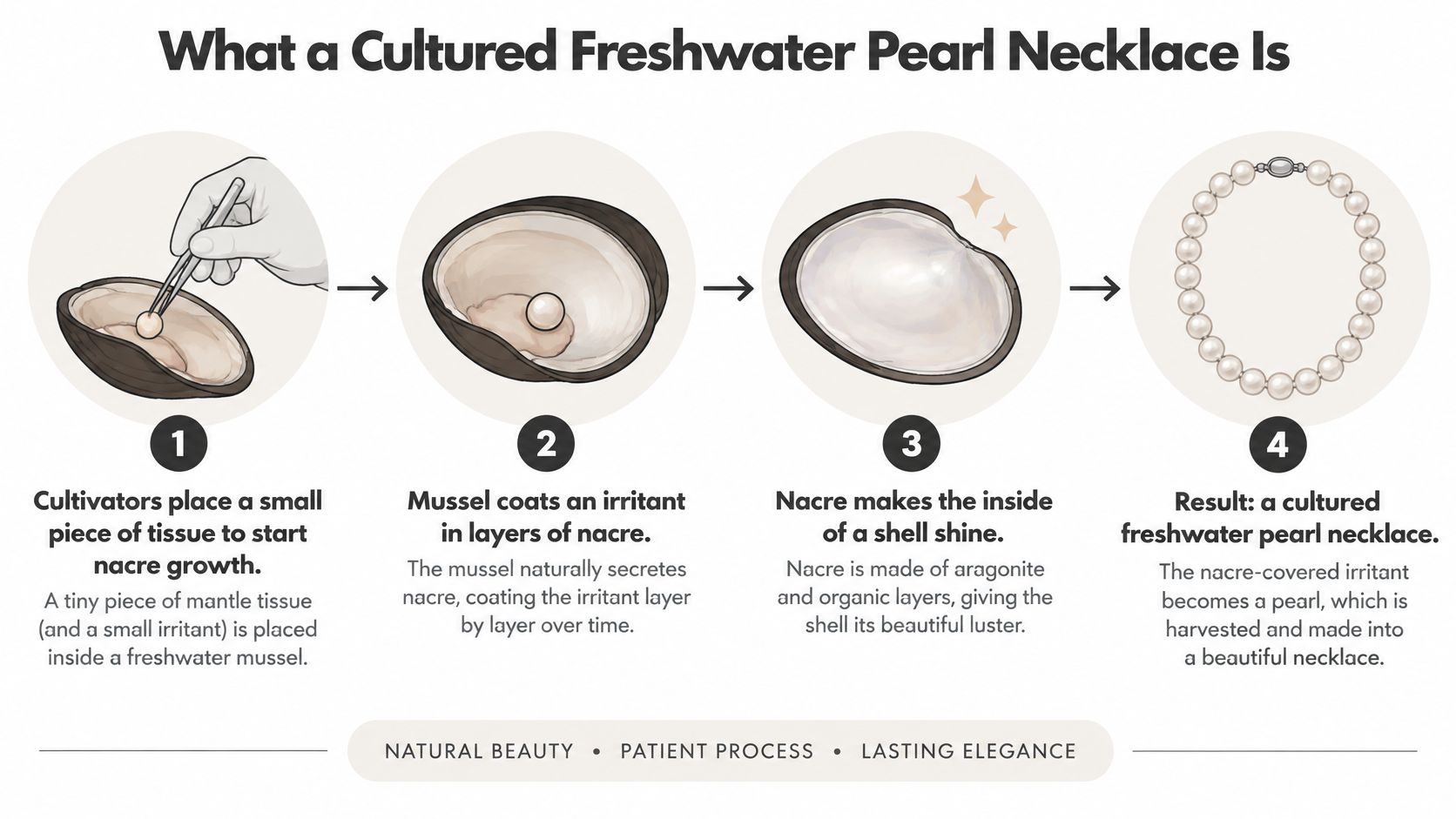
Start with the animal. A freshwater mussel sitting in a pond or lake takes in an irritant, a grain of grit or a parasite, and does the only thing it can. It coats the intruder in nacre, the same material that gives the inside of a shell its shine. Layer on layer, over months and years, the irritation becomes a smooth bead.
Cultivators start that defense on purpose. A technician opens the mussel slightly and places a small piece of mantle tissue inside, sometimes with a bead at its centre, then returns the animal to the water. The mussel builds nacre around whatever it was given for one to several years, depending on the size and coating the grower is aiming for.
Bead-nucleated or non-bead, and why it matters
Bead-nucleated pearls contain a solid core, so the nacre is a coating over that sphere. Non-bead pearls have no core at all, meaning the pearl is nacre from the middle outward. Most freshwater production is non-bead or uses a very small nucleus, which is one reason freshwater pearls give you a lot of nacre for the money. Ask which type you're looking at. It changes what you're paying for and how the pearl will age.
The strand itself
Pearls commonly run from 3 mm to 10 mm, in white, cream, pink, peach, lavender and treated shades, and in shapes from round to oval to the flat-sided forms sold as baroque. A necklace is those pearls drilled, threaded on silk or a synthetic equivalent, and usually knotted between each pearl. The knots do two jobs: they keep pearls from grinding against each other, and if the thread breaks, one pearl comes loose instead of the whole strand sliding onto the floor.
Supply shapes what reaches the shelf. China has led production for decades, with more than 1,000 pearl-mussel farms by the 1990s and output averaging 3,540 tonnes a year from 2005 through 2014, more than 98% of global cultured-pearl output, per the GIA's analysis of Chinese freshwater pearl culturing. That output fell to 454 tonnes in 2020 before recovering to 1,125 tonnes in 2024, so availability and pricing do move with policy and water conditions. Fewer pearls means a narrower choice of shapes and sizes, and prices follow.
Three words carry the rest of this guide: nacre (the layers), nucleus (the core, if there is one) and strand (the assembled necklace). If you're building a set for a birthday, a strand sits well beside a June birthstone ring.
Choosing Necklace Length and Pearl Size
Length decides where the pearls land, so settle it before you fall for a pearl size. The four standard lengths cover almost every outfit you own.
| Length | Where it sits | Best fit |
|---|---|---|
| Choker | Base of the neck, 14 to 16 inches (36 to 41 cm) | Close-necked tops and formal wear |
| Princess | Collarbone, 18 inches (46 cm) | Most everyday wear and gifts |
| Matinee | Upper chest, 20 to 24 inches (51 to 61 cm) | Layering and open necklines |
| Opera | Mid-chest or lower, 28 to 36 inches (71 to 91 cm) | Evening wear and long wrapped styles |
Then move to size. 4 to 6 mm pearls read as delicate and suit short lengths and fine features. 6 to 8 mm is the everyday size for most necklaces and the safest gift. 8 to 10 mm is a statement: the strand feels noticeably heavier on the neck, and it works best at matinee or opera length where the weight spreads along the body instead of pulling at the collarbone.
Try this in the shop: hold the strand against your neck without fastening it, then check whether the pearls sit where you want them to, not where the clasp happens to fall.
Check the stated length rather than assuming. Many necklaces ship with an extender, so a piece listed at 16 inches may adjust by an inch or two, which is the difference between a choker and a princess length on most necks. Our own guide to the necklace length chart walks through the same measurements in more detail.
To measure yourself, wrap a soft tape around your neck exactly where you want the strand to sit, then add about 1 inch of ease so the necklace doesn't fight your collarbone when you turn your head.
How to Judge Pearl Quality at a Glance
The two numbers shoppers read first, size and price, say almost nothing about how a necklace will look in five years. Luster comes from the nacre surface, so judge it in two passes. Hold the strand in diffuse daylight and look for an even glow. Then tilt it toward a window or a single lamp and watch for sharp, defined reflections, the kind that look almost like a reflection in glass rather than a blurry sheen.
GIA's pearl buyer's guide ranks nacre quality, surface condition and luster ahead of size for exactly this reason: the nacre's thickness and integrity drive both how the pearl looks and how well it resists wear, and thin or poorly formed nacre can look dull or even reveal the nucleus in bead-cultured pearls. The structure varies more than most buyers imagine. A scientific examination of modern freshwater nacre found tablet thickness varying by roughly sixfold along a single pearl, with tablets measuring about 0.23 to 0.72 micrometers in one sample. Two necklaces with the same colour and millimetre size can therefore age very differently.
| Factor | Look for | Red flag |
|---|---|---|
| Luster | Sharp, clear reflections across the surface | Dull, hazy or chalky look |
| Nacre thickness | Thick, continuous layer that looks solid at the drill hole | Thin, chalky or patchy layer |
| Surface condition | Smooth, with only minor spots | Deep pits, chips, gaps or flaking |
| Shape | Round or near-round, or a clearly stated baroque shape | Lumpy shape sold as round |
| Nucleation | Seller states bead-nucleated or non-bead | No disclosure of how the pearl was made |
| Drill hole | Clean, centred hole with no chips | Chipped or cracked edges around the hole |
| Strand matching | Similar size, colour and luster along the strand | Mixed sizes and tones that look random |
What a seller can and cannot verify
A seller can show you luster, surface, shape and matching, and can tell you whether the pearls are bead-nucleated or non-bead. A seller cannot measure nacre thickness without laboratory equipment. Treat any precise thickness figure quoted at a counter as an estimate unless it comes with a grading report.
Severe surface defects aren't cosmetic only. Deep pits, chips and gaps weaken the nacre and raise the chance of peeling or breakage later, which is why a flawless 7 mm pearl is usually the better buy than a pitted 9 mm one.
A necklace that looks bright today can still be fragile. Judge the layer, not the glare.
Give yourself about five minutes with the table above and you'll reach a verdict most shoppers never get to.
Styling Your Pearl Necklace for Any Occasion
What makes one pearl necklace look balanced with a neckline while another seems out of place? Start with where the strand sits, then consider its size, color, and what else you wear.
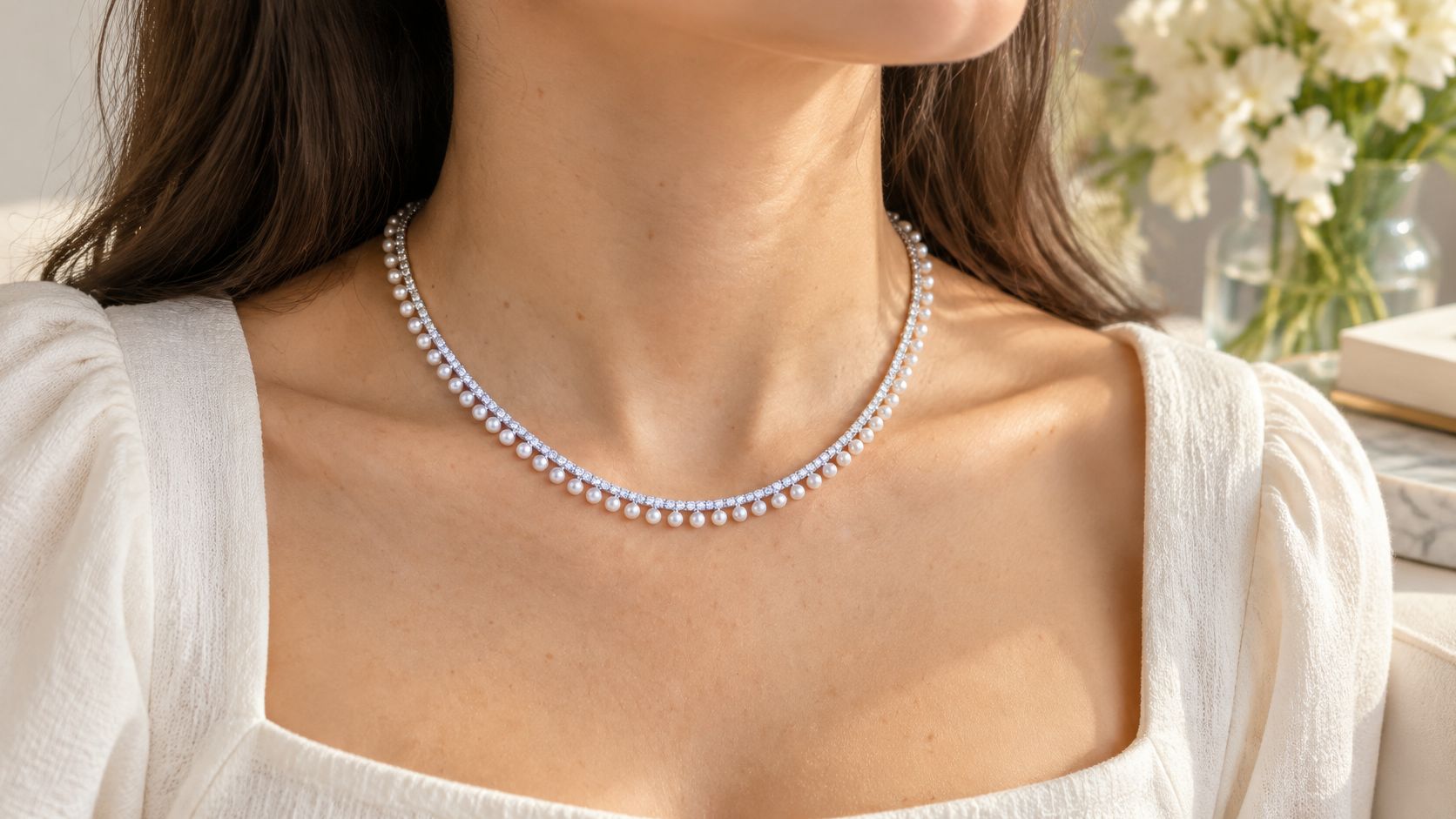
A round or crew neckline frames a princess or matinee strand, with the pearls resting against the clothing's outline. A V-neck or open collar gives a matinee or opera strand room to show; the V also draws the eye down the necklace. Strapless and square necklines leave more open space, so a choker can look intentional rather than too short.
Color changes the effect. White and cream are classic choices that work with many outfits. Rose or silver overtones can complement cooler skin tones, while gold-toned metalwork often suits warmer tones. If you are unsure, hold the strand near your jaw in daylight and compare which color makes your skin look more even.
For a work meeting, try one princess-length strand with 6 to 8 mm pearls over a plain knit or shirt collar. Its scale keeps the look restrained. At dinner, an 8 to 10 mm strand can stand on its own, without competing pieces. For a gift, a simple princess strand with 6 to 8 mm pearls is a flexible choice for different ages and outfits. Add a handwritten note, and use these romantic and funny anniversary card examples for wording ideas.
Layering is a matter of spacing and balance. Pair a matinee strand with a thinner chain, keep the metals consistent if you want a unified look, and stop at three strands. Our guide to gold necklaces layering explains how chain weights and mixed metals affect the result.
For evening wear, the Diamond and Pearl Tennis Necklace is listed at $350. Its name and price do not establish details such as length or materials, so check the product listing for the specifications that matter to you before buying. A pearl necklace can suit a special occasion without relying on size or first-glance shine alone. Consider how its construction, styling, and care fit the way you plan to wear it.
Daily Care, Storage and Fixing Common Pearl Problems
Care is a materials question, not housekeeping. Pearl is soft and chemically reactive, and how you handle it decides whether the nacre you paid for stays intact.
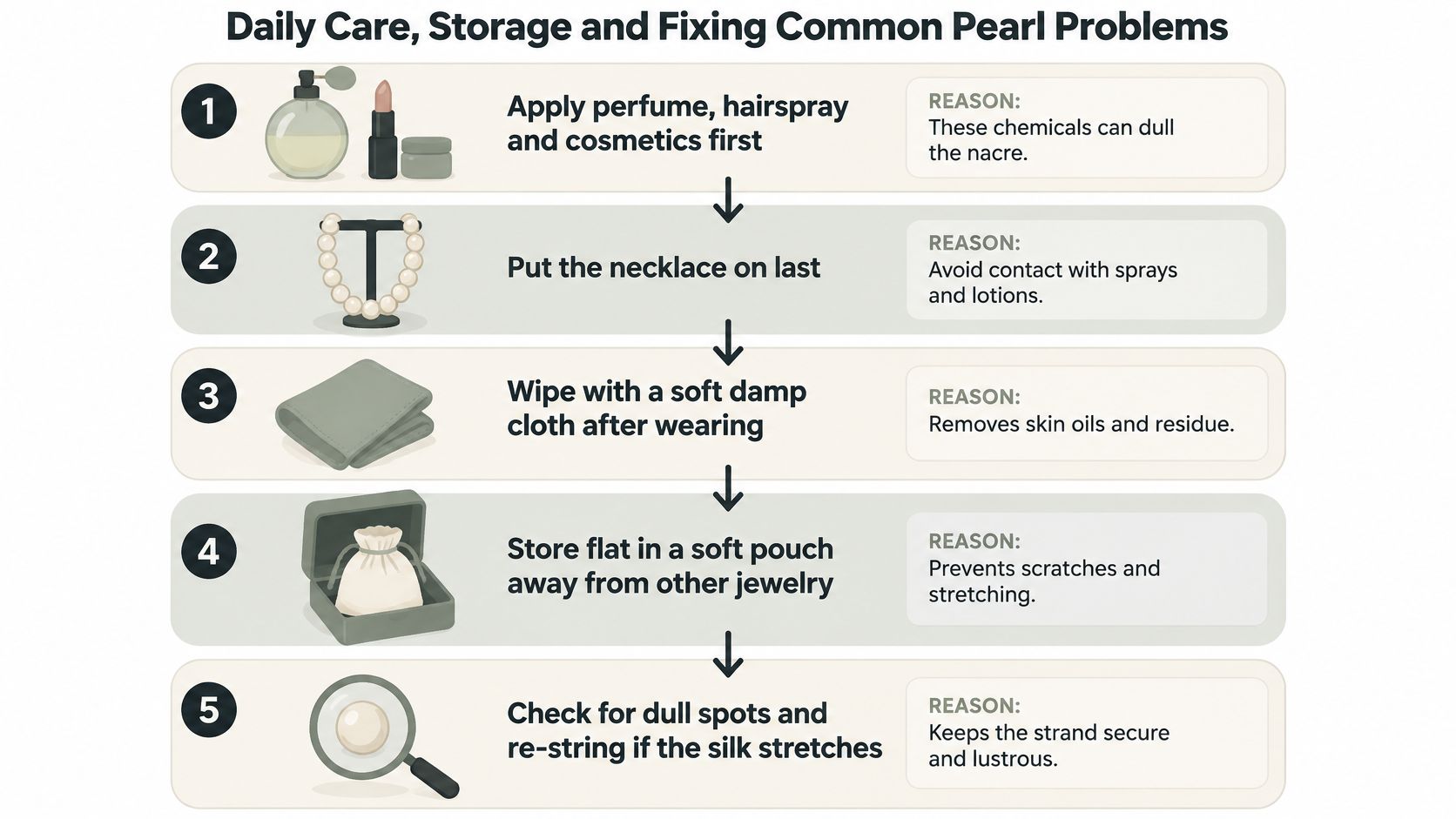
Daily care in six steps
- Apply fragrance and makeup first. Perfume, hairspray and cosmetics carry acids and solvents that dull nacre. Let them dry before the necklace goes near your skin.
- Put the necklace on last. Dressing first means the strand doesn't catch on fabric or scrape against harder jewelry on the way.
- Remove it before exercise, swimming or a hot shower. Perspiration and pool chemicals attack the surface, and heat does its own damage.
- Wipe every pearl after each wear. A very soft cloth lifts skin oils and residue before they set.
- Clean deeper with mild soapy water only. Rinse lightly, then lay the strand flat until fully dry.
- Skip ultrasonic and steam cleaners. Their energy and heat can damage nacre.
GIA reports pearl at a Mohs hardness of about 2.5 and notes that high heat can dehydrate a pearl, causing discoloration, splitting or cracking. Its pearl care and cleaning guidance sets out the same order: cosmetics first, necklace last, a soft cloth after wearing, mild soapy water when needed, and no ultrasonic or steam cleaning.
Storage and restringing
Store the necklace in a soft, breathable pouch, not an airtight box and not a bone-dry drawer. Pearls hold some moisture, and prolonged dry conditions can change the surface. Keep it away from loose diamonds and metal bangles, which scratch nacre without any effort at all.
Silk thread stretches with wear. If the pearls slide along the strand, if the knots feel loose, or if you can see fraying at the clasp, restring soon. Regular wearers often restring every few years, and it's cheap insurance compared with losing pearls one by one. The knots between pearls exist so a single failure stays a single failure.
If you'd rather watch the routine than read it, this walkthrough covers the same handling rules.
When the surface tells you something
Nacre thickness varies far more than shoppers expect. Technical literature reports cultured-pearl nacre ranging roughly from 0.1 to 1.3 mm: layers below about 0.3 to 0.4 mm are generally considered poor or marginal, around 0.5 mm or more is commercially acceptable, and premium examples can exceed 1.0 mm, as summarized in this review of pearl durability research. CIBJO also lists nacre thickness and continuity, alongside the pearl's organic structure, as factors in durability.
That matters because abrasion concentrates in a few places: where the clasp rubs, where pearls rest against your neck, and at the drill holes. A thin or discontinuous layer shows wear there first. It dulls gradually, then goes chalky, then flakes.
| Symptom | Likely cause | Fix |
|---|---|---|
| Dull or chalky surface | Cosmetics, sweat, or thin nacre worn through | Wipe after each wear; if dullness stays, the nacre may be worn |
| Peeling or flaking layer | Thin or poorly formed nacre, abrasion | Stop wearing and ask a jeweler to assess it |
| Loose or sliding pearls | Stretched or aged thread | Restring with knots between pearls |
| Cracks or splits | Heat, rapid drying or knocks | Keep away from heat and store in a soft pouch |
| Clasp catches or tangles | Clasp friction against pearls | Check the clasp for sharp edges and fasten it at the back |
| Pearls turn yellow | Oils, hairspray or heat | Clean gently and keep chemicals off the necklace |
Stop wearing the strand and get an assessment if a pearl has peeled, split, or gone chalky in patches. Surface damage like that doesn't reverse, and continuing to wear it spreads the problem to neighbouring pearls through the knots.
Practical rule: before you put the necklace away, hold it under a lamp. If the surface is still bright and smooth, with no new marks, your routine is working.
For a broader routine that covers metals and other stones in the same box, our guide to cleaning jewelry at home walks through the order of operations.
Confirm Quality, Origin and Returns Before You Buy
Turn everything above into a short list of questions, and the buying decision gets much simpler.
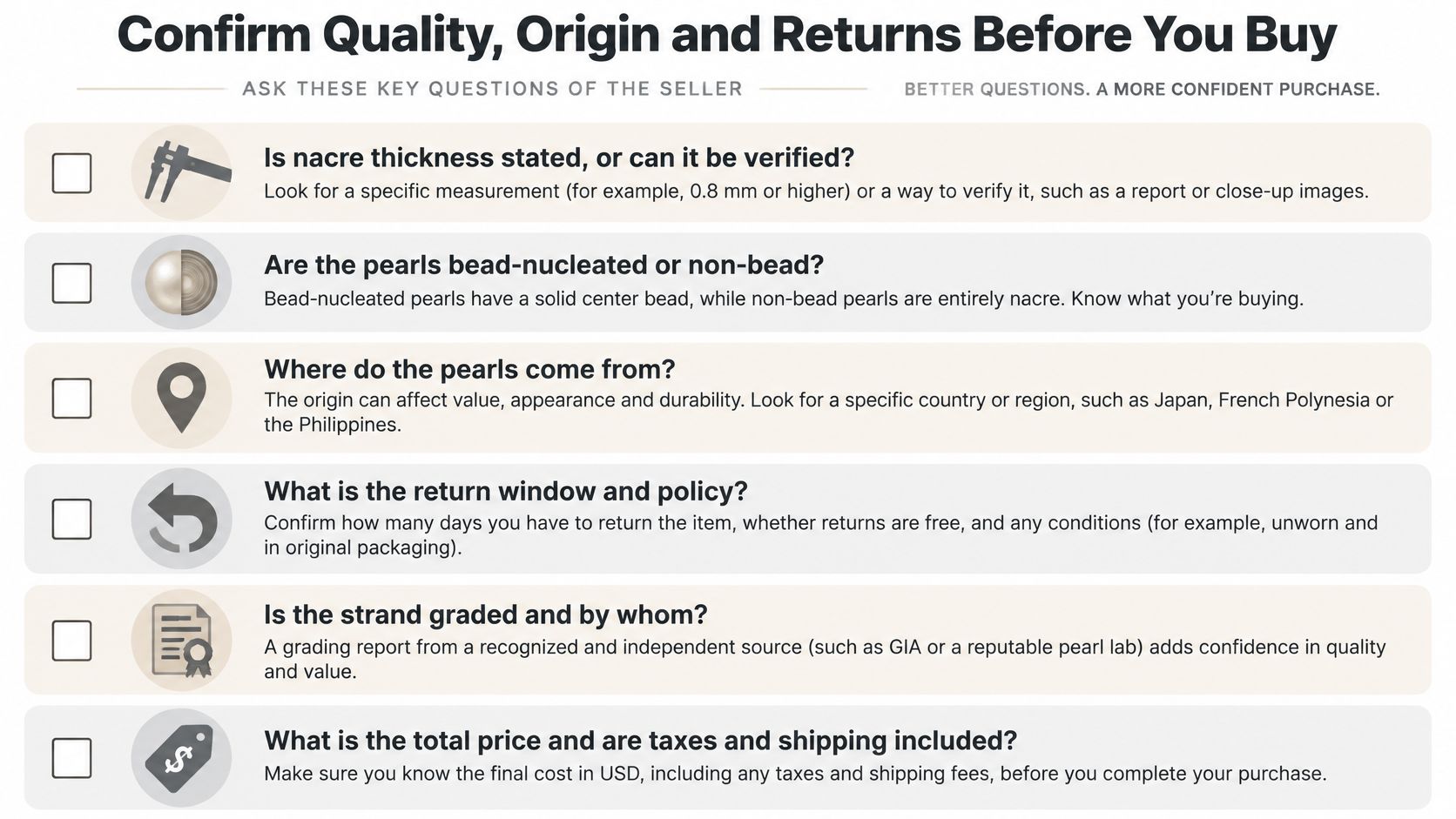
- Nacre thickness. Is it stated, or can it be verified? If neither, judge by luster and surface and price the strand accordingly.
- Nucleation. Are the pearls bead-nucleated or non-bead? The seller should know.
- Origin and farm practices. Where were they grown, and what does the supplier say about wastewater controls and stocking density?
- Grading. Is the strand graded, and by which laboratory?
- Returns. What's the window, what condition is required, and are taxes and shipping included in the total?
- Strand construction. Knotted between pearls, and what thread?
What the freshwater label doesn't tell you
Freshwater farming can be responsible or damaging, and the label alone doesn't settle which. Research on Chinese freshwater pearl farming identifies wastewater high in ammoniacal nitrogen, linked partly to overfeeding, as an environmental threat, and a recent review reports that excessive fertilizer use and high stocking densities contributed to eutrophication, degraded water quality and oversupply. The same review concludes that well-managed farms can support ecosystem rehabilitation while poor management worsens pollution, as detailed in this study of China's freshwater pearl industry. So the useful question isn't "freshwater or not" but "how was this farm run."
Two practical notes for sensitive skin and second thoughts. None of our jewelry contains nickel, which matters if you react to base metals. And read the return terms before you order rather than after; our returns and refunds policy sets out how that works.
Decide in this order: length first, then pearl size, then quality by nacre and luster, then whether you'll keep up the care routine. A strand you'll wipe down and store in a pouch beats a finer one that lives in a hot bathroom drawer.
Shortlist two or three necklaces, hold each against the checklist, and compare the returns and shipping terms before you pay. That's the step most buyers skip, and it's the one that saves the money.
EP Fine Jewelry makes fashion jewelry in silver and 14K gold, with necklaces grouped by collection so you can compare lengths and materials side by side, and none of our jewelry contains nickel. Our jewelry care page covers the daily routine described here, and our returns and shipping terms are published up front so you can check them before you commit. Visit EP Fine Jewelry to compare necklaces by length and material, and pick the one you'll wear.