
You're probably here because you want a necklace that feels unmistakably personal, but you don't want to guess wrong on the shape. A heart diamond necklace can look elegant in a gift box and disappointing on the neck if the heart outline doesn't read clearly, so the key question isn't only “does it sparkle?”, it's “will someone see a heart when it's worn?” That's the difference between a piece that feels thoughtful and one that just looks decorative.
Table of Contents
- Why a Heart Diamond Necklace Still Feels Personal
- What a Heart-Shaped Diamond Actually Is
- A Short History of the Heart in Jewelry
- Design Options That Shape the Look
- How to Judge a Heart Shape Before You Buy
- Matching the Piece to the Occasion
- Keeping the Heart Pendant Looking New
- Choosing Your Heart Diamond Necklace with Confidence
Why a Heart Diamond Necklace Still Feels Personal
A late-night browser session is often where this search starts. Someone is comparing photos, thinking about an anniversary, a graduation, or a daughter's milestone, and the heart shape keeps pulling them back because it says something without needing a long explanation. That's why a heart design keeps showing up in gifting, it carries emotion in a way few other necklace silhouettes do, especially when the piece is intended to feel intimate rather than flashy.
What usually gets skipped is the practical side. People don't just want a symbol, they want confidence that the necklace will sit well, read clearly, and make sense on the person wearing it. If you're looking at a piece like the styles in EP Fine Jewelry's personalized necklace collection, the useful question is whether the design feels custom in spirit, not just in marketing language.
The heart motif has a long memory in jewelry, but buyers usually meet it in a very human moment. They're choosing for someone they know well, and they want the pendant to reflect that relationship plainly. A heart diamond necklace works best when the buyer can connect three things at once, the message, the shape, and the wearability.
Practical rule: a meaningful necklace should look as intentional on the body as it does in the box.
That's why this guide focuses on how the shape reads when worn, not just what it represents. Once you can judge the outline, the rest of the decision gets easier.
What a Heart-Shaped Diamond Actually Is
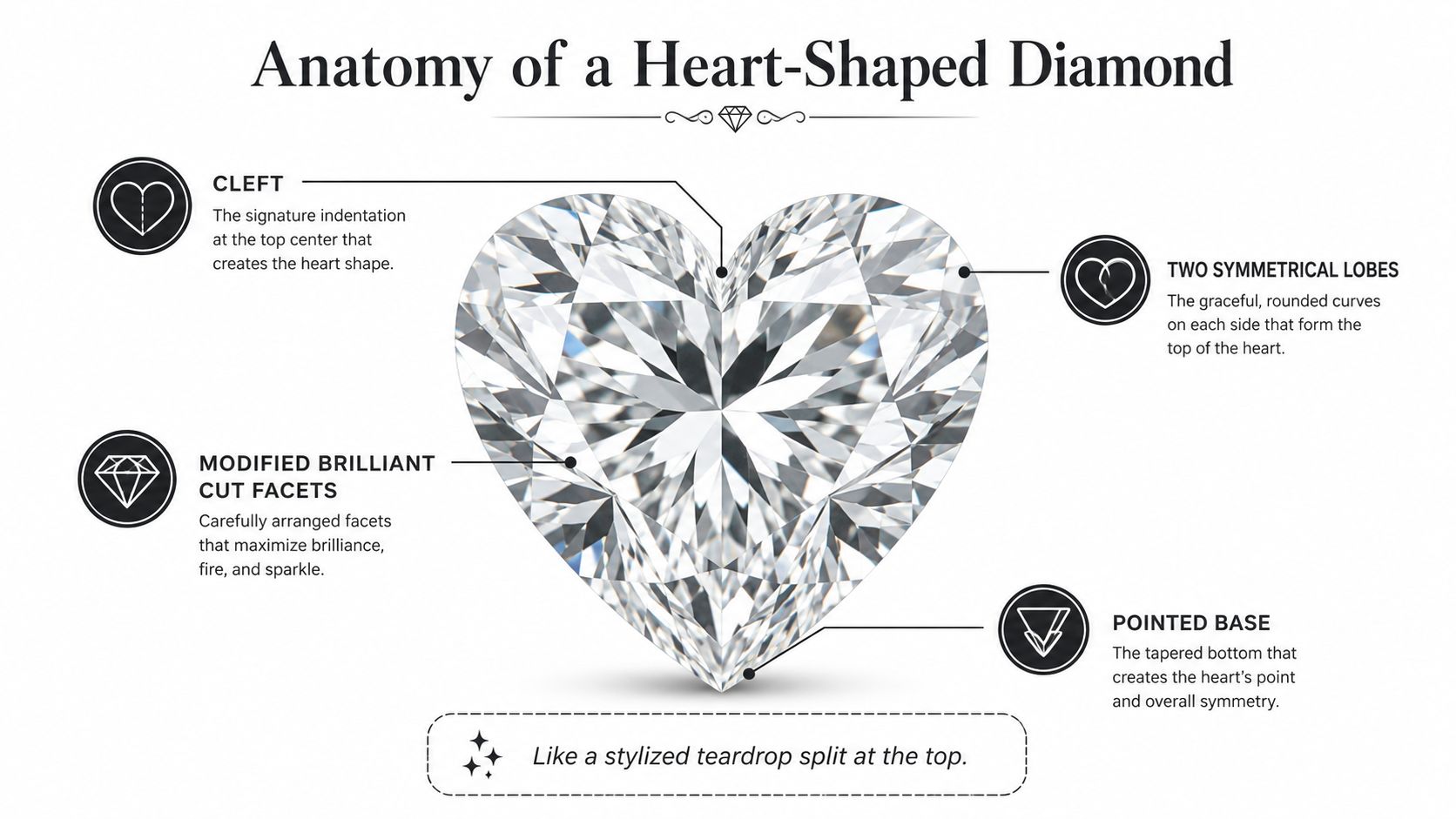
A heart-shaped diamond is a modified brilliant cut, which means it's engineered to catch light while still holding a recognizable outline. The easiest way to picture it is as a stylized paper heart, folded open and refined so the top cleft, the two lobes, and the pointed bottom all stay balanced. If any one part gets too heavy or too narrow, the whole shape starts to look less like a heart and more like an abstract teardrop.
The three proportions that matter
The clearest heart shapes usually sit near a length-to-width ratio of about 1.00 to 1.10, with depth around 56% to 65% and table around 55% to 65% diamdb.com. In plain language, that means the stone shouldn't look squat, stretched, or bulky. A pendant seen at arm's length needs the outline to do a lot of visual work, because the eye reads the whole form before it notices tiny facet details.
That's also why size matters in a necklace setting. Guides aimed at shoppers often recommend 0.70 ct and above for clearer heart recognition, because smaller stones can lose the cleft and the lobe definition once they're mounted and viewed from a distance diamdb.com. The point isn't that smaller hearts are bad, it's that the body changes how the shape is perceived.
What the eye should notice first
When a heart shape is well cut, the lobes feel balanced, the cleft is easy to see, and the point looks centered rather than pulled off to one side. That's the visual test that matters most for a necklace pendant. You don't need to memorize cut terminology to evaluate it, you just need to ask whether the silhouette reads cleanly in a quick glance.
A Short History of the Heart in Jewelry
A heart diamond necklace may feel like a modern gift, but the shape has a much older paper trail. One of the earliest recorded references appears in 1463, when Galeazzo Maria Sforza, Duke of Milan, mentioned a “heart-shaped diamond” in correspondence, as recorded by Gems Society. That detail matters because it shows the heart was already part of elite jewelry language long before it became a familiar retail choice.
From court exchange to coded sentiment
The shape took on even clearer meaning in 1562, when Mary, Queen of Scots is said to have sent Queen Elizabeth I a heart-shaped diamond ring, a story also documented by the Gems Society. The exchange linked the heart motif with love, admiration, and political goodwill. So the heart was never only decoration. It also worked as a message the wearer could send without speaking.
By the 18th century, jewelers were making variations such as twisted hearts and double hearts to suggest being “bewitched by love” or pledged to a partnership, as noted earlier. That helps explain why the form has lasted so long. The style changed, but the reading stayed clear. People kept understanding what the shape was meant to say.
A heart-shaped piece carries more than a shape, it carries a social code that's been refined for centuries.
That long history helps explain why a heart diamond necklace still feels direct in a gift context. The design is not just cute or romantic. It belongs to a long visual tradition where jewelry spoke for the wearer, the way a handwritten note speaks more personally than a printed card. For someone choosing a gift, that gives the piece cultural weight, not just seasonal appeal.
Design Options That Shape the Look
The same heart shape can look delicate, bold, modern, or traditionally romantic depending on how it's built. Metal color changes the mood first. Yellow gold reads warmer and more classic, white gold feels cleaner and cooler, and rose gold adds a softer romantic tone. Once you choose the metal, the chain and pendant proportions decide how visible the necklace will be in everyday wear.
How the usual retail build affects appearance
Major-market listings for heart diamond necklaces commonly use 14K gold, pendant dimensions in the roughly 16 to 21 mm range, and chains around 16 to 18 inches with spring-ring or lobster clasps myprivee.com. Those dimensions aren't random. They're a compromise between a pendant large enough to read as a heart and small enough to sit comfortably near the collarbone.
A good example of the category is EP Fine Jewelry's solitaire heart necklace, which fits the simpler end of the spectrum. Solitaire styles usually keep the focus on the outline itself, while pavé and accent-stone designs use many small stones to create more surface sparkle. One common listing uses 44 round natural diamonds totaling 1/4 ct tw, while another white-gold design lists 1/4 ct tw with an 18-inch chain, 16.5 mm width, and 19.25 mm height myprivee.com.
Solitary or accented
If you want the heart to be the star, a solitaire or lightly framed design keeps the shape easy to read. If you want the necklace to show more from across a room, pavé accents or a halo-style border increase visible sparkle without necessarily making the pendant huge. That tradeoff matters because bigger doesn't always look better. Sometimes the cleanest silhouette is the most elegant one.
| Common Heart Diamond Necklace Specifications | ||
|---|---|---|
| Specification | Common Range | Why It Matters |
| Metal | 14K gold is common | Affects color, durability, and overall tone |
| Pendant size | Roughly 16 to 21 mm | Helps the heart read clearly on the body |
| Chain length | 16 to 18 inches | Changes where the pendant rests on the chest |
| Clasp | Spring-ring or lobster | Affects ease of fastening and everyday security |
| Diamond layout | Solitaire or accent-stone style | Controls whether the look is subtle or more sparkly |
How to Judge a Heart Shape Before You Buy
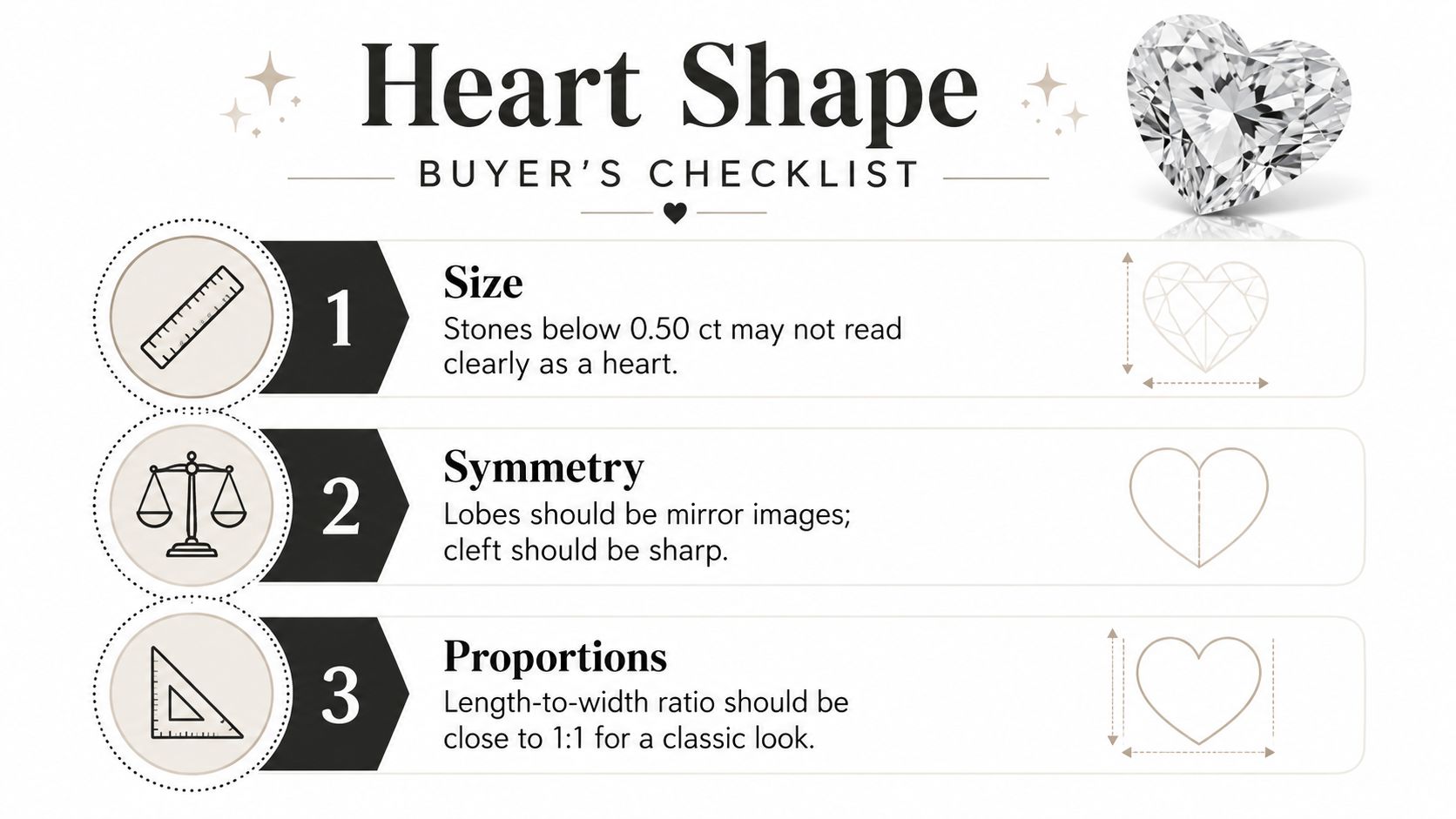
A heart-shaped pendant can look perfect in a product photo and still feel unclear once it hangs on the body. The safest way to judge it is to check size, symmetry, and proportions in that order. A necklace also sits farther from the eye than a ring, so a shape that looks obvious up close may turn vague when worn.
Start with size
A small heart can still be lovely, but the outline may rely more on the setting than on the stone itself. A buyer's checklist from Areté Diamond notes that stones below about 0.50 ct may not read clearly as a heart once set, while 0.70 ct or larger is often easier to recognize. That difference matters more in a necklace than in a ring, because the pendant is usually seen from a little farther away and often in motion.
The simplest way to judge size is to ask one question. Does the heart still look like a heart without you squinting?
If the answer is no, the stone may be too small for the look you want, even if the diamond itself is attractive. In that case, the pendant can still work, but the design needs help from a strong outline, a clear frame, or a setting that keeps the shape from getting visually lost.
Then check symmetry by eye
A grading report can tell you a lot, but your eye will notice the shape first. Look for matched lobes, a sharp cleft, and a centered point. Those are the same features that make a paper heart icon read instantly, while a lopsided version starts to look unfinished.
One easy test is to compare the two sides as if you were folding the pendant down the middle. If one lobe seems fuller, flatter, or pulled higher than the other, the heart can feel off even when the stone is technically fine. A pendant with good symmetry usually looks calmer and more deliberate, which helps it read clearly in everyday wear.
Finish with the outline ratio
The outline also matters. Independent buyer guidance places a more recognizable heart shape around a 0.90 to 1.10 length-to-width ratio, with 1.00 the most balanced Areté Diamond. A slightly elongated heart can look graceful, but it may start to feel less instantly legible, especially in a pendant where the shape is the main point.
A useful way to judge this is to look at the pendant the way someone across a table would see it. If the heart reads clearly in a still photo, it will usually read clearly on the body too. For shoppers who are also deciding how low or high they want the pendant to sit, a necklace length chart can help you picture how the shape will present at different chain lengths.
Matching the Piece to the Occasion
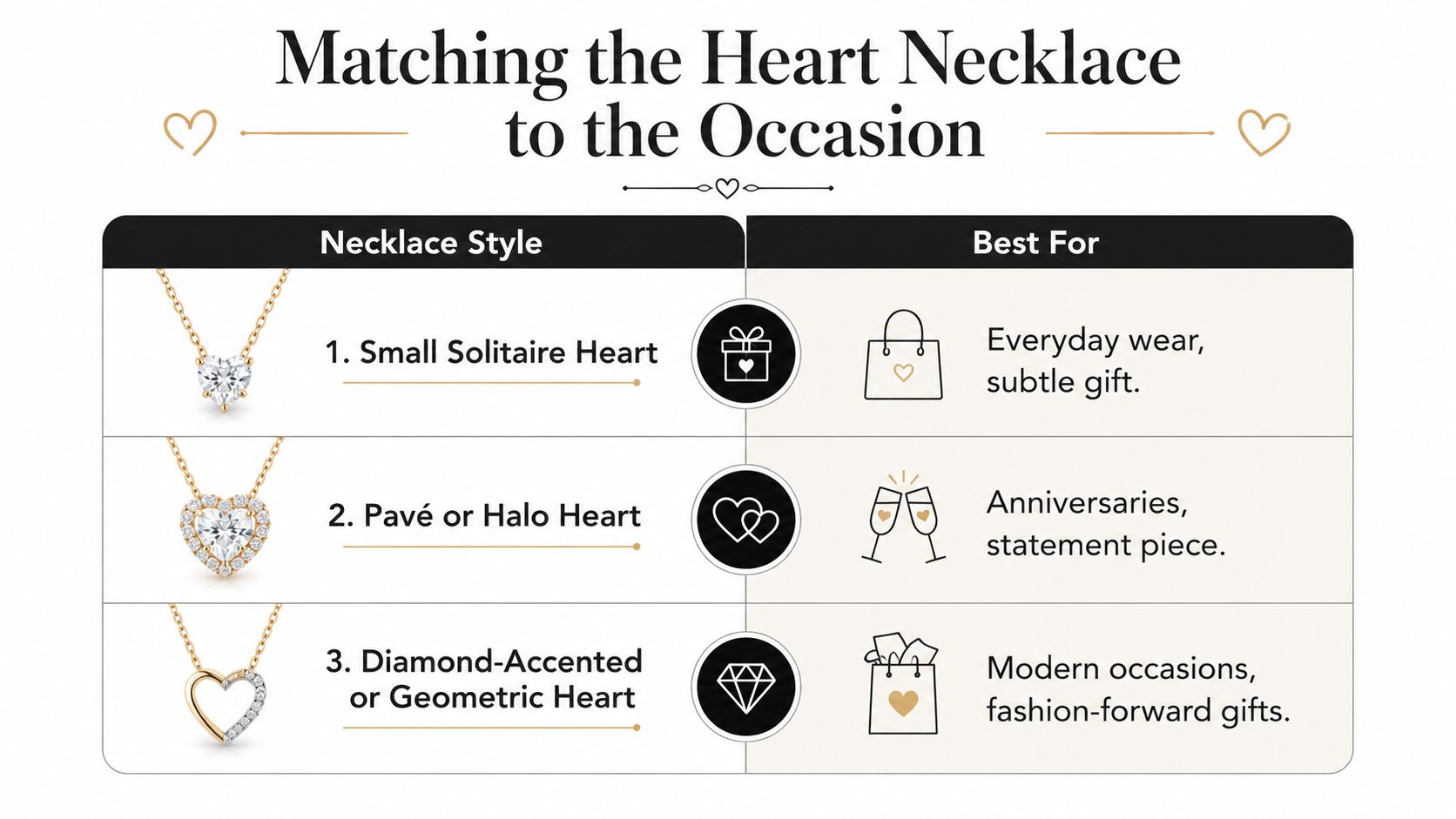
A small solitaire heart usually works best when the gift needs to feel personal without being loud. That makes it a natural choice for everyday wear, thank-you gifting, or a relationship milestone that isn't meant to feel overly formal. A pendant with a cleaner outline also layers more easily with other necklaces, which helps if the wearer likes a simple, repeatable look.
Occasion and style tend to split this way
A pavé or halo heart feels more like an event piece. It has more sparkle and more visual presence, so it suits anniversaries, romantic celebrations, and moments where the gift is meant to announce itself. A diamond-accented or geometric heart can feel more fashion-forward, which is useful when the recipient prefers something a little less literal and a little more modern.
The value side is worth looking at too. One recent buying guide notes that heart-shaped diamonds are generally 15 to 20 percent cheaper than other diamond shapes Lab Diamonds Review. That can make the category feel more accessible than many shoppers expect. But a lower price doesn't remove the need to inspect shape quality carefully, because symmetry still drives how good the pendant looks.
A simple way to choose
- Everyday wear: choose a smaller, simpler heart if you want something subtle and easy to pair.
- Romantic gift: choose a design with more sparkle if you want the piece to feel celebratory.
- Milestone moment: choose a heart with stronger visual presence if the occasion calls for a memorable reveal.
For chain and pendant balance, this necklace length chart from EP Fine Jewelry is useful when you're trying to picture where the pendant will sit. That placement changes the whole feel of the piece, especially with a heart shape, because a pendant resting higher on the chest reads differently from one that drops lower.
Keeping the Heart Pendant Looking New
A heart pendant stays gift-ready when care becomes a tiny habit, not a project. The easiest routine is a weekly wipe with a soft, lint-free cloth and a monthly soak in mild soapy water, followed by a gentle brush if needed EP Fine Jewelry care guide. That keeps skin oils, dust, and everyday residue from building up around the setting.
What to avoid
Chlorine, lotions, and sleeping in the pendant can all shorten the time your necklace looks fresh. Chemical exposure dulls metal and can leave residue in small settings, while sleeping in a necklace increases tangling and stress on the chain. If you wear the piece often, take it off before swimming, cleaning, or applying products that leave a film.
A simple storage habit helps more than people expect. Keep the necklace in a separate soft pouch or lined box so the chain doesn't knot and the pendant doesn't scratch other pieces. That's especially important for heart pendants with pavé detail, since small stones can catch on neighboring jewelry.
If a clasp feels loose or the chain starts twisting often, a professional check is smarter than waiting for a break.
If you're ever giving a gift card to let someone choose later, the Gift Card (Virtual) listing shows 7 variants across option1, option2, option3, which is enough to tell you the format is built for choice rather than a single fixed selection. A pendant or chain still needs the same care routine once it's chosen, so the gift stays wearable long after the first unboxing.
Choosing Your Heart Diamond Necklace with Confidence
The cleanest way to decide is to bring three checks together. First, does the size let the heart read clearly? Second, does the symmetry look balanced, with matched lobes and a centered point? Third, do the proportions give you a shape that feels elegant instead of awkward? Those three details matter more than a glossy product photo, because they determine whether the necklace feels like a heart once it's worn.
The meaning matters too. A heart motif has centuries of recorded use behind it, so when you choose one well, you're not buying a trend, you're choosing a symbol with depth. That's why the best purchase is usually the one that matches the wearer's style, the occasion, and the feeling you want the piece to carry. If you're comparing natural and lab-grown options, EP Fine Jewelry's lab versus natural guide can help you think through that part of the decision without guessing.
Ask yourself three final questions. Who is this for? When will it be worn? What should it say the moment it's fastened? If you can answer those clearly, you're close to the right heart diamond necklace.
EP Fine Jewelry offers necklace styles, personalized pieces, and care guidance in one place, which makes it easier to choose a heart design with both meaning and wearability in mind. If you're ready to compare options and think through the details, visit EP Fine Jewelry and look for the pieces that fit the occasion, the chain length, and the shape you want to see on the body.