
You see a stranger with a wrist full of gold chains, colorful beads, and one meaningful charm, and the whole combination looks effortless. Then you look at your own jewelry box and wonder how several unrelated bracelets could possibly become that polished without tangling, scratching, or sliding into your hand.
That's the appeal of arm candy bracelets. The look is fashionable, but the best stacks also work as small wearable systems. You'll need to think about proportion, movement, closures, materials, and skin comfort, not just whether the pieces look attractive beside one another.
Table of Contents
- What Arm Candy Bracelets Actually Mean
- The Five Bracelet Types That Build a Stack
- Stacking Rules That Make Any Combination Look Intentional
- Skin Safety and Wearability Engineering
- Stack Formulas for Every Occasion
- Personalization Ideas That Turn a Stack Into a Story
- Caring for Your Stack So It Stays Photo-Ready
What Arm Candy Bracelets Actually Mean
Arm candy describes wearing several bracelets together as one coordinated look. It isn't the name of a particular product, and there's no single bracelet you need to buy before you can start. A stack might include a charm bracelet, a slim chain, a rigid bangle, a cuff, or a strand of beads.
Suppose you own a sentimental charm bracelet, a plain metal bangle, and a bracelet you bought on vacation. Worn separately, they may feel like three different styles. Put them together around a shared metal tone or color story, and they can read as intentional arm candy.
The concept belongs to the wider bracelet category, which includes many different materials, designs, and price points. One market estimate placed the worldwide bracelet jewelry segment at approximately USD 46.84 billion in 2025, with a projection of about USD 67.55 billion by 2033, representing a projected 4.8% compound annual growth rate from 2025 through 2033. The same estimate identifies Asia-Pacific as the largest regional revenue market in 2025 and projects India to have the highest growth rate from 2026 through 2033. These figures describe the broader bracelet market, not arm candy as a separately measured category. (Grand View Research bracelet market estimate)
Think in roles, not random pieces
A useful stack usually has:
- An anchor: A cuff, broad bangle, or prominent charm bracelet that gives the arrangement visual direction.
- A bridge: A chain or medium-width bracelet that connects the anchor to lighter pieces.
- An accent: Beads, color, a birthstone, or a small charm that adds personality.
That means you can begin with what you already own. Arm candy is a styling method, not a trend you have to copy exactly from a celebrity photo or Pinterest board.
The Five Bracelet Types That Build a Stack
Before combining pieces, identify what each bracelet contributes. The following five families cover most arm candy combinations.
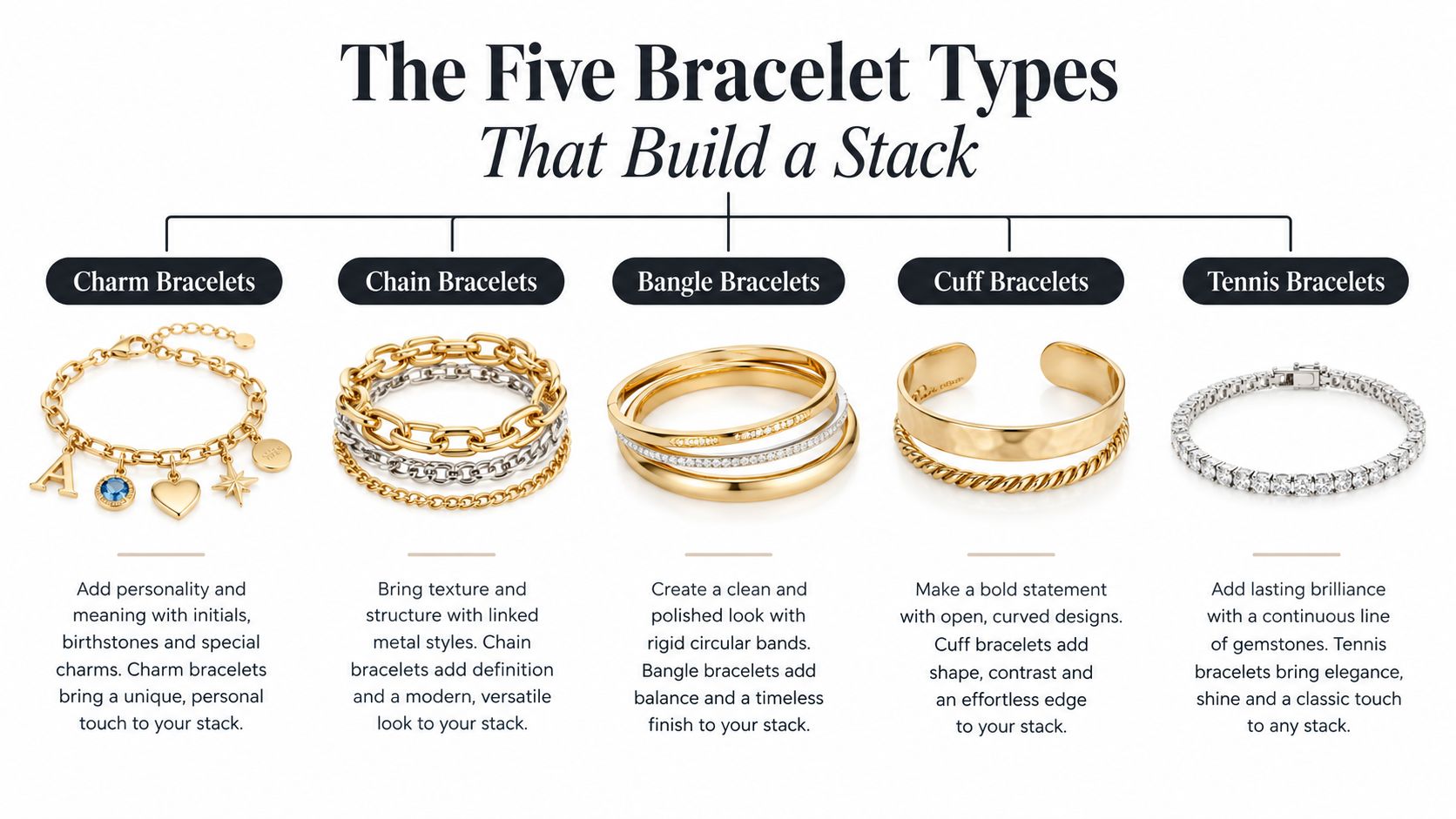
Charm bracelets
Charm bracelets carry symbols that move or sit along the bracelet. Initials, birthstones, zodiac motifs, tiny lockets, and meaningful shapes make them natural storytelling pieces. They often serve as the lead bracelet because the eye has something to discover.
They're especially useful for birthdays, graduations, friendship gifts, and sentimental everyday stacks. Keep nearby pieces relatively smooth if the charms are large, since dangling elements can rub against neighboring bracelets.
Cuffs
A cuff is a rigid, open-ended bracelet that slips over the wrist. It usually acts as the anchor, particularly when the rest of the stack consists of delicate chains or beads.
A polished cuff suits workwear and evening outfits, while a textured or sculptural cuff can carry a simpler outfit on its own. Because cuffs hold their shape, check that the opening and profile don't press into your wrist as you move.
Bangles
Bangles are closed, circular bracelets. They may be slim and understated or wide enough to become the main visual feature. Multiple bangles create movement and a familiar light clinking sound, but several rigid pieces can also collide during daily tasks.
Use one bangle as a clean separator between a charm bracelet and a chain. If you combine several, vary their finish or width rather than choosing a group that looks identical.
Chain bracelets
Chains range from fine cable links to chunkier paperclip and rope designs. They're the connective tissue of a stack because they add movement without always adding much visual bulk.
A delicate chain works near the hand or beside a statement piece. A heavier chain can become the anchor, but inspect its clasp and links before pairing it with dangling charms.
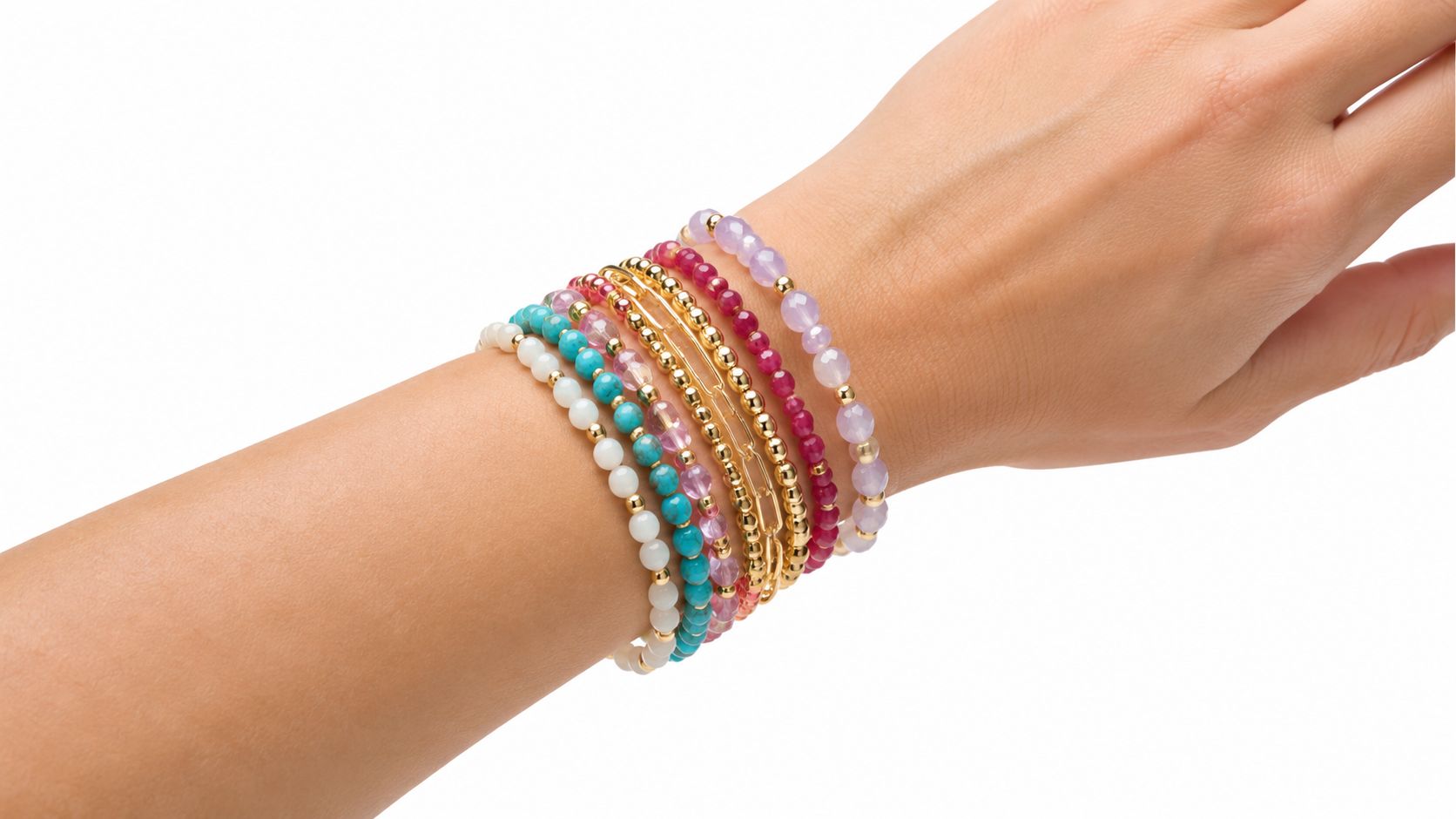
Beaded bracelets
Beaded bracelets bring color, texture, and a softer visual rhythm. Gemstone, glass, and wooden beads can make a metal-heavy stack feel warmer and more relaxed.
They suit casual clothing, travel outfits, and colorful gift combinations. Beads may feel more substantial than a fine chain, so place them where they can move without pressing against a rigid cuff.
For a useful everyday reference on choosing wearable pieces, see bracelets to wear every day.
Stacking Rules That Make Any Combination Look Intentional
A beautiful stack usually follows a few quiet design rules. You don't need every piece to match. You do need the pieces to relate.
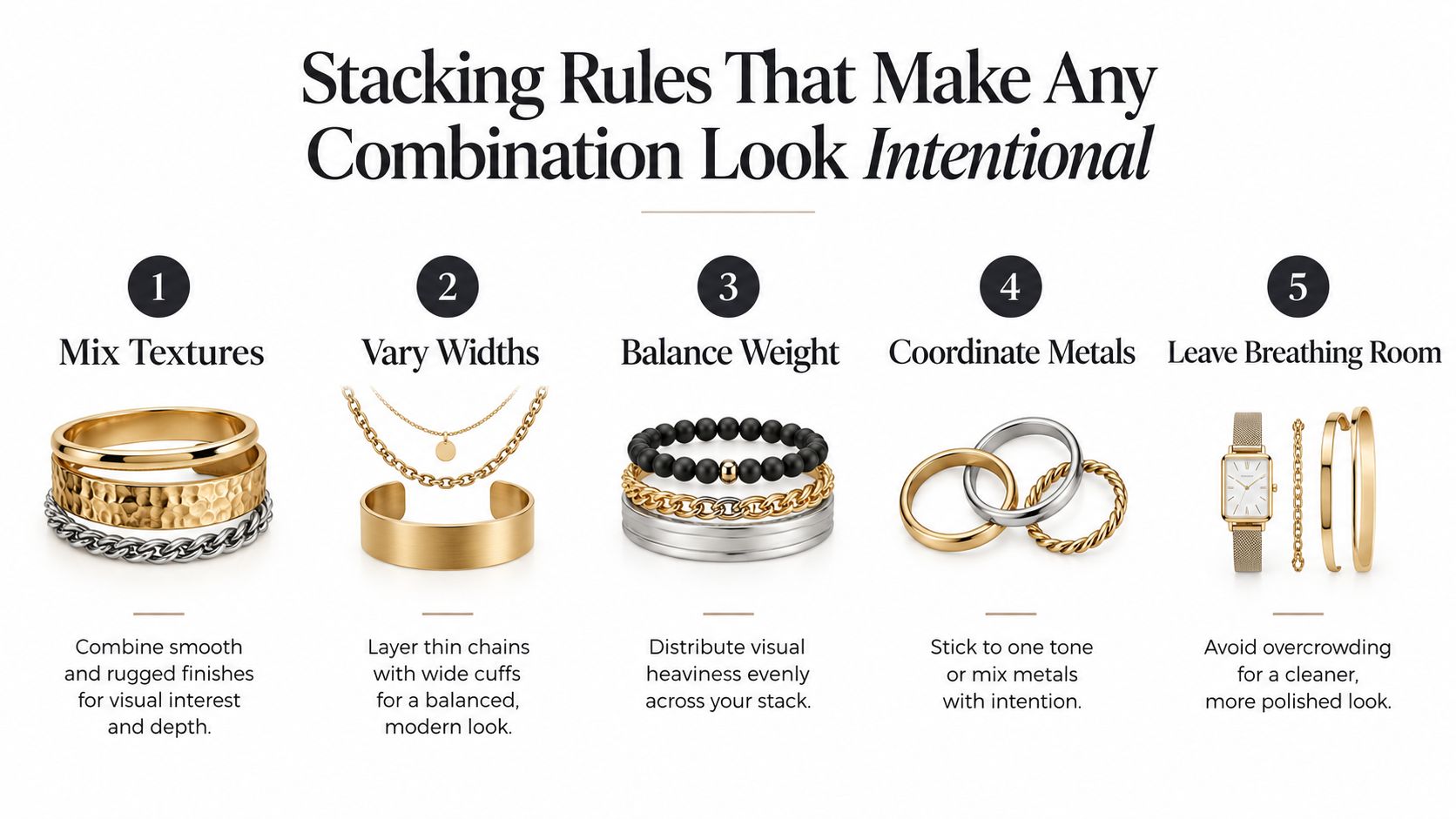
Start with texture
Texture gives the eye variety. A smooth bangle beside a beaded strand feels more considered than three nearly identical polished bangles. A fine chain can soften a hammered cuff, while a matte bead can keep a high-shine stack from looking too formal.
Try this simple test: if every piece reflects light in the same way, add one bracelet with a different surface. If every piece is textured, introduce one clean, smooth form for contrast.
Choose a dominant metal
Gold, silver, and rose gold can work together, but a dominant finish keeps the result cohesive. Let one tone appear most often, then use another as a small accent through a clasp, charm, bead cap, or bridge bracelet.
For example, a mostly gold stack can include one silver charm without looking accidental if the silver appears again in a small detail elsewhere. If you're unsure, begin with one metal family and experiment with mixed metals later.
Vary width and position
Proportion creates a visual path across the wrist. A wider cuff or bangle can provide structure, while slim chains create breathing room around it.
Place the broadest piece where it won't interfere with your hand, then let narrower bracelets move toward the forearm. The aim isn't a strict universal order. It's to prevent several wide pieces from forming one dense block.
Leave breathing room
Negative space is part of the design. Five wide cuffs pressed together hide their individual shapes and create friction. A gap between a rigid bangle and a delicate chain lets both pieces remain visible.
You can create that space through width, shape, or movement. A slim chain may separate two solid forms, while a flexible beaded bracelet can break up a row of rigid metal.
Distribute weight deliberately
Heavy pieces affect comfort more than they affect a photograph. Put substantial cuffs or solid bangles closer to the hand if that position feels stable, then place lighter chains and charms where they can move more freely along the forearm.
Practical rule: Build the stack while doing an ordinary task. Type, open a door, pick up a cup, and rotate your wrist before deciding it works.
This distinction matters: styling compatibility means the pieces look right together. Material compatibility means their surfaces, closures, and skin-contact materials can coexist comfortably. A gold-and-silver combination may look deliberate while still containing one clasp or plated surface that irritates the wearer.
For related proportion ideas across jewelry, learn how to stack rings.
Skin Safety and Wearability Engineering
A stack can look perfect and still be a poor choice for all-day wear. Skin reactions from bracelets are often linked to nickel release, which is different from judging an alloy by its color, shine, or total nickel content.
In the European Union, bracelets designed for direct and prolonged skin contact must release no more than 0.5 micrograms of nickel per square centimeter per week. Manufacturers assess this through standardized artificial-sweat testing, including EN 1811 methods. (Nickel Institute guidance on nickel release and dermatitis)
Inspect every skin-contact component
A product label alone may not tell you enough. Ask what touches the wrist, including:
- Clasps and extender chains, which can sit against the skin even when the main bracelet is made from another material.
- Plated surfaces, where wear can expose an underlying alloy over time.
- Charms and connectors, which may create extra contact points.
- Unspecified alloys, which provide less useful information than a named, tested material.
For people with known sensitivity, clearly disclosed solid platinum, higher-karat gold, sterling silver, or appropriately tested stainless steel can offer more actionable guidance than terms such as “hypoallergenic.” White gold and lower-karat gold may contain nickel, so ask for the actual metal details rather than relying on color.
Fit the stack to movement
More bracelets create more contact points, friction interfaces, and opportunities for snags. Measure your wrist circumference, then choose adjustable chains or bangles with enough clearance to avoid constriction without leaving so much slack that the stack catches on sleeves, keyboards, or equipment.
Don't treat an unsupported weight limit as a medical or ergonomic rule. Instead, look for practical specifications such as mass, width, internal diameter or adjustable length, clasp geometry, and edge finish. Smooth, rounded, polished surfaces are generally easier to live with than sharp corners beside moving charms.
Sweat and trapped moisture can worsen irritation. Remove the full stack during exercise, bathing, and sleep. If itching, redness, dryness, bumps, or blisters appear, take off every bracelet rather than guessing which piece caused the problem. Nickel-related symptoms can appear 12 to 72 hours after exposure, and a dermatologist can confirm an allergy through patch testing. (American Academy of Dermatology information on nickel allergy)
For a plain-language explanation of material disclosure, see what nickel-free jewelry means.
Stack Formulas for Every Occasion
A stack for a desk job doesn't need the same construction as one for a wedding or a long travel day. Start with the activity, then choose the visual mood.
| Formula | Pieces Included | Best For | Comfort Note |
|---|---|---|---|
| Everyday | Slim chain, beaded strand, thin bangle | Casual outfits and regular routines | Smooth, lighter pieces keep contact and snagging manageable |
| Office | Polished cuff, delicate chain, personalized charm bracelet | Sleeves, meetings, and polished workwear | Keep the charm compact so it doesn't catch on fabric |
| Travel | Adjustable chain, durable beaded strand, silicone or fabric band | Transit, changing weather, and active moments | Use secure, adjustable closures and remove pieces for exercise or water |
| Evening | Statement cuff or pavé bangle, fine chain, charm bracelet | Dinners, celebrations, and event dressing | Dramatic surfaces may need more spacing to prevent rubbing |
| Gift-ready | Charm bracelet, matching chain, birthstone or initial bangle | Birthdays, graduations, and meaningful gifts | Three coordinated pieces can be worn together or separately |
Everyday and office combinations
The everyday formula keeps the wrist expressive without making every movement feel crowded. A slim chain supplies movement, beads add color, and a thin bangle gives the combination a clean outline. Keep the metal family consistent if you want the lowest visual friction.
For the office, reverse the emphasis. Let a polished cuff provide the structure, then add a delicate chain and a personalized charm bracelet that can peek from beneath a sleeve. The charm creates interest without requiring a large statement piece.
Travel and evening combinations
Travel calls for pieces you can adjust and remove easily. A chain with a secure closure, durable beads, and a silicone or fabric band can shift from sightseeing to a more active moment without putting delicate plated surfaces through unnecessary friction.
Evening styling allows more sparkle and movement. A statement cuff or pavé bangle becomes the lead, a fine chain softens its edge, and a charm bracelet catches light as you move. Leave enough space for the pieces to remain distinct.
A gift-ready combination
The gift formula works because it offers more than one way to wear the present. A charm bracelet carries the personal meaning, a matching chain creates continuity, and a birthstone or initial bangle completes the set. The recipient can wear all three for a curated look or separate them across different outfits.
Personalization and gifting are meaningful parts of bracelet demand. One market estimate attributes approximately 34% of purchases to gifting trends, reports that nearly 41% of sales are expected through e-commerce platforms, and estimates that about 31% of consumers prefer customized or personalized designs. These are market-research estimates, not official government statistics. (Global Growth Insights bracelet market estimate)
Personalization Ideas That Turn a Stack Into a Story
Color makes a stack attractive, but meaning gives it staying power. A personalized arrangement can mark a relationship, place, milestone, or private joke without making the symbolism feel obvious to everyone else.
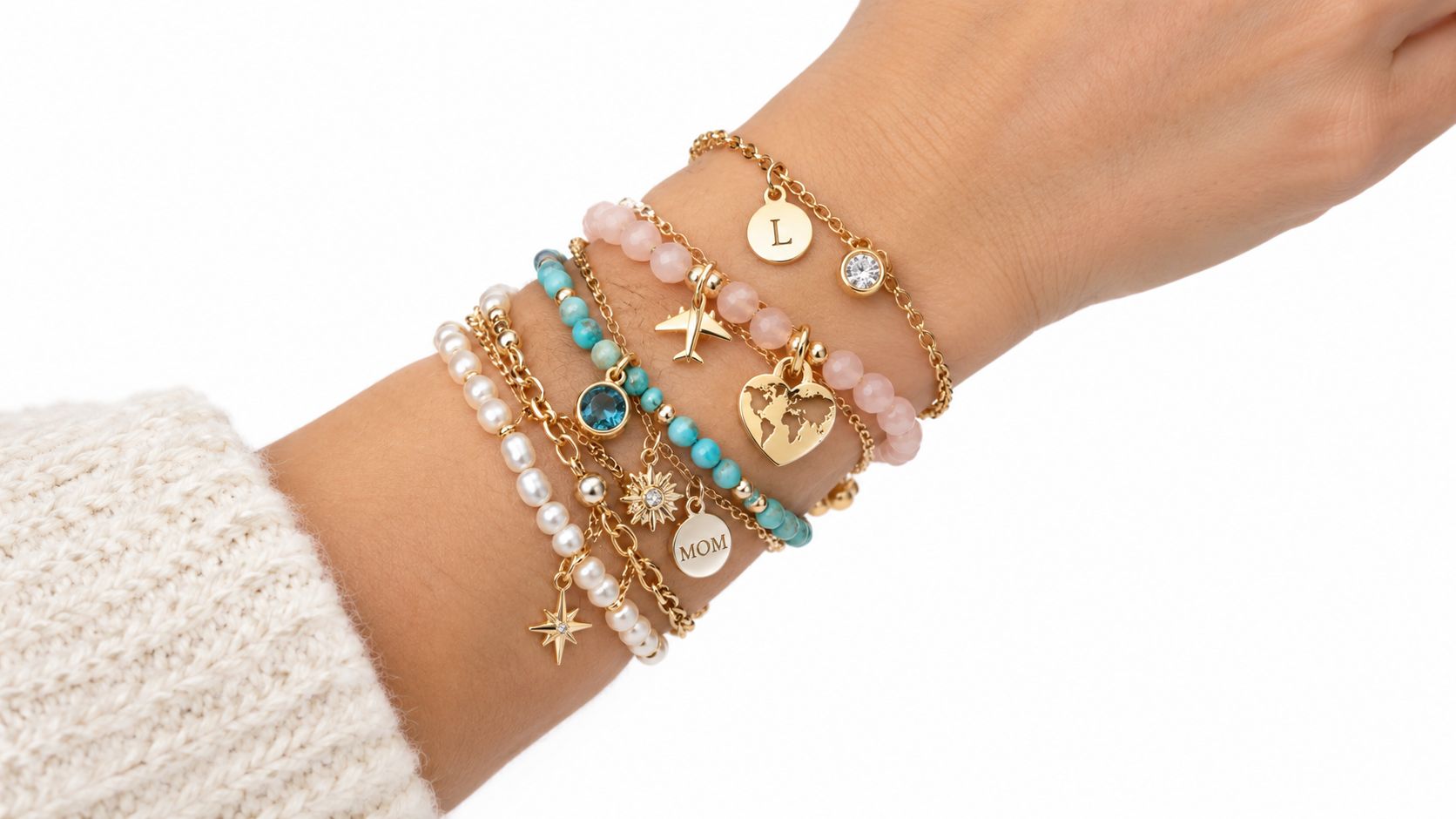
Begin with initials
An initial or monogram works well on a flat bangle, a tag charm, or a small disc. Use one initial for a subtle everyday piece, two initials for a couple, or several initials for a family or friendship stack.
For a birthday gift, the recipient's initial keeps the piece personal without requiring you to know their entire jewelry style. A friendship stack can use matching initials on separate bracelets, so each person wears one part of the same idea.
Add a birthstone or zodiac symbol
Birthstones provide color as well as meaning. Place one in a charm bracelet, or repeat the color in a beaded strand so the personalized detail connects to the rest of the wrist.
A zodiac charm can suit a birthday or graduation gift, especially when paired with a simple chain that lets the symbol remain visible. If the recipient prefers understated jewelry, use the birthstone as a small accent rather than the center of the stack.
Mark a place or moment
Coordinates can represent a hometown, first meeting place, wedding venue, or favorite travel destination. A date can mark an anniversary, graduation, adoption, or another private milestone on a cuff or tag charm.
Keep the surrounding bracelets simple when the engraving is detailed. A smooth chain and a narrow bangle frame the message without competing with it.
Choose symbolic charms
Hearts, evil eyes, four-leaf clovers, miniature animals, and other symbols can carry personal memories. A tiny animal may reference a beloved pet, while a clover can represent luck during a new chapter.
For a new mother, a charm connected to family can form the center of a soft, wearable stack. For a bridal party, coordinated symbols can create a shared gift while allowing each person to choose a different initial or birthstone. EP Fine Jewelry's personalized bracelets collection is one place to compare personalized bracelet formats and charm-led options.
If you're sending the stack directly to the recipient, a gift box and an order-note message can make the presentation feel complete. The message doesn't need to be elaborate. A specific memory or short reason for choosing the charm often matters more than a long greeting.
Caring for Your Stack So It Stays Photo-Ready
Care begins with knowing when the stack shouldn't be on your wrist. Remove all pieces before showering, swimming, exercising, or applying lotion and sunscreen. Sweat, chlorine, and product residue can dull surfaces, affect plating, and collect around clasps and charms.
Store bracelets flat in a soft pouch or lined tray. Hanging chains can tangle, while unsupported clasps may pull against neighboring links. Keep delicate pieces separated from textured bangles so repeated contact doesn't create unnecessary scratches.
A simple care routine
- Wipe after wear: Use a soft cloth to remove moisture and residue before storage.
- Clean gently: For many metals, mild soap and lukewarm water followed by careful drying is a practical starting point.
- Treat silver selectively: Use silver polish only on solid sterling silver, and avoid it on plated or vermeil pieces unless the maker specifically permits it.
- Inspect connections: Check charms, jump rings, clasps, and extender chains periodically, especially when a bracelet is worn often.
- Separate delicate finishes: Give plated, polished, and stone-set pieces their own space when possible.
For material-specific guidance, follow EP Fine Jewelry's jewelry care instructions. A piece such as the Fancy Shape Cuff has a latch for taking it on and off, an oval, emerald, heart, or pear shape, a 3mm thickness, 5-6mm shapes, small and medium measurements of 6.2" and 6.8", and 14K gold-plated/CZ materials, so removing it before water, sport, and sleep is a sensible part of its care routine.
A well-built stack should be easy to take off. Convenience protects both your skin and your jewelry.
EP Fine Jewelry offers personalized bracelets, charms, bangles, and gift options that can help you assemble an arm candy stack with a clear story and practical purpose. Visit EP Fine Jewelry to explore pieces you can combine for everyday wear, meaningful gifts, and comfortable, considered layering.