
You're standing at your vanity, running late, and you reach for the necklace you want. It comes up attached to two others. You pull gently, they tighten, and now you're doing surgery with your fingernails over the sink. That knot didn't happen while you wore it. It happened in storage. Learning how to store necklaces without tangling comes down to one clear rule, then matching the method to each piece. Separate every chain, control its movement, and stop treating a delicate pendant like a sturdy curb chain.
Table of Contents
- Why Necklaces Always End Up in a Knot
- Building a One-Piece-at-a-Time Home Setup
- Hang, Lay Flat, Thread, or Pouch
- DIY Storage Hacks You Can Set Up Tonight
- Travel and Drawer Packing Without Knots
- Material-Specific Care for Lasting Storage
- Your Tangling-Free Storage Routine
Why Necklaces Always End Up in a Knot
Open most jewelry drawers and you'll see the same scene. A fine chain has looped through a pendant, a longer chain has wrapped around both, and lifting one piece drags the whole braid with it. You're not careless. Loose chains in a shared, jostled space rotate, shift, and interlock. That's predictable physics, not bad luck.
Length makes the problem worse. A longer chain has more slack to curl around itself and its neighbors, and a 2022 survey of jewelry owners on why necklace chains tangle reported that necklaces shorter than 16 inches tangled 68% less often than necklaces measuring 20 inches or longer, with more than 82% of reported tangling incidents associated with storage rather than chain design. Treat those industry figures as directional, not as academic proof. The practical point stands. Where and how you put a necklace down matters more than blaming the chain.
Separation Is an Old Idea
Jewelry owners learned this long ago. A visual history of the jewelry box notes that jewelry boxes were reportedly in common use in ancient Egypt by approximately 5000 BC, and by the 16th century European boxes commonly had velvet or leather linings. Slotted panels and other specialized compartments followed in the late 19th and early 20th centuries. Storage evolved from one treasure container into organizers shaped around each type of piece.
Storage should create separation rather than place chains together in an undivided space.
Four methods do that job well. You can use individual compartments, hanging hooks, straw or tube threading, or separate pouches, chosen according to the necklace in your hand. Start by checking your pieces against a necklace length chart for common chain lengths, because your longest, finest chains and anything with charms need the most protection from contact. Fasten each clasp before you store it, and don't let necklaces overlap. Once you remove shared space and loose ends, the morning knot mostly disappears.
Building a One-Piece-at-a-Time Home Setup
Set up your home storage in one focused session, then follow the same four motions every time you take a necklace off. Don't build a system that needs willpower. Build one where the right move is also the easy move.
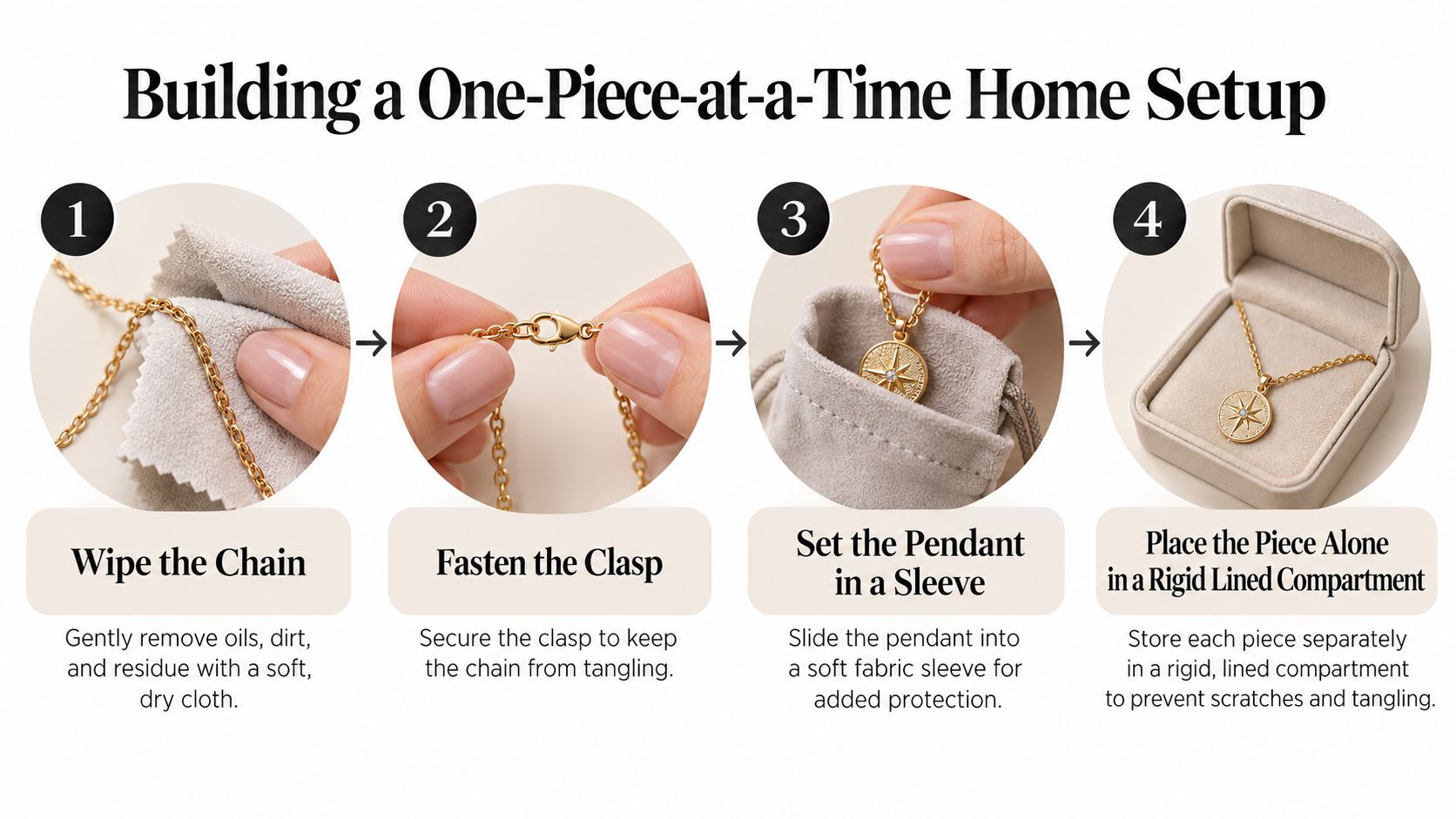
Use this routine for each piece, in order:
- Wipe the chain. Run a microfiber cloth along its length to remove skin oils before you seal or box it.
- Fasten the clasp. A closed clasp removes the loose ends that thread through neighboring links.
- Set the pendant in a sleeve or pocket. Keep the pendant from swinging, scratching, or catching on the chain itself.
- Place the piece alone. Lay it in a rigid, felt or velvet lined compartment where no other chain can touch it.
This visual walkthrough shows the sequence from wiping to compartment storage.
If You Prefer to Hang
Hanging works well on a vanity wall or inside a cabinet door, with one condition. Every chain gets its own padded hook. Guidance on spaced padded hooks for jewelry organization recommends roughly 2 inches between hooks, which reduces cross contact while keeping each chain vertically aligned. Don't double up two necklaces on one hook to save space. You've just rebuilt the drawer problem on a wall.
Give each hook enough vertical room so the pendant doesn't rest against a shelf or pool at the bottom. Chains that bunch at the base tangle just as readily as chains in a bowl. If a long necklace reaches the surface below, move it to a taller hook or lay it flat instead.
Traps That Quietly Cause Knots
Skip the pretty open bowl. Lifting one necklace creates micro motion that drags adjacent chains into contact, and shared pouches do the same damage out of sight. Overfilled trays are another silent culprit, because an overstuffed compartment lets chains spill over dividers.
- Open clasps in flat compartments: Loose ends wander and hook neighboring links.
- Delicate chains stored with heavy pieces: Weight drags and bends fine links.
- Humid bathrooms: Moisture raises corrosion and tarnish risk while chains sit exposed.
A divided rigid case does double duty for gifting too, which is why a jewelry gift box designed for necklaces makes a sensible home for a favorite piece, not just presentation packaging. Ignore online claims of "zero tangles" or guaranteed success rates. Physical isolation plus motion control is the principle that holds up. One necklace, one space, every time.
Hang, Lay Flat, Thread, or Pouch
Stop looking for one organizer that suits your whole collection. A heavy pendant pulls a fine chain into bends when it hangs, while a long floppy chain crumples into loops when it lies loose in a wide compartment. Match the method to chain thickness, length, pendant weight, and clasp type, piece by piece.
Recent guidance on storing and packing jewelry by piece type recommends hanging chains individually for maximum separation, but also notes that flat storage is preferable when hanging could stress joints or delicate links. That's the nuance most advice skips. Hanging protects against contact tangles, yet it lets pendants swing and can strain the spot where a pendant meets the chain.
Matching Storage Method to Necklace Type
| Method | Best For | Watch Out For |
|---|---|---|
| Hang on its own hook | Sturdy chains, medium lengths, pieces you wear daily | Heavy pendants that pull on fine links, swinging against a wall |
| Lay flat in a compartment | Heavy pendants, rigid chains, delicate links needing full support | Compartments so wide the chain can coil freely |
| Thread through a straw or tube | Long, fine, flexible chains that knot on themselves | Pendants too wide to sit neatly at the tube's end |
| Store in an individual pouch | Travel, infrequently worn pieces, protecting a finish from scratches | Tightly packed pouches trapping moisture, or more than one necklace per pouch |
Read the table by starting with your necklace, not your furniture. A rigid collar style chain holds its shape on a hook and stays visible, so you'll wear it. A long rope chain has too much slack for a shallow tray, so constrain it along its length with a tube or give it a tall hook with clear vertical drop.
The Pendant Test
Hold the necklace by its clasp and let it hang. If the pendant drags the chain into a narrow V and strains the links near the bail, lay that piece flat with the pendant supported, not dangling. Personalized nameplates and charm clusters deserve this check every time, because projecting letters and charms add weight and catch on anything nearby.
Practical rule: If gravity is bending the chain, laying it flat isn't a compromise. It's the correct method.
Clasp type matters too. A necklace with a small spring ring that's fiddly to close tempts you to drop it in unclasped. Close it anyway, or thread it so the ends can't travel. Plated, sterling silver, pearl, enamel, and gemstone pieces add finish concerns covered later in this article, but the mechanical decision comes first. Support the weight, limit the slack, prevent contact. When a method does all three for that specific necklace, it's the right one, even if its neighbor needs something completely different.
DIY Storage Hacks You Can Set Up Tonight
You don't need to order anything to fix your worst tangles tonight. You need dividers, one pocket per necklace, and items already in your kitchen or desk. This flatlay shows the end goal, with necklaces sitting in compartments and on cards instead of in a pile.
Start with a rigid drinking straw for a long, fine chain. Unclasp the necklace, thread one end through the straw, then reconnect the clasp so the chain can't fold back on itself. A spare button works for shorter chains. Thread the clasp end through the buttonholes and fasten it, which holds the ends apart in a fixed loop.
Household Items That Create Compartments
- Ice cube tray: Drop one fastened necklace per cube well, pendant resting on top of its own chain.
- Empty pill organizer: Each lidded cell becomes a rigid single necklace compartment, ideal for short chains.
- Index cards with slits: Cut two small slits, wrap the chain once, tuck the ends in, and file cards upright in a box.
- Paper towel roll: Drape fastened, sturdy necklaces over a roll mounted horizontally, spaced so they don't touch.
Watch a demonstration of these simple separation tricks before you start sorting your own drawer.
Choose by length and pendant, just as you would with store bought storage. Straws and cards control long chains best because they constrain slack. Trays and pill boxes suit short chains and small pendants that fit without being forced. Don't cram a chunky pendant into a cell that's too small, and don't let a charm dangle over a divider into the next well.
Handmade solutions beat an expensive organizer you'll use wrong. If your setup enforces one necklace per pocket, keeps clasps closed, and stops chains from sliding into each other, it works. Label the cells if it helps you put things back in the same spot. The best hack is the one still in use a month from now.
Travel and Drawer Packing Without Knots
Necklaces that travel face agitation your vanity never delivers. Suitcases tip, gym bags swing, and small drawer inserts slide every time you open them. Pack for movement, not for stillness.
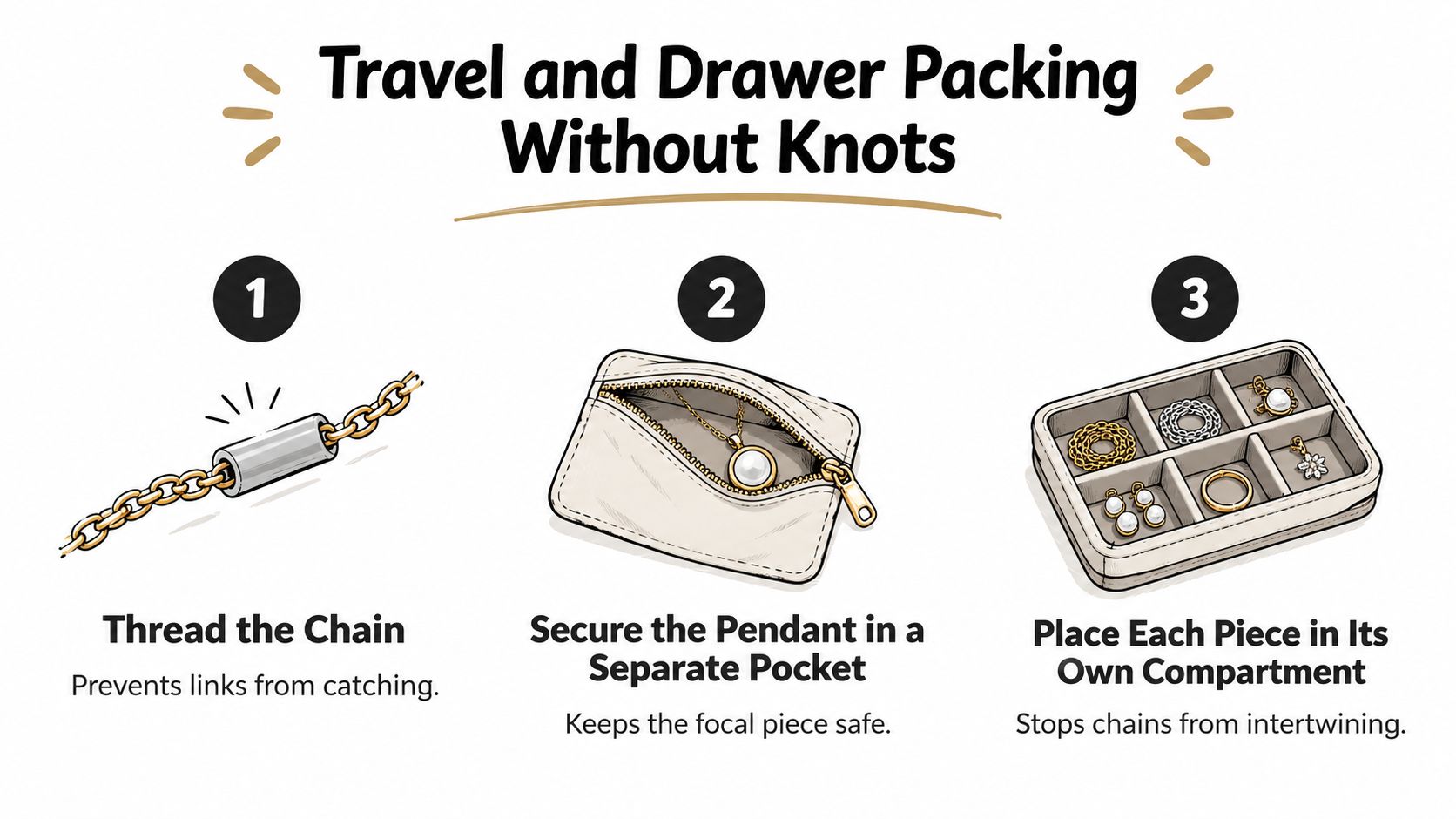
Follow this sequence for each piece. First, inspect the chain for weak or bent links before it goes anywhere, because travel stress finds flaws fast. Second, thread long or fine chains through a straw or narrow protective tube and reconnect the clasp, following the method described in step-by-step guidance on storing necklaces without tangling. Third, secure the pendant in a separate pocket or sleeve so it can't swing against the chain. Fourth, place each protected necklace in its own zip pouch or dedicated slot.
This checklist graphic sums up the three core packing moves before you close any case.
Run the Invert and Shake Test
Before you zip the case shut, gently invert it and shake it. If a chain shifts or a pendant escapes its sleeve, repack that piece with a tighter anchor or a stronger compartment. Don't hope the flight will be smooth. Test it at home while fixing it costs you one minute.
If it moves in your hand, it'll knot in your suitcase. Repack it now.
Keep heavy necklaces in separate slots from fine chains, and never stack multiple pieces in one pouch to save room. A pouch only prevents tangles when it holds one necklace and restricts its movement. A pouch holding three chains is just a smaller tangling chamber with a zipper.
For a full packing walkthrough, including what to carry on versus check, read this guide on how to store jewelry when traveling before your next trip. Wipe each chain dry before sealing it, and keep the packed case away from bathroom humidity, heat, and direct sunlight at your destination. Hotel safes are fine for security, but your necklaces should already be individually contained before they go in. Tangling during travel is driven by chain length, flexibility, friction, and agitation, and this routine controls all four.
Material-Specific Care for Lasting Storage
A tangle free setup can still damage a necklace if the environment is wrong for its material. Silver and plated metals tarnish faster with moisture and temperature swings, so they belong in cool, stable, dry storage away from bathrooms. Pearls and other organic materials play by different rules and can suffer in overly dry, sealed air.
Guidance on proper jewelry storage and humidity control points to roughly 40 to 50% relative humidity as a sensible target area for metal chains. Put a small hygrometer near your storage spot so you're measuring conditions instead of guessing. Move the box out of the bathroom and out of direct sunlight first. That single change does more than any accessory.
Separate Zones for Mixed Collections
Don't force one environment on every material. Use moisture control or anti-tarnish storage, such as silica gel, only for compatible metals. Give pearls breathable soft pouches where air can circulate gently. If you use plastic for individual containment, choose inert polyethylene or polypropylene, since unsuitable plastics can trap moisture or emit reactive chemicals.
Personalized and charm necklaces need extra attention in any zone. Pendant weight and projecting charms raise snag risk, so they get dedicated hooks or sleeves, never shared space. EP Fine Jewelry sells personalized necklaces and charm necklaces, and those pieces follow the same rule as any pendant heavy design. Support the pendant, protect the finish, keep it alone.
Review the full jewelry care instructions for everyday maintenance for your specific metals and stones, then inspect clasps, links, and pendants regularly instead of trusting airtight storage alone. A clasp that's loosening or a link that's starting to bend will cause trouble no organizer can prevent. Catch it during inspection, not after a pendant slides off in a drawer.
Your Tangling-Free Storage Routine
Turn everything above into a five minute weekly habit and you'll stop spending ten minutes untangling. Check your storage once a week, return strays to their slots, and give your most worn pieces a quick once over. Consistency beats a perfect organizer used carelessly.
- Fasten every clasp: No necklace goes back with loose ends, ever.
- Give each necklace its own slot: One hook, one compartment, or one pouch per piece.
- Run the invert and shake test: Do it before closing any case, box, or travel pouch.
- Inspect chains monthly: Look at clasps, links, and pendant attachments under good light.
Pair the inspection with cleaning so both habits stick, using this routine for how to clean jewelry at home on the same day each month. Storage should create separation, and your routine is what keeps that separation intact. Make the small setup change once, follow it without negotiating with yourself, and your favorite necklaces will be ready to wear the moment you reach for them.
Your necklaces deserve storage that protects the personalization and detail you chose them for, and EP Fine Jewelry offers personalized necklaces, charm necklaces, and everyday pieces built for exactly that kind of care. Browse the collections, pick the piece that fits your routine, and store it the one piece at a time way from day one by visiting EP Fine Jewelry today.