
You've found the personalized necklace you want, added it to your cart, and reached checkout expecting the final total to look familiar. Then a shipping fee appears. The necklace costs $140, delivery adds $12, and a small message offers a tempting alternative: add $60 more to qualify for free shipping.
That message is a free shipping threshold. It can change the way you shop, especially when your cart contains jewelry that naturally works in pairs, sets, or gifts. The key is understanding when reaching the threshold adds genuine value, and when it encourages you to buy something you didn't want.
Table of Contents
- What a Free Shipping Threshold Actually Means
- How Thresholds Work Behind the Scenes
- Why Retailers Set a Minimum Spend
- Smart Ways to Reach the Free Shipping Mark
- How the Threshold Shows Up at Checkout
- Free Shipping Thresholds Across Product Categories
- Common Misconceptions About Shipping Thresholds
- Putting It All Together for Your Next Order
What a Free Shipping Threshold Actually Means
A free shipping threshold is the minimum order value you must reach before a retailer removes the delivery charge. If a store sets its threshold at $200, an order with a qualifying subtotal of $200 or more can receive free shipping under that store's terms.
It isn't a discount code. You usually don't need to enter anything at checkout. Instead, the cart watches the order subtotal and applies the shipping benefit once your qualifying items cross the stated amount.
The process is straightforward:
- You add products to your cart.
- The store compares the qualifying subtotal with its threshold.
- The cart tells you how much more you need, if anything.
- Once you reach the mark, the shipping charge changes according to the store's policy.
For a personalized jewelry order, the difference can feel especially noticeable. A custom name necklace may be the main purchase, while a charm, matching earrings, or gift packaging helps you reach the line without choosing a random filler item. The threshold turns shipping from a surprise at the end into a target you can consider while building the cart.
The important question isn't, “Can I reach free shipping?” It's whether the extra item belongs in the order anyway. A $60 add-on only makes sense if it gives you useful jewelry, completes a gift, or replaces a future purchase.
You'll also see how retailers set these rules, why the $200 mark can influence basket decisions, how shoppers can reach it thoughtfully, and what the messaging looks like inside a real cart.
How Thresholds Work Behind the Scenes
A free shipping threshold works a little like a coffee shop stamp card. You need to collect a set number of stamps before receiving the free drink. An online retailer uses money rather than stamps, but the structure is similar: reach the qualifying point, then receive the benefit.
The retailer chooses a dollar figure, builds its delivery economics into its pricing and margins, and programs the cart to track progress. If the subtotal is below the line, the cart may show a shipping charge. If the subtotal crosses it, the system can replace that charge with free shipping, provided the products and destination qualify.
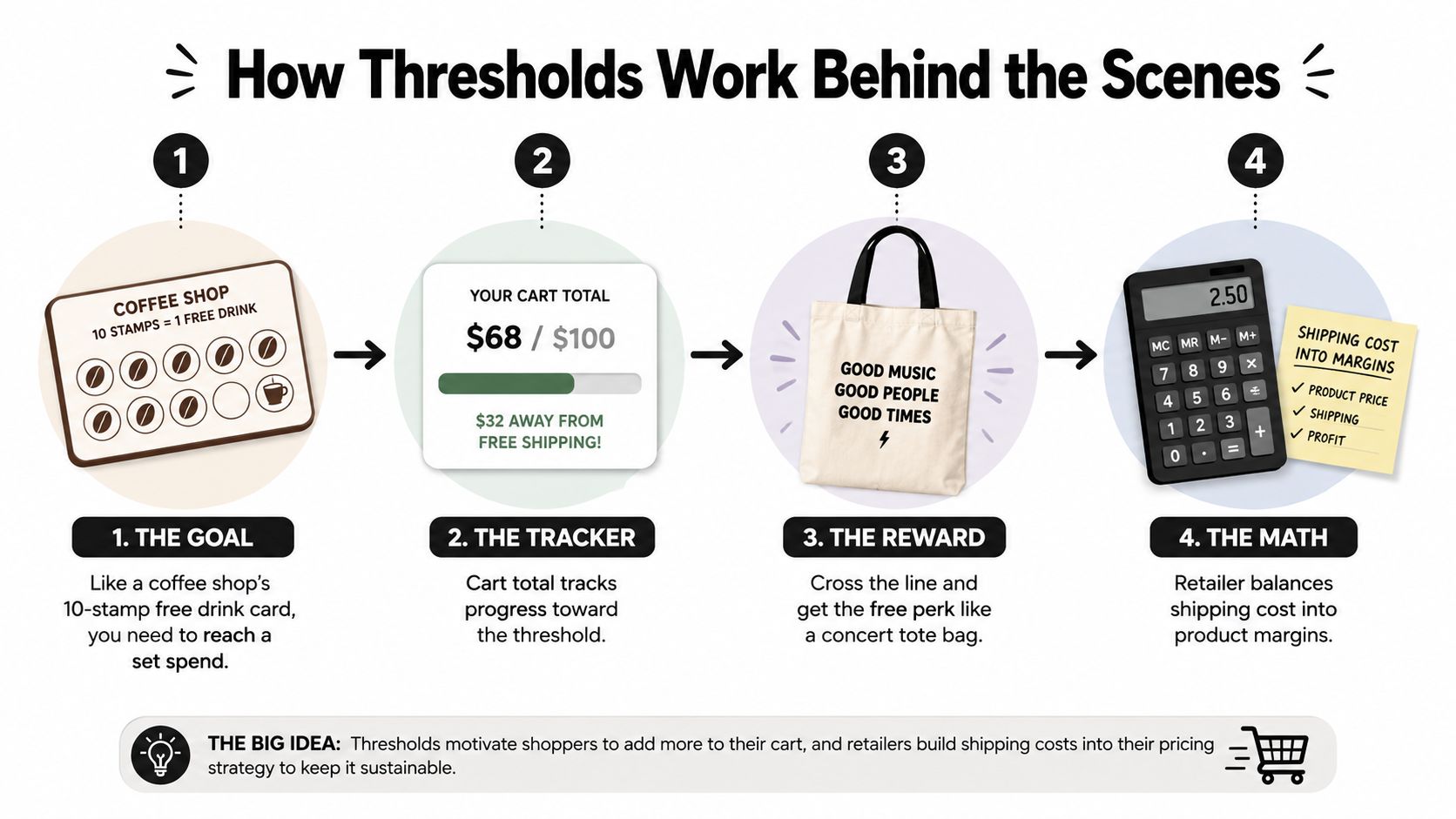
Retailers usually communicate the rule in several places:
- Header bars can announce the threshold before you start browsing.
- Product pages may mention the delivery offer near the add-to-cart button.
- Cart banners can show the remaining amount needed.
- Progress bars make the gap visible as your subtotal changes.
- Email reminders can repeat the offer when an unfinished cart is revisited.
Some stores use one threshold across the whole catalog. Others apply different rules by product category, promotion, destination, or membership status. The exact conditions matter, so shoppers should check the retailer's terms of service before assuming every item qualifies.
For jewelry brands, a threshold between $150 and $250 can fit the way shoppers combine a primary piece with a related accessory or gift item. EP Fine Jewelry's stated shopping experience uses $200 as the qualifying order value. That figure is high enough to encourage thoughtful bundling, but it still gives a shopper with a personalized centerpiece a realistic path to the benefit.
The math is simple for the shopper. If your qualifying subtotal is $140 and the threshold is $200, your cart needs another $60. The harder decision is choosing something that makes the order better, not merely larger.
Why Retailers Set a Minimum Spend
A shopper at EP Fine Jewelry adds a personalized necklace priced at $140. Checkout shows a shipping charge, while the cart also displays a $60 gap to the free-shipping mark. That changes the decision. The fee feels like a loss, but the gap can feel like a reason to complete a gift with something useful.
Retailers set a minimum spend because shipping has a real cost. A larger basket gives the retailer more order value against that cost, while the shopper gets a clear target instead of an open-ended delivery fee. The threshold works like a shared trade: the store absorbs shipping after the order reaches its chosen level, and the shopper decides whether reaching it improves the purchase.
This is the basket-building effect. Someone buying a necklace may add a charm, gift box, or coordinating earrings because the order now feels close to a reward. The retailer receives a larger basket, and the shopper avoids a separate delivery charge.
Industry guidance reports that around 58% of consumers add extra items to reach a free-shipping threshold, while another benchmark associates free shipping with an average-order-value increase of roughly 15% to 20%. These figures come from an industry synthesis on free shipping thresholds. Treat them as directional benchmarks, not promises for every retailer.
The useful question: Would you still want the added item if shipping were already free?
Jewelry gives retailers practical ways to support this choice. Personalized pieces can invite matching items, and gift orders may include presentation options the buyer already planned to purchase. A $140 necklace could become a more complete present with earrings, a bracelet, or gift packaging. The point is a better order, not an unrelated product added to fill space.
A threshold also reduces checkout hesitation by turning delivery into a visible target. The shopper can see the remaining amount and judge whether the benefit is worth pursuing.
Wholesale orders follow different rules because product mix, order size, and fulfillment arrangements may use separate commercial terms. EP Fine Jewelry provides information for those customers on its wholesale page.
The arrangement benefits both sides only when the added purchase has a purpose. Buying something unwanted to avoid shipping may raise today's order value, but it can leave the shopper dissatisfied afterward.
Smart Ways to Reach the Free Shipping Mark
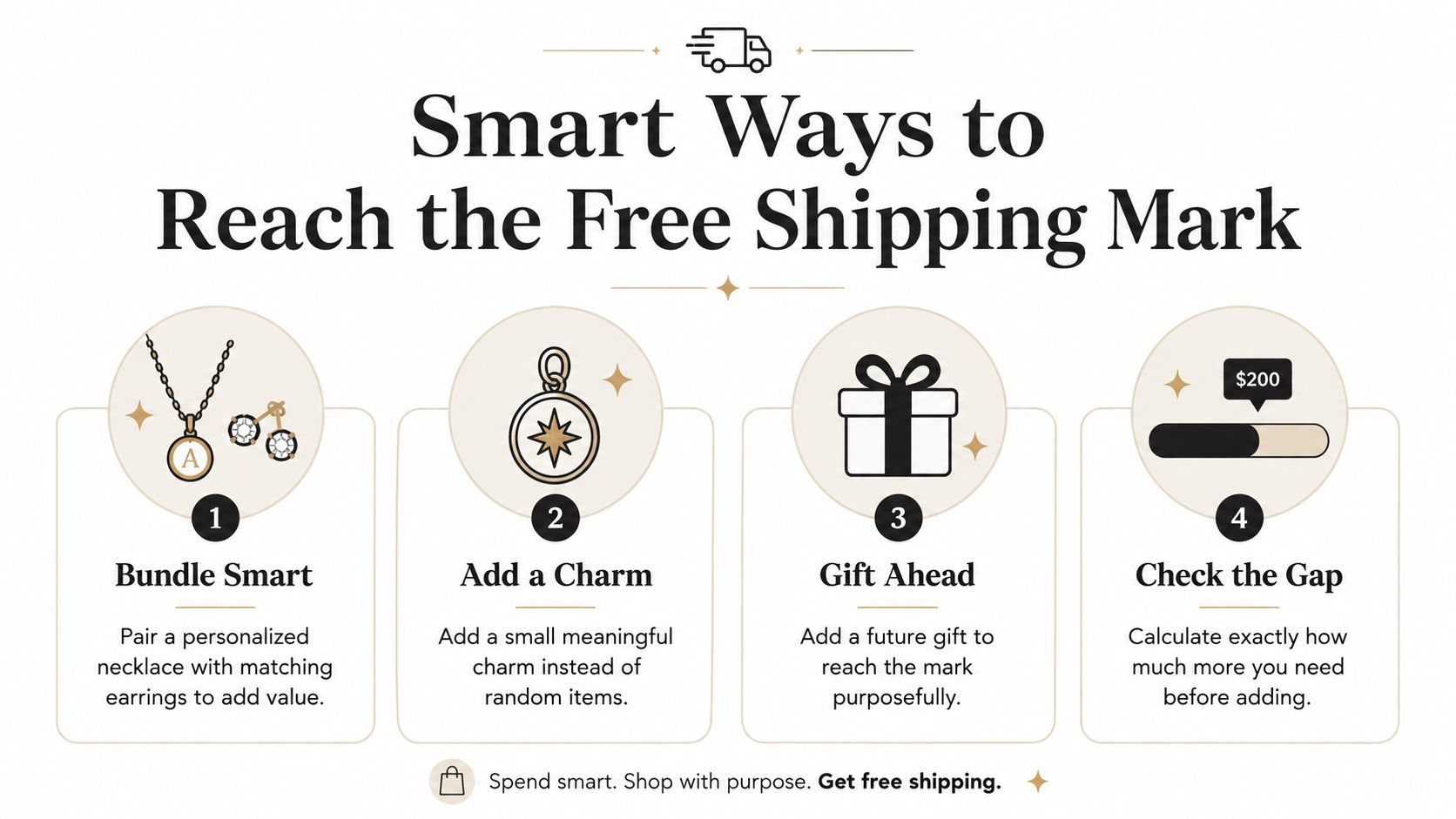
A $200 threshold doesn't require random filler. Start with the reason for the purchase, then look for an item that improves the gift, completes a look, or gives you something you were already considering.
Build a coordinated set
Suppose your personalized necklace costs $140 and a pair of coordinating earrings brings the subtotal to $200. That combination gives the recipient a matched look and gets the cart to the stated threshold without adding an unrelated product.
The same principle works with a bracelet and pendant. If the bracelet is your main choice, a coordinating pendant can turn a single-piece gift into a more intentional set. The right pairing depends on the recipient's style, so don't treat every suggested combination as automatically worthwhile.
Choose a meaningful small add-on
A charm extender or individual charm can make more sense than a second major piece. If your cart reaches $175 after selecting the main necklace, a useful add-on that brings the subtotal to $200 may be a better decision than buying an item you'll never wear.
The value comes from function or meaning. A charm connected to the recipient, or an extender that changes how a necklace sits, has a clear purpose. A random low-interest product does not become valuable just because it moves a progress bar.
Prepare the gift properly
Gift packaging can be a practical way to close a small gap. If the jewelry is going directly to the recipient, a premium gift box may save you from arranging presentation later. An order note can also help communicate a gift message or handling request when the retailer supports that feature.
Another purposeful option is a future gift. The Gift Card (Virtual) is listed with 7 variants across option1, option2, and option3. That makes it something to review if a flexible present fits your plans, though you should confirm the selected option and current terms before completing the order.
Check the gap before adding anything
Look at the exact amount remaining. If you need $10 and add a $45 item, you may be spending far more than the delivery charge you hoped to avoid. If the gap is close to the price of something you already wanted, reaching the threshold may be sensible.
EP Fine Jewelry organizes its catalog across personalized jewelry, charms, bracelets, necklaces, rings, and earrings. Browsing its best sellers can help you find a relevant pairing, but the decision should still begin with your recipient, wardrobe, or gift list.
How the Threshold Shows Up at Checkout
The clearest carts don't make you guess. They show the current subtotal, state the qualifying amount, and tell you how much remains. Some retailers use a text message, while others add a progress bar that fills as products enter the cart.
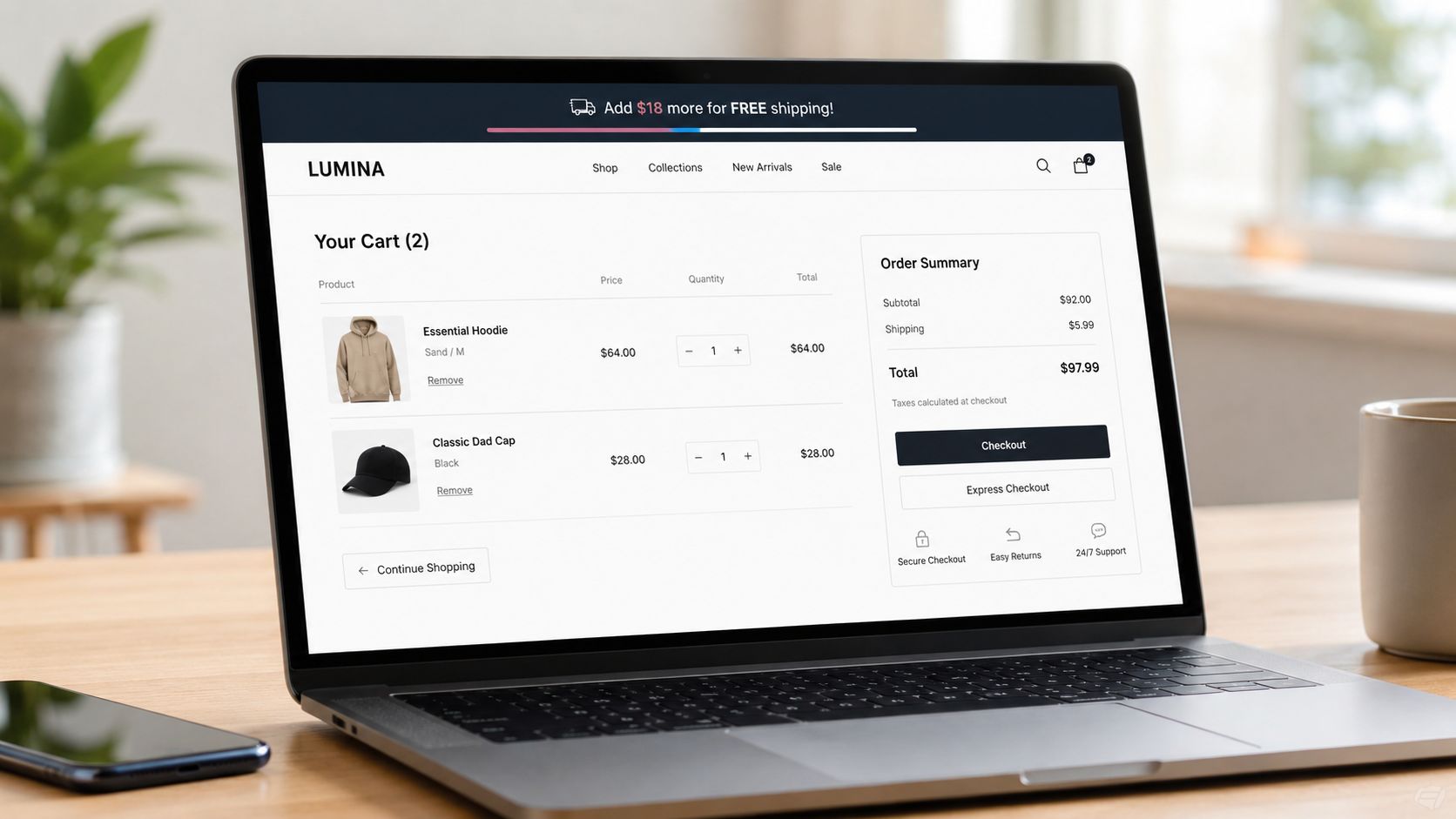
A typical threshold journey looks like this:
- The first cart view: Your items appear with a message showing the remaining amount needed.
- The near-miss: You add a product, and the message updates with the smaller gap.
- The qualification moment: The progress indicator reaches the target and the copy changes to confirm eligibility.
- The shipping line: The delivery charge reflects the free-shipping offer, subject to the retailer's stated conditions.
EP Fine Jewelry's shopping flow displays the running total against its $200 free-shipping mark. That visibility matters because it lets you make the decision before the final payment step, rather than discovering the shipping charge only after entering your details.
The cart may also respond when you remove an item. If the subtotal drops below the threshold, the qualifying message can return and the shipping charge may reappear. That isn't an error. The order no longer meets the minimum spend, so the cart recalculates the offer.
Here's a visual example of how a progress message can guide the decision without forcing it.
Transparency builds confidence when the message matches the final shipping terms. Before paying, review the retailer's shipping and returns information, especially if your order includes personalized items, gifts, or products sent to a different destination.
Free Shipping Thresholds Across Product Categories
A threshold only makes sense in context. Retailers choose a line based partly on what customers normally put in a basket, how products are priced, and how much delivery costs relative to the order.
Recent category research reported these typical free-shipping thresholds:
| Category | Typical Free Shipping Threshold | Average Order Value |
|---|---|---|
| Fashion | $73 | Not provided |
| Health and beauty | $61.25 | Not provided |
| Homeware | $45 | Not provided |
| Electronics | $139.50 | Not provided |
| Overall median in 2025 | $64 | Not provided |
The figures come from the parcelLab U.S. ecommerce shipping study. The source reports threshold levels, but it doesn't provide average order values for each category in the verified information available here, so those cells shouldn't be treated as estimates.
Jewelry sits near fashion and accessories in the way shoppers often browse and combine products. A necklace, ring, or pair of earrings can be a complete purchase on its own, but matching pieces and gift additions can also raise the basket naturally. Personalized jewelry may behave differently from everyday accessories because the shopper can be buying for a specific event or recipient.
Higher-priced categories can support a higher qualifying line because individual products may already bring the order close to it. Lower-priced categories often need a more accessible threshold to avoid turning free shipping into an unreachable promise.
That's why there's no universal “correct” number. A shopper should judge a threshold against the products they're considering, the store's category, and the usefulness of likely add-ons.
Common Misconceptions About Shipping Thresholds
A personalized-jewelry cart at EP Fine Jewelry can make these myths easy to spot. A necklace selected for one recipient may already feel complete, while a matching charm or pair of earrings could add meaning. The shipping message may still encourage an extra purchase, but the decision depends on the item's value to the shopper.
Myth one, the retailer absorbs everything
Retailers still pay delivery providers when shipping appears free. They may account for that expense through product margins, order volume, carrier arrangements, or the additional contribution from a larger basket.
Shopper takeaway: compare the full cart total with the delivery charge. A free-shipping offer is not automatically cheaper if reaching it requires an unwanted item.
Myth two, the threshold is arbitrary
A round number can look simple on the storefront, yet retailers commonly consider average order value, product margins, delivery costs, and customer behavior when setting the line. One independent ecommerce guide suggests placing a threshold about 15% to 30% above current average order value, according to independent ecommerce threshold guidance.
That range is a starting point, not a rule for every shop. If the line sits far above ordinary baskets, shoppers may abandon checkout rather than add products. If it sits too close, the retailer may waive shipping for orders that would have qualified without any additional purchase.
Myth three, mobile and desktop carts behave identically
Both devices may use the same subtotal rule, but the shopping experience can differ. A desktop cart has more room for a progress bar and recommendations. On mobile, shoppers may see fewer prompts or have less patience for extra browsing.
Research on threshold behavior found that shoppers padded orders more on PC than on mobile in one online-retailer study. A peer-reviewed paper also found that perceived threshold and delivery speed shape value perceptions. The findings are discussed in research on free shipping and value perceptions.
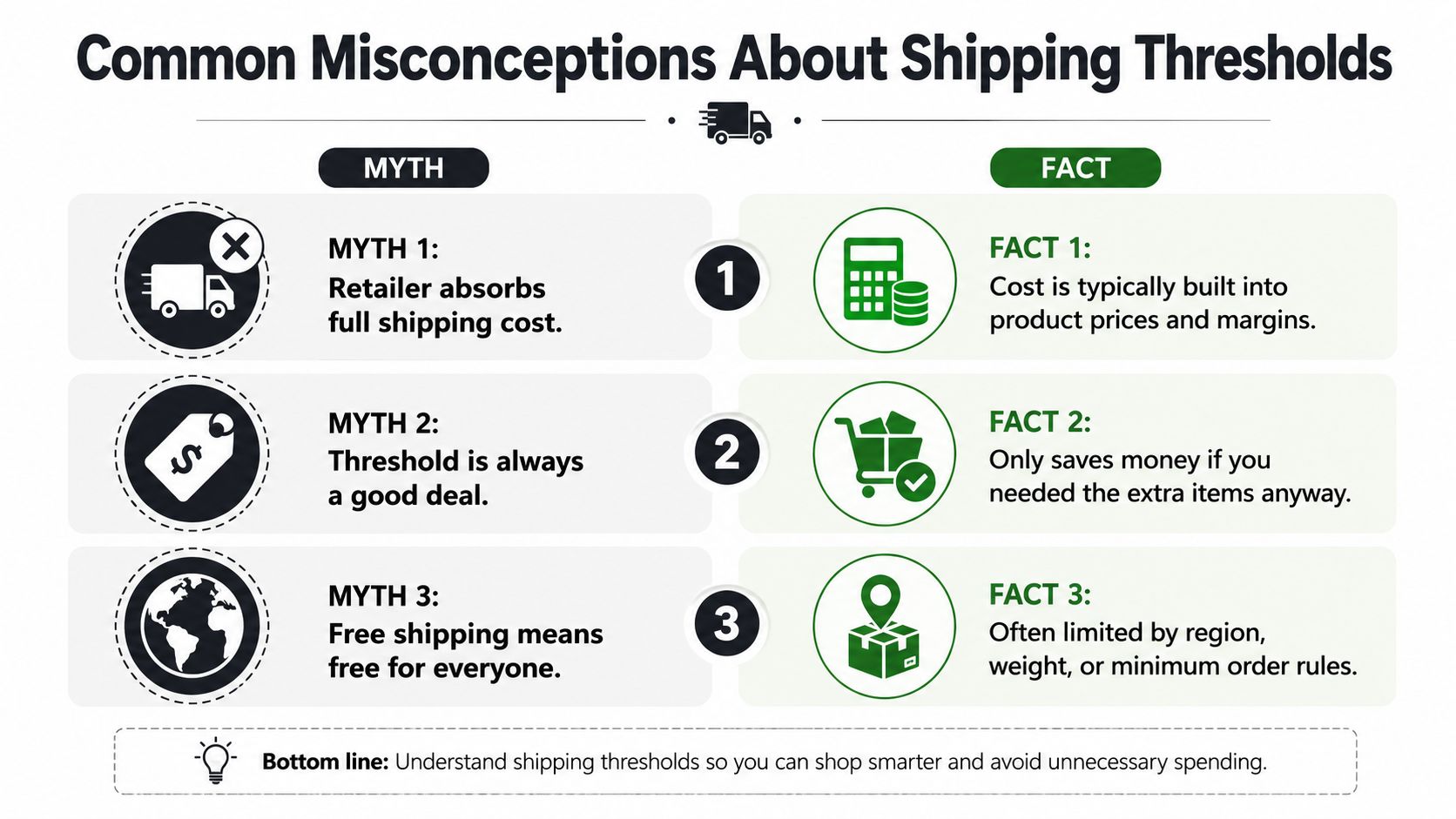
Free shipping may also have conditions. Eligibility can depend on destination, product type, order value, promotion, or other terms. If the cart message and checkout result do not match, review the retailer's shipping and order FAQ.
Putting It All Together for Your Next Order
Use a simple decision check before chasing a free shipping threshold.
First, identify the gap. Look at the cart subtotal and the stated qualifying amount. If the cart is close, you can evaluate relevant additions. If it's far away, the threshold may not be worth pursuing for this order.
Next, inspect the reason for each possible add-on. A matching earring, meaningful charm, gift box, or future gift can serve a real purpose. An unwanted item is still unwanted, even when the cart labels it as the last step toward free delivery.
Then, compare the cost. If an item you already wanted costs less than the shipping charge it replaces, reaching the threshold may make practical sense. If the add-on costs substantially more and has no independent value, paying shipping can be the better financial choice.
Finally, check the conditions. Confirm that the products qualify, the destination is covered, and the final shipping line changes as expected. Personalized purchases and gifts deserve extra attention because timing, return terms, and presentation can matter as much as the delivery fee.
The strongest threshold decisions happen before the last click. You plan the complete gift, notice the cart gap, and choose a useful addition if one fits. You don't scramble through unrelated products to make a progress bar turn green.
A free shipping threshold rewards thoughtful bundling, gives retailers a way to manage fulfillment costs, and can help shoppers build a more complete jewelry order. It only works in your favor when the final cart reflects what you wanted to buy.
EP Fine Jewelry offers personalized jewelry alongside charms, necklaces, bracelets, rings, and earrings, with a $200 free-shipping threshold shown within the shopping flow. Visit EP Fine Jewelry to build your next order around a meaningful centerpiece and decide whether a useful matching piece or gift addition makes reaching the threshold worthwhile.