
You've found a cuff that looks perfect online, but the moment you try it on, the opening catches at your hand. Or it clears your knuckles, then spins around your wrist and disappears under your sleeve. That frustrating gap between a petite wrist and a standard cuff isn't a styling failure. It's a measurement problem involving wrist circumference, hand clearance, cuff opening, and movement.
A good fit should pass over the widest part of your hand, sit securely on your wrist, and feel comfortable while you type, drive, or reach. This guide will help you measure those points, choose between fixed and adjustable designs, judge proportion, and test a cuff before committing to it.
Table of Contents
- Why Cuff Bracelets Fit So Differently on Petite Wrists
- How to Measure Your Wrist the Right Way
- Fixed Adjustable or Custom Cuffs Compared
- Design Choices That Flatter Smaller Wrists
- How to Test Fit Comfort and Movement
- Gifting and Personalization Ideas
- Your Pre-Purchase Checklist and Care Tips
- Cuff Bracelet Questions Petite Shoppers Ask
Why Cuff Bracelets Fit So Differently on Petite Wrists
You may find a cuff that looks delicate online, then discover that its opening will not pass over your hand. A slim wrist does not always mean a slim hand. The wrist may be narrow while the knuckles are wider, so the cuff must fit two different areas before it can sit comfortably.
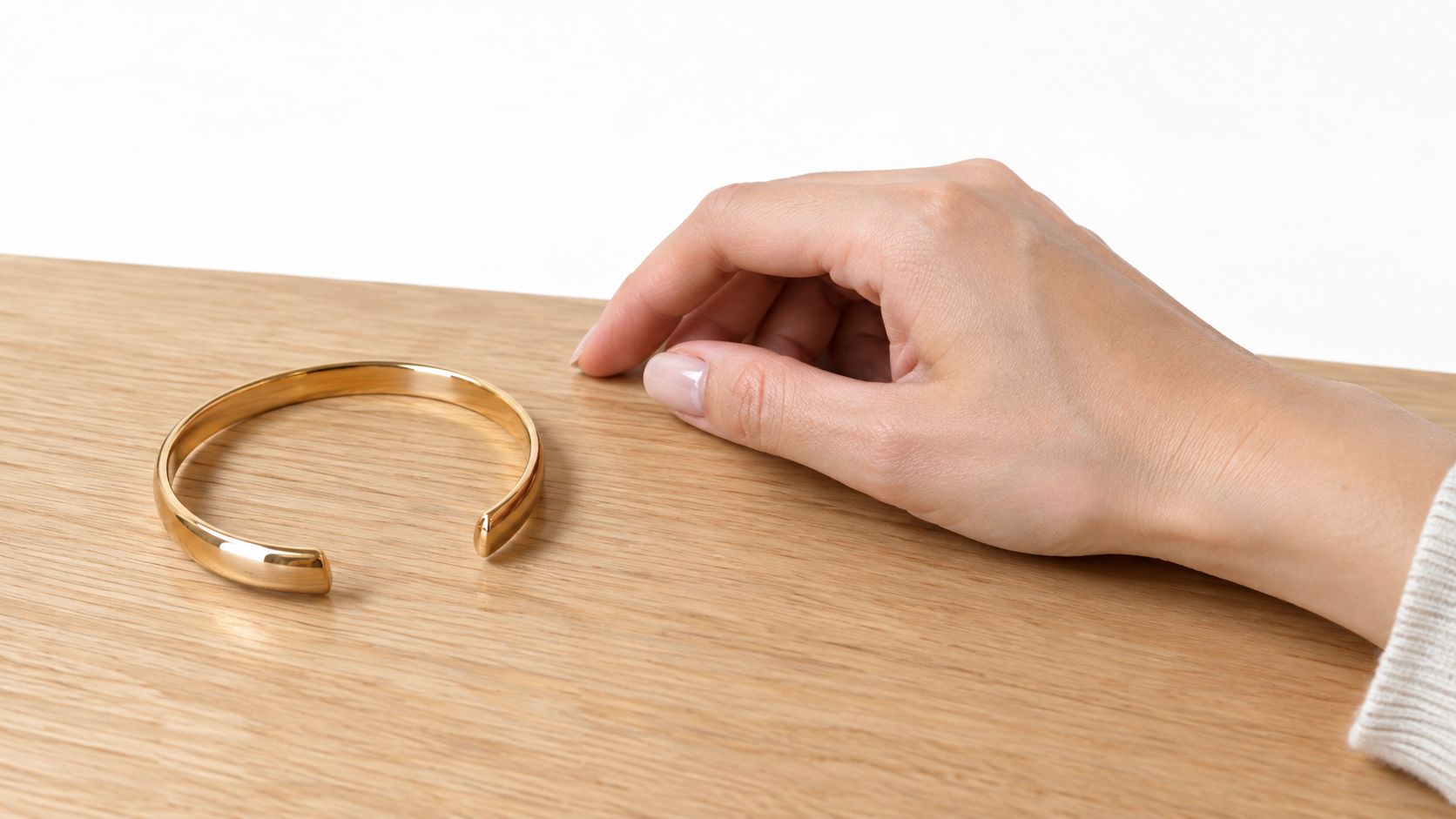
The fit works like a coat that is loose at the waist but difficult to pull over the shoulders. A cuff can have plenty of room around a petite wrist and still feel too tight at the opening. That is why a product label such as small, or a general bracelet length, cannot describe the whole fit.
The measurements that shape the fit
Begin with wrist circumference, taken where the cuff will rest. Then consider the cuff's inner circumference and opening width. The widest part of your hand, often across the knuckles, determines whether the cuff can pass over your hand without uncomfortable pressure.
For reference, Tailor Size Guide's bracelet chart places a 7-inch wrist with a cuff measuring 6.0 to 6.5 inches in inside circumference, suggesting a reduction of 0.5 to 1 inch for comfort. The same guide describes small wrists as roughly 5.5 to 6.0 inches and lists bracelet lengths of 6.5 to 7.0 inches. These figures show why allowance matters, but they do not replace checking your hand clearance.
Use those measurements as starting points, not guarantees. A rigid cuff cannot stretch around the hand like an elastic bracelet. An opening that is too narrow can catch at the knuckles, while one that is too generous may let the cuff slide toward the hand or rotate repeatedly.
Practical rule: Choose a small-wrist cuff by measured wrist size and hand clearance, not by the word “small” on the product page.
Fit also depends on how you want the bracelet to behave. A snug cuff should stay near the wrist without pinching. A roomier one may shift slightly as you type or reach, but full spinning, pressure at the opening, or repeated slipping over the hand points to a proportion problem. For petite shoppers, checking clearance and rotation alongside wrist size leads to a more reliable purchase than relying on a standard chart alone.
How to Measure Your Wrist the Right Way
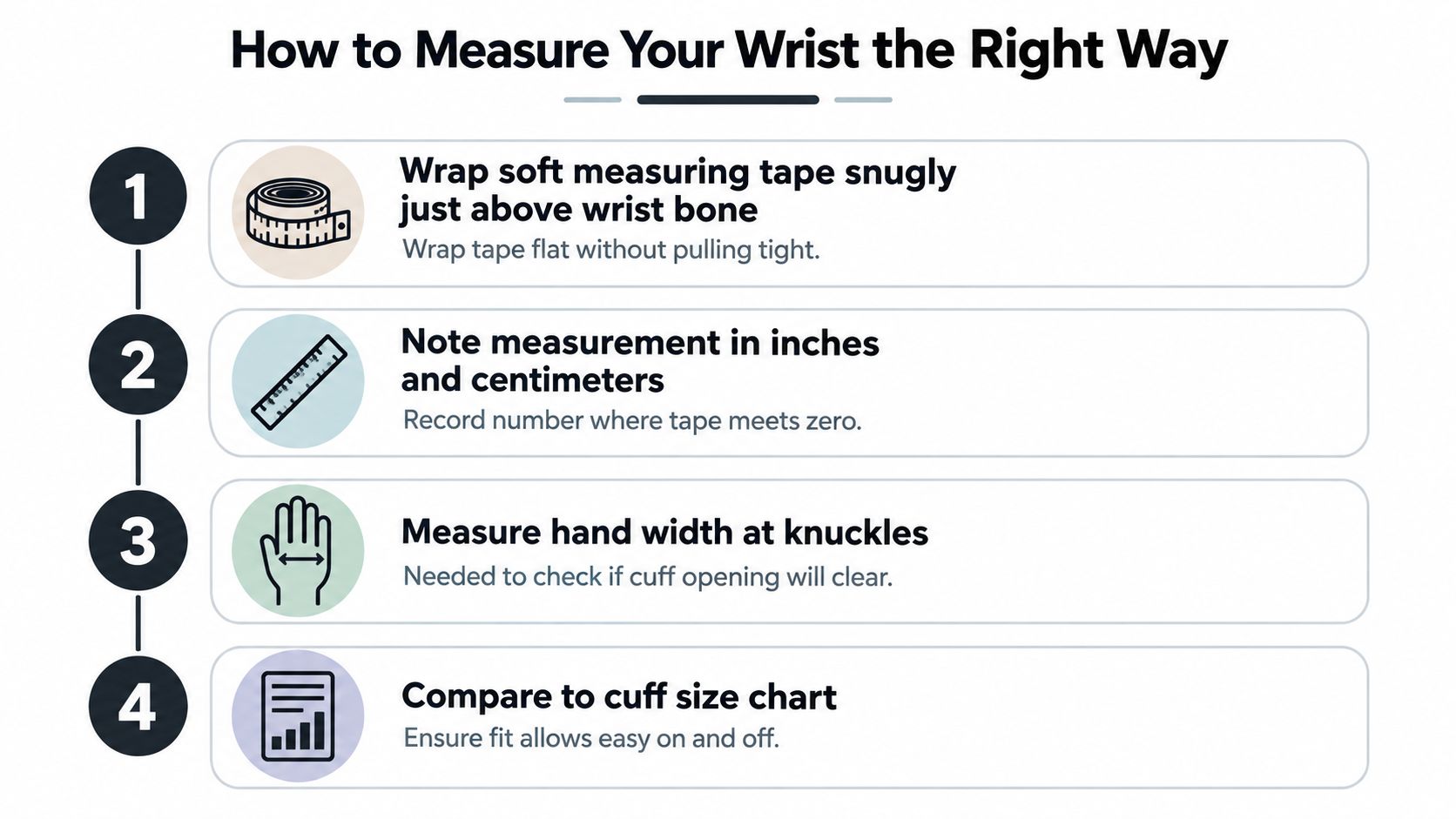
A cuff can look perfect online yet pinch at the knuckles when you put it on. Measure your bare wrist first, using a soft measuring tape. Without one, wrap a narrow paper strip around your wrist, mark the overlap, and compare it with a ruler.
Follow these checkpoints
- Wrap the tape above the wrist bone. Keep it flat and comfortably snug. It should touch your skin without pulling tight or leaving an indentation.
- Record the meeting point. Write the result in inches or centimeters. If it falls between marks, note the nearest visible measurement, then measure again to confirm it.
- Measure the hand separately. Close your fingers together and measure across the widest area, usually around the knuckles. A cuff must clear this area, even when your wrist is narrow.
- Compare both figures with the product dimensions. Check the inner circumference and opening width. A label such as small or extra-small cannot show how the cuff will pass over your hand.
Sizing guidance commonly recommends adding about 0.25 to 0.5 inches, or 0.6 to 1.2 centimeters, for a snug but wearable fit. A looser drape generally needs about 0.75 to 1 inch, or 2 to 2.5 centimeters, of additional length (Topsail Winds Jewelry's cuff sizing guidance). Use these figures as starting points, then check whether the opening clears your knuckles comfortably. A cuff is shaped more like a doorway than a stretch bracelet. The wrist measurement tells you where it rests, while the hand measurement tells you whether it can get there.
Your dominant wrist may measure slightly differently from the other because of regular use and muscle. Measure the wrist where you plan to wear the cuff, especially if that is your writing or working hand.
Bring two numbers to the product page
Keep your wrist circumference beside your preferred comfort gap. Someone with a 5.8-inch wrist may want a close fit, while another shopper with the same measurement may prefer more movement and less contact with the skin. Both preferences can work, provided the opening still passes over the widest part of the hand.
For a visual comparison, review this bangle bracelet size chart when comparing wrist measurements and snug versus looser wear. Record both measurements before ordering, then confirm the cuff's opening and inner circumference match them.
Fixed Adjustable or Custom Cuffs Compared
The right cuff style depends on how precisely your wrist and hand measurements match standard dimensions. A fixed cuff has a defined shape and opening. It can produce the cleanest silhouette, but it gives you little room to correct a mismatch after purchase.
An office worker who knows their wrist and hand measurements may choose a fixed sterling cuff for a neat, understated look. That works well when the cuff's inner circumference, opening, and profile all match the wearer's measurements. It's less forgiving if the wearer experiences daily swelling or wants to move the piece between wrists.
An adjustable cuff offers more flexibility. Its open gap, hinge, or gently bendable construction can help someone whose hand is wider than their wrist. It also makes sense for a gift recipient whose exact measurements are uncertain. Adjustable designs still need care, though. Repeatedly forcing the metal wider or narrower can distort the shape or weaken a delicate area.
A new mother dealing with changes in comfort and water retention might prefer an open adjustable bangle. The wearer can make small fit changes without committing to a rigid inner circumference. The design should still close securely enough to avoid catching on clothing or slipping over the hand.
A custom cuff is the most precise option for an unusual wrist-to-hand proportion. It can be especially useful when standard petite sizes fit the wrist but fail at the knuckles. A graduate whose parents commission a sized-to-fit piece may receive a cuff shaped around both measurements rather than a generic small.
| Cuff Type | Best For | Trade-off |
|---|---|---|
| Fixed cuff | Shoppers with confirmed measurements who want a crisp silhouette | Little forgiveness for measurement errors or changes in comfort |
| Adjustable cuff | Gift buyers, fluctuating measurements, and wrist-to-hand mismatches | Requires careful adjustment and may have a more visibly open design |
| Custom cuff | Petite shoppers between standard dimensions | Usually involves more planning and a higher design commitment |
Personalized designs can make a custom-feeling gift more meaningful. Browse personalized bracelets for ideas, then confirm whether the seller can provide inner measurements or adjustment options before ordering.
Design Choices That Flatter Smaller Wrists
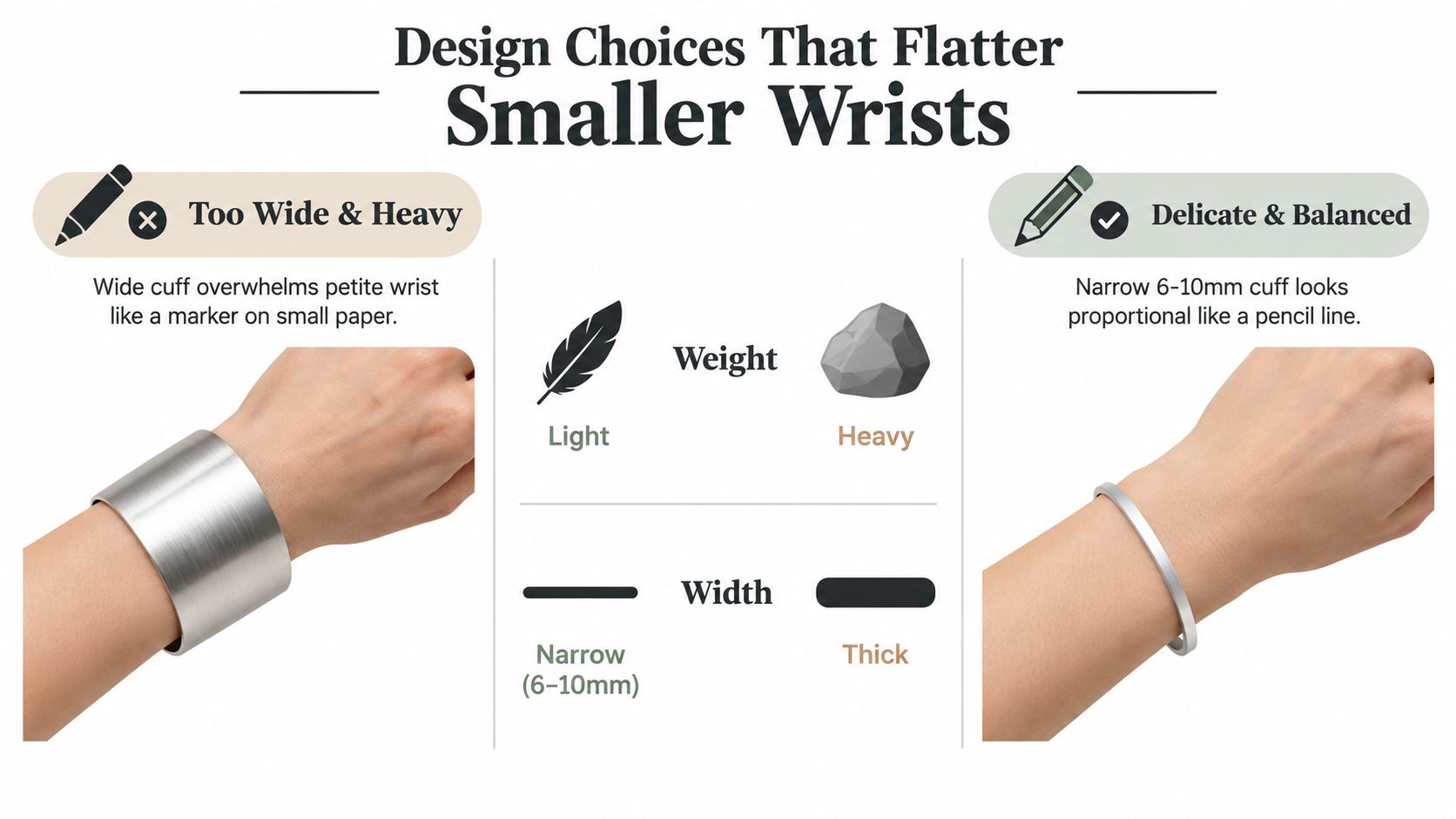
Width often changes the appearance of a cuff more than the metal color does. A narrow cuff is like a pencil line on a small page. A wide cuff is more like a marker stroke, and even a beautiful design can dominate the space around it.
A cuff that looks delicate in a product photograph may appear substantial on a petite wrist because photographs flatten scale. Check the listed width in millimeters and compare it with something familiar, such as a ruler edge or the end of a pencil.
Use width as your first visual filter
For a refined everyday look, a cuff under 10 millimeters often reads as elegant on a smaller wrist. A width of 10 to 15 millimeters can provide more presence while remaining versatile. Designs over 20 millimeters tend to create a strong statement and may look armor-like on a petite wrist, unless that bold effect is exactly what you want.
These are style guidelines, not fit rules. A wide openwork cuff may feel visually lighter than a solid narrow band, while a tapered design can soften the effect of greater width at the center.
Consider weight and profile together
Metal density affects how a cuff feels during a full day. A solid sterling piece can feel heavier than hollow gold in a similar shape, even when the dimensions look comparable. Ask whether the design is hollow, solid, domed, or flat, and check the return policy if the product description doesn't explain the weight.
A thin, gently curved cuff usually follows the wrist instead of projecting away from it. A chunky torque-style shape can overwhelm a small wrist because it adds both width and visual height. Matte and hammered finishes can add texture without making the cuff physically larger, while polished metal reflects light and draws attention to the band's shape.
For a restrained option, consider a skinny personalized cuff, then verify its listed dimensions against your own measurement rather than relying on the product name alone.
A petite wrist doesn't require tiny jewelry. It requires deliberate scale, comfortable weight, and enough opening to clear the hand.
How to Test Fit Comfort and Movement
A cuff can pass a size chart and still fail during ordinary movement. Test it as you'd wear it, with your hand relaxed, your wrist bent, and your fingers working.
Start with the finger-slide test
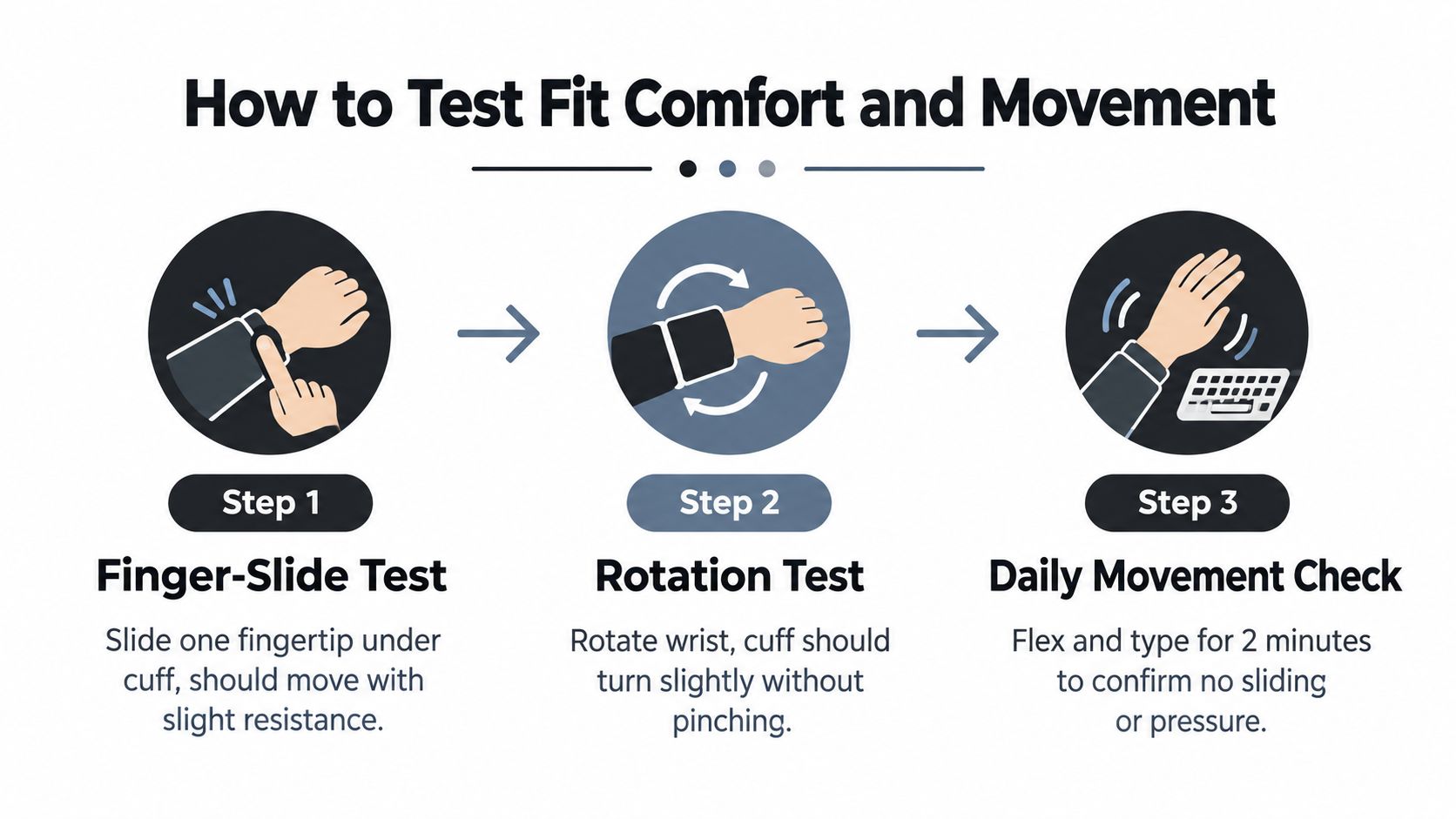
Put the cuff on and try to slide one finger between the band and the underside of your wrist. Your finger should fit without force, but the cuff shouldn't feel loose enough to drop away from the skin. This simple check helps identify pressure that may become irritating during typing or other repetitive work.
Look at your skin after removing the cuff. Red marks, pinching, or a persistent indentation indicate too much pressure. A cold spot can also signal that the metal is pressing against one area for too long.
Check rotation and hand clearance
Turn your wrist as if you're pouring water from a pitcher. The cuff may twist slightly, but it shouldn't rotate freely through a complete circle. One fit guide says a slight twist is acceptable, while full 360-degree spinning indicates that the cuff is too loose (the cuff fit guide).
Open your hand wide, close it, and repeat the motion you'll use when putting the cuff on. The opening should pass over the widest part without a struggle. Don't squeeze a rigid cuff aggressively to make it fit. If the opening catches at the knuckles, choose another dimension or an adjustable design.
Wear it before deciding
Keep the cuff on for a short trial while typing, reaching, and turning your wrist. Notice whether it slides toward the hand, catches on clothing, presses into the wrist bone, or flips when you bend your hand.
Comfort check: A cuff should feel present, not demanding. If you keep adjusting it every few minutes, the fit or shape needs another look.
Gifting and Personalization Ideas
Small-wrist jewelry makes a thoughtful gift only when the recipient can wear it comfortably. The safest approach is to select a design with flexible sizing, confirm the seller's measurements, or provide an easy exchange path.
For an anniversary, a slim hammered gold cuff with a quiet interior engraving can feel personal without adding visual bulk. An engraved date or short phrase stays private while the narrow profile remains easy to pair with a watch or delicate chain bracelet. Before ordering, ask for the cuff's inner circumference and opening dimensions, especially if the recipient has a petite wrist but a broader hand.
A graduation gift can take a more flexible route. An adjustable silver cuff with a subtle birthstone detail gives the recipient room to fine-tune the fit and suits changing style preferences. The open construction also reduces the risk that the buyer chooses a wrist measurement that doesn't match the hand.
Personalization that suits smaller cuffs
- Interior engraving: A date, initials, or short message adds meaning without making the outer surface busy.
- Monogrammed closure: A clasp or hinge can carry personalization while keeping the band visually slim.
- Charm attachment: A bangle designed for charms allows the recipient to add or remove small details over time.
- Gift-ready presentation: A gift box and order note can make the package feel complete while preserving the option to exchange.
EP Fine Jewelry's guide to personalized jewelry gifts for her can help you compare personalization ideas before choosing a cuff.
Include a gift receipt when measurements are uncertain. An adjustable design is usually safer than a fixed one for a surprise gift, but it still shouldn't be treated as universally sized. If the seller offers professional resizing, confirm the service before checkout and ask whether engraving affects eligibility.
Your Pre-Purchase Checklist and Care Tips
Before paying for a cuff, stop at the product dimensions instead of relying on the title. A petite-friendly purchase should make sense on paper and feel comfortable in your hand.
Run this check before checkout
- Confirm the wrist measurement: Compare your measured wrist circumference with the listed inner circumference.
- Choose the intended fit: Decide whether you want a close, stable position or more visible movement.
- Check hand clearance: Make sure the opening can pass over the widest part of your hand.
- Review the width: For a balanced everyday appearance, look closely at designs around under 10 millimeters or within the 10 to 15 millimeter range. These style benchmarks are discussed in the design section above.
- Inspect an adjustable gap: Confirm that the opening can be adjusted without forcing the metal.
- Consider the weight: Hold the cuff while moving your wrist. A piece that feels tiring before you wear it probably won't become more comfortable later.
- Read the policies: Check returns, exchanges, engraving limitations, and resizing before placing the order.
Your care routine should match the metal and finish. Wipe the cuff with a soft, dry cloth after wearing it to remove skin oils and lotion residue. Store it flat in a pouch or lined box, and avoid bending a rigid cuff around another object.
Remove the bracelet before showering or sleeping. Take it off before applying perfume or sunscreen, especially if the piece has plating or a finish that may react poorly to repeated product contact.
For broader maintenance guidance, consult how to clean jewelry at home. If the listed dimensions seem borderline, contact the seller before ordering. A small adjustment or professional resizing is generally easier to arrange before purchase than after a return has become necessary.
Cuff Bracelet Questions Petite Shoppers Ask
Can I stretch a tight cuff at home?
Don't use pliers. They can leave marks, flatten the curve, or create a sharp pressure point. A very small adjustment may be possible with a soft mallet and a wood block for suitable metals, but only when the maker confirms that the construction can tolerate it. Hinged, engraved, hollow, or plated cuffs may need professional handling instead.
How can I stack cuffs without crowding a narrow wrist?
Choose slim pieces with different finishes or profiles rather than several heavy bands. Keep the stack visually light, and leave enough space for each cuff to move without scraping the next one. If stacking makes one piece push another into your skin, wear fewer pieces or move one to the other wrist.
What if my favorite cuff becomes too loose?
First, check whether the cuff has changed shape or whether your wearing position has changed. A jeweler may be able to reshape a suitable fixed cuff or adjust an open design, but don't bend it repeatedly at home. Full spinning, sliding toward the hand, and frequent repositioning are practical signs that the fit needs correction, not a different styling trick.
Do child-sized cuffs work for slim adults?
They can work if the opening and inner dimensions fit an adult hand and wrist, but the design may look juvenile. Judge the piece by its measurements, materials, and proportions rather than the label. A petite adult often gets a more polished result from an adjustable adult cuff with a narrow profile.
Which metals suit sensitive skin?
Look for materials commonly selected for lower-irritation jewelry, such as surgical steel, titanium, or 14k gold. Read the full material description, including plating and alloy information, because the surface finish may not tell you what sits against your skin. Stop wearing the piece if you develop irritation and ask the seller about the exact composition.
Should a cuff hug the wrist bone?
It can sit near the wrist bone, but it shouldn't press sharply against it when you bend your hand. Position the cuff where it feels stable, then repeat the finger-slide and rotation checks. A slight twist is acceptable, while unrestricted spinning suggests excessive room, as noted in the earlier fit guidance.
Most cuff problems become easier to solve once you check wrist circumference, hand clearance, and rotation behavior together. Measure both sides, compare the actual product dimensions, and choose the design that matches how you move, not only how it looks in a photograph.
EP Fine Jewelry offers personalized jewelry, bangles, and bracelets, including options that can support a more considered petite-wrist gift. Visit EP Fine Jewelry to browse cuff and personalization options, then confirm the measurements and fit details before ordering.