
You're at the designer screen, staring at a skinny charm bangle and deciding whether the stone should be cubic zirconia or diamond. That choice is not cosmetic fluff. It changes how the bracelet reads from across a room, how it feels when it slides, and whether the piece should act like a playful stackable or a keep-forever jewel.
A charm bangle already carries a long jewelry history. Bangles appear in ancient Egyptian burials, and the Metropolitan Museum of Art notes Early Dynastic flint bangles dating to roughly 3100–2890 BCE, with multiple bangles often worn on one or both forearms The Metropolitan Museum of Art. Modern charm bangles took a different path in Victorian Britain, where sentimental jewelry turned personal stories into wearable objects. That history matters because today's stone choice still does the same job, it tells people what kind of piece you made.
Table of Contents
- Why the Stone on Your Charm Bangle Matters
- Cubic Zirconia vs Diamond at a Glance
- How Each Stone Actually Looks on the Wrist
- Hardness, Durability, and Everyday Wear
- Price, Value, and Where Each Stone Makes Sense
- Ethics, Sourcing, and the Environmental Trade-Off
- Care, Sizing, and Saving Your Custom Design
- FAQ
Why the Stone on Your Charm Bangle Matters
You're not choosing a stone in isolation. In a 3D charm bangle designer, the glider metal, border style, charm base, and size all change the final result. A 14K gold glider with a pave border gives a different visual weight than a plain border in silver 925 gold plated, and a gold base charm doesn't read the same way as a silver base charm when the whole piece is meant to feel coordinated.
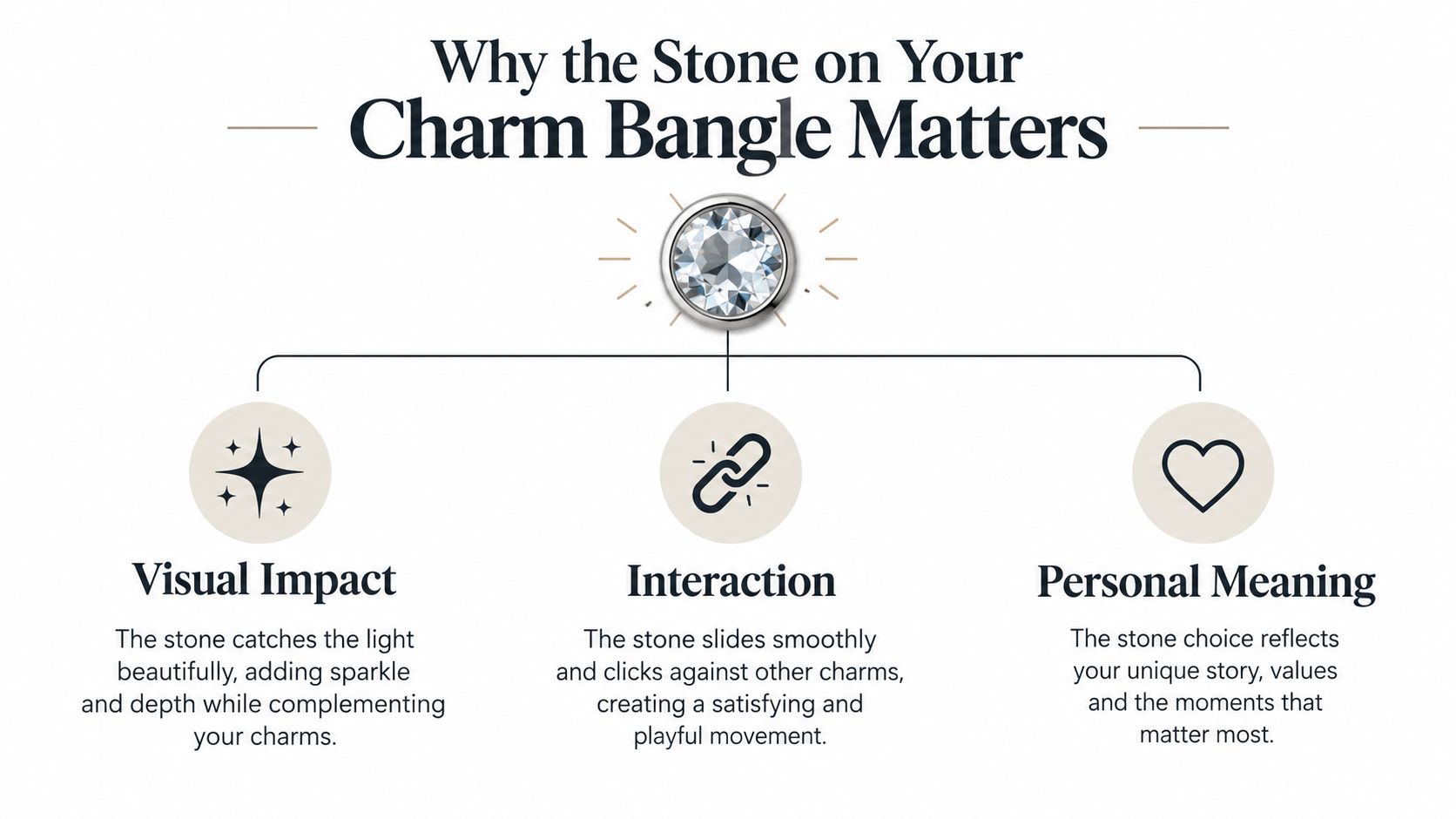
A stone also changes the way the bracelet behaves on the wrist. Smaller, lighter builds can take a cleaner stone, while a fully loaded bangle with multiple charms needs better balance and less visual clutter. That's why the same diamond charm can look sharp on one build and overpowered on another, while cubic zirconia can be the more sensible choice when you want sparkle without pushing the bracelet into “too much” territory.
Practical rule: choose the stone after you've chosen the bangle metal, border, and charm mix. If you reverse that order, you end up forcing the design instead of letting it work.
Size matters too. The XS, S, M, L, and XL options aren't just wrist labels, they affect how many charms you can add. If you want the design to carry several charms, the stone has to fit the role. A crowded bracelet needs stones that stay readable in motion, not stones that depend on perfect stillness.
For more background on the broader charm-bracelet format, the EP Fine Jewelry charm bracelet guide is the right related read.
Cubic Zirconia vs Diamond at a Glance
Here's the quick verdict. If you want strong sparkle for less commitment, cubic zirconia makes sense. If you want permanence, sharper prestige, and a stone you're unlikely to outgrow, diamond is the cleaner choice.
| Criterion | Cubic Zirconia | Diamond |
|---|---|---|
| Appearance | Bright, lively, and often more colorful in the flash | Tighter, whiter sparkle with a more controlled look |
| Hardness | Lower than diamond, so it shows wear sooner | Much harder and far more resistant to scratching |
| Durability | Good for regular wear, but not the toughest option | The better pick for long-term daily wear |
| Price | Easier on the budget | The premium option |
| Ethics | Manufactured, so no mining footprint | Needs more sourcing scrutiny, especially for origin and traceability |
| Care | Needs more attention if you want it to stay crisp | Still needs cleaning, but holds its look better |
The big split is simple. Cubic zirconia is the practical stone when you're building a charm bangle that's meant to be playful, layered, or giftable. Diamond belongs on the charms you want to feel permanent, especially when the bracelet itself is already doing a lot visually.
If you're browsing stone-heavy pieces, the comparison is even easier when you look at other diamond jewelry like diamond studs. The same rule applies here, diamond carries more long-term authority, but it also demands a higher commitment.
The two stones are not interchangeable. Cubic zirconia usually gives you more visible flash per dollar, while diamond gives you cleaner brilliance that doesn't rely on size to look convincing. On a charm bangle, that difference shows up fast, because the stone is moving, catching light, and sitting next to other charms instead of floating alone.
How Each Stone Actually Looks on the Wrist
A charm bangle lives in motion. That means the stone has to work in daylight, in a dim restaurant, and during the close-up wrist check when you turn your hand and inspect the piece in the mirror. What looks perfect in a product shot can feel completely different once the bracelet starts sliding and clicking against other charms.
Daylight versus evening light
Cubic zirconia throws a broader, more colorful kind of sparkle. In direct light, that can be exactly what you want on a bold charm like a palm tree, heart, or lip-shaped design. On a single small charm, though, it can read a little loud, especially if the rest of the bracelet is already busy.
Diamond gives a tighter, whiter return. It looks cleaner at small sizes and holds its shape better when the charm sits beside a pave border or a polished gold glider. That matters on a skinny bangle, because the eye sees the whole composition at once, not just one stone.
Close-up inspection is where the decision gets real
When you turn the wrist, cubic zirconia tends to show a more obvious “sparkle first” personality. Diamond feels more restrained and more expensive in the hand. If the charm is a letter, number, or birthstone-style accent, diamond usually looks more refined. If the charm is a fun shape or a color-forward piece, cubic zirconia often fits the mood better.
The metal base also changes the read. A gold base makes warm stones and bright flashes feel richer, while a silver base pushes the look cooler and more modern. That's why mixed charm choices can work, but only if the whole design has one clear visual idea.
For a basic wearing reference, this bangle styling guide is useful if you want to compare how the piece sits on the arm.
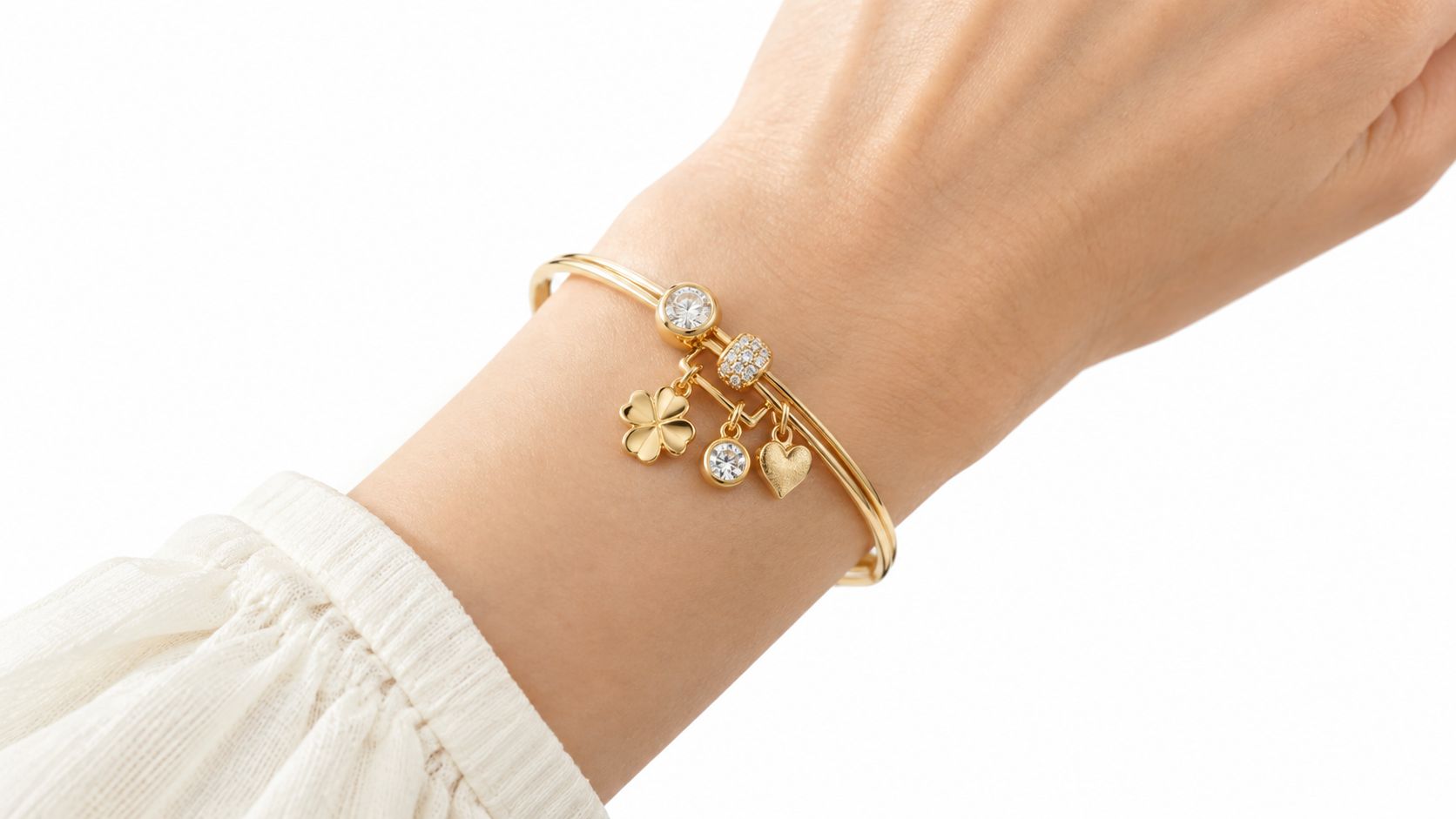
If you want the bracelet to feel polished rather than flashy, choose diamond. If you want it to feel lively, colorful, and a little more playful, cubic zirconia earns its place fast.
Hardness, Durability, and Everyday Wear
A charm bangle lives a rougher life than its sparkle suggests. It taps laptop edges, rubs against other bracelets, twists when you carry bags, and keeps taking small hits all day. In a customizable 3D build, that changes the right stone choice fast. A slim glider, a raised border, or a larger charm face can all leave the stone more exposed than it looked on screen.
What survives real wear
Diamond is the stronger everyday pick. It resists scratching better than cubic zirconia, so it keeps a cleaner surface when the bracelet gets worn often. If your design includes a charm that sits proud of the bangle, or one placed where it will knock into cuffs and desks, diamond earns its keep.
Setting choice decides a lot of the outcome. On a bangle, a prong setting gives the stone more open light, but it also leaves the girdle and edges easier to hit. A bezel setting wraps the perimeter in metal and is the safer default for a bracelet that moves constantly on the wrist. That protection logic lines up with GIA on diamond protection.
Cubic zirconia works for regular wear, but it shows age sooner. Surface scratches, slight dulling, and contact wear are more likely when the charm slides beside metal borders or knocks against other charms in a stack. On a playful build with replaceable accents, that may be fine. On a bracelet you plan to wear for years, it gets old.
Practical rule: if the charm sits high, is worn daily, or is built in a size that makes the stone more exposed, choose diamond in a bezel setting. If the charm is decorative, lower-cost, and easy to swap out later, cubic zirconia does the job.
Setting and build need to match
The best choice depends on the whole bracelet, not the stone by itself. A narrow glider with a crisp border and a small charm base often looks better with a protected stone that stays neat over time. A larger, more playful charm can carry cubic zirconia well, especially if the design is meant to change with seasons or outfits.
If you want extra context on protected stone layouts, this bezel setting reference is worth a look. My advice is simple. For a permanent, everyday charm bangle, pick bezel-set diamond. For a fun build you expect to refresh, cubic zirconia is the practical compromise.
Price, Value, and Where Each Stone Makes Sense
Most shoppers start here, because price decides the build faster than anything else. Cubic zirconia wins on cost every time, and that makes it the smarter choice when you want multiple sparkly charms without turning the bracelet into a major purchase. Diamond makes sense when the charm is meant to feel permanent and the bracelet is building toward heirloom territory.
Spend where the piece actually works hardest
A cubic zirconia charm is the right move for travel, starter bracelets, and gifts where the wearer will probably keep changing the design. It also makes sense on colorful combinations, especially when you're mixing it with playful shapes like a bee, cocktail glass, palm tree, or heart. In those cases, the stone should support the charm, not compete with it.
Diamond is the better choice for milestone pieces. A birthday, anniversary, or name bracelet feels more serious when at least one charm has real stone authority. The same logic applies to a charm with a date or a loved one's name. If the message matters, diamond makes the message feel fixed.
The bangle itself matters too. The EP Fine Jewelry customizable 14K skinny charm bangle uses a glider in 14K gold or silver 925 gold plated, and the finish you choose affects how expensive the whole composition feels. A diamond charm on a gold glider reads as a stronger luxury signal than the same charm on a mixed, playful stack.
Value is not just resale value
Diamond carries stronger long-term value. Cubic zirconia doesn't pretend otherwise, and that honesty is fine. The smarter question is what role the stone plays in your specific bracelet.
- Choose cubic zirconia when you want flexibility, more color, and lower replacement cost.
- Choose diamond when the charm marks a real moment and should age with the wearer.
- Mix them if one or two diamond charms anchor the piece while the rest stay casual.
The best-looking bangle is usually the one that doesn't overspend on every charm. Put diamond where the eye lands first. Use cubic zirconia where the design needs movement, color, or lightness.
Ethics, Sourcing, and the Environmental Trade-Off
Ethics starts with knowing how each stone is made. Diamond raises questions about mining, labor, and conflict, although traceability efforts and lab-grown options have expanded. Cubic zirconia avoids mining because it is manufactured, yet production still uses resources and leaves an environmental footprint.
Durability matters just as much as origin. A charm bangle that wears out, gets replaced, or cannot be repaired creates more waste than one that stays in use and can be updated. In a customizable 3D charm-bangle designer, glider metal, border style, charm base, and size all affect that outcome. A design with charms that glide in and out can keep the bracelet in service as your style changes, unlike a fixed piece built for a short trend.
What you should ask for is simple: the metal composition, the plating details, whether the piece can be repaired, and whether charms can be reused later.
Choose the stone according to the bracelet's intended life. A diamond suits a piece designed for years of wear or eventual hand-me-down use. Cubic zirconia fits a bangle you expect to rebuild, restyle, or change as your wardrobe changes. The charm base and border also matter. A stone that works on a substantial base may look misplaced on a delicate glider, while a bright cubic zirconia can support a more playful custom arrangement without making every component feel formal.
For a broader comparison of sourcing choices, read this lab versus natural guide. No stone becomes ethical because its description sounds responsible. Ask how it was made, how long it should remain wearable, and what happens when you change the design. A reusable charm system gives those answers more weight than a one-season bracelet.
Care, Sizing, and Saving Your Custom Design
A charm bangle gets dirty faster than people expect. Skin oils collect around the rails, charms rub against each other, and a shiny piece can turn dull if it's thrown in a drawer with other jewelry. Care is easy if you're disciplined, sloppy if you're not.
Keep the metal and stone from fighting each other
Remove the bangle before bathing, swimming, exercising, or spending time around chlorine or sulfur-heavy environments. Those conditions are rough on metal finishes, and they're unnecessary risk for a piece that should stay polished. Store the bracelet separately so the charms don't scratch the glider or chip at the border.
Clean it with a soft cloth after wear. That's the simplest habit and the one most often skipped. For diamond, a gentle clean keeps the sparkle sharp. For cubic zirconia, cleaning matters even more because surface dulling shows sooner when oils build up.
The same caution applies to the setting. If your charm is prong-set, check for looseness around the stone. If it's bezel-set, inspect the rim for wear and make sure the stone still sits cleanly inside the metal.
Size the bangle the right way
A lot of returns happen when a charm bangle, especially a solid one, fails to pass over the hand rather than just sitting comfortably around the wrist. Wrist circumference helps, but it's not the full answer. Measure the widest part of your hand across the knuckles, then compare that measurement with the bangle's inner diameter and opening.
For the EP Fine Jewelry designer, the size labels XS, S, M, L, and XL affect both fit and how many charms you can add. If you want a tighter wrist fit, size carefully and don't guess. A bracelet that's too loose won't feel intentional, and one that's too tight won't glide properly.
Sizing rule: measure the hand first, then the wrist, then check the inner diameter. If you skip the hand, the bangle can fail even when the wrist number looks right.
Save the design before you buy
Once the glider metal, border, charm base, stone choice, and size all line up, save the design in the 3D tool and review it one more time. That review step matters because the bracelet only looks right when the whole composition is balanced. If it feels crowded, remove a charm. If it feels flat, add one stone-forward piece for contrast.
Here's the shortlist before checkout:
- Wipe the bracelet clean after wear.
- Check the fit against the hand, not only the wrist.
- Keep heavy stacking modest so the charms can move without grinding.
- Save the 3D design before adding it to cart.
- Recheck metal, base, and stone pairing one last time.
If you want a direct purchase path, use the EP Fine Jewelry 14K Skinny Charm Bangle product page, review the images and description, then open the designer and build the version that matches your wrist instead of forcing a generic size. For buyers who want one bracelet that can shift from playful to polished, that's the right way to do it.
FAQ
How many charms fit on each size
It depends on the size you choose, because XS through XL changes the available space on the bangle. More charms fit on the larger sizes, and fewer fit on the smaller ones, especially once you start using wider or heavier pieces.
Can I reuse charms if one stone gets damaged
Yes, if the charm is designed to be added and removed, you can usually reuse the rest of the design and swap out the damaged charm later. That's one of the practical advantages of a modular charm bangle.
Does the glide effect really matter
It does. The charms move across the bracelet and create that soft clicking sound when you turn the bangle on your arm. Some people love that motion because it makes the piece feel alive, not static.
What if the fit is slightly off when it arrives
Check the inner diameter against your hand measurement, not only your wrist. If the size is off, compare the bangle's measurements to the designer's size guide before you decide whether the bracelet can stay in your collection.
Which combination looks strongest
Gold bangle with gold color charms is the cleanest and most popular-looking pairing. If you like a silver look, pair silver with silver based charms. Mixing both can work too, but only if you want a more eclectic result.
What payment options can I use
EP Fine Jewelry supports major payment methods during checkout, including American Express, Apple Pay, Discover, Mastercard, Shop Pay, and Visa. Orders of $200 qualify for free shipping, so it's worth checking your cart total before you finish.
If you want a charm bangle that looks deliberate instead of crowded, build it in the designer and choose the stone after the metal, border, and charm base are set. EP Fine Jewelry gives you the tools to do that, with a customizable bangle, individual charms, and a checkout flow built for personalized gifts. Open the designer, save the version that feels right, and turn the bracelet into something you'll want to wear.