
You're holding a tiny photo, a folded note, or a keepsake that feels too important to leave in a drawer. You want it close, but you also want to protect it and wear it comfortably. A charm necklace locket can do both: it's jewelry you can style, with a small compartment for something personal.
If you're new to lockets, the practical questions matter as much as the sentiment. What's the difference between a charm necklace and a locket? What can fit inside? How do the hinge and clasp stay secure, and which metal makes sense for everyday wear? Knowing the answers makes it easier to choose a piece that looks right and works as intended.
Table of Contents
- A Small Object That Carries a Big Story
- Understanding Charm Necklaces and Lockets
- Where the Locket Tradition Comes From
- Personalization Options Worth Knowing
- How a Locket Stays Secure and Holds Up
- What Actually Fits Inside and How to Prepare It
- Styling Ideas for Everyday and Special Moments
- Choosing a Charm Necklace Locket as a Gift
A Small Object That Carries a Big Story
A locket is a keepsake with a door. Open it, and you might find a photograph, a note in familiar handwriting, or a small memento that brings someone to mind. Closed, it looks like a pendant. Worn on a chain, it keeps the keepsake nearby without asking you to carry it in a pocket or purse.
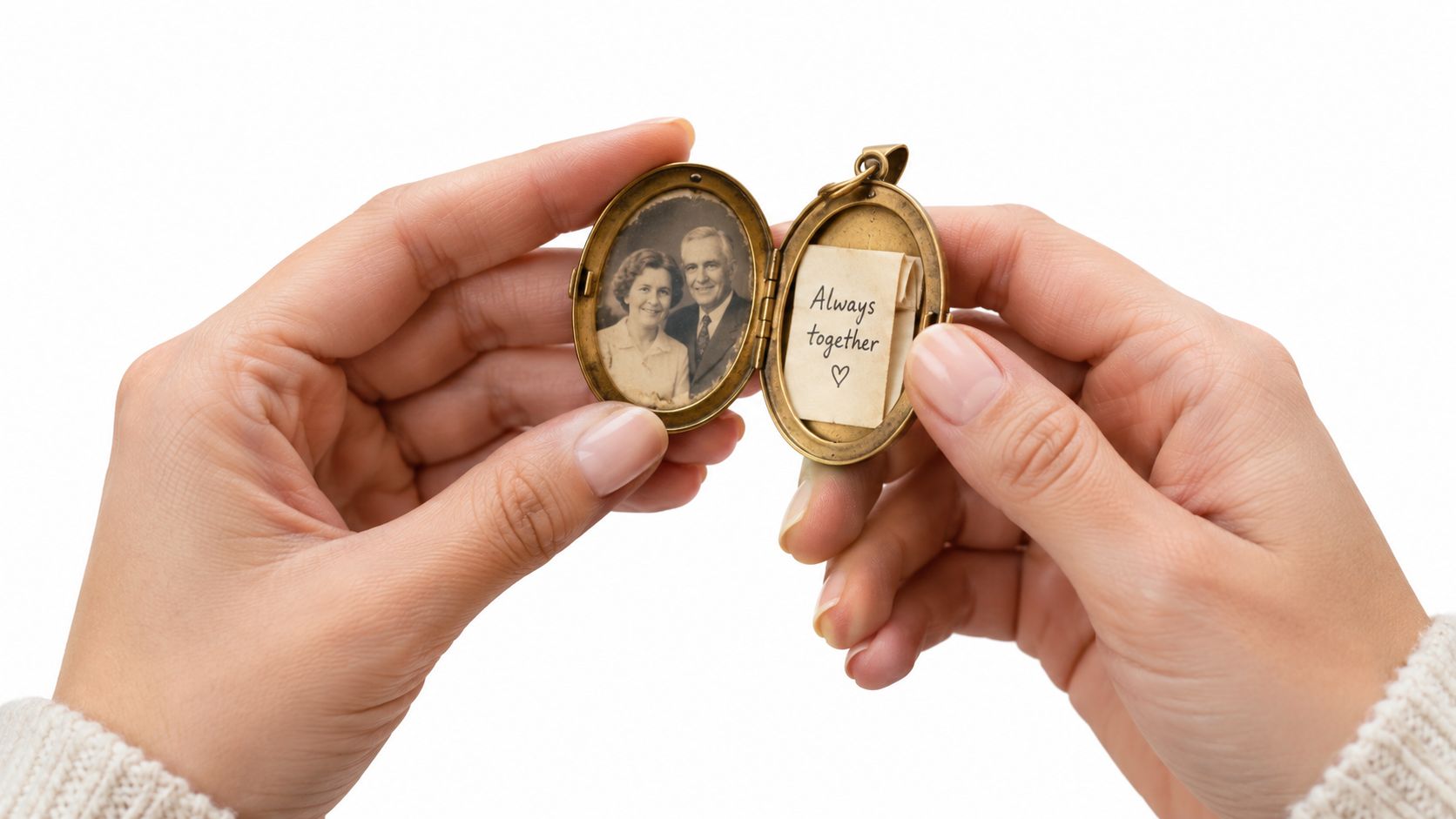
The useful detail is easy to miss: a locket isn't just a symbol of affection. It's also a little container, and its size, closure, and hinge determine what you can put inside and how well the piece will wear. A photo trimmed to fit may work beautifully; a thick folded note may keep the locket from closing.
That balance is why this guide treats the locket as both jewelry and an object with physical limits. You'll learn how to tell a locket from a charm necklace, choose personalization, prepare contents, and assess the features that help the piece hold up to regular wear. There are also ideas for choosing a locket as a gift, whether you're marking a birthday, graduation, or a personal milestone.
The best choice isn't necessarily the one that holds the most. It's the one that carries a meaningful keepsake without putting pressure on the closure or making the pendant awkward to wear.
Understanding Charm Necklaces and Lockets
Start with the simplest distinction: a charm is a small ornament that hangs from a chain; a locket is a small case that opens. Think of a charm as a badge you wear on the outside. It tells a story through its shape, such as a heart, initial, or other symbol. A locket is more like a pocket-sized keepsake box. Its story is often inside.
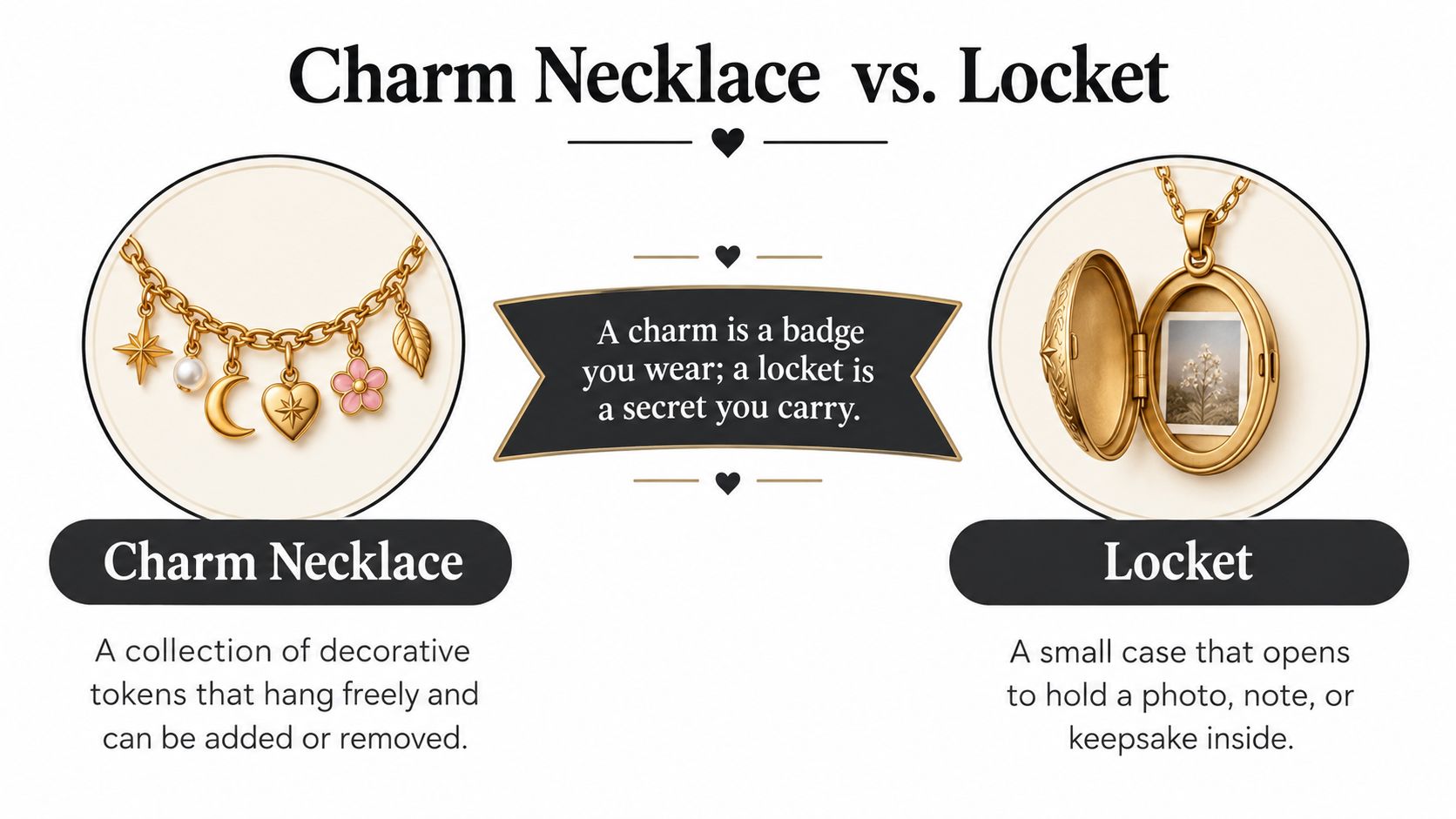
A charm necklace locket brings those ideas together. The locket is the central pendant, and charms can add visible symbols around it or along the chain. Depending on the design, charms may be fixed in place or removable. Check the product details before assuming you can rearrange them.
The parts you can see and use
- Chain: The strand worn around the neck. Its length affects where the pendant sits, and its strength should suit the locket's weight.
- Bail: The loop that connects the pendant to the chain. It needs enough room to move without letting the locket twist awkwardly.
- Hinge: The joint that lets the locket open and close. It's a working part, not merely decoration.
- Inner compartment: The space inside the locket for a flat photo, note, or other small keepsake.
- Clasp: The closure that holds the two halves together. It should close cleanly without force.
A quick way to shop is to look at the pendant first, then trace how it connects to the chain and how it opens. If you're comparing lockets with other charm-holder styles, this guide to charm holder necklaces can help clarify the difference between a pendant that stores something and one designed mainly to display charms.
The key idea is simple: a charm tells its story on the outside; a locket can keep part of its story hidden. When a necklace combines both, look at the charm attachments and the locket compartment as separate features.
Where the Locket Tradition Comes From
Lockets have carried personal meaning for centuries because their defining feature is practical: they keep a small object close to the wearer. Historical evidence places lockets as pendants, brooches, and rings as early as the 15th century, with both men and women wearing them. Renaissance examples developed from personal and devotional jewelry, holding portraits, relics, hair, and other keepsakes. (The National Park Service describes Abigail Adams's locket and the broader history of these objects.)
By the 16th and 17th centuries, portrait lockets were associated with European nobility, courtly exchange, and political loyalty. After King Charles I was executed in 1649, supporters reportedly wore his likeness concealed in lockets. Hair also became a locket keepsake in the 17th century, and the 18th century brought “eye” lockets with miniature paintings of a loved one's eye. These objects weren't just decorative. Their contents made them specific to a person or cause.
Memorial jewelry became especially prominent in Europe and North America during the 18th and 19th centuries. The Victoria and Albert Museum describes memorial jewelry as a major surviving category of 18th-century jewelry and records a vogue for memorial medallions and lockets beginning around 1760. Some included names and dates, along with imagery such as urns, angels, and weeping willows. During the Victorian era, Queen Victoria's public mourning after Prince Albert's death in 1861 reinforced the locket's association with remembrance. A surviving locket associated with Victoria holds Albert's photograph and a lock of his hair. (See the V&A's collection record for the locket.)
| Era | Typical contents | Common symbols | Cultural meaning |
|---|---|---|---|
| Renaissance | Portraits, relics, small keepsakes | Portrait miniatures, devotional imagery | Personal connection, devotion, or loyalty |
| Victorian mourning | Names, dates, photographs, hair | Urns, angels, weeping willows | Remembrance of the dead |
| Contemporary charm necklace locket | Photographs, notes, meaningful mementos | Initials, personal symbols, charms | A private memory worn as everyday jewelry |
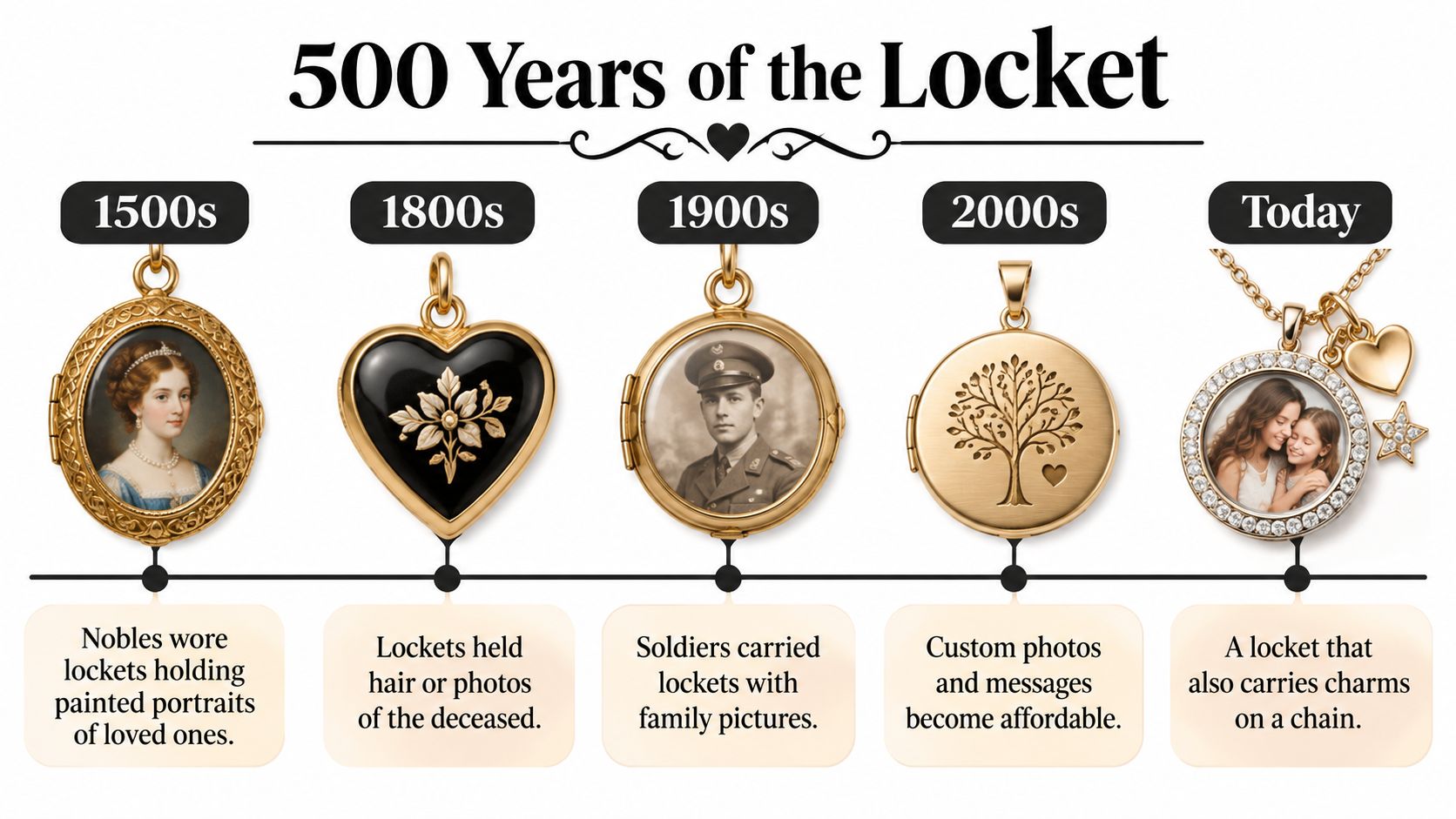
The details have changed, but the underlying idea hasn't: a locket holds something personally meaningful. Modern personalization continues that tradition, whether the keepsake commemorates a living relationship, a family member, or an important occasion.
Personalization Options Worth Knowing
Personalization works best when you decide what should be noticed first. An engraving is visible whenever the locket is closed. A charm adds a symbol to the necklace's outside. An interior photo or note is private, revealed only when the wearer opens the pendant.
Choose the outside details
Engraving is a direct way to mark the locket with a name, date, initials, or another short detail. Keep the wording brief so it remains easy to read on a small surface. If you're considering coordinates or a longer phrase, check the available engraving area before ordering.
Charms add visible meaning without changing the locket's function. An initial can identify the recipient, while a symbol can stand for a shared memory. For a coordinated look, choose charm finishes that work with the locket's metal tone. If you're choosing for family members, these mother-and-daughter charm ideas can help you think through paired or complementary symbols.
Add a private keepsake
A photo or handwritten note gives the inside of the locket a personal layer. You can also consider a thin, dry memento, provided it fits without pressing against the closure. The locket's shape matters here: a small oval interior may need a different crop from a round or heart-shaped one.
A few combinations make the decision easier:
- Quiet and classic: A short engraving outside, with a small photograph inside.
- Visible and personal: An initial charm alongside a plain locket, leaving the interior for a note.
- Story-led: A symbolic charm on the chain, paired with a dated message inside.
EP Fine Jewelry's Personalized collection offers custom selections, and its order notes field can be used for a gift message or special handling instructions. Before settling on a combination, decide whether the recipient would prefer a detail they can see at a glance or a keepsake they can keep private.
How a Locket Stays Secure and Holds Up
A locket opens because its hinge moves. That movement also creates wear: each opening and closing loads the hinge pin and causes the inner knuckle surfaces to press and rub against each other. As clearance grows, the halves can become misaligned, and the locket may stop closing securely. The clasp is another working point, so appearance alone can't tell you whether the assembly is dependable.
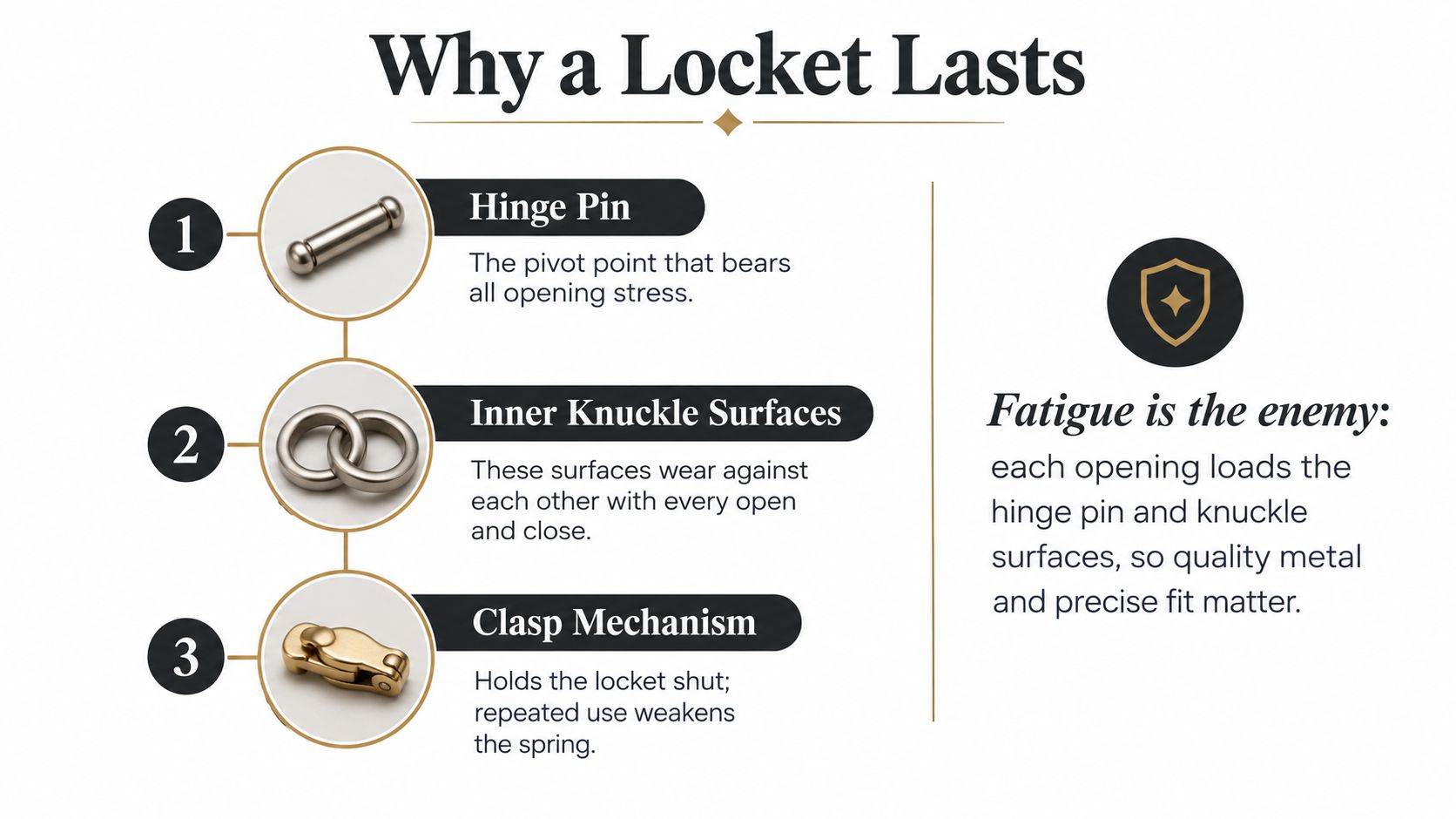
When assessing a piece, look for a hinge that feels aligned and moves smoothly, without a loose or rattling feel. Product development should match the hinge pin and locket body with corrosion compatibility, control the pin diameter and knuckle fit, and test the assembled locket through repeated opening, closing, and drop tests. For a buyer, the practical version is to open and close the piece gently and check that it meets evenly.
Metal affects how readily the locket deforms. Pure 24-karat gold measures roughly 25–30 HV on the Vickers hardness scale, while typical 18-karat gold alloys measure about 120–180 HV and 14-karat alloys about 150–220 HV, depending on composition and processing. (Gold-alloy engineering data provides these approximate hardness ranges.) Higher-purity gold may be more vulnerable to dents and edge deformation; lower-karat alloys generally offer greater mechanical durability.
| Metal | Approx. Vickers hardness | Durability for daily wear | Plating risk at hinge |
|---|---|---|---|
| 24-karat gold | 25–30 HV | More prone to dents and deformation | Depends on construction; inspect moving areas |
| 18-karat gold alloy | 120–180 HV | Generally more resistant to wear than pure gold | Low if solid; plating can wear where present |
| 14-karat gold alloy | 150–220 HV | Generally suited to greater mechanical wear resistance | Low if solid; plating can wear where present |
Thin decorative plating can wear fastest where parts rub, including the hinge, clasp, and charm-contact points. Once the underlying metal is exposed, discoloration or further wear may become a concern. Choose clearly described solid-metal or plated construction, and follow practical jewelry-cleaning guidance to avoid unnecessary abrasion or chemical exposure.
Buying check: Favor an aligned hinge and a secure-feeling closure over extra decoration at the moving parts.
What Actually Fits Inside and How to Prepare It
A locket's inside is a small compartment, so prepare the keepsake to fit the actual interior rather than relying on the pendant's outside dimensions. Open the locket and measure the usable space inside its frame. If it has a paper insert or frame, use that as a template, or trace the inner opening onto plain paper and trim a test piece to match.
For a photograph, crop the image before printing. Keep the subject's face clear of the edge, especially if the locket is oval or heart-shaped, since the frame may cover the corners. A phone photo can look sharp on screen but lose important detail when reduced, so choose a close crop with one main subject rather than a busy scene.
Paper should stay thin and lie flat. A brief handwritten message can feel intimate, but use a fine pen and keep the writing compact enough to remain legible after trimming. Avoid thick folds: even a small bump can stop the locket from closing flush and put pressure on the hinge.
Choose flat, dry keepsakes
A small fabric swatch, a pressed flower, or a single strand of hair may work if it stays thin and dry. Avoid damp, sticky, or bulky materials, and don't force anything into the compartment. More personalization isn't always better; an oversized photo or thick memento can make the locket uncomfortable and interfere with the closure.
Before wearing it, run through this check:
- Test the fit: Place the keepsake inside without pushing it beneath the frame.
- Close gently: The halves should meet without pressure or a visible gap.
- Check alignment: Make sure the edges sit evenly and the hinge hasn't shifted.
- Move the bail: Confirm it swings freely and doesn't catch on the chain.
If the locket won't close naturally, trim or simplify the contents. The keepsake should fit the locket, not make the locket work harder.
Styling Ideas for Everyday and Special Moments
The locket can be the main detail in an outfit or one layer among several. For everyday wear, place it on a fine chain and pair it with a slightly longer necklace carrying a simple charm. The difference in length helps keep the pendants from sitting on top of each other. Keep extra charms light so the locket hangs forward rather than tipping or twisting.
Neckline helps narrow down the look:
- V-neck: Let the locket sit within the open line of the neckline. A shorter chain can make it the focal point.
- Crew neck: Wear the pendant over the fabric, or choose a longer chain so it doesn't crowd the neckline.
- Button-down: Leave the locket visible at the collar for a relaxed look, or tuck it beneath the shirt for a more private effect.
A necklace's length changes where its pendant rests, so compare how the chain sits against the clothes you wear most. This necklace length chart can help you think through placement before you choose.
For a wedding or formal event, let the locket complement rather than compete with the dress. A simple pendant can pair well with detailed fabric, while a more embellished locket may suit a plainer neckline. At a graduation or milestone birthday, the locket can be the personal feature, worn over a simple top so its shape remains visible.
Tucking the locket inside a collar suits moments when you want to keep it close and discreet. Wearing it on top makes the pendant and any attached charms easier to see. If the piece swings, catches, or turns over as you move, remove excess charm weight or adjust the chain length.
Choosing a Charm Necklace Locket as a Gift
For a partner's birthday, choose a short engraving or a photo that captures a shared memory. For a parent's milestone, a handwritten note or family photograph can make the inside meaningful without adding bulk. For a friend's graduation, an initial or symbolic charm offers a visible reminder, while a small note can carry a private message.
Match the metal and construction to the recipient's habits. Someone who wears jewelry often may benefit from a sturdier alloy and a hinge that closes cleanly; someone who saves special pieces for occasions may prioritize the look or engraving. EP Fine Jewelry offers an optional gift box and an order notes field for a message. Its guide to personalized jewelry gifts can provide more ideas, and a Gift Card (Virtual) is listed as a gift card with variants across its product options.
Before gifting, confirm the engraving or charm choice, prepare a thin and dry keepsake, and test the hinge and clasp. That small check helps make sure the locket is ready to wear, not just lovely to open.
Explore EP Fine Jewelry to browse personalized jewelry, charm necklaces, and individual charms. Choose a locket, decide what belongs inside, and use the order notes field for a gift message or special handling request.