
Most everyday rings can be sized up about 1 to 2 full sizes by adding metal, but eternity bands, many pavé styles, and rings made from tungsten or titanium generally can't be upsized the traditional way. That's why a ring that feels only a little too tight might be a simple bench job, while another ring that looks similar from the top may need a remake, an exchange, or a different solution entirely.
You're probably here because a ring almost fits. It goes over the knuckle with effort, or it stops halfway and you're wondering whether a jeweler can just “make it bigger.” Sometimes the answer is yes. Sometimes the better answer is, “Not this ring, not safely.”
That sounds frustrating until you see what jewelers work with. We don't resize a ring in the abstract. We resize a specific metal, with a specific thickness, holding a specific setting design. A plain yellow gold band behaves very differently from a delicate eternity ring, even if both are only a little snug.
Think of ring sizing like altering clothing. Letting out a plain seam is one thing. Trying to expand a beaded, fully embellished cuff without disturbing the pattern is another. Rings work the same way.
If you haven't confirmed the fit yet, it helps to start with a proper measurement before changing anything. EP Fine Jewelry's guide on how to find ring size is a useful place to check the basics first.
Table of Contents
- Introduction to Sizing Up a Ring
- How Sizing Up Works and How Much Is Possible
- Which Rings Can Be Sized Up and Which Cannot
- Common Methods Jewelers Use to Make Rings Larger
- Risks Costs and How Many Times a Ring Can Be Resized
- Smarter Alternatives When Sizing Up Is Not Ideal
- What to Do Next and How to Care for a Resized Ring
Introduction to Sizing Up a Ring
A ring comes in almost fitting. It slides past the fingertip, reaches the knuckle, and then refuses to go farther. The first question is usually simple. Can you size it up?
At the bench, the answer starts with the ring itself. I look at the back of the band, the metal, the thickness, and how the stones are set. A ring may look like a plain circle from the top, but it works more like a tiny piece of hardware. Every part has a job, and changing the size changes the stress on that whole structure.
That is why sizing up is not a universal service. It is a design and material decision.
A plain gold band often gives a jeweler workable room at the bottom of the shank, which is the lower part of the ring. A ring with diamonds running around the band, a very thin shank, or a metal that resists soldering is a different story. Two rings can look close in style and still have completely different options once they are on the bench.
Ring sizing works a lot like clothing alterations. Letting out a simple seam is usually straightforward. Expanding a fitted jacket with beading along every edge is much harder, and sometimes it is smarter to remake the piece than force the alteration. Rings follow the same logic. The question is not only whether the ring can be made bigger, but whether it can be made bigger without weakening it or changing how it looks.
That small shift clears up a lot of confusion. Shoppers often hear that rings can be resized, then hear that some cannot. Both are true because the question is, "Can this specific ring be enlarged safely and cleanly?"
If you have not confirmed the fit yet, start there before any jeweler changes the metal. A careful ring size measurement at home or with a jeweler can tell you whether you need a small adjustment, a different finger, or a different plan altogether.
That is also where people save money and frustration. Some rings are good candidates for sizing up. Some are better exchanged in a larger size. Some heirloom or stone-heavy designs are better remade so the original look survives. Enlarging a ring is often possible, but the smart choice depends on the ring's build, not on a blanket rule.
How Sizing Up Works and How Much Is Possible
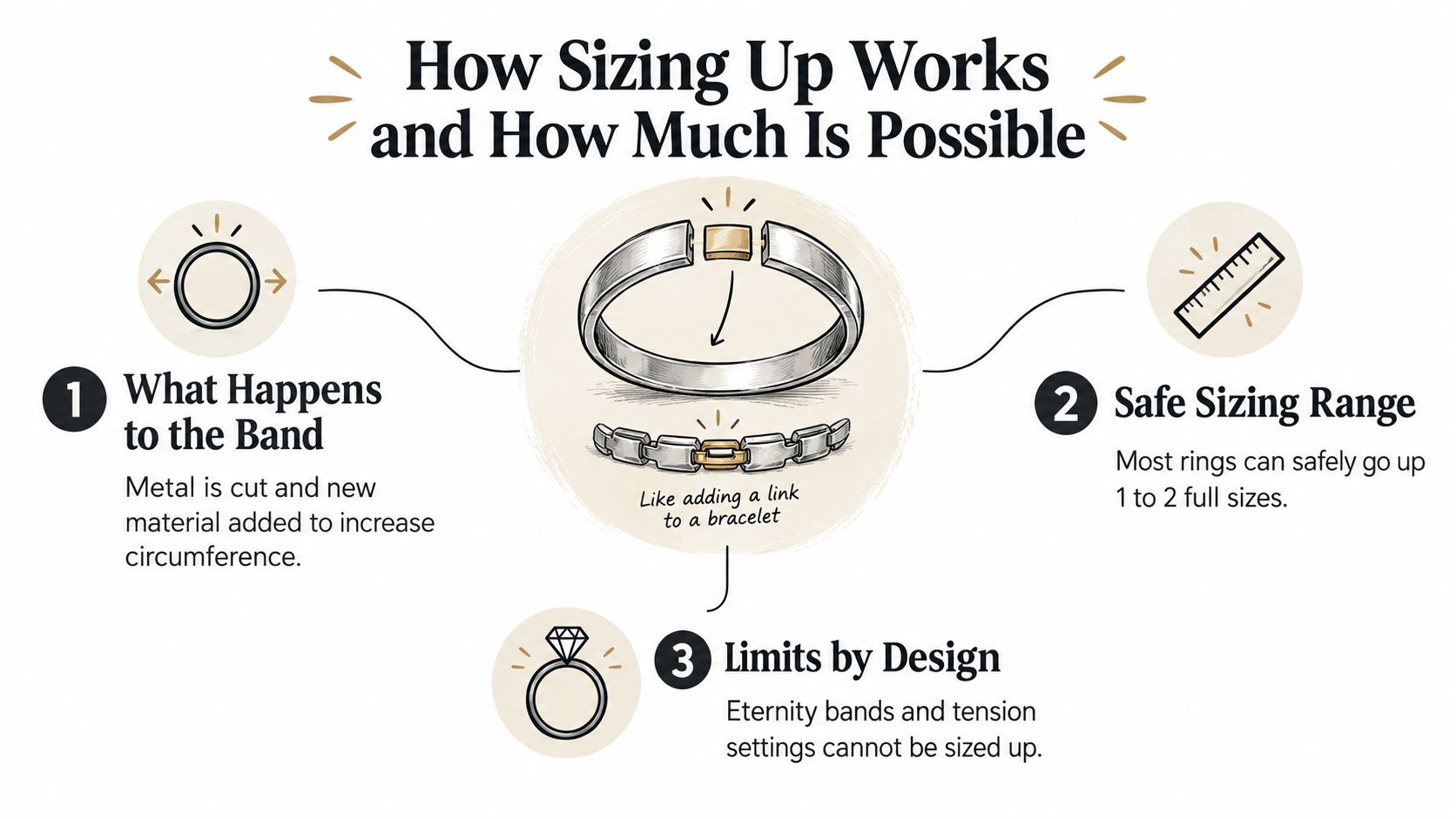
You slip on a ring that almost fits, but it stops at the knuckle. At that point, sizing up is not a matter of stretching it like a rubber band. A jeweler has to create more room in the circle while keeping the ring round, stable, and secure for everyday wear.
The basic idea
A ring works like a tiny metal loop. If that loop needs more circumference, the jeweler usually has to add metal or, in limited cases, gently expand the existing shank. The goal is not only a larger size. The goal is a larger size that still looks balanced and holds up over time.
That is why sizing up is really a construction decision.
For a very small change on a plain, sturdy band, controlled stretching may work. For anything more than a slight adjustment, the usual method is bench work at the bottom of the ring, where changes are least visible and least likely to disturb the top design.
How jewelers usually make a ring larger
The most common process is straightforward:
- Cut the shank at the bottom of the band.
- Open the ring to the new size.
- Add matching metal to fill the gap.
- Solder or weld the join depending on the metal.
- Round, finish, and inspect the ring so the new section blends in.
A bracelet made longer with an extra link is a close comparison. The ring is still the same piece, but it now has more material to complete the circle.
How much bigger is realistic
There is no safe universal limit. What a jeweler can do depends on how the ring was built in the first place.
A plain wedding band usually gives the jeweler more room to work. A ring with diamonds along the shoulders, engraving around the shank, or a very thin back section usually gives less. Each size increase asks the metal to cover more distance, and that change can affect the ring's thickness, shape, pattern spacing, and stone alignment.
Past a certain point, enlarging stops being a simple service and starts becoming a design compromise. That is often the line where a remake, exchange, or one of these customized ring options makes more sense than forcing the original ring beyond what its structure can handle.
Why two similar rings can have different sizing limits
From the top, two rings can look nearly identical. On the bench, they may be completely different jobs.
One may have a thick, plain lower shank that can accept added metal cleanly. The other may have a hollow area, a tapering band, or decorative details running through the section that would need to be cut. In that case, making the ring bigger can distort the pattern or leave too little strength at the bottom.
This is the part many shoppers do not see. Size is only one variable. Thickness, width, setting layout, and metal behavior matter just as much.
What the jeweler checks before saying yes
A careful sizing consultation usually starts with the ring upside down, because the lower half tells most of the story. The jeweler will check:
- Metal type, to see how workable it is
- Shank thickness and width, to judge whether it can support a larger circle
- Stone placement, especially near the shoulders or all the way around
- Design details, such as engraving, milgrain, or shape that may be disrupted
- How many sizes you need, because a small correction and a major jump are very different jobs
If a jeweler says the ring can be enlarged only a little, that is often careful bench judgment. They are weighing whether the ring will still look right and wear safely after the work is done.
Which Rings Can Be Sized Up and Which Cannot
Some rings are naturally cooperative. Others fight the process from the start. The easiest way to sort them is by material first, then design.
One recent guide puts it plainly: metal type is the biggest factor. It notes that yellow gold is generally the most workable, platinum is usually resizable but more technically demanding, and titanium and tungsten carbide are widely described as unable to be resized with standard methods. The same source adds that 14K yellow gold bands can often be enlarged by up to about 3 sizes, while platinum 950 may safely handle about 1 to 2 sizes depending on wall thickness (wedding ring resizing by metal type).
Start with the metal
Yellow gold is the bench jeweler's friend. It's workable, familiar, and usually forgiving enough for careful resizing.
Platinum can often be resized too, but it's denser and more demanding to work cleanly. A skilled jeweler can handle it, but the ring has to offer enough thickness and structure to support the change.
Tungsten and titanium are the common stopping points. People often assume “harder” means “easier to keep strong while resizing.” In practice, hard alternative metals often don't cooperate with traditional cutting and soldering at all.
Then look at the design
Design can veto an otherwise good metal. A gold ring may still be a poor candidate if stones travel around the band or the setting depends on exact tension.
A practical guide for consumers notes that simple gold or platinum bands are usually the easiest to enlarge, while eternity bands, tension settings, and rings with stones around the shank often cannot be enlarged without risking stone security or band integrity (consumer guide to resizing a ring).
Can Your Ring Be Sized Up by Material and Design
| Ring Type | Sizing Up Potential | Why It Matters |
|---|---|---|
| Plain yellow gold band | Often likely | Gold is usually workable, and a plain shank gives the jeweler a clean area to add metal |
| Plain platinum band | Often possible, but more limited | Platinum can be resized, but it takes more technical work and depends on thickness |
| Ring with side stones only at the top | Sometimes possible | The lower shank may still allow bench work if stones don't extend too far |
| Pavé band | Limited | Small stones near the resize area can shift or loosen |
| Channel-set band | Limited to poor | The channel may distort if the circumference changes too much |
| Full eternity band | Often not suitable | There's no plain section to cut and rejoin safely |
| Tension setting | Often not suitable | The design depends on precise pressure and geometry |
| Titanium ring | Generally not resizable traditionally | Standard cut-and-solder methods usually don't work |
| Tungsten ring | Generally not resizable traditionally | The material is typically incompatible with traditional resizing |
If you're shopping rather than resizing, this matters even more. A style like an expanding round eternity band may look flexible in concept, but any ring with stones encircling the band deserves special sizing questions before purchase.
If a ring has detail all the way around, treat sizing as part of the design, not an afterthought.
Common Methods Jewelers Use to Make Rings Larger
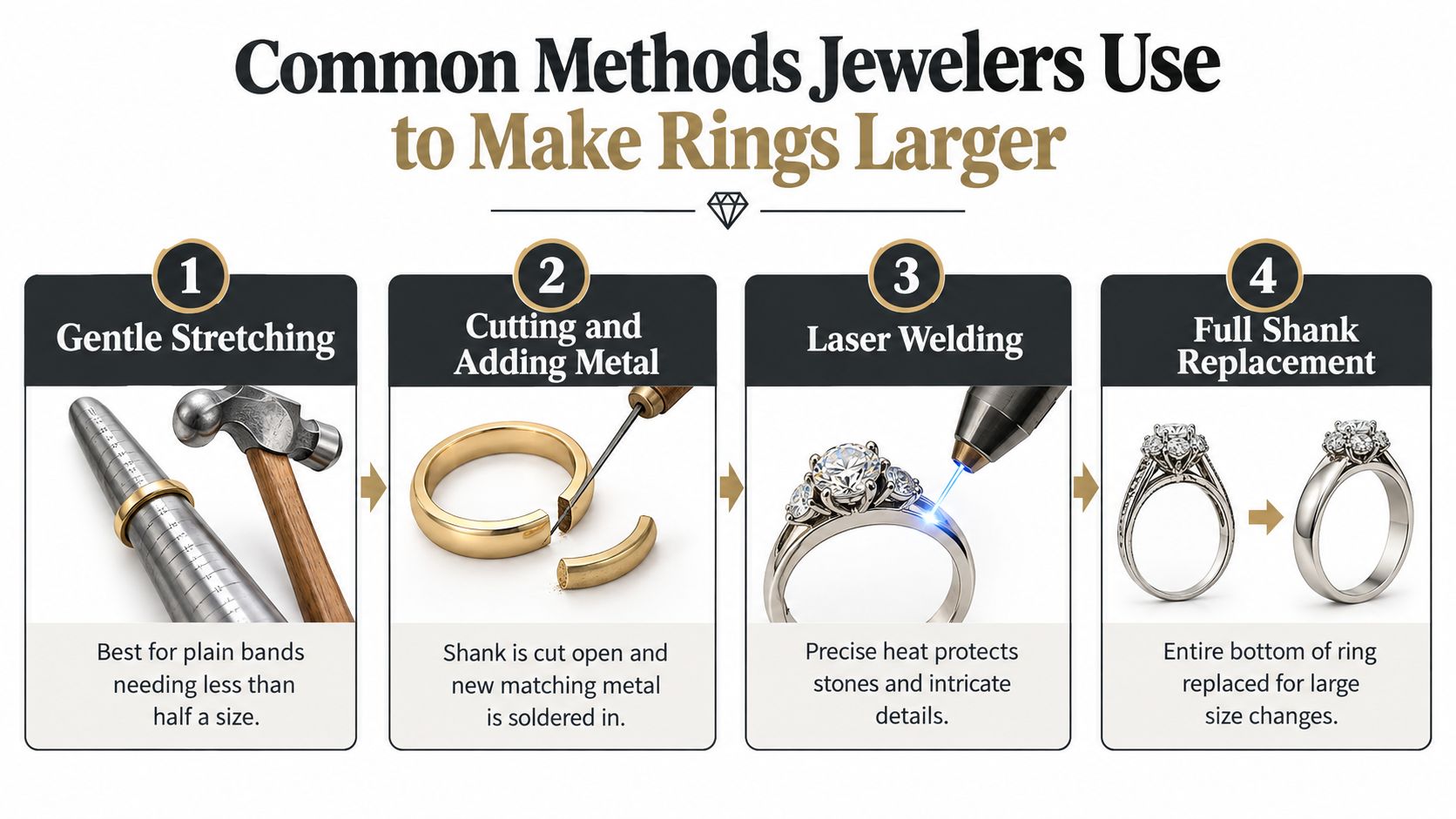
A ring can be made larger in more than one way, and the method matters because each one changes the ring differently. A plain gold band gives a jeweler several workable options. A stone-heavy eternity band may give almost none. That is why sizing up is really a construction decision, not a routine service.
Gentle stretching
Stretching is the smallest adjustment a jeweler can make. It works a bit like widening a plain metal bracelet by a tiny amount. The ring keeps the same basic structure, but the metal is persuaded outward with controlled pressure on a mandrel or stretcher.
This method fits simple bands best, especially rings without stones near the lower shank. It is usually used for a slight size increase, not a major jump. On a thin ring, a patterned band, or a design with stones around the sides, stretching can change the shape or leave the base thinner than before.
Cutting the shank and adding metal
For a more noticeable size increase, jewelers usually enlarge the ring by adding new metal. They cut the shank at the bottom, open the band enough to reach the new size, insert a matching piece of metal, then join and finish the ring so it looks like one continuous circle.
This is the bench method many people are asking about when they say, "Can my ring be sized up?" It gives the jeweler more control than stretching because the extra circumference comes from added material, not from forcing the original shank to cover more distance.
The important detail is placement. Jewelers prefer to work in the plainest, least stressed area of the ring, usually the bottom, because that is where a repair can be blended without disturbing the design at the top.
Laser welding for rings with delicate details
Some rings need a tighter, more precise heat source. Laser welding helps when the design has nearby stones, fine engraving, or small details that broad heat could affect.
Laser work does not turn an unsuitable ring into a suitable one. It gives the jeweler a finer tool, like using a detail brush instead of a house-paint brush. The ring still needs enough safe metal in the right area for the size change to work.
A short bench demonstration helps make the process easier to picture:
Full shank replacement
Sometimes adding a small piece is not the smartest repair. If the lower half of the ring is worn thin, cracked from past work, or uneven from years of wear, a jeweler may replace that whole section instead.
This is closer to rebuilding the foundation than patching a spot in the wall. It costs more and takes more labor, but it can leave the ring stronger and cleaner-looking than another small insert would.
Before you approve any resize, ask:
- Are you stretching the ring or adding metal? The answer tells you how much the ring itself is being asked to give.
- Where will the work be done on the shank? Placement affects appearance, strength, and whether details stay intact.
- Will you use soldering or laser welding? The heat method can matter on rings with stones or delicate surfaces.
- Will you inspect and tighten the stones afterward? Changing the ring's circumference can shift pressure through the setting.
Risks Costs and How Many Times a Ring Can Be Resized
A ring can be made larger and still fail as a good sizing job if the process leaves the band weaker, the stones less secure, or the design visibly changed. That is why sizing up is not just a service menu item. It is a repair decision about structure, wear, and value.
The part that takes the stress
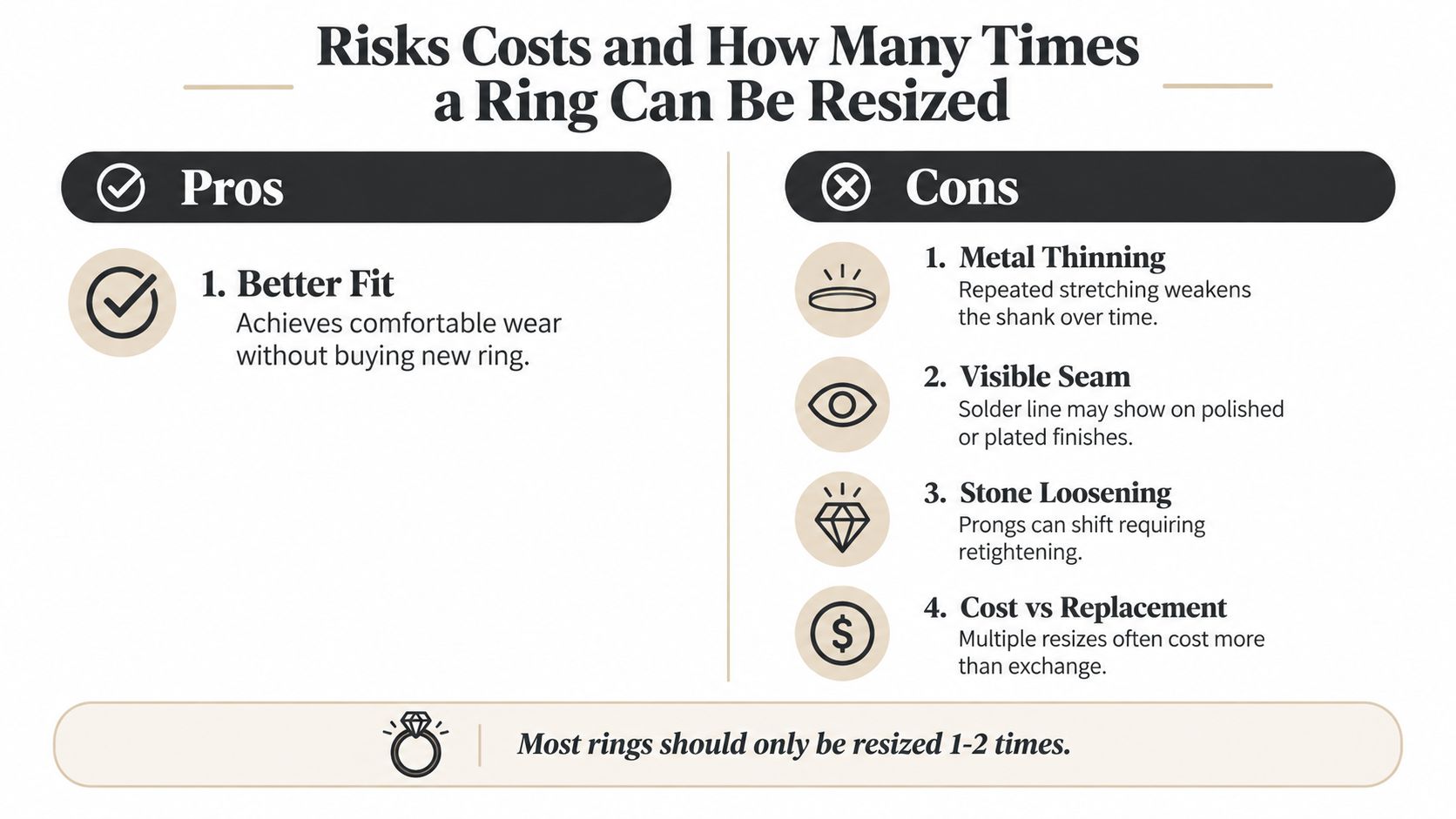
The lower shank does the hard work every day. It presses against shopping bags, steering wheels, doorknobs, gym equipment, and countertops. After a resize, that area has usually been stretched, cut and joined, or rebuilt. Even when the finish looks clean, the metal in that spot is no longer in its original condition.
As noted earlier, repeated enlargements can leave the resize area more prone to thinning or tiny structural flaws. On a thick plain band, that may remain manageable for years. On a light shank or a ring with stones close to the shoulders, the margin for error is much smaller.
A resized ring can still be strong. It just needs to be judged like a repaired structure, not like untouched factory metal.
What jewelers watch after sizing up
The risk is not the same for every ring. A jeweler is usually checking for a short list of practical problems:
- Metal loss or thinning at the base, especially if the ring was stretched in the past or started out delicate
- A visible seam or color mismatch, which can show more clearly on high-polish finishes or plated metals
- Loose stones, because changing the band's circumference can shift pressure through the head and shoulders
- Out-of-round shape, which is more common in wide bands or rings with uneven top-heavy settings
These are not automatic failures. They are the trade-offs that help answer a bigger question: is enlarging this ring the smartest option, or just the fastest one?
How many times can a ring be resized
There is no universal lifetime limit. Rings are more like hinges than T-shirts. The answer depends on metal thickness, past repairs, stone placement, and how much of the plain shank is left to work with.
One ownership guide explains that many rings are safest within a modest size range, often around one to two sizes, and warns that repeated resizing can weaken the band over time. It also notes that some jewelers treat a small number of total resizes over the life of the ring as a practical ceiling for preserving strength (engagement ring sizing guide).
In bench terms, history matters more than the raw count. A ring sized once by adding fresh metal may have a better future than a ring sized several times after years of thinning and wear. The record of past work matters almost as much as the current fit.
When the cost is worth paying
A careful resize often makes sense when the ring has sentimental value, a healthy lower shank, and a modest size change. That is the sweet spot.
Cost tends to rise when the jeweler has to do more than change the circumference. Stone checking, replating, correcting an out-of-round band, or replacing a worn section of shank all add labor. In those cases, you are not only buying size. You are buying stability and safe wear.
If the ring is low-value fashion jewelry, heavily patterned all the way around, or already weakened by prior work, spending more on another enlargement may not be the smart choice. A remake or exchange can protect both your budget and the look of the ring better than one more resize.
Smarter Alternatives When Sizing Up Is Not Ideal
Sometimes the right answer is not to resize at all.
A newer consumer guide points out an important mismatch: a ring may technically be resizable, but not without damaging the design. It also notes that gold and platinum are often resizable by about two sizes, while pavé, channel-set, eternity, titanium, tungsten, and ceramic styles are much more limited, and that newer guidance puts more focus on temporary adjusters and remake-versus-resize decisions (ring resizing cost and alternatives).
Temporary fixes for tricky rings
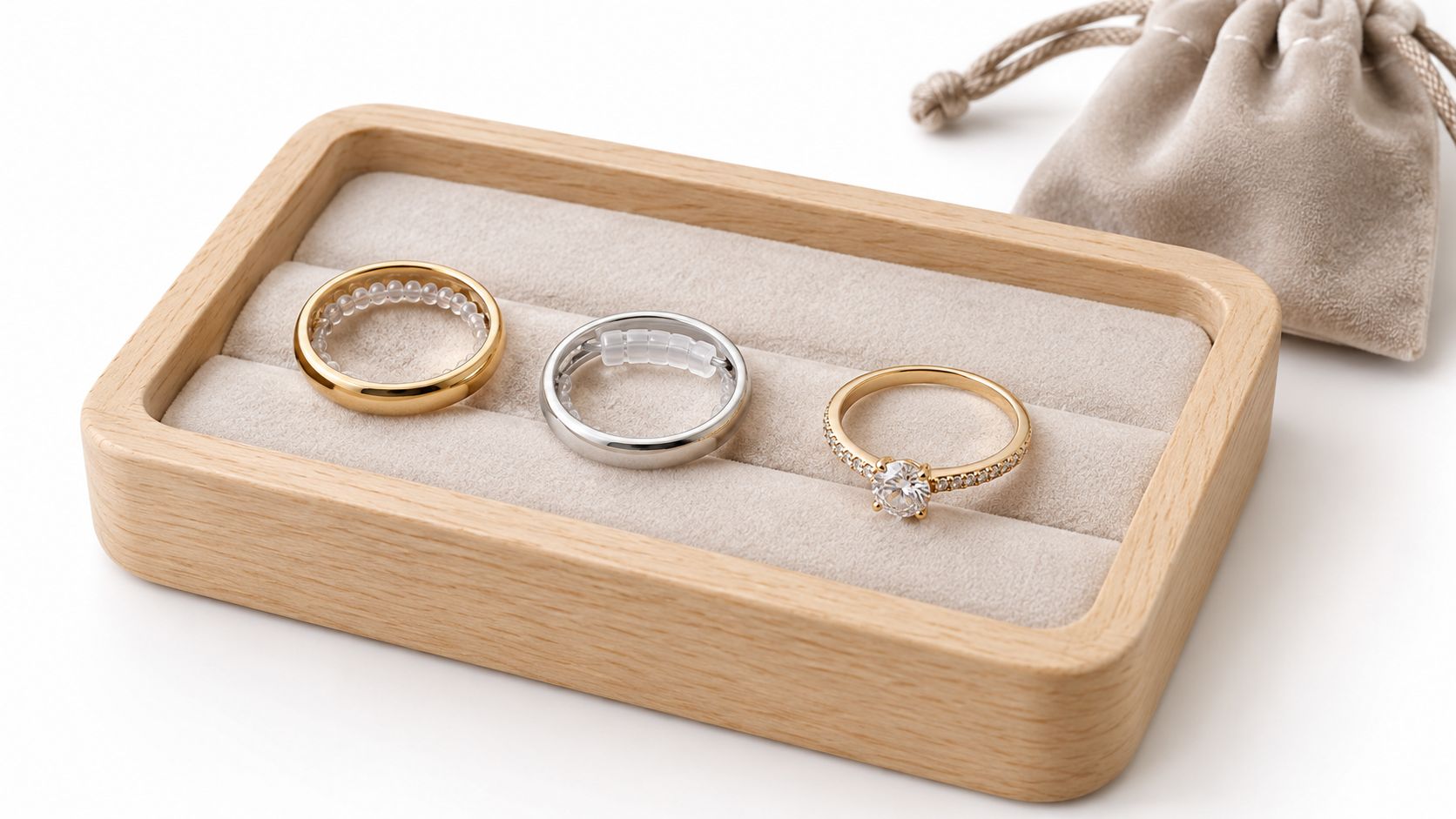
If the ring is only slightly loose or you're still deciding, temporary options can buy time without cutting into the band.
- Sizing adjusters can help test comfort before committing to bench work.
- Sizing beads or inserts may help some rings sit more securely depending on the design.
- Occasional wear only is sometimes the safest path for sentimental rings with fragile settings.
These options aren't glamorous, but they're often kinder to the ring.
When a remake or exchange makes more sense
If a ring is tungsten, titanium, ceramic, full eternity, or very design-sensitive, resizing may be the wrong question. The better one is, “Should this be remade in the right size?”
For personalized and fashion jewelry, an exchange can be cleaner than forcing an unsuitable resize. If you're buying new pieces to stack or gift, looking at styling and sizing together also helps. EP Fine Jewelry, for example, sells rings within a broader catalog of stackable jewelry, and their guide on how to stack rings helps shoppers think about comfort and shape before adding more bands to one finger.
The safest fix for a ring problem is often the least invasive one.
What to Do Next and How to Care for a Resized Ring
Take the ring to a jeweler in good light and ask for a plain-language explanation. You want to know whether the ring can be sized up safely, which method they'd use, and whether the setting should be checked after the work.
When you visit, bring a few questions:
- Can you show me where the resize would happen?
- Will the finish and metal color match well afterward?
- Do any stones need tightening after the size change?
- Would you resize this ring if it were your own?
After resizing, treat the ring gently for a while. Avoid hard gripping, heavy lifting, and any habit that puts side pressure on the lower shank. Keep the ring clean, and have the stones checked during routine maintenance.
For ongoing upkeep, EP Fine Jewelry's Jewelry Care page is a practical reference for day-to-day maintenance habits.
A well-done resize should feel comfortable and look natural. The smart move is choosing the right solution for the ring in front of you, not forcing every ring into the same answer.
If you're shopping for a ring and want fewer sizing surprises, EP Fine Jewelry offers rings, personalized pieces, care guidance, and clear store policies that help you think about fit before and after purchase. If your ring is a poor candidate for upsizing, their catalog and support resources can also help you compare replacement, gifting, and styling options without guessing.