
Most advice about an adjustable necklace chain starts with styling. That's backwards. A necklace that changes length is a small load-bearing system, and the wrong slider, extender, or clasp can loosen, shift, or fail even when the chain itself looks perfectly fine.
I've seen the same mistake repeatedly. Someone buys a delicate chain with a substantial pendant, chooses a sleek sliding bead because it looks tidy, then finds the pendant dropping off-center or the slider creeping downward during the day. Another wearer uses a long extender on a fine chain, catches it on clothing, and stresses the rear connection until a link opens. The purchase wasn't necessarily poor. The mechanism didn't match the load or the way the necklace was worn.
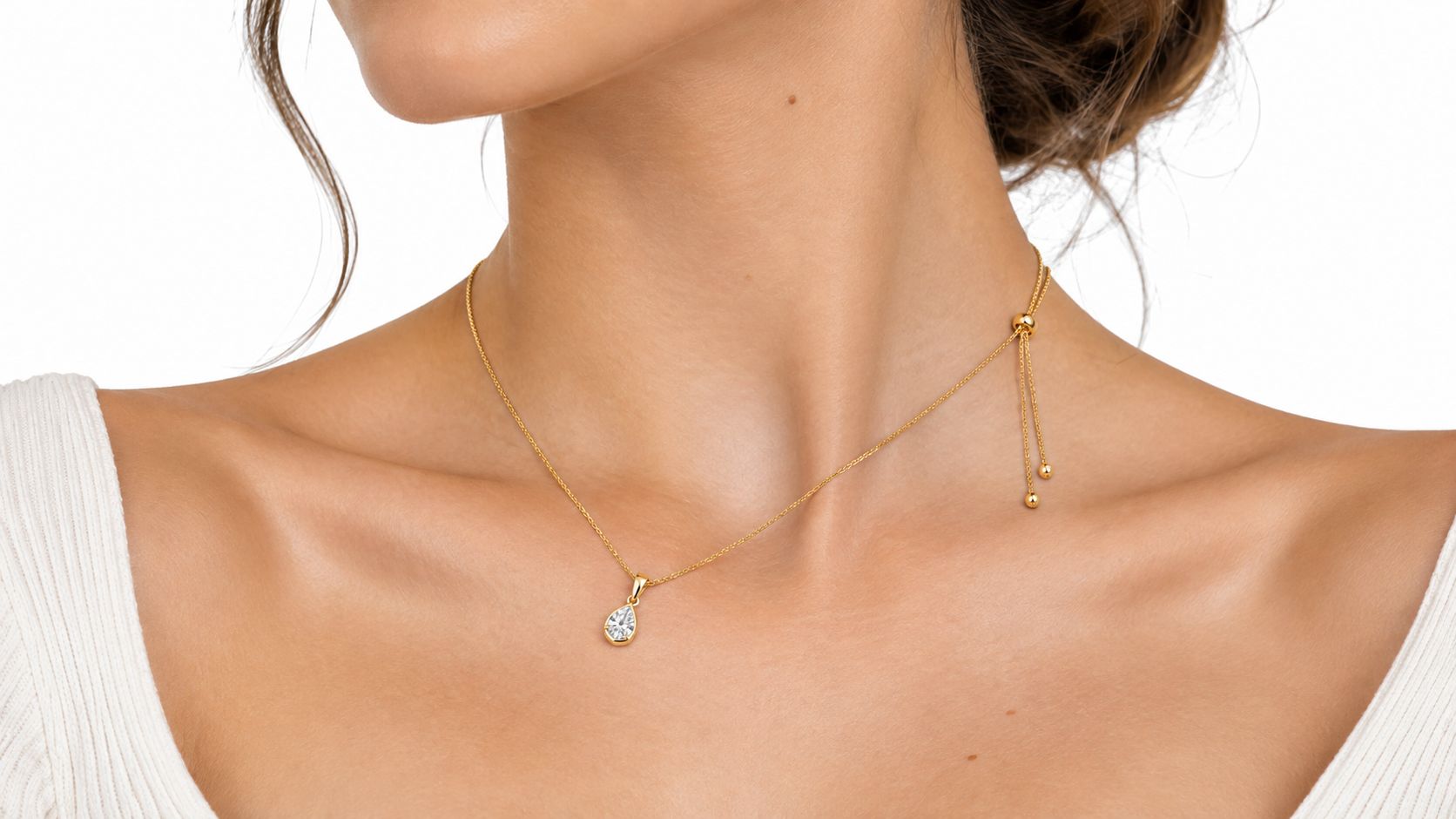
That's why material, construction, and wear habits matter more than a product photo. If you're comparing plated and filled finishes as well as chain construction, this guide to gold-filled versus gold-plated jewelry can help separate surface finish from the mechanical questions that determine whether the necklace stays secure.
Table of Contents
- Why Your Adjustable Necklace Chain Keeps Failing
- What an Adjustable Necklace Chain Actually Is
- The Three Mechanisms Behind Adjustable Necklace Chains
- How to Measure and Fit Your Adjustable Necklace Chain
- Choosing the Right Length Range for Your Style and Layering Goals
- Caring for Your Adjustable Necklace Chain So It Lasts
Why Your Adjustable Necklace Chain Keeps Failing
The failure usually begins at the back of the neck, where the wearer can't see it. A clasp is hooked into a small ring, the pendant looks centered, and the necklace feels comfortable. After movement, the extension chain swings, the clasp pulls at an angle, and the ring or anchor point takes more stress than the main chain.
A customer might wear the piece over a sweater one day and against bare skin the next. The pendant may be light enough for a slider in the morning, then replaced with a heavier charm for an evening outfit. Those changes alter the load, friction, and direction of force. A chain can be strong in a straight line but vulnerable when a pendant repeatedly twists the attachment point sideways.
The mismatch behind the slip
The common mismatches are simple to identify:
- Fine chain with a heavy pendant: The pendant can pull a delicate mechanism downward, especially when the slider depends on friction.
- Large extender on a light chain: A longer rear section creates more opportunity for catching, twisting, and angle-pulling.
- Small closure on a substantial design: A standard lobster clasp may be convenient, but heavier pieces need a closure system suited to their load.
- Weak anchor point: Even a well-made chain can fail where the adjustment hardware joins the necklace.
Practical rule: Choose the adjustment mechanism after considering the pendant, chain gauge, and daily movement, not before.
The right question isn't “How many lengths does this necklace offer?” Ask instead, “What holds the chosen length in place, and what happens when the pendant pulls against it?” That shift prevents many avoidable failures.
What to inspect before buying
Look closely at the connection between the main chain and the adjustable component. The ring should sit cleanly, without a visible gap or distortion. On a slider style, check whether the bead appears designed for the chain thickness rather than crimped onto it.
Also consider how you wear jewelry. If you change necklaces often, layer several pieces, or wear pendants that catch on fabric, you need a mechanism that tolerates repeated repositioning. Adjustability is useful, but it isn't automatically durable. The design has to be engineered around the forces your lifestyle creates.
What an Adjustable Necklace Chain Actually Is
An adjustable necklace chain is a length-calibrated jewelry system. It uses a chain and an adjustment method that lets the wearer select a position within a defined range. That can mean an extension chain with several rings, a sliding bead that travels along the chain, or multiple attachment points built into the closure area.
It isn't the same as an elastic cord, and it doesn't rely on the chain stretching. A fixed-length necklace has one intended configuration. An adjustable design has several possible configurations, but each depends on the relationship between the chain, the adjustment hardware, and the closure.
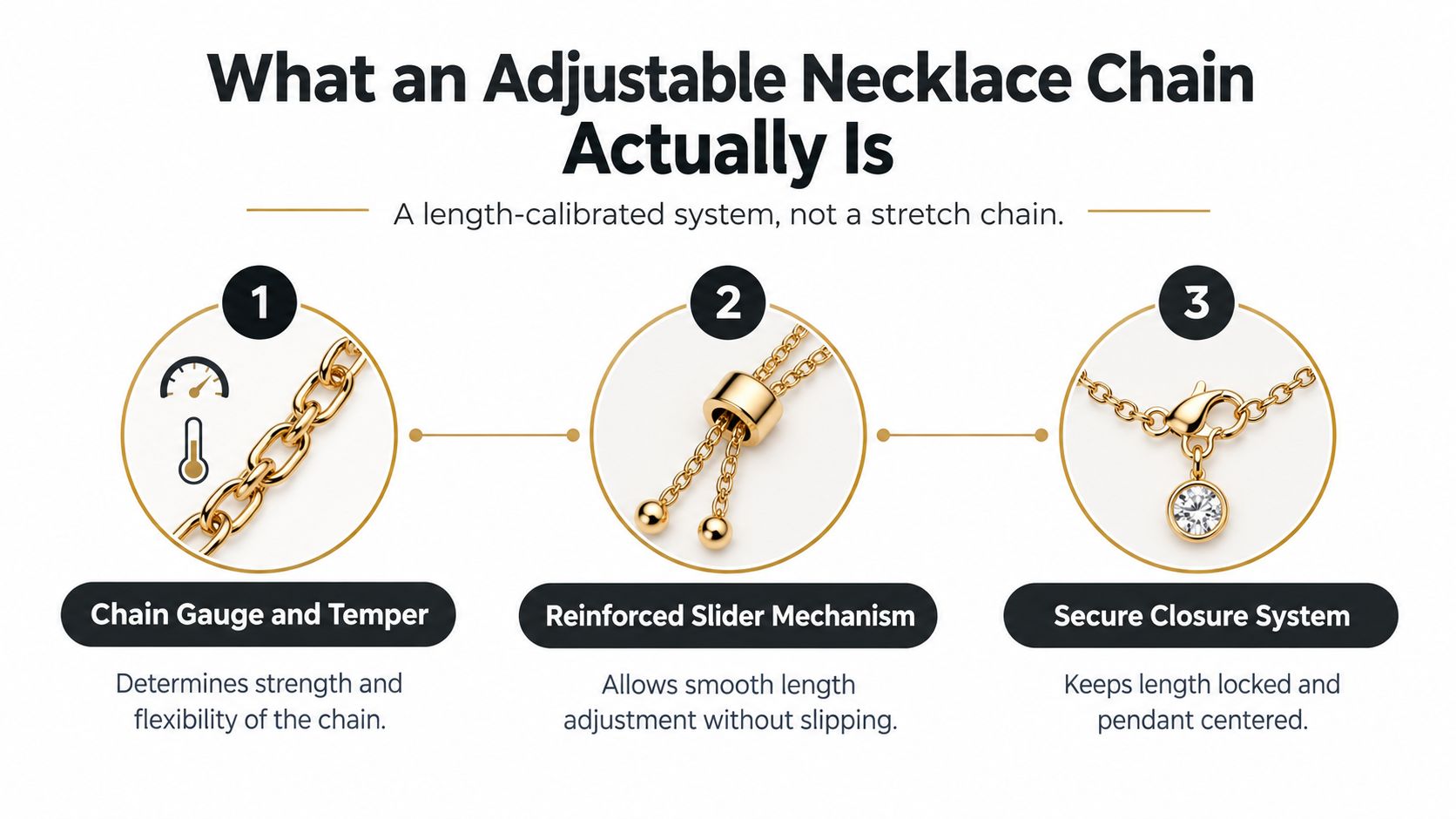
Three parts carry the responsibility
First, chain gauge and temper affect how the chain handles tension and flexing. Second, reinforced anchor points distribute the force where the adjustment component attaches. Third, the clasp must hold the selected length without becoming the weakest part of the system. Professional jewelry guidance also highlights consistent chain-wire diameter, specified at ±0.05 mm, as part of reliable construction, and notes that heavier pieces need a more secure closure than a standard lobster clasp. Those construction principles are outlined in this professional guide to making an adjustable chain necklace.
The category has a longer engineering history than many shoppers realize. U.S. Patent No. 1,124,518, titled “Adjustable neck-chain,” was published on January 12, 1915. Later patent records cite an earlier 1871 neck-chain improvement and a 1982 adjustable-length necklace disclosure, showing that length-adjustable jewelry has developed over generations rather than appearing as a passing fashion idea. The patent record is documented in this history of necklace extenders and adjustable neck chains.
Why shoppers keep looking for it
Adjustability solves a practical problem. One necklace can sit closer to the collarbone with a low neckline, then move lower over a high neckline or into a layered arrangement. It also reduces the risk of buying a length that feels almost right but becomes uncomfortable when the wearer moves.
The U.S. e-commerce niche is measurable as well. A 2026 market tracker estimated annual Amazon U.S. revenue for necklace extenders at about $1.0M to $1.2M, with roughly 125K to 150K units sold annually, about 1.3M annual searches, and a 10.6% conversion rate. These figures come from the U.S. necklace extender market estimate, and they indicate sustained interest in adjustable-length solutions.
The useful takeaway is clear: treat the necklace as a coordinated system. A pretty chain with a poorly matched adjustment method still has a mechanical weakness.
The Three Mechanisms Behind Adjustable Necklace Chains
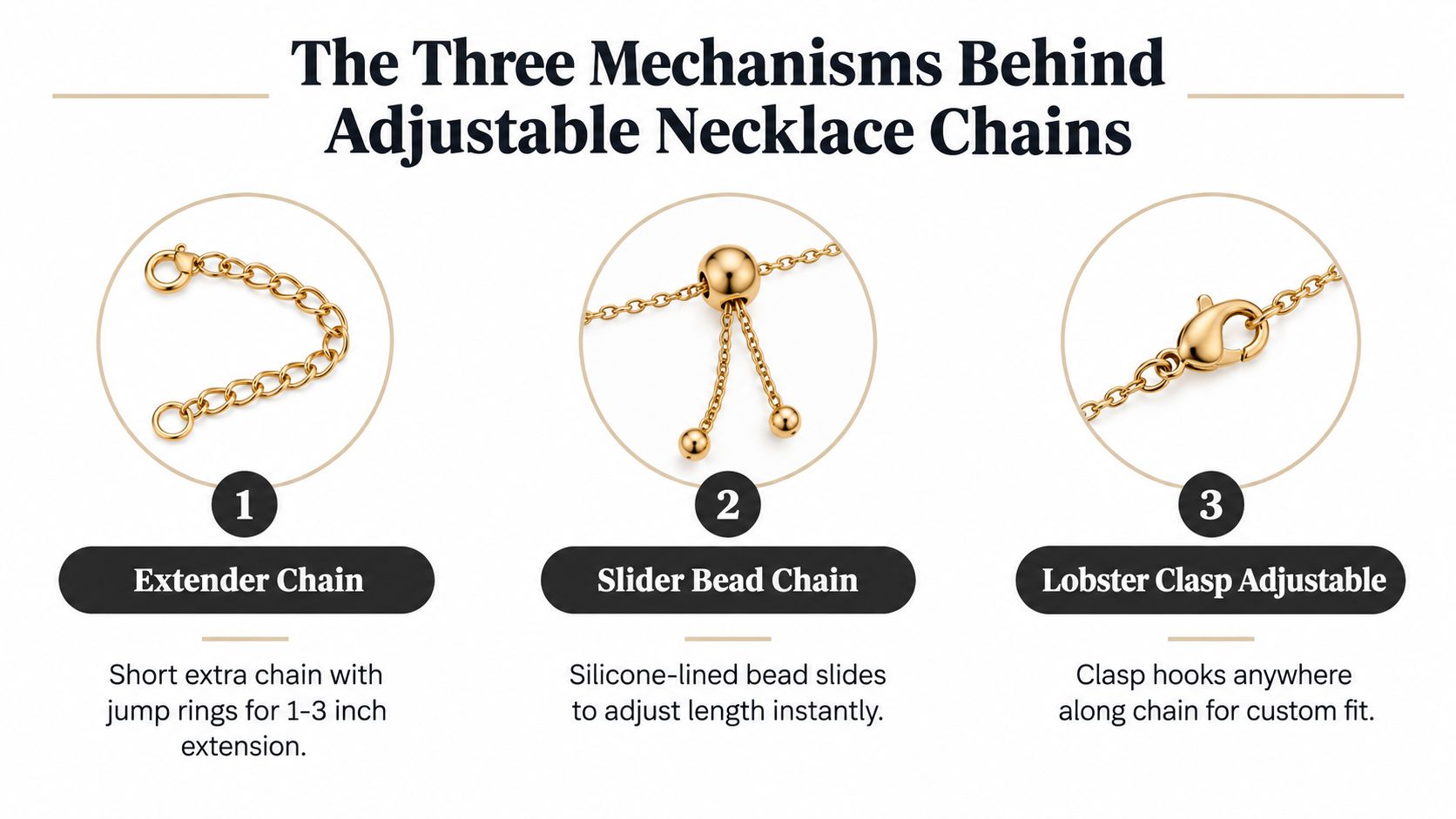
The mechanism determines how the necklace changes length, where the load travels, and what kind of failure you should watch for. Three designs appear most often, and each suits a different type of chain and wearer.
Extender chains
An extender chain adds a short section of linked chain behind the main necklace. The clasp hooks into one of several rings, giving the wearer a set of length positions. This is usually the most forgiving arrangement for everyday jewelry because the selected ring carries the closure in a clear, visible location.
It works well with medium-weight pendants and with necklaces that need occasional adjustment between outfits. The trade-off is bulk. If the extension is too long for the necklace, it can gather at the nape, catch on hair, or move visibly when you turn your head.
Slider beads
A slider clasp, also called a running chain or sliding bead system, moves along the chain and holds by friction. It gives a clean appearance because the wearer doesn't need a long visible extension chain. Delicate chains often pair well with sliders, particularly when the pendant is light and the wearer wants frequent, smooth adjustments.
The risk is load-related slipping. A heavy pendant can pull the slider downward, while angle-pulling can make the bead grip unevenly. A slider should be checked with a gentle tug after adjustment. If it moves without deliberate pressure, it isn't holding the load reliably.
Multiple rings and interchangeable closures
Some necklaces use several jump rings or interchangeable clasp positions to create a wider range. This can be useful for modular jewelry and layering, but every additional connection is another place where a ring can bend, open, or fatigue.
The most common mistake is using the sleekest mechanism for the heaviest piece. Professional guidance emphasizes matching chain gauge and temper, reinforced anchor points, and clasp selection. It also notes that heavier jewelry calls for a more substantial closure than a standard lobster clasp. For a heavier chain style, such as a Cuban link chain necklace, inspect the closure and connection points rather than assuming a conventional slider will cope.
| Mechanism | Best for | Main risk |
|---|---|---|
| Extender chain | Everyday wear and medium-weight pendants | Bulk, catching, or stress at the end ring |
| Slider bead | Delicate chains and light pendants | Slipping under load or angle-pulling |
| Multiple rings or interchangeable clasps | Modular styling and broad length changes | More connection points can mean more failure points |
A smooth adjustment isn't proof of a secure adjustment. Test the mechanism under the pendant's real load.
How to Measure and Fit Your Adjustable Necklace Chain
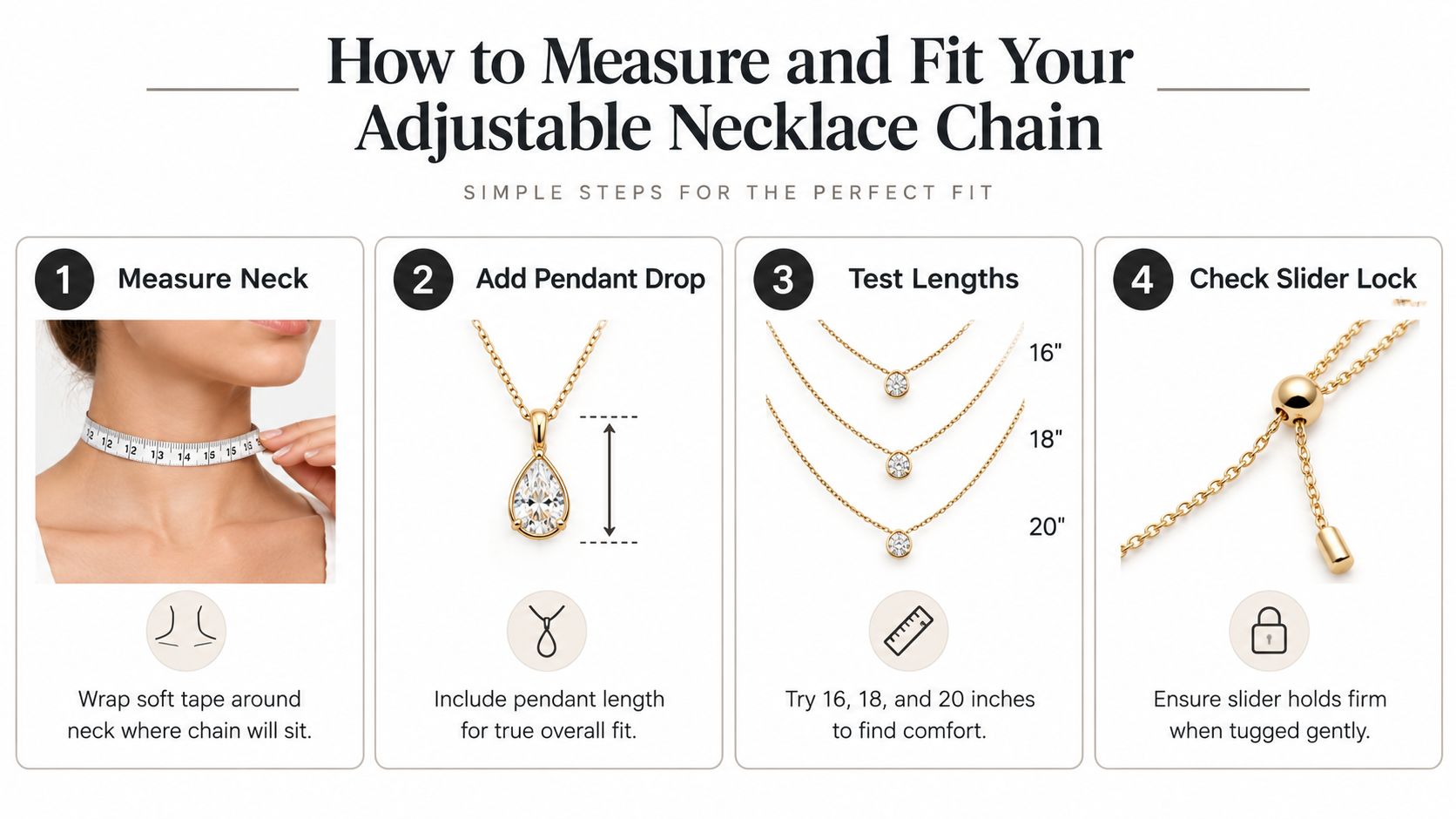
Start with the position you want, not the chain length printed on a product page. Wrap a soft measuring tape around your neck where the necklace should sit. If you're using paper or ribbon, mark the overlap and measure it against a ruler. Leave enough room for normal movement, especially if the necklace will sit against the skin.
A favorite necklace provides an even better reference. Lay it flat and measure from clasp to clasp, then include the pendant drop separately. The chain length and the pendant's vertical drop determine where the finished piece rests.
Use the sitting position as your guide
A close-fitting choker generally sits around the base of the neck. A princess-length necklace rests near the collarbone, while a matinee length falls lower and often suits open collars, V-necks, or layered outfits. These labels are useful starting points, but body shape, chain thickness, and pendant size can shift the visual result.
For shopping purposes, look for two separate details:
- Fixed chain length: This tells you the shortest or primary configuration.
- Extender range: This shows how far the necklace can move from that starting point.
A listing that gives only a maximum length leaves out important information. You need to know whether the necklace begins close to the neck and extends lower, or starts at a longer position with only modest flexibility.
Check the pendant drop
Put the chain on without the pendant, then add the pendant and reassess. A long pendant can make a necklace look lower than its chain measurement suggests. A compact charm may have the opposite effect.
For a broader reference, compare your result with this necklace length chart. The practical rule is simple: choose the fixed length first, then confirm that the adjustment range covers the necklines and layering positions you'll use.
Before leaving the house, gently pull the pendant downward and move your shoulders. The slider or clasp shouldn't shift during that light test. Never force a mechanism to reach a position that bends the chain or twists the closure.
Choosing the Right Length Range for Your Style and Layering Goals
The right range depends on the longest look you intend to wear, not the shortest look that works today. A small extender may be enough for comfort, but it won't necessarily create useful separation between layers or move a necklace over a high neckline.
A recent guide compares 1.5-inch, 2-inch, 2.5-inch, and 3-inch extenders, describing 2 inches as the most versatile and 2.5 to 3 inches as better for layering or higher necklines. Those ranges are discussed in this guide to adding an extender chain. Treat them as planning options, not universal rules.
Match the range to your wardrobe
A 2-inch extender is a sensible everyday choice when you want one necklace to move between a crewneck, scoop neckline, and a more open top without adding an obvious tail at the back. It provides useful flexibility while keeping the mechanism relatively compact.
A 2.5- to 3-inch range makes more sense when the necklace needs to participate in layering. It gives the pendant more room to separate from a shorter chain and can help the same piece sit comfortably over a higher neckline. The extra length is worthwhile only if the chain and clasp can carry it without catching.
A 3- to 4-inch extension serves a different purpose. It supports genuine reconfiguration, such as moving from a close-fitting style toward a matinee-style drop. That range can be valuable for modular wardrobes, but it also creates more rear-chain movement. Use it with a mechanism and chain gauge suited to repeated adjustment.
Let the pendant and neckline decide
A light pendant can tolerate more styling experimentation with a delicate slider. A heavier pendant needs a stable closure and a range that doesn't force the chain into a sharp angle. High collars often need additional length, while a low neckline may need only enough extension to prevent the pendant from sitting too high.
Before buying, write down your two most common outfits and your longest intended position. If the necklace works only at its shortest setting, you're buying a fixed necklace with extra hardware. If the longest setting solves a real outfit problem and the mechanism remains secure, the adjustability is doing useful engineering work.
For ideas on coordinating multiple pieces, see this guide to layering gold necklaces. Keep the visual spacing deliberate, and make sure each layer has enough room to move without dragging its neighbor.
Caring for Your Adjustable Necklace Chain So It Lasts
An adjustable necklace has moving parts, so care should focus on the places that move. Sweat, perfume, lotion, and fabric fibers can collect around slider tracks, extender rings, and clasp joints. That residue can make a slider grip unevenly or prevent a clasp from seating cleanly.
Wipe the necklace with a soft, dry cloth after wear. For a deeper clean, use a solution appropriate for the specific metal and finish, and follow the maker's care instructions. Avoid soaking a mechanism when you don't know how its internal grip or finish will react. Guidance on finish longevity is available in this article about how long gold-plated jewelry lasts.
Prevent loosening
Check the slider before every important wear. Move it to the selected position, then apply a gentle downward pull to the pendant. If the bead creeps, don't compensate by tightening it harder or adding extra force. The slider may be worn, contaminated, or mismatched to the chain.
For an extender, inspect the ring where the clasp hooks. A ring that has become oval can make the clasp sit at an angle, increasing the chance of disengagement. A jeweler can often correct a minor ring distortion before the chain breaks.
Protect the anchor points
Store the necklace flat or hang it separately from other jewelry. Tangling forces the chain through sharp bends, while other pieces can catch on the extender rings and pull at the anchors. Keep the pendant from swinging freely against hard objects during storage.
Look for thinning, stretched links, bent jump rings, or a clasp that no longer closes with its usual resistance. These are early warnings, not cosmetic flaws. Stop wearing the piece if an anchor point is visibly distorted, particularly when the pendant has meaningful weight.
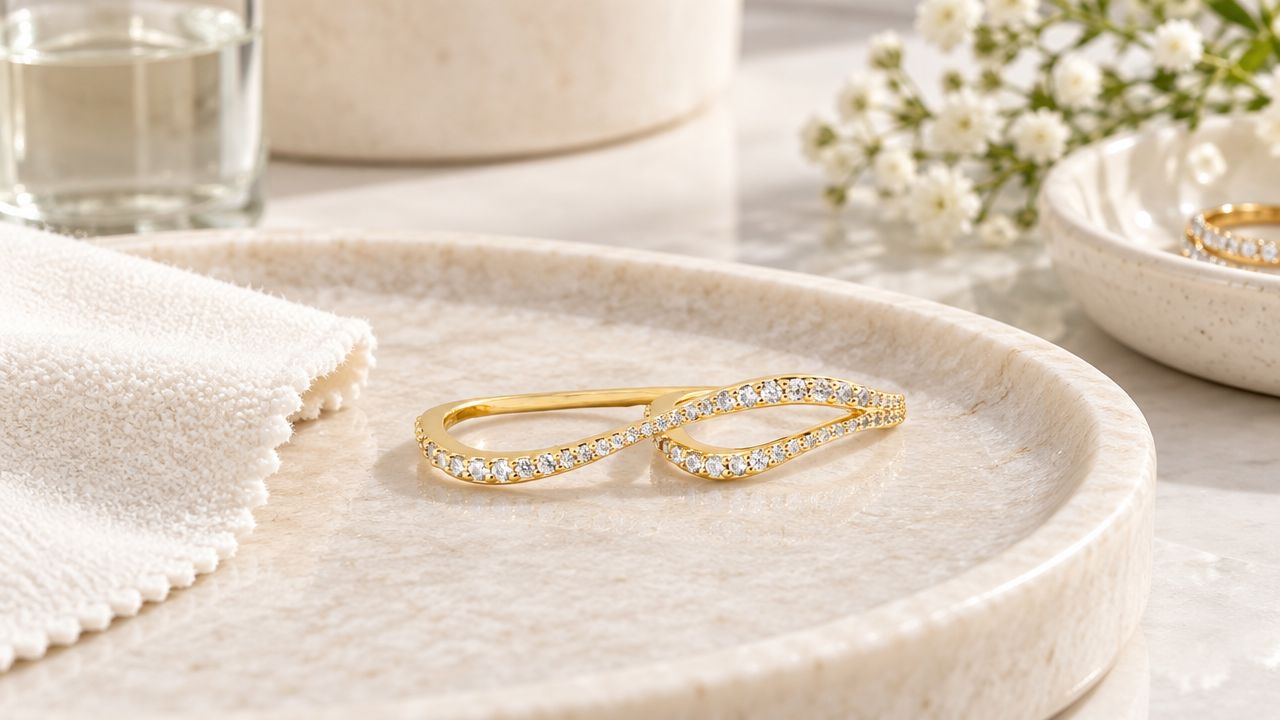
The Two Finger Twist Ring is a separate statement design that fits across two fingers, with size options listed as 6/7 and 7/8 and an 18K gold-plated and CZ material description. Its construction is different from an adjustable necklace, but the same ownership principle applies: inspect moving or stressed areas early instead of waiting for visible failure.
Clean after wear, store without friction, and test the closure whenever the necklace changes length. Those small habits protect the engineering you paid for and help the chain remain useful across different outfits.
EP Fine Jewelry offers personalized jewelry, charm necklaces, necklaces, rings, bracelets, and earrings, along with jewelry care guidance and product policies. Visit EP Fine Jewelry to browse pieces that can complement an adjustable necklace system and choose jewelry with maintenance in mind.