
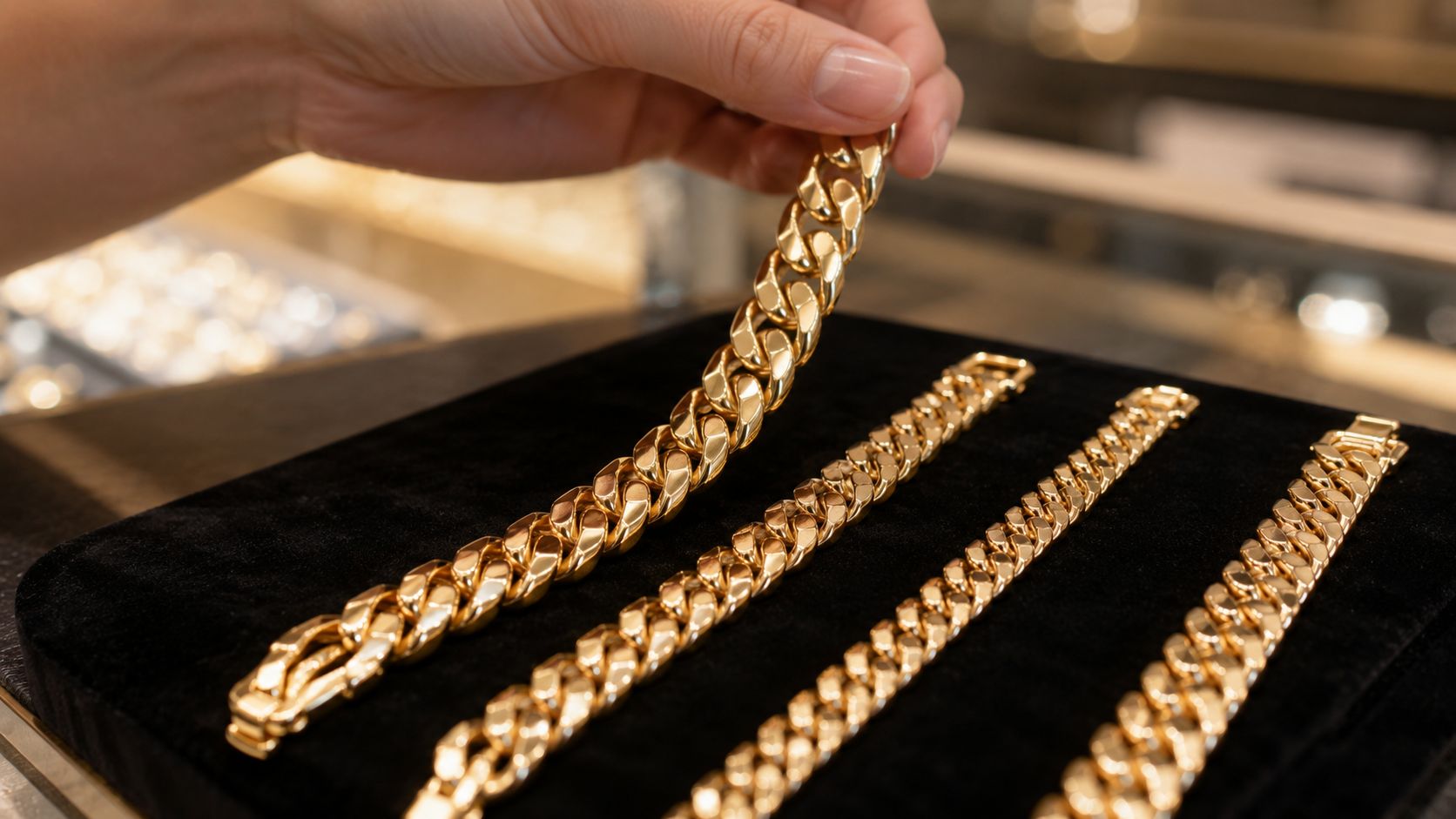
You're standing at a jewelry counter with several Cuban link chain necklaces spread across black velvet. One looks polished and refined, another feels dramatically heavy, and a third seems affordable until you notice that its width doesn't match your frame. The right choice isn't the shiniest chain or the one with the biggest links. It's the piece whose width, length, weight, metal, and construction fit the way you dress and live.
A Cuban link chain necklace can be subtle, balanced, or unmistakably bold. This guide breaks down the decisions that change its appearance and comfort, so you can shop with a clear idea of what to check before buying.
Table of Contents
- What Makes a Cuban Link Chain Necklace
- How the Cuban Link Chain Got Its Look
- Choosing the Right Width, Length, and Weight
- Metals, Finishes, and Quality Differences
- Styling a Cuban Link Chain for Everyday Wear
- Caring for Your Chain So It Lasts
- Putting Your Buying Decision Together
- Cuban Link Chain Questions Buyers Ask Most
What Makes a Cuban Link Chain Necklace
Look closely at a Cuban link chain and you'll see a repeated pattern of curved oval links interlocking tightly with one another. The links twist into position and lie flat, creating the smooth, continuous surface that gives the style its recognizable shine. Unlike a rope chain, which creates a spiraled texture, or a figaro chain, which alternates link sizes, a Cuban link relies on uniformity and density.
That construction affects more than appearance. Tightly connected links usually create a heavier drape than a more open chain of the same length. The chain may sit smoothly across your chest, but its mass can also place more demand on the clasp and connection points. A wide chain needs stronger construction because every link contributes to the overall load.
Start with the proportions
Width is measured across the chain in millimeters, while length is measured from end to end in inches. Weight tells you how much material is present. These are separate measurements, and a product listing should provide all three whenever possible.
A slim chain can look clean and understated on a smaller frame, but it may disappear against a broader chest or a thick sweatshirt. A wider chain creates more visual authority, yet it can overwhelm a narrow neckline or feel tiring during long wear. Before comparing logos or packaging, compare the measurements.
Practical rule: Choose the proportion that supports your wardrobe first. A familiar brand name can't correct a chain that sits at the wrong height or feels too heavy.
Inspect the links for consistent spacing, smooth edges, and a clasp that looks appropriately strong for the chain's width. You can also browse Cuban link chain styles to compare silhouettes before narrowing down metal and size.
How the Cuban Link Chain Got Its Look
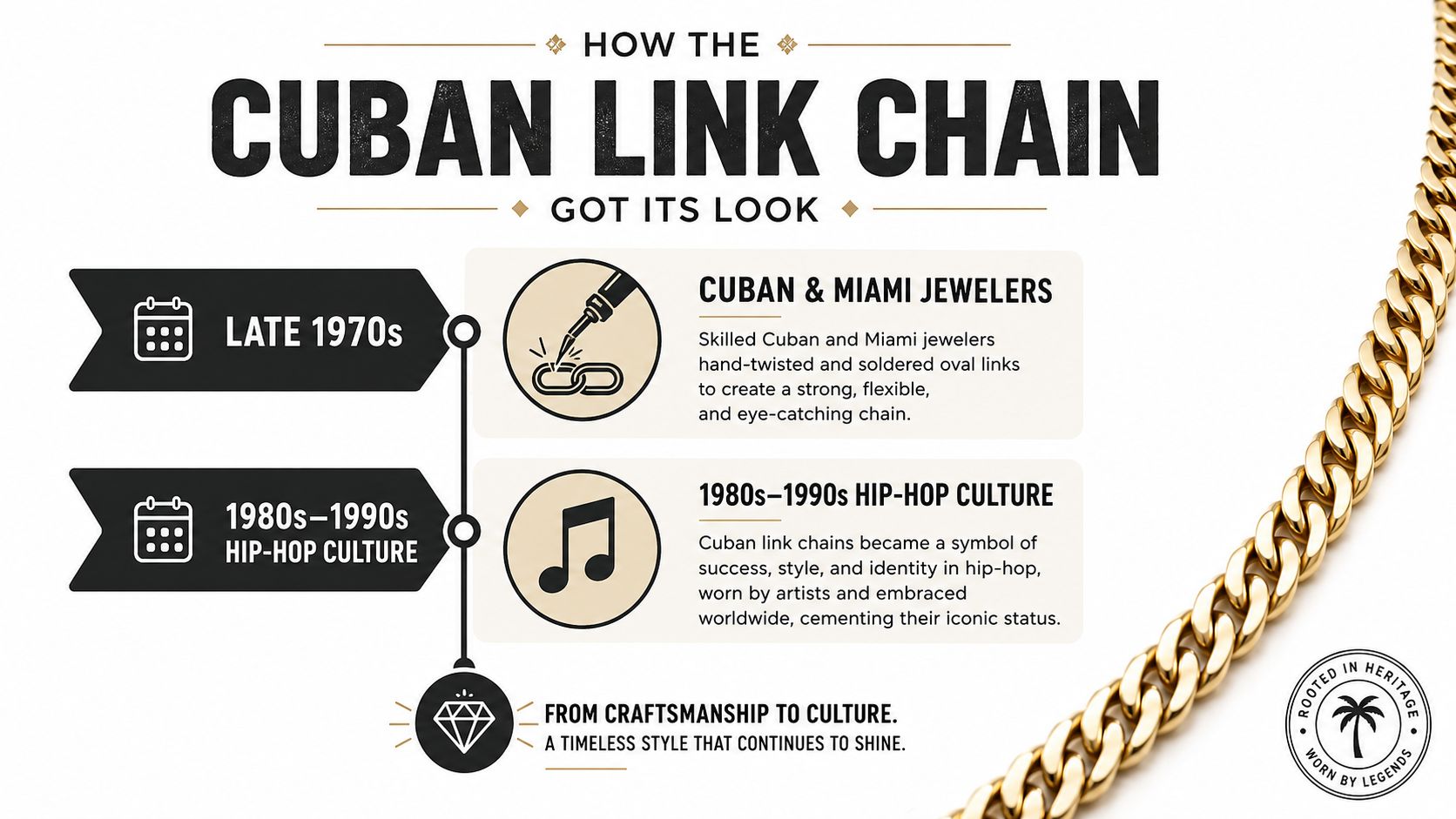
The Cuban link chain's history begins in the late twentieth century, not in an ancient jewelry tradition. Historical summaries widely trace its rise to the 1970s and 1980s, when the design moved from niche urban and Latino style circles into mainstream hip-hop fashion. Some accounts place its surge in the late 1970s, while others connect its broader adoption to hip-hop's beginnings in 1973, including DJ Kool Herc's Bronx block parties. (Historical overview of the Cuban link chain)
Miami became central to the chain's commercial identity. The style grew closely associated with Cuban-American and Latin communities in Miami, Florida, then traveled through cultural and fashion networks toward New York and beyond. That Miami-to-New-York corridor helps explain why the chain feels both regional and globally recognizable.
From status piece to broad category
Early Cuban link chains were commonly made from solid gold and were described as quite heavy. Their scale made them visible status pieces, but the underlying design was simple enough to reinterpret in other materials. Later versions expanded into silver, platinum, and stainless steel, allowing the same linked silhouette to reach different budgets and styling preferences. (History of Cuban link chains and material development)
The style also experienced a renewed wave of attention in the 2010s. One historical summary reports a steep rise in interest in 2012, followed by continued growth afterward. That revival shows how the necklace can leave the center of fashion conversation and return without losing its cultural meaning.
There isn't one universally documented inventor or workshop that settles the question of origin. The stronger consensus points to late twentieth-century cultural diffusion, especially through Miami and hip-hop communities. Each generation then adjusted the chain's width, metal, finish, and stone setting while preserving the same tight, flat-laying link structure.
Choosing the Right Width, Length, and Weight
Think of width, length, and weight as three controls on the same piece of jewelry. Width determines how much visual space the chain occupies. Length controls where it rests. Weight affects its feel, drape, clasp stress, and comfort.
Retail listings commonly show Cuban link chain widths from 2 mm to 19 mm and lengths from 16 to 30 inches. The most frequently ordered lengths include 20 and 22 inches, because they generally sit on the chest and work for everyday wear or pendant layering. (Cuban link chain sizing examples)
Width sets the visual volume
A 2 to 4 mm chain usually reads as subtle and works well for layering. A 5 to 6 mm chain has more presence while remaining practical for regular wear. Chains measuring 8 to 12 mm or more become statement pieces, especially when worn alone.
Don't use a rigid body-weight formula to choose width. Build, neck size, clothing, and personal taste matter more than a single number on a scale. Instead, ask how visible you want the chain to be. A narrow chain can look refined on a slim frame, while a wider one may balance a broader chest or a heavier jacket.
Length controls where the eye lands
Measure your neck with a flexible tape or use a piece of string, then add the amount of drop you want below the neck. A shorter length sits higher and draws attention toward the collarbone. A longer length creates more movement across the chest and leaves room for layered chains or a pendant.
For a visual reference, compare your intended length with an established necklace length chart before ordering. Remember that neck size, chain thickness, and body shape can make the same nominal length sit differently on two people.
Weight reveals construction
Weight often matters more than width alone. A 10 mm solid 925 sterling silver chain can weigh about 100 g at 22 inches, while an 8 mm 14K gold chain can weigh roughly 36 g at 22 inches and a 9 mm version can approach 47 g at that length. Other sterling silver specifications list 7.26 mm models at 58 to 60 g and 5.75 mm models at 35 to 37 g, both at 22 inches. (Independent Cuban link weight specifications)
| Body Build | Width | Length | Approx. Weight, solid 14K, 22" |
|---|---|---|---|
| Slim or narrow frame | 3 to 5 mm | 18 to 20 in | Ask the seller for the exact gram weight |
| Average or balanced frame | 5 to 8 mm | 20 to 22 in | Ask the seller for the exact gram weight |
| Broad or larger frame | 8 to 12 mm | 22 to 24 in | Ask the seller for the exact gram weight |
The table uses qualitative weight guidance because exact gram totals change with link shape, metal, clasp, and hollow or solid construction. A seller who provides gram-per-inch information gives you a clearer basis for comparison than width by itself.
Metals, Finishes, and Quality Differences
Metal choice should follow your daily habits. Someone who wants a chain for frequent wear has different priorities from someone buying a bright statement piece for occasional outfits.
Compare the metal before the finish
Solid gold offers the most traditional feel, but purity changes the balance between richness and hardness. 10K gold is generally chosen for durability and accessibility. 14K gold offers a practical middle ground for shoppers who want a warm gold appearance with everyday usability. 18K gold has a richer composition and needs more careful handling because higher-purity gold is softer.
925 sterling silver gives you a bright, relatively accessible alternative, though it can tarnish and needs regular polishing. Stainless steel and titanium are useful for shoppers who prefer strength and lower maintenance. Brass and gold-plated pieces can work when the priority is trying a look without committing to a precious-metal chain, but plating can wear with repeated contact, moisture, and friction. For more context on plated jewelry care, see how long gold-plated jewelry lasts.
| Metal | Relative Cost | Tarnish Risk | Best Use Case |
|---|---|---|---|
| 10K gold | Lower among solid gold options | Low | Frequent wear with a focus on durability |
| 14K gold | Mid to premium | Low | Versatile daily jewelry |
| 18K gold | Premium | Low | Rich color and occasional or careful wear |
| 925 sterling silver | Accessible | Moderate | Silver-tone everyday styling with routine care |
| Stainless steel | Accessible | Low | Low-maintenance fashion wear |
| Titanium | Accessible | Low | Lightweight, strong styling |
| Brass or gold-plated | Entry-level | Material-dependent | Testing a style or occasional wear |
Sensitive skin requires an extra check. Ask the seller which alloys are used, especially if you've reacted to inexpensive jewelry before. A hallmark can identify the stated metal purity, but it doesn't replace a clear product description or a conversation with the jeweler.
Finish changes the mood
High polish reflects the most light and creates a dressier appearance. Brushed or satin finishes look quieter and can make small surface marks less obvious. Two-tone finishes add contrast, while iced designs place stones across the links and create a more elaborate focal point.
The best finish is the one you'll still enjoy when the chain is paired with your ordinary clothes, not only with the outfit that inspired the purchase.
Styling a Cuban Link Chain for Everyday Wear
A Cuban link chain necklace can change character with a small adjustment in width or placement. Worn alone, a slimmer chain can support an outfit without becoming its center. A wider chain turns the necklace into the main visual feature, so the rest of the clothing usually works better when it stays simple.
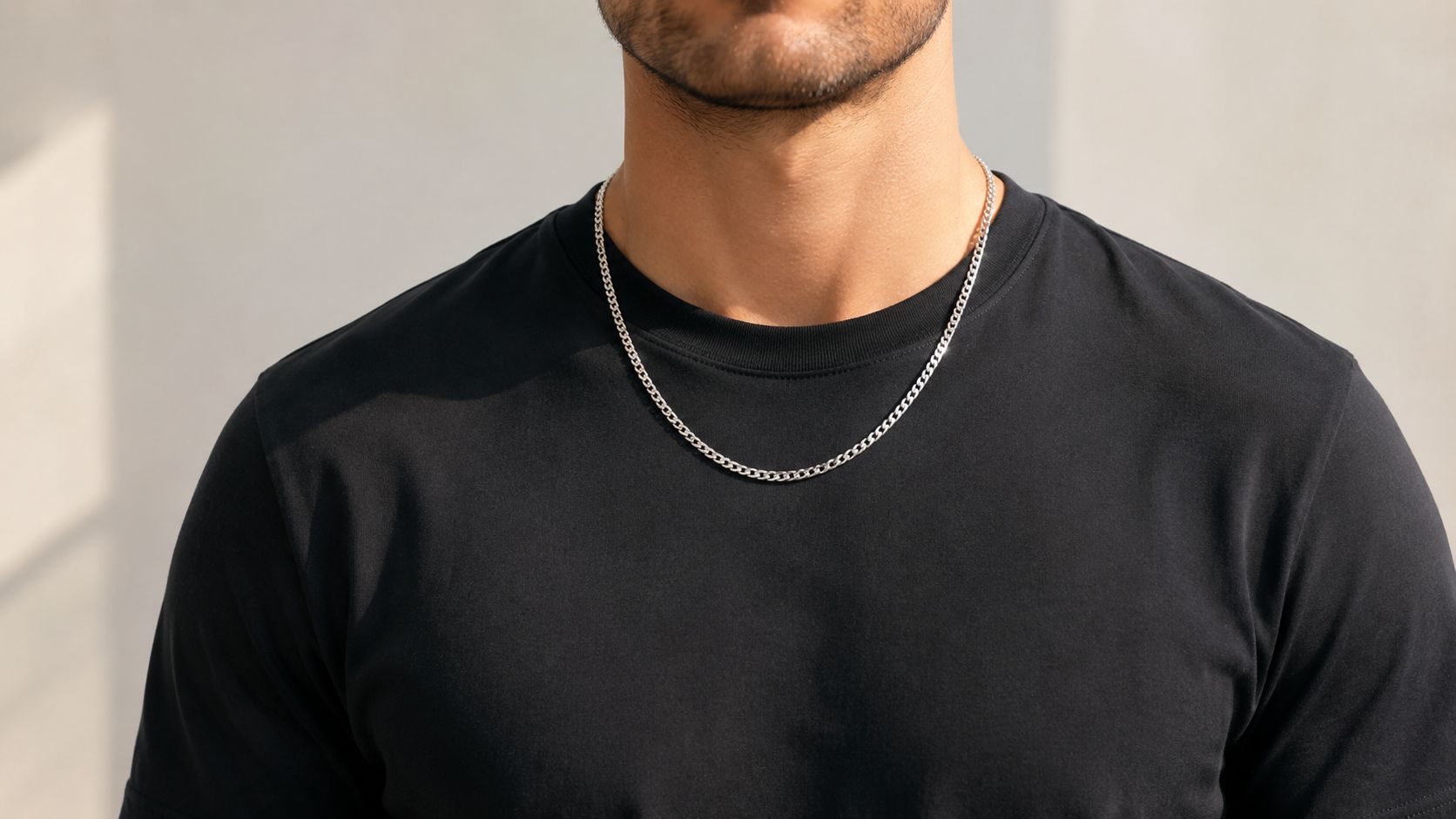
A 3 to 5 mm chain can sit neatly over a crew-neck T-shirt or beneath an open button-down. It adds structure without competing with the face. A 6 to 8 mm chain reads more clearly as a focal point over an open collar, henley, or hoodie.
Build depth with controlled layering
Layering works best when the chains occupy different visual levels. Try a shorter Cuban link around 18 to 20 inches with a longer rope or box chain around 24 to 26 inches. Keep the second chain noticeably thinner or use a different finish, so the links don't merge into one dense strip.
For more ideas about combining tones, use this guide to mixing gold and silver jewelry. The goal isn't perfect matching. It's giving each chain enough contrast to remain readable.
A polished gold-tone chain works with a blazer at dinner because its reflective surface echoes the formality of the jacket. A brushed silver-tone chain under a henley feels more relaxed for weekends. For a night out, a heavier chain over a plain black T-shirt creates a strong focal point without requiring extra patterns.
A pendant needs room to remain visible. If the Cuban link is already wide or heavily decorated, choose a simpler pendant or wear the chain alone. Keep the clasp positioned comfortably at the back or side of the neck unless you want the clasp to become part of the look.
The video below offers another visual reference for Cuban link styling and proportions.
Caring for Your Chain So It Lasts
Most chain maintenance starts with a small habit after wearing. Sweat, lotion, skin oils, and fragrance can settle into the inside curves of the links, where they dull the surface and make deeper cleaning harder.
Use a simple cleaning routine
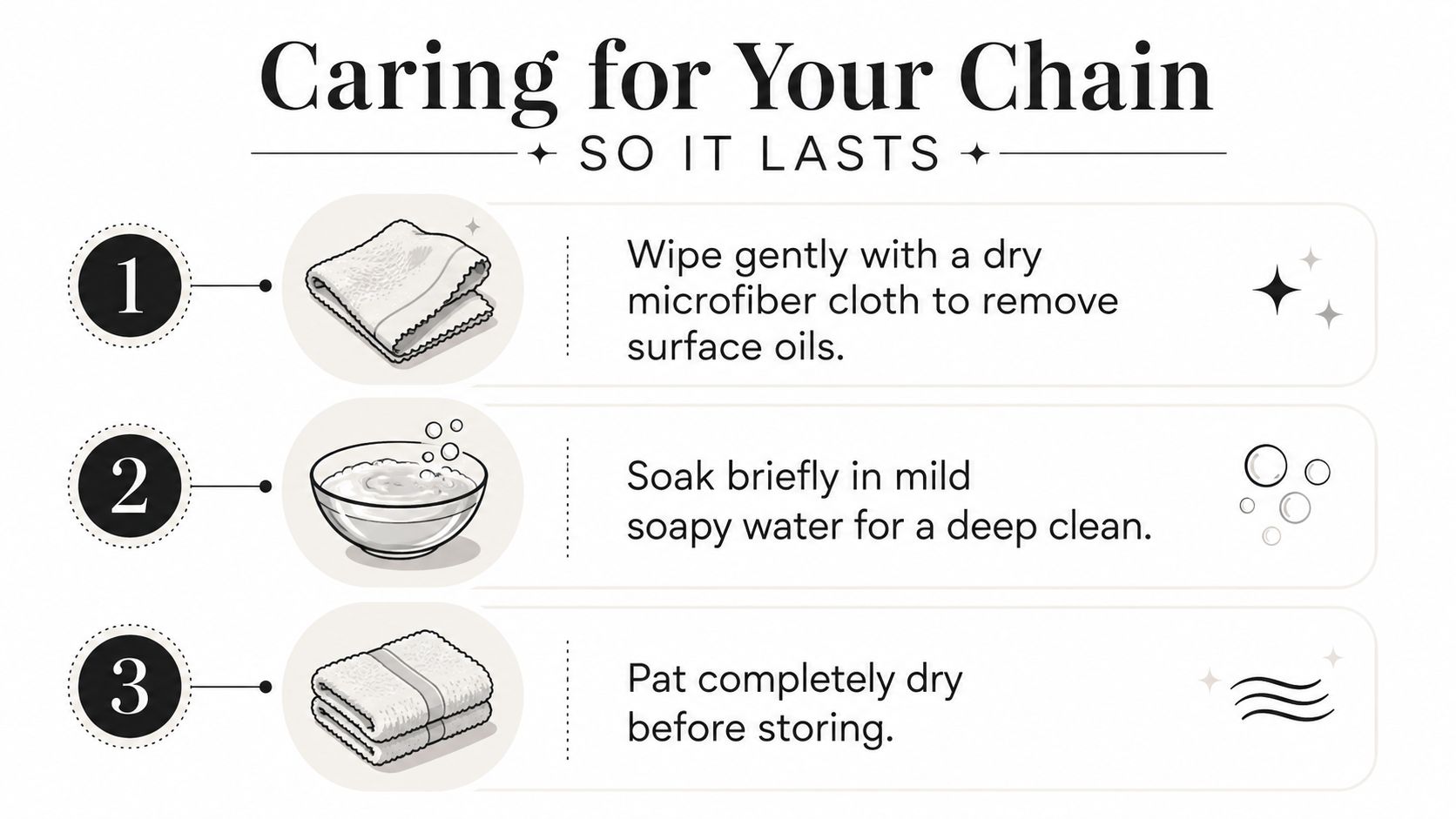
After each wear, wipe the chain with a soft microfiber cloth. Pay attention to the underside and the spaces around the clasp. This takes little time and removes surface residue before it dries.
For a deeper clean, place the chain in warm water with a small amount of mild dish soap. Use a soft-bristle toothbrush to lift buildup from the grooves, rinse carefully, and pat the chain completely dry. Avoid rough brushes and aggressive rubbing, especially on plated finishes or pieces with stones.
The jewelry cleaning guide can help you build a consistent home-care routine.
Protect the chain between wears
- Keep chemicals away: Chlorine pools, saltwater, and direct fragrance can affect metals, finishes, and soldered connections.
- Remove it before sleeping: Nighttime movement can pull at links and clasps or catch the chain on bedding.
- Store it separately: Use a soft pouch or a lined jewelry-box slot to reduce scratching and tangling.
- Check the clasp: Test that it closes cleanly and doesn't feel loose before wearing the chain outside the home.
Sterling silver benefits from regular polishing because tarnish can develop over time. Gold usually needs less frequent surface care, but an occasional clasp inspection is sensible for a heavier piece. If you're coordinating a statement necklace with another bold accessory, the Two Finger Twist Ring is listed as an 18K gold-plated and CZ ring designed to fit across two fingers, with size options described as 6/7 and 7/8.
Putting Your Buying Decision Together
A good purchase becomes easier when you reduce it to four questions:
- What width suits your frame and wardrobe? Choose a slimmer profile for subtle layering and more width when you want the chain to lead the outfit.
- Where should it sit? Select the length based on your neck, neckline, and whether you'll add a pendant.
- Which metal matches your routine? Solid gold suits shoppers seeking a precious-metal daily piece, while silver, steel, titanium, brass, or plated options serve different budgets and care preferences.
- Will you maintain it? A chain exposed to sweat, fragrance, and frequent movement needs more consistent care than one worn occasionally.
Consider two buyers. A slim office wearer may prefer a narrower chain at a collarbone-friendly length, perhaps in a low-maintenance metal or a restrained gold finish. The same chain could look too delicate on a broader wearer who usually dresses in heavyweight streetwear, where a wider profile and longer drop may create better balance.
The most common regrets come from mismatching comfort and appearance. A chain can look attractive online but feel too heavy for daily use, or it can seem substantial in a product photo and disappear under a collar.
Before checkout, confirm the exact width, length, construction, metal purity, gram weight, clasp type, return policy, and care requirements. Those details tell you far more than a product title alone.
Cuban Link Chain Questions Buyers Ask Most
Is a box clasp safer than a lobster clasp?
A lobster clasp is practical for slimmer chains and everyday handling. A box clasp can suit wider, heavier designs because it distributes the closure across a broader section. Choose based on the chain's mass and your ability to operate the clasp comfortably.
Should I buy solid or hollow links?
Solid links are the stronger choice when you expect frequent wear and want substantial weight. Hollow links create a larger visual profile with less material, but they're more vulnerable to dents and pressure. Ask for construction details and exact weight before comparing prices.
Does a Cuban link make a good gift?
It can, especially when you know the recipient's preferred metal and approximate neck fit. A neutral finish, flexible length, gift-ready presentation, and space for a message make the purchase easier when you can't try the chain on together.
Can a jeweler shorten or resize one?
A jeweler can often remove links to shorten a chain, but the exact process depends on its construction, clasp, and finish. Ask whether the removed links will be returned and whether the alteration could affect the warranty or appearance.
EP Fine Jewelry offers necklaces, chains, personalized jewelry, and care guidance for shoppers comparing everyday and giftable pieces. Visit EP Fine Jewelry to review available collections, check the care resources, and choose a piece that fits your preferred width, length, metal, and styling routine.