
You're browsing for a necklace, ring, or bracelet that feels right for you, but the product page keeps asking you to choose between “men's” and “women's.” Or you're buying a gift and don't want to guess someone's identity, proportions, or style from a label. Gender-neutral jewelry offers a more useful starting point: choose the piece for its fit, materials, shape, and meaning rather than for a traditional category.
That approach makes shopping more comfortable and gifting more personal. The right design should work with the wearer's body and wardrobe while leaving room for individual expression, whether that means a quiet silver chain, a textured cuff, a personalized charm, or a bold ring.
Table of Contents
- What Gender Neutral Jewelry Really Means
- The History Behind Inclusive Jewelry Design
- Design Elements That Make Jewelry Truly Inclusive
- How to Style Gender Neutral Jewelry for Any Occasion
- Smart Shopping Strategies for Inclusive Jewelry
- Common Misconceptions About Gender Neutral Jewelry
- Building Your Inclusive Jewelry Collection
What Gender Neutral Jewelry Really Means
Gender-neutral jewelry is designed to be worn by anyone, regardless of gender identity. In practical terms, that usually means the piece relies on balanced proportions, clean lines, adaptable sizing, and versatile materials instead of visual rules associated with masculinity or femininity.
Consider someone choosing a ring online. They may like a wide band, a polished finish, or an unusual shape, but a gendered filter can make the search feel narrower than it needs to be. A gender-neutral approach asks better questions: Does the ring fit comfortably? Does its visual weight suit the wearer? Can it be styled with other pieces? Does it express something personal?
The term “unisex” is often used in a similar way, but inclusive design goes beyond placing one item in a shared category. A one-size-fits-all piece may technically be available to everyone while still feeling uncomfortable, overly heavy, or difficult to adjust. Inclusion has a physical side, not only a marketing side.
Look past the label
When evaluating a piece, check:
- Shape: Straight lines, geometric forms, organic textures, and simple symbols can suit a wide range of personal styles.
- Scale: A piece should be available in proportions that work with different wrists, necks, fingers, and ears.
- Adjustment: Extenders, flexible chains, expandable rings, and multiple closure positions make fit less dependent on assumptions.
- Meaning: Engravings, charms, initials, and stones let the wearer define the piece.
This same logic applies across formats, from studs and hoops to cuffs and layered chains. EP Fine Jewelry's guide to different types of earrings is useful when comparing silhouettes by comfort and styling effect rather than by gendered sections.
A gender-neutral piece doesn't have to be plain. It can be delicate, dramatic, colorful, architectural, or sentimental. The defining feature is freedom of use, the design invites the wearer to decide what it means and how it belongs in their wardrobe.
The History Behind Inclusive Jewelry Design
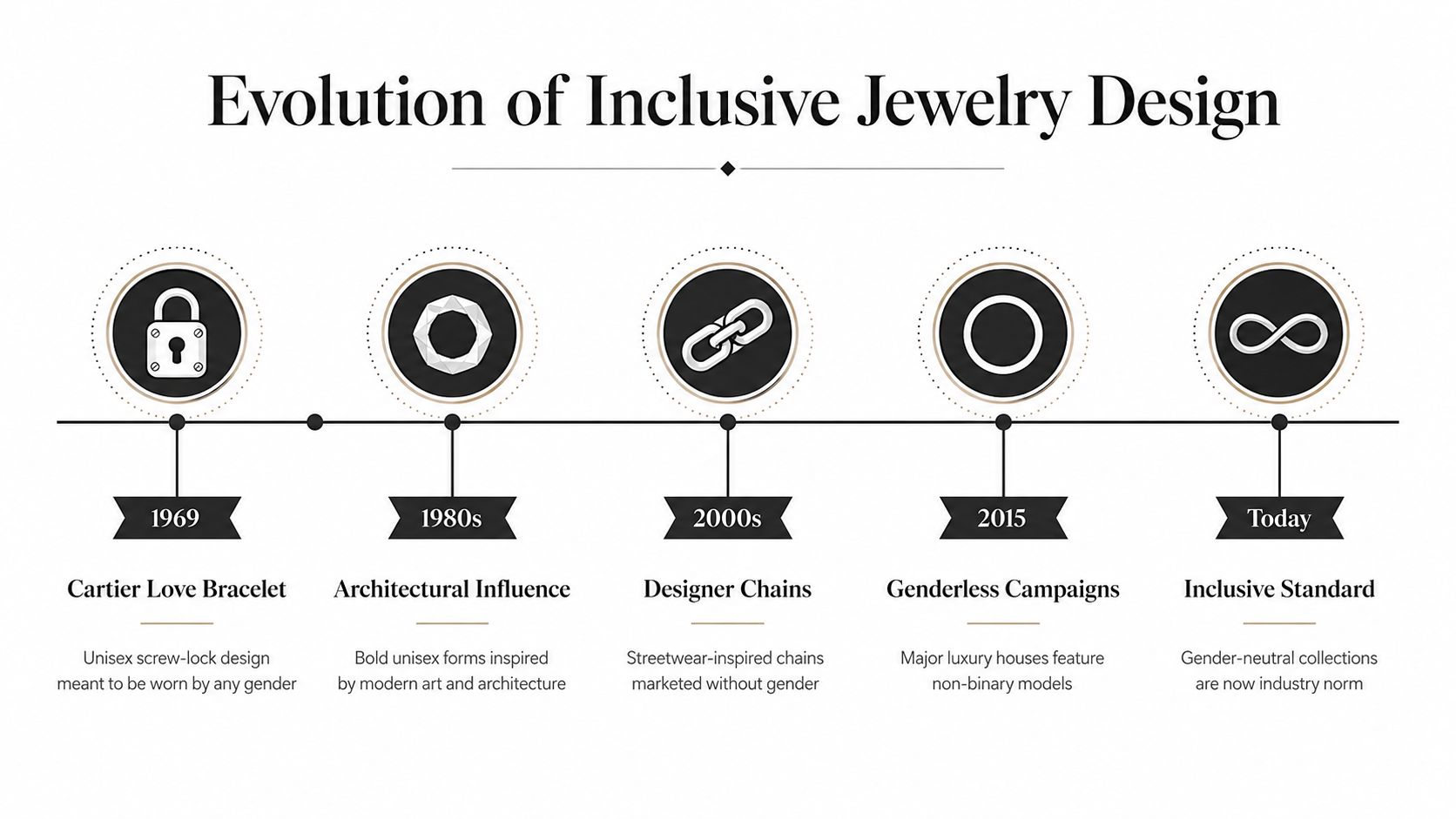
Gender-neutral jewelry has deep roots in modern luxury branding. The movement didn't begin with recent social media language or a sudden change in consumer taste. Major jewelry houses have spent decades developing pieces whose appeal comes from minimalism, recognizable form, and flexibility, rather than from a strict gender distinction.
Harper's Bazaar's historical overview traces Cartier's Love collection to the late 1960s and Juste un Clou to the early 1970s. Both became associated with minimalism, androgyny, and timeless design. Their lasting influence came partly from their strong visual identities. A screw motif, a nail-inspired shape, or a clean band can communicate character without telling the wearer who is allowed to wear it. Harper's Bazaar's account of the rise of gender-neutral jewelry places these collections within a longer design evolution.
From recognizable icons to broader positioning
Boucheron's Quatre arrived in 2004, adding another example of a collection built around layered geometry and mixed visual references. Bvlgari's B.zero1 debuted in 1999 and was relaunched as a unisex collection in 2020. These milestones show how inclusive design moved through different stages, from iconic forms that crossed gender lines in practice to collections explicitly positioned for a wider audience.
The year 2020 also marked a clearer shift in luxury messaging. Bvlgari and Comme des Garçons/Mikimoto framed releases as pieces for “all, regardless of age or gender,” according to the same Harper's Bazaar reference. That language matters because it made broad wearability part of the product's stated identity, not merely an interpretation made by individual shoppers.
The result is a design tradition lasting more than five decades, with recognizable luxury collections deliberately blurring gender distinctions. For today's shopper, that history offers useful reassurance. Choosing a clean band, a substantial chain, or a mix-and-match charm isn't abandoning tradition. It connects to a long-running idea that jewelry can be elegant, meaningful, and widely wearable at the same time.
Design Elements That Make Jewelry Truly Inclusive
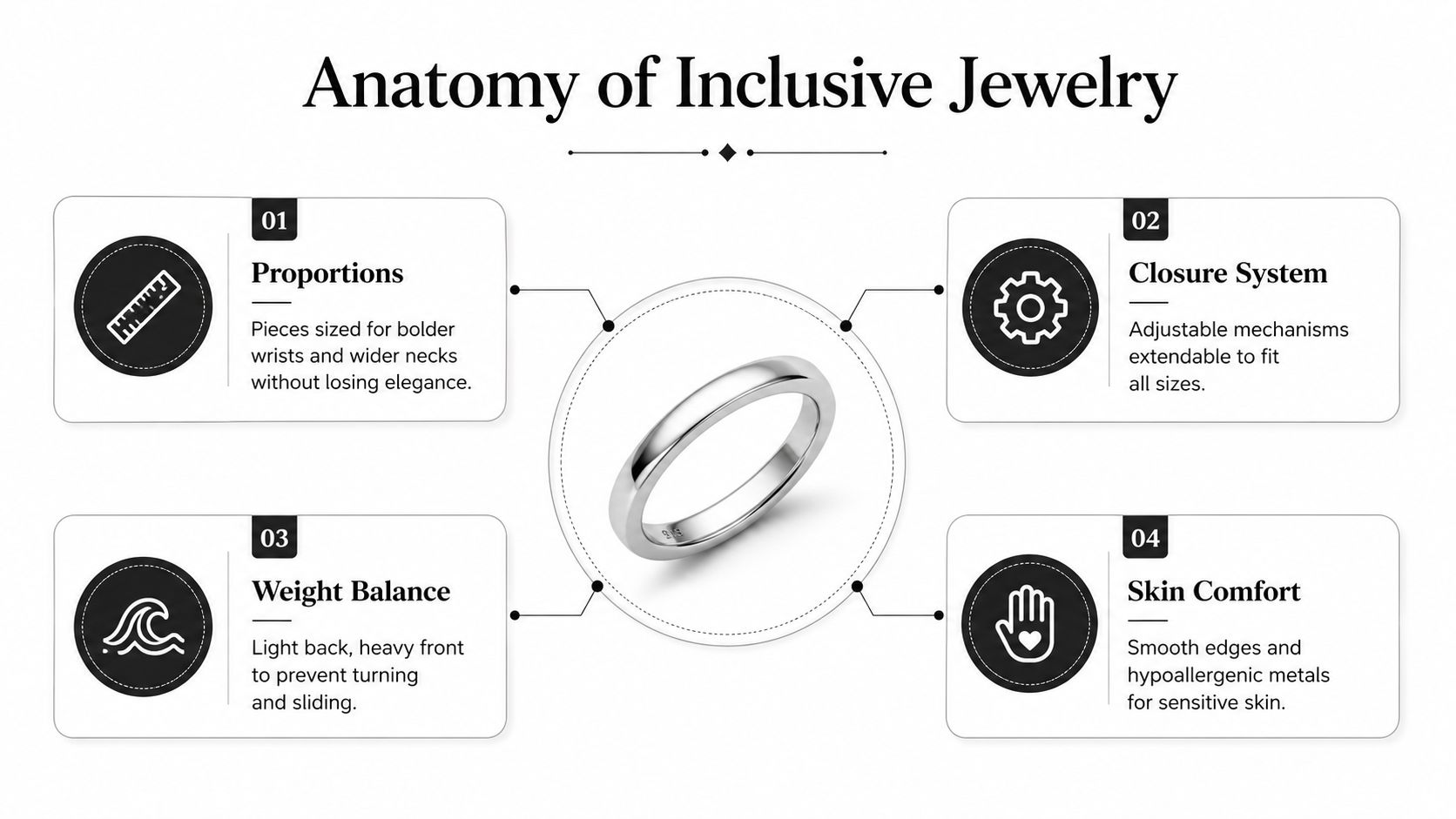
A gender-neutral piece succeeds when it works on the body, not just in a product photograph. Designers need to consider proportions, surfaces, weight, closures, and material compatibility together. Shoppers can use the same checklist before buying.
Start with proportions, not gendered sizing
Width and diameter affect how jewelry looks and feels. A narrow chain may disappear visually on one wearer, while a wide chain may feel too dominant on another. Neither choice is masculine or feminine. The important question is whether the scale feels balanced with the wearer's build and personal preference.
For many wearers, necklaces commonly fall within the 18 to 22 inch range, according to gender-neutral jewelry sizing guidance from Brite. Treat that range as a starting point, not a rule. Measure from the body, consider where the pendant should sit, and check whether the wearer prefers a close neckline or a lower drop.
Rings and bracelets should also be measured from the person rather than assigned by gender. A bracelet that slides constantly can catch on clothing, while one that presses into the wrist becomes distracting. An inclusive design gives the wearer enough flexibility to find a secure but comfortable position.
Choose materials for real life
Material affects appearance, durability, skin compatibility, and maintenance. Universally wearable options commonly include steel, sterling silver, gold, and titanium. For sensitive skin, look for nickel-free or hypoallergenic choices. Design guidance on adaptive jewelry ergonomics also emphasizes lightweight construction, balanced weight, adjustable sizing, and flexible components.
The construction matters as much as the metal. Smooth edges reduce catching and pressure points. A well-balanced pendant should stay oriented instead of constantly flipping. A bracelet extender can make gifting safer when you don't know the recipient's exact wrist measurement, while an expandable ring can accommodate everyday changes such as temperature-related swelling.
Test the design questions
Before purchasing, ask:
- Can the piece adjust? Look for extender links, multiple clasp positions, removable links, or expandable structures.
- Will it feel comfortable all day? Check weight, edge shape, and whether moving parts can pinch.
- Does the finish suit the wearer? Matte, brushed, polished, textured, and mixed-metal surfaces create different impressions without requiring a gender label.
- Can it work with existing jewelry? A versatile piece should layer or stand alone.
For mixed-metal wardrobes, EP Fine Jewelry's guide to mixing gold and silver offers a practical way to think about contrast, repetition, and balance.
How to Style Gender Neutral Jewelry for Any Occasion
The easiest way to style gender-neutral jewelry is to begin with one anchor piece. That might be a chain, a signet-style ring, a cuff, or a pair of hoops. Build around its visual weight instead of trying to match every item perfectly.
Build layers with contrast
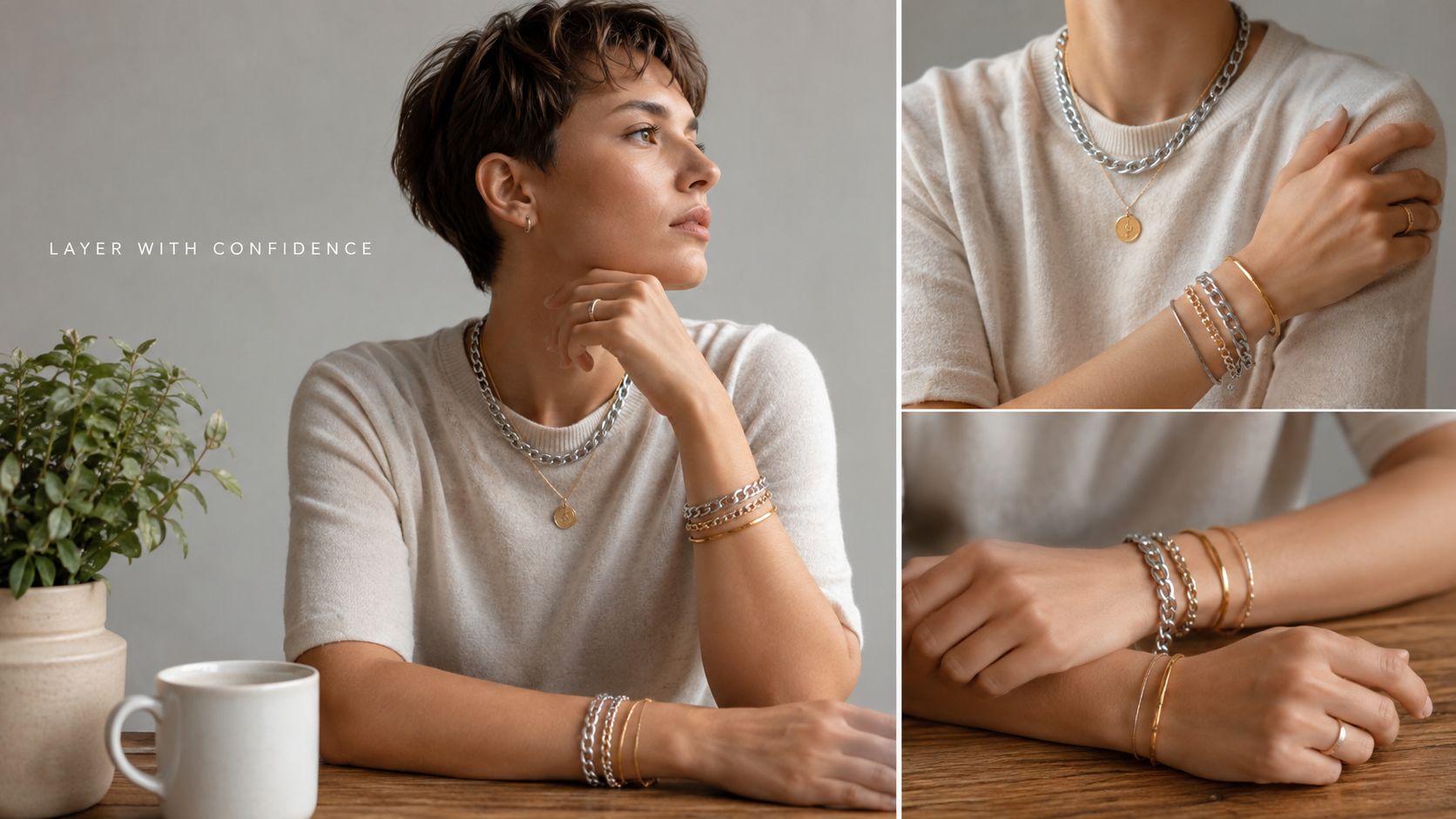
Layering looks intentional when each piece has a clear role. Combine a shorter chain with a longer pendant, or place a smooth bracelet beside one with texture. If every item has the same length, finish, and thickness, the arrangement can look flat. If every item competes for attention, the result becomes busy.
A mixed-metal combination can also create structure. Let one metal appear in more than one place, such as a gold charm on a silver necklace paired with a slim gold ring. That repetition makes the contrast feel planned rather than accidental.
For ears, combine formats according to comfort and spacing. A small hoop can anchor the lobe, while a stud or subtle secondary piece adds height. EP Fine Jewelry's minimalist ear stack guide can help you compare placement and proportion without tying a look to a gender category.
Match the setting to the occasion
Everyday styling benefits from pieces that won't compete with movement or clothing. Try a medium chain, a low-profile ring, or a lightweight bracelet with a plain shirt, knitwear, or denim.
For work, reduce the number of focal points. A polished pendant or a pair of clean hoops can add definition without creating noise. For a weekend look, use texture and layering. A matte ring beside a polished band, or a charm necklace over a casual top, gives the outfit more personality.
Special occasions allow one stronger element. Choose a sculptural ring, a substantial cuff, or a pendant with a meaningful engraving, then keep nearby pieces quieter. The balance comes from contrast in scale, not from following a formal “for him” or “for her” formula.
A useful styling test is simple: remove one piece before leaving the house. If the outfit still feels complete, the remaining jewelry is doing its job. You can always add the extra layer later when the setting feels right.
Personalization makes versatile jewelry feel less generic. Add a charm connected to a place, initial, or memory, or choose a finish that reflects the wearer's everyday wardrobe. The strongest gender-neutral styling doesn't erase personality. It gives personality more room to lead.
Smart Shopping Strategies for Inclusive Jewelry
Online shopping becomes easier when you separate fit, material, style, and service instead of judging a piece from a gendered category. Product photos may show only one person, but the description should give you enough information to decide whether the jewelry can work for the intended wearer.
Compare the practical details
| Consideration | What to Look For | Why It Matters |
|---|---|---|
| Fit | Measurements taken from the body, size charts, and adjustable options | A close fit is more reliable than a gender assumption |
| Materials | Clear metal information, plating details, and nickel-free or hypoallergenic options | Material affects comfort, durability, and skin compatibility |
| Closure | Extenders, flexible chains, expandable rings, or multiple fastening points | Adjustment makes gifting and daily wear easier |
| Personalization | Engraving, initials, charms, or selectable components | Meaning comes from the wearer's story, not a category label |
| Care | Cleaning instructions and storage guidance | Proper maintenance helps preserve the finish |
| Policies | Clear shipping, return, and exchange information | A transparent policy reduces risk when buying online |
Measure before you guess
For a necklace, measure around the neck or use a cord to test where different lengths sit. For a bracelet, measure the wrist where the piece will rest, then check the product's finished dimensions and adjustment range. For a ring, measure the actual finger and remember that the intended finger may differ from the one used for comparison.
If you're buying a gift, adjustable designs are often safer than tightly sized pieces. A charm necklace, extendable bracelet, or open-form ring can give the recipient room to make the fit their own. Personalization should also remain flexible. A symbol or initial may carry more meaning than a design chosen only because it appears broadly wearable.
Material descriptions deserve careful reading. “Gold” can describe solid gold, plating, or a color, so confirm the construction before purchase. EP Fine Jewelry's information on rhodium-plated sterling silver is a useful example of why the base metal and surface finish should both be considered.
Make gifting feel deliberate
A meaningful gift doesn't require you to know someone's style perfectly. Choose a piece with a balanced silhouette, an adjustable fit, and a finish that works with what they already wear. Add a gift box if available, and use the order notes field for a personal message or special handling request.
Before checkout, review care information, shipping timing, and return terms. Those details matter just as much as the design when you're sending jewelry directly to someone else. A clear retailer experience lets the recipient enjoy the gift without turning fit or maintenance into a guessing game.
Common Misconceptions About Gender Neutral Jewelry
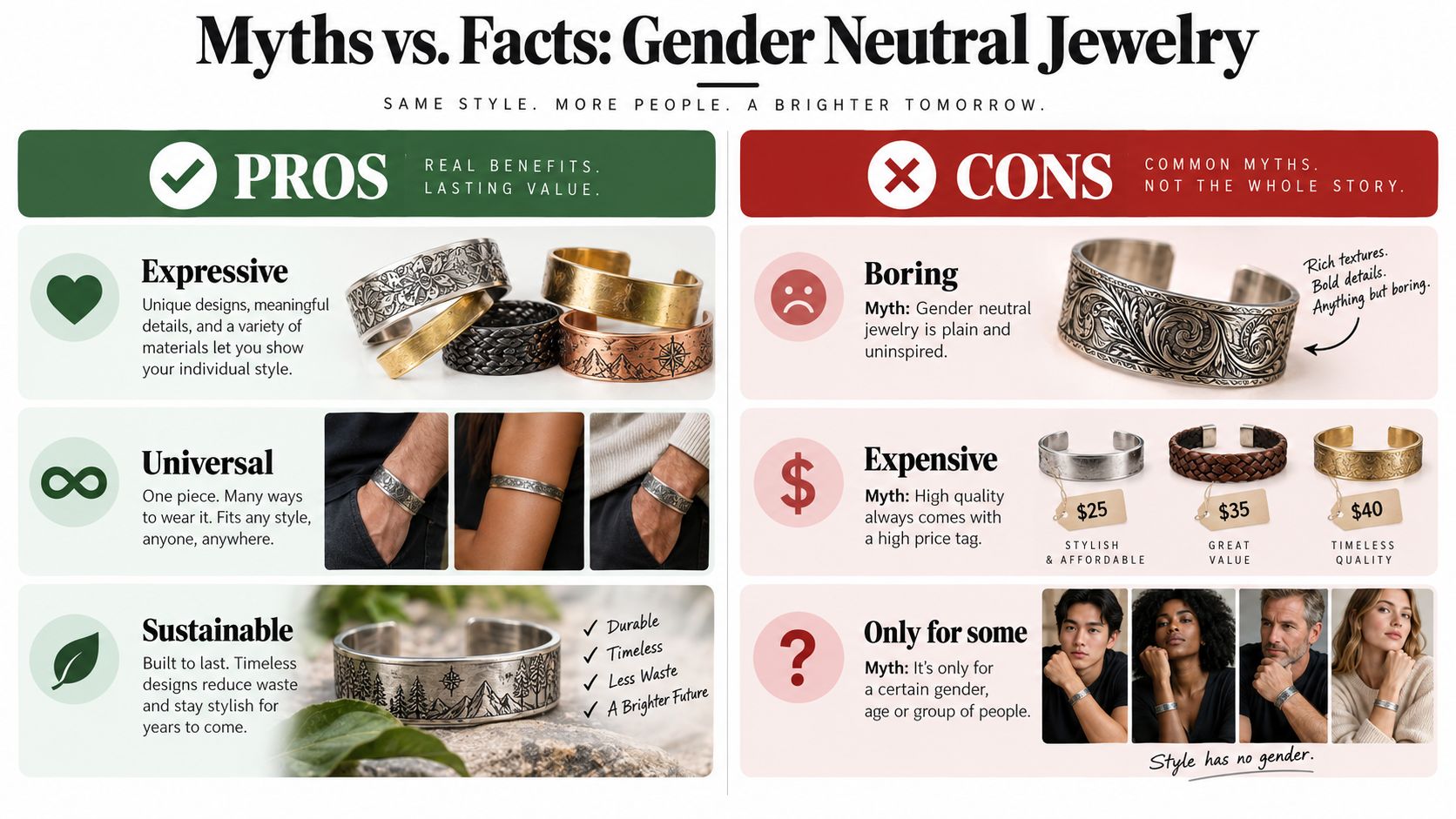
The first misconception is that gender-neutral jewelry must be boring. Minimalism is one option, not the entire category. A piece can use intricate engraving, bold texture, sculptural geometry, mixed metals, or a vivid stone while remaining open to anyone who wants to wear it.
A second assumption says inclusive jewelry works only on certain body types. In reality, proportion and adjustment provide more useful guidance than gendered sizing. A chain can be selected for its intended drop, a bracelet can include an extender, and a ring can be chosen by finger measurement. These choices solve real fit problems rather than assigning style based on identity.
The market is broader than a trend label
Market data also places gender-neutral jewelry inside a substantial global category. Icecartel reports that the unisex segment was valued at about $8 billion in 2025 and cites an estimated 8.00% compound annual growth rate through 2033 in its jewelry market overview. The same source reports the broader global jewelry market at roughly $308.5 billion in 2025, with an approximate rise to $340.8 billion in 2026.
Other industry estimates describe a market still shaped heavily by gendered purchasing. Fortune Business Insights valued the global jewelry market at $242.79 billion in 2025, while Mordor Intelligence reported that women accounted for 74.25% of gems and jewelry spending in 2025 and projected the men's segment to expand at a 6.03% CAGR to 2031, as summarized in the same Icecartel source.
These figures come from different market reports and should not be treated as one unified measurement. Together, they do show why neutral design has practical value. It can help retailers reach people who don't identify with traditional categories, shoppers seeking flexible gifts, and customers who prefer to choose by shape and comfort.
The final misconception is that a gender-neutral gift feels less personal. Personalization reverses that idea. An engraving, charm, finish, or carefully chosen proportion can make a piece more thoughtful because it reflects the recipient rather than a stereotype.
Building Your Inclusive Jewelry Collection
A useful collection doesn't need to begin with a large shopping list. Start with one piece that can serve more than one role, such as an adjustable necklace, a comfortable bracelet, or a ring with enough visual character to wear alone and enough restraint to layer.
Choose the item by fit first, then examine the material, finish, and care requirements. Once you know what feels comfortable, add contrast. A polished piece can sit beside a matte one, and a simple chain can support a meaningful charm. Personalization gives the collection continuity without forcing every item to match.
Necklace length is especially important when building layers. Use a practical necklace length chart from EP Fine Jewelry to compare where different styles sit, then adapt the choice to the wearer's neckline and preferred drop.
The strongest collection reflects habits, not categories. Some people want understated daily pieces. Others prefer statement rings, textured cuffs, or expressive charms. Gender-neutral jewelry makes room for both approaches because it treats identity and style as personal rather than predetermined.
Start with the piece you can imagine wearing or gifting repeatedly. Let comfort, materials, personalization, and real wardrobe use guide the next choice. That's how a collection becomes authentic, one considered piece at a time.
EP Fine Jewelry offers personalized jewelry, charm necklaces, rings, bracelets, necklaces, and earrings, along with gift box options, order notes, care guidance, and clear shipping and return information. Explore the inclusive pieces and personalization choices at EP Fine Jewelry, and choose a design that fits the wearer rather than a traditional label.