
You're staring at ring options, and the usual solitaire keeps showing up, but the two-stone design keeps pulling your eye back. It looks more personal, a little less expected, and it raises the practical question many first-time buyers have: does a two stone ring work for everyday wear, or is it mostly a pretty trend?
The short answer is that it can do both. A two-stone ring carries a long history, clear symbolism, and enough design flexibility to suit someone who wants meaning without giving up comfort or versatility. If you're deciding between a classic single stone and something more expressive, the details below will help you judge the style by how it looks, how it wears, and how it fits into real life.
Table of Contents
- Why Two Stone Rings Are Worth a Second Look
- What a Two Stone Ring Actually Is
- Symbolic Meaning Behind the Two Stones
- Design and Setting Choices That Matter
- Two Stone vs Solitaire vs Three Stone Rings
- Famous Two Stone Rings and What They Show
- Buying, Personalizing, and Wearing a Two Stone Ring
- Choosing the Two Stone Ring That Fits Your Story
Why Two Stone Rings Are Worth a Second Look
A shopper usually doesn't start with a two-stone ring. They start with a solitaire search, then scroll past rows of similar-looking settings until a two-stone design interrupts the pattern. That moment matters, because the style doesn't rely on novelty alone, it offers a different way to think about the ring as a pair of equal parts instead of one dominant centerpiece.
The appeal is easy to understand for anyone who wants something personal but still wearable every day. A two-stone ring can signal partnership, contrast, or balance without becoming visually heavy, and that makes it useful for engagement rings, milestone gifts, and custom pieces. It also gives buyers more room to decide what matters most, matching stones, mixed shapes, metal color, or a lower profile that won't feel oversized on the hand.
If you're browsing options like EP Fine Jewelry's two-stone collection, the main question isn't whether the style is “on trend.” It's whether the design gives you enough symbolism, enough comfort, and enough flexibility to fit the way you wear jewelry.
Practical rule: choose the style that answers your daily questions first, not the one that photographs best.
That's why this ring category deserves more than a passing glance. It's not only about romance or fashion, it's about how a ring handles movement, stacking, and the kind of personal story you want it to tell.
What a Two Stone Ring Actually Is
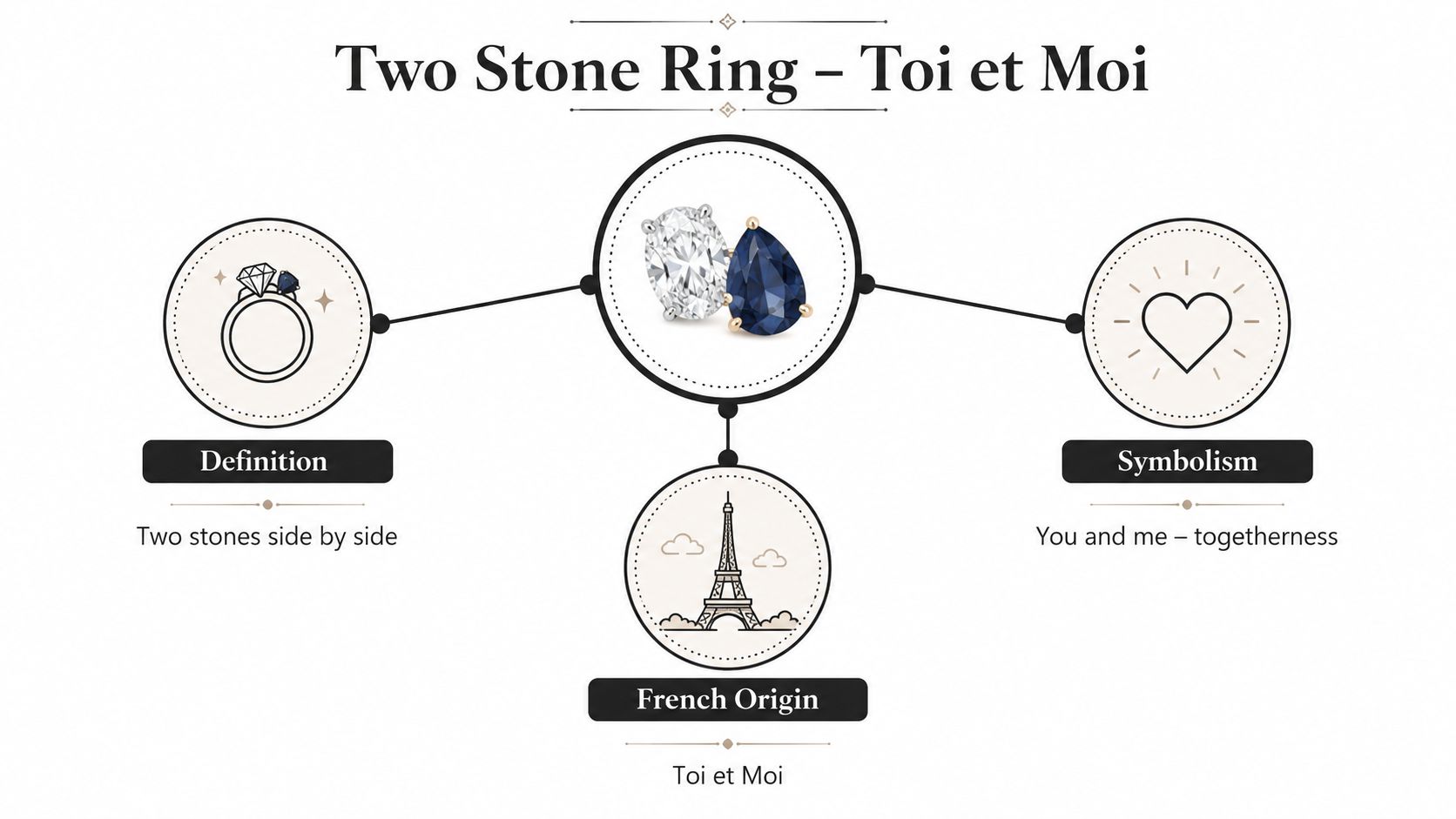
A two stone ring is exactly what it sounds like, a ring built around two primary stones instead of one. In the French phrase toi et moi, the idea is “you and me,” which makes the symbolism easy to grasp even if you've never heard the term before. Think of it as one band carrying two focal points, both visible, both important.
That structure changes how the ring reads. A solitaire points attention to one center stone, while a two-stone design creates a visual conversation between the two gems. The stones can match, contrast, lean toward each other, or sit with a little space between them, and each choice changes the mood. If you're comparing a simple ring to something custom-feeling, that difference is the whole point.
The style's best-known origin goes back to January 1796, when Napoléon Bonaparte proposed to Joséphine de Beauharnais with a ring set with two pear-shaped stones, commonly described as a diamond and a sapphire (Sotheby's). That detail matters because it places the design in late-18th-century European jewelry rather than in a recent trend cycle. It also helps explain why the style still feels current, the design has been returning for more than 200 years.
If you want a simple real-world comparison, the 14K Two Stone Ring sits in that tradition of pairing two focal stones in one setting. A customized piece like the Personalized Date Ring shows the same broader idea of turning jewelry into a readable personal message, even though it uses a different format.
The easiest way to remember the category is this. A two-stone ring is a single ring made to hold two centers, and those two centers are what give it meaning, balance, and shape.
Symbolic Meaning Behind the Two Stones
The symbolism is simple, which is part of why the style connects so quickly with buyers. Each stone can stand for one person in a couple, or one half of a shared story, while still keeping its own shape and personality. That gives the ring a built-in sense of unity without flattening either side into sameness.
Matching stones feel balanced
When the two stones are matched, the ring reads as calm and symmetrical. That works well for buyers who want equality to feel obvious at a glance, especially in engagement pieces where the ring should signal two people joining without one overpowering the other. Matched stones also make the visual language easier to read from across a room.
Contrasting stones feel more personal
Different shapes or colors make the ring feel more like a story than a formula. One stone can bring brightness while the other brings depth, or one can be softer in outline while the other feels more architectural. That contrast doesn't weaken the symbolism, it usually strengthens it by showing that two distinct personalities can sit side by side.
Birthstones and color choices add another layer
A lot of buyers want the ring to say something only they understand. Birthstones, favorite colors, or a combination that reflects shared memories can make the design feel less generic and more deliberate. In that sense, the two-stone format works almost like a tiny family archive, one that you can wear daily.
Useful way to think about it: the stones don't have to be identical to belong together, they only need to make sense together.
That flexibility is why the style holds up so well for gifting. It can feel formal, romantic, playful, or commemorative depending on how the stones are chosen. The ring doesn't force one meaning on every wearer, it leaves room for the wearer to decide what the pairing should represent.
Design and Setting Choices That Matter
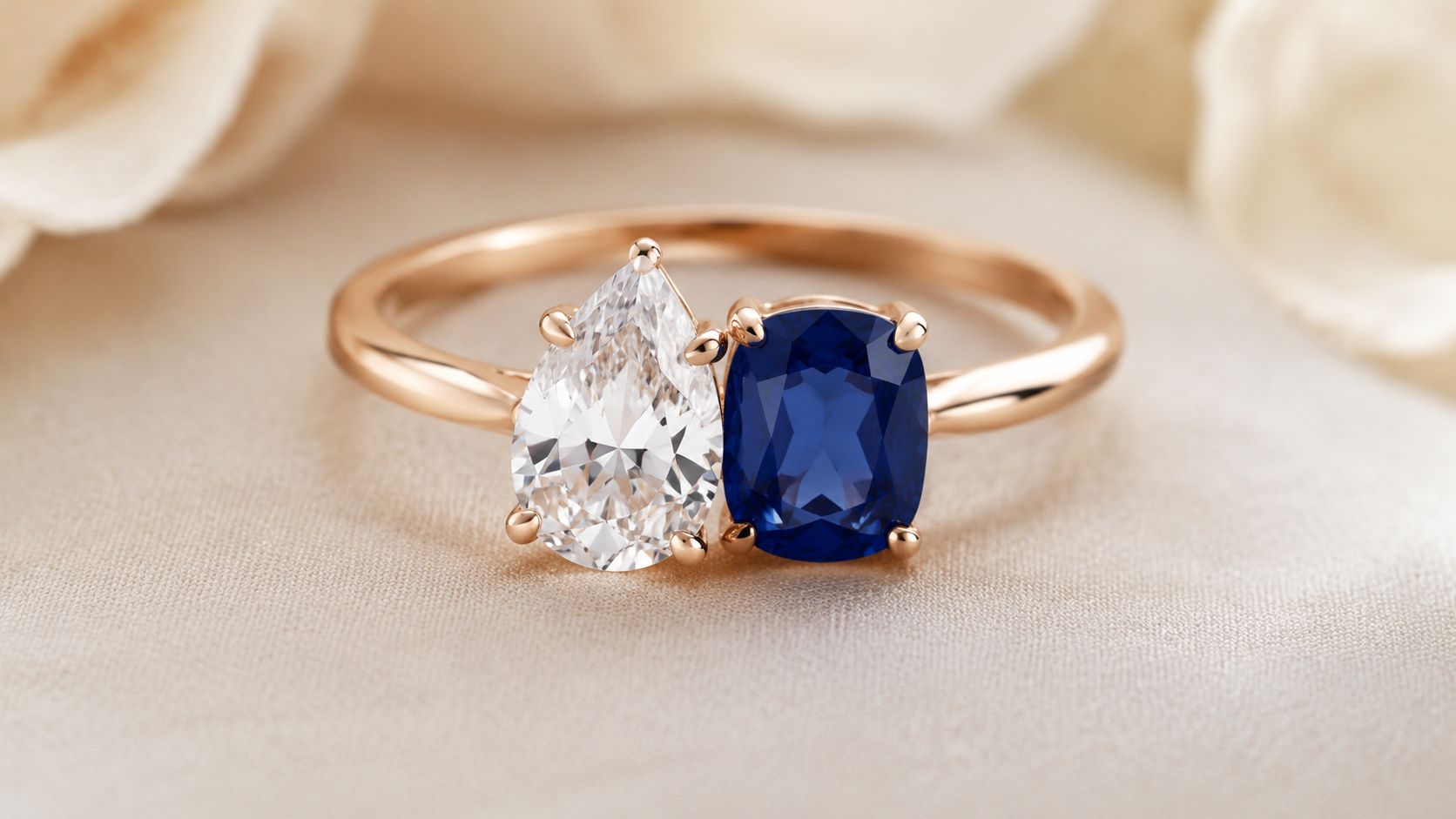
The first thing to understand is that a two-stone ring is a design problem as much as a style choice. Two stones need to balance each other visually and physically, so the ring's shape, metal, and setting all matter more than they do in many single-stone designs. The best-looking ring on a screen can still feel awkward on the hand if the mounting sits too high or the stones fight each other.
Shape pairing changes the whole ring
A pear paired with a cushion looks softer and more fluid, while a round paired with an oval feels cleaner and more even. Matched emerald cuts usually read as structured and formal. Those decisions aren't just about taste, they affect how much the ring spreads across the finger and how stable the stones look together.
A practical product example shows how much variation exists even within the category. One two-stone engagement-ring specification lists a 0.25 ct center diamond with 7 × 3.5 mm dimensions, VS1 clarity, G-H color, 14K yellow gold, and a total weight of 3.53 g, while another uses 14K white gold, an approximate 1.5 mm band width, and about 0.15 tcw in 28 natural diamonds with center stones sold separately (Trinity Jewelers). Those differences show how quickly the same basic idea can move from minimal to ornate.
Setting style affects wearability
Prong settings leave more of the stones visible, which helps brilliance but can raise the profile. Bezel settings wrap more metal around the stone, which can feel safer for daily use. Pavé accents add sparkle, but they also add visual weight and more small points to inspect over time. If you want a cleaner everyday profile, the 14K Bezel Two Stone Ring fits that logic better than a heavily decorated setting.
Metal and band width shape comfort
Metal choice changes both the look and the feel. Gold reads warmer, white metals feel sharper, and silver can suit lighter fashion pieces. Band width matters too, because a narrow band can feel delicate while a wider one can steady the top of the ring on the finger. In a two-stone design, that balance is not cosmetic, it affects how top-heavy the ring feels during wear.
Two Stone vs Solitaire vs Three Stone Rings
A buyer often compares these three styles by photos first, then by how the ring will feel on the hand. A better way is to separate visual impact, symbolism, and everyday comfort, because each style solves a different problem. A solitaire keeps the design focused on one stone. A three-stone ring adds more surface area and a straightforward narrative. A two-stone ring sits between them, with more meaning than a solitaire and often less bulk than a three-stone design.
| Feature | Two Stone | Solitaire | Three Stone |
|---|---|---|---|
| Visual presence | Strong, balanced, and distinctive | Clean and classic | Larger and more elaborate |
| Symbolism | Shared partnership, duality, balance | Focus on one center stone | Commonly read as past, present, future |
| Comfort on the hand | Often comfortable if the setting stays low | Usually the easiest to wear | Can feel heavier or broader |
| Budget flexibility | Room to vary stone sizes and shapes | Simpler structure can keep costs focused | More stone weight can raise complexity |
| Everyday versatility | Good for custom looks and stacking, depending on profile | Very easy to pair with bands | Can be harder to stack neatly |
A solitaire still fits well if you want the least visual clutter and the easiest stacking with other rings. A three-stone ring works when you want more sparkle and a clear story without making the design asymmetrical. For buyers who want something expressive but still wearable, the two-stone format often lands in the middle in a useful way.
That middle position matters for daily wear. A ring can look striking in a display case and still feel awkward after a full day of typing, commuting, or wearing a wedding band beside it. The two-stone design lets you decide where the emphasis goes, on meaning, on shape contrast, or on a lower, lighter profile that stays comfortable.
The tradeoff is not only style, it is also structure. Two stones can be sized and shaped to share the visual load, so the ring may feel less top-heavy than a single large center stone or a wider three-stone layout. That can make it a practical choice for someone who wants presence without giving up ease of wear.
If you are choosing based on routine instead of trend, pay attention to how your hand moves during the day. A ring that brushes sleeves, bumps into objects, or crowds a wedding band may look polished in a photo but become irritating quickly. A two-stone ring can avoid that problem when the setting is kept thoughtful and restrained, and a 14K Three Stone Ring usually makes the opposite choice, favoring more coverage and more visual weight.
Famous Two Stone Rings and What They Show
The style makes more sense through real examples than through a generic mood board. One of the clearest is the 1953 engagement ring given by John F. Kennedy to Jacqueline Kennedy. It is widely described as pairing an emerald-cut diamond with an emerald-cut emerald of nearly equal size, around 3 carats each or, in some accounts, 2.88 carats and 2.84 carats (Natural Diamonds). That ring shows that the two-stone idea has long belonged in serious design, not only in boutique fashion pieces.
The Napoléon-Joséphine ring is another landmark. It reportedly sold in 2013 for just under $1 million at Osenat. Because the same Natural Diamonds article discusses both rings, the auction attention here reinforces a simple point, the style has collecting value as well as sentimental appeal. It also helps explain why the design keeps returning in modern jewelry conversations.
A well-made two-stone ring has always sat between intimacy and display. It feels personal, almost like a private message, yet it is distinctive enough to read as a statement from across a room. That balance is one reason the category keeps returning in new forms without losing its original identity.
The design has also stayed visible because it lets people do more with less. Two stones can carry a complete idea while still leaving space for the shapes, colors, and proportions to speak for themselves. For a first-time buyer, that can be the practical appeal, the ring looks expressive without needing the visual weight of a larger single center stone or a wider multi-stone layout.
Buying, Personalizing, and Wearing a Two Stone Ring
The best buying questions are practical ones. Do the two stones look balanced in real light, not just in product photos? Do the prongs feel secure? Will the ring snag on knitwear or sit too high for your day-to-day routine? Those questions matter more than marketing language because they determine whether the ring stays in your rotation.
Check pairing with your eyes, not just on paper
Independent jewelry guidance on stone pairing shows that matching is often judged in millimeters and visual symmetry rather than carat weight, and that cut and symmetry can matter more than a single shared color grade (GuruDiam). That's useful because a buyer can assume two stones of similar carat weight will look balanced, then find that the shapes still feel uneven. A good jeweler pays attention to how the stones read together from the top, the side, and at a slight angle.
Think about wear, not just appearance
A lower setting usually reduces snag risk, which matters if you wear sweaters, gloves, or a lot of layered jewelry. A more protective mounting can also help if one stone is softer or more exposed than the other. If you're comparing materials or deciding between natural and lab-grown stones, the EP Fine Jewelry page on lab versus natural is a straightforward place to review that choice alongside the ring style itself.
Practical rule: the ring should feel secure enough that you stop thinking about it after a few days.
Personalization works well in this category
Two-stone rings are already personal, so small custom touches fit naturally. An engraving, a date format, or a stone pairing that reflects a relationship can give the ring a clearer meaning without making it busy. If you prefer a design that announces its message more directly, a personalized date format can work alongside, or instead of, a two-stone layout depending on how literal you want the symbolism to be.
For care, keep the ring clean, check the setting periodically, and store it separately from harder jewelry. Two-stone rings reward attention because their appeal comes from balance, and balance is the first thing that gets lost when a setting loosens or a stone shifts.
Choosing the Two Stone Ring That Fits Your Story
A two stone ring makes sense when you want visible symbolism, a design that can stay comfortable for everyday wear, and room to choose between matching and contrasting stones. It's a strong option for someone who likes the emotional read of a two-person story but doesn't want the visual weight of a larger multi-stone ring. If that sounds like you, the next step is simple, compare a few stone pairings, check the setting height, and decide how much of the design should feel classic versus personal.
Look at collections that show different versions of the format, then narrow your choice by how you'll wear it. A ring that fits your routine will age better in your life than one chosen only because it looked beautiful in a photo. If you want a piece with a clearer personal message, think about dates, initials, or stone combinations before you buy, and make sure the return and care policies feel as solid as the ring itself.
EP Fine Jewelry offers ring collections, personalized pieces, and clear product information that can help you compare styles before you commit. If you're ready to explore a two-stone design or a personalized ring that fits your own story, visit EP Fine Jewelry and review the ring options, care guidance, and ordering details at your own pace.