
You're standing in a jewelry shop, trying to choose a gift that feels personal without becoming too specific. A full name may be beautiful, but it can feel risky if you're unsure about the recipient's preferred style. A cursive initial necklace often lands in the sweet spot: intimate, recognizable, and easy to wear with pieces she already owns.
The catch is that script jewelry isn't only about appearance. A delicate letter must remain legible at a small size, attach securely to its chain, and suit the way the recipient dresses. The right choice depends on the font, metal, pendant proportions, chain length, care requirements, and the seller's custom-order policy.
Table of Contents
- Why Cursive Initial Necklaces Remain a Timeless Choice
- Choosing the Right Cursive Font and Letter Style
- Metal Options and Chain Durability for Everyday Wear
- Sizing, Layering, and Styling Your Initial Necklace
- Smart Gifting Strategies for Personalized Necklaces
- Caring for Your Cursive Initial Necklace
- Your Quick Purchase Checklist
Why Cursive Initial Necklaces Remain a Timeless Choice
You might choose an initial necklace for a birthday, a new mother, a graduation, or because one letter carries private meaning. It could represent her first name, a child's name, a family surname, or a shared memory. That personal connection gives the necklace more emotional weight than a generic pendant while keeping the design understated enough for regular wear.
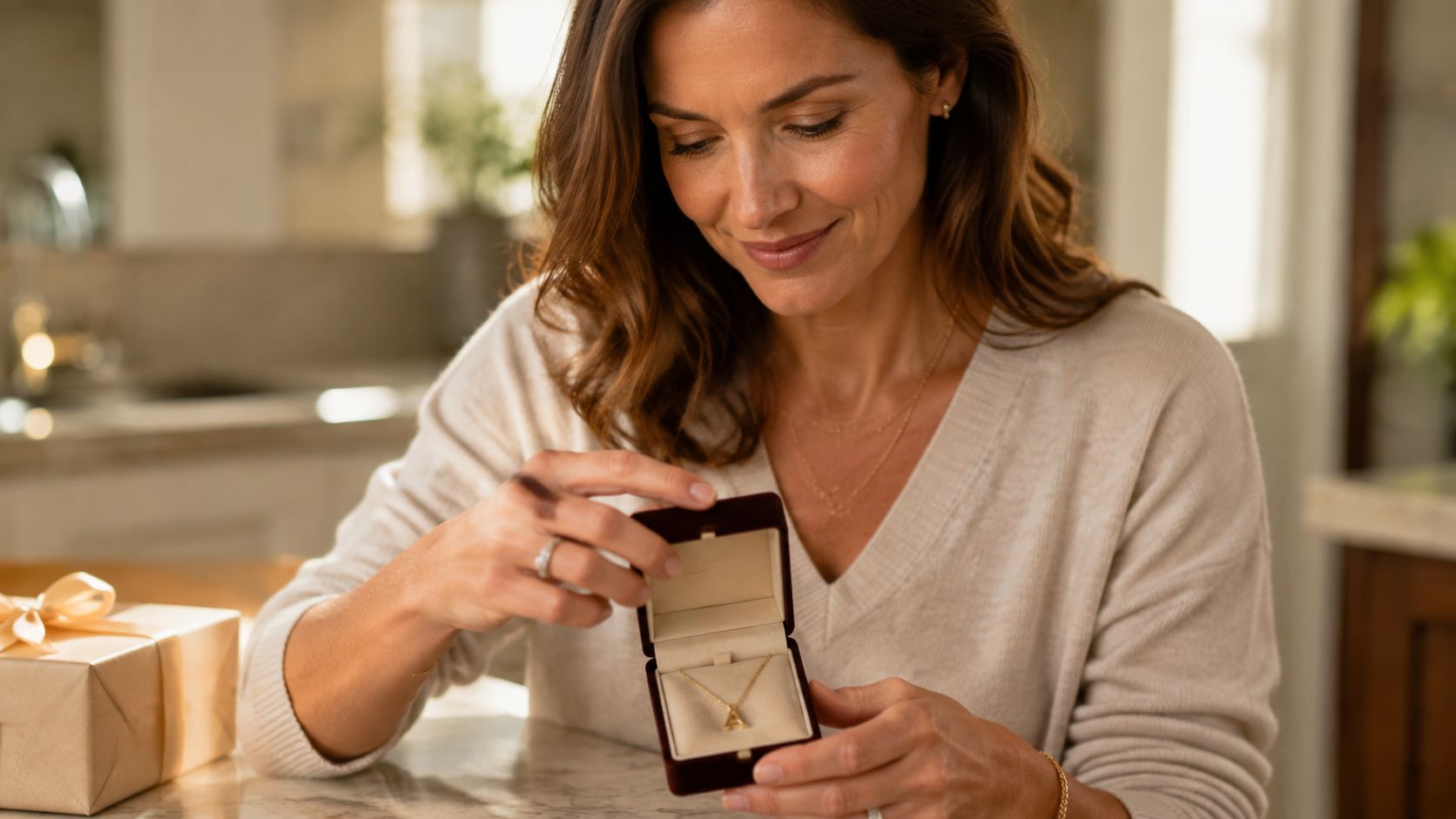
Cursive works because it softens the letter. A block initial looks graphic and direct. A flowing script initial feels more like a signature, especially when the pendant has a gentle curve, a narrow stroke, or a small flourish. That makes it suitable for someone who likes feminine jewelry but doesn't want a large statement piece.
The format also offers useful flexibility. A single letter can sit on its own, pair with a birthstone pendant, or become part of a layered necklace arrangement. You can browse options through a dedicated personalized necklace collection when you want to compare initials, names, and related designs in one place.
Personalization has moved beyond novelty
Initial necklaces belong to a substantial identity-driven jewelry category, not a narrow souvenir market. The global personalized jewelry market is estimated at USD 38.6 billion in 2025 and projected to reach USD 81.4 billion by 2034 at an 8.7% CAGR, according to Dataintelo's personalized jewelry market overview. The category is tied to meaningful gifts, weddings, fashion purchases, and other occasions where the buyer wants the piece to feel chosen rather than interchangeable.
That context matters, but market size shouldn't decide your purchase. The better test is simple: does the letter mean something, and will the recipient wear it? If the answer is yes, cursive gives you a personal design without forcing an elaborate message into the jewelry.
Choosing the Right Cursive Font and Letter Style
The prettiest script sample on a product page may not be the most practical choice once it becomes a small metal pendant. Tiny loops can merge, thin strokes can disappear against skin, and long flourishes can catch on clothing. Ask to see the actual letter at the intended pendant size, not only a large font preview.
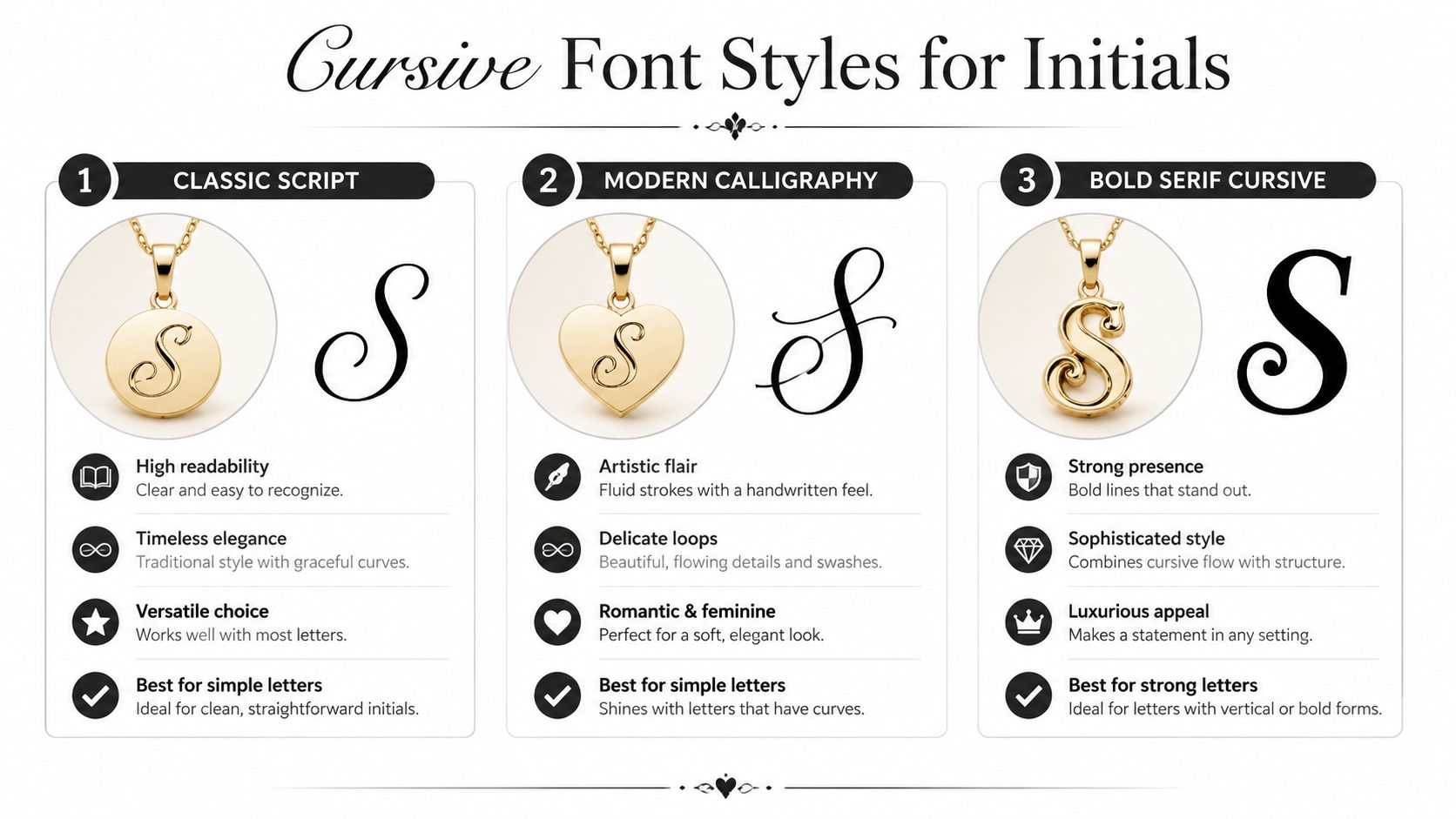
Three useful script directions
Classic script has sweeping strokes, rounded connections, and a traditional calligraphy feel. It suits romantic gifts and letters with naturally open shapes. The risk is excessive decoration. A long entry stroke or narrow loop may become difficult to read when the pendant is small.
Modern calligraphy usually has a cleaner rhythm and less ornament. It's my preferred choice for most everyday cursive initial necklaces because it preserves the handwritten character while reducing fragile details. This style often works particularly well for letters with clear verticals and open counters.
Bold handwritten script uses thicker strokes and stronger visual presence. Choose it when the necklace will be worn daily, layered with other chains, or given to someone who prefers noticeable jewelry. A bold design may lose some delicacy, but it generally gives the letter a better chance of staying readable and structurally sound.
For a more embellished option, examine the product photography and letter preview in a 14K pave script letter necklace listing. Look closely at the bail, the joins between strokes, and the amount of open space inside the letter.
Letter shape changes the decision
Open, flowing letters such as S, L, and M often retain their identity well in script. Tighter forms such as A and E need more scrutiny because their crossbars, loops, and connecting strokes can crowd together. Letters with multiple narrow turns may need a simplified version rather than a highly ornamental font.
Use this quick inspection before ordering:
- View the letter small: Zoom out until it resembles the size it will have on the wearer.
- Check the negative space: Open areas should remain visibly open instead of filling with metal or shadow.
- Inspect the thinnest strokes: If they look hairline-thin in the preview, ask whether a heavier version is available.
- Look for unsupported flourishes: A long tail should connect cleanly and avoid creating a weak projecting point.
- Consider the recipient's taste: Delicate script suits a subtle dresser, while bold handwritten lettering works better for someone who likes visible personalization.
If the seller can't show a clear preview of the chosen letter, choose a simpler font. Legibility is more valuable than a flourish that only looks impressive in a large digital sample.
Metal Options and Chain Durability for Everyday Wear
A cursive initial necklace can fail at the chain even when the pendant itself looks well made. The letter often presents a broad, flat surface, so it twists, rotates, and catches differently from a small round charm. For daily wear, I'd prioritize the chain gauge and attachment points before choosing decorative details.
14K gold is a strong choice for a frequently worn gift because it offers a warm gold appearance and a solid precious-metal construction. Sterling silver gives you a bright, cooler finish and can work well for someone who prefers silver jewelry, though it needs regular care to maintain its appearance. Gold vermeil offers a gold surface over sterling silver, while gold-plated jewelry depends more heavily on the thickness and condition of its surface layer. For practical maintenance expectations, review this guide to how long gold-plated jewelry lasts.
Match the chain to the pendant
Jewelry specialists generally place everyday-wear chains at at least 1.6 mm, with 2.0 to 2.5 mm preferred for heavier pendants, as explained in this chain strength guide. One technical comparison reports that a 2.2 mm wheat chain supports up to 22 kgf, while a 1.4 mm version supports 9 kgf, demonstrating how a modest change in thickness can substantially affect load capacity.
Use the table as a starting point, not a substitute for the seller's pendant specifications.
| Chain Thickness | Best For | Durability Notes |
|---|---|---|
| Below 1.6 mm | Very light, compact initials | More vulnerable to snags and repeated twisting |
| 1.6 mm | Light to standard daily pendants | A sensible baseline for regular wear |
| 2.0 to 2.5 mm | Wider, heavier, or flatter script pendants | Better suited to heavier loads and sudden pulls |
The pendant should never be judged by weight alone. Chain failure frequently starts at a solder seam, clasp ring, or link contact point, so inspect those areas in product images or ask the seller about construction. A secure bail should hold the initial without allowing the pendant to grind against the chain every time it moves.
Practical rule: Pair the chain with several times the pendant's weight when the necklace is intended for daily wear or layering. That extra capacity helps absorb sudden pulls rather than transferring every shock to one tiny ring.
Sizing, Layering, and Styling Your Initial Necklace
Chain length determines whether the initial looks intentional or disappears under a neckline. A 16-inch chain usually creates a closer, more delicate placement, while an 18-inch chain gives the pendant more room and works with a broader range of tops. An extender is useful when the recipient's wardrobe changes often or when you're unsure how close she likes her necklaces to sit.
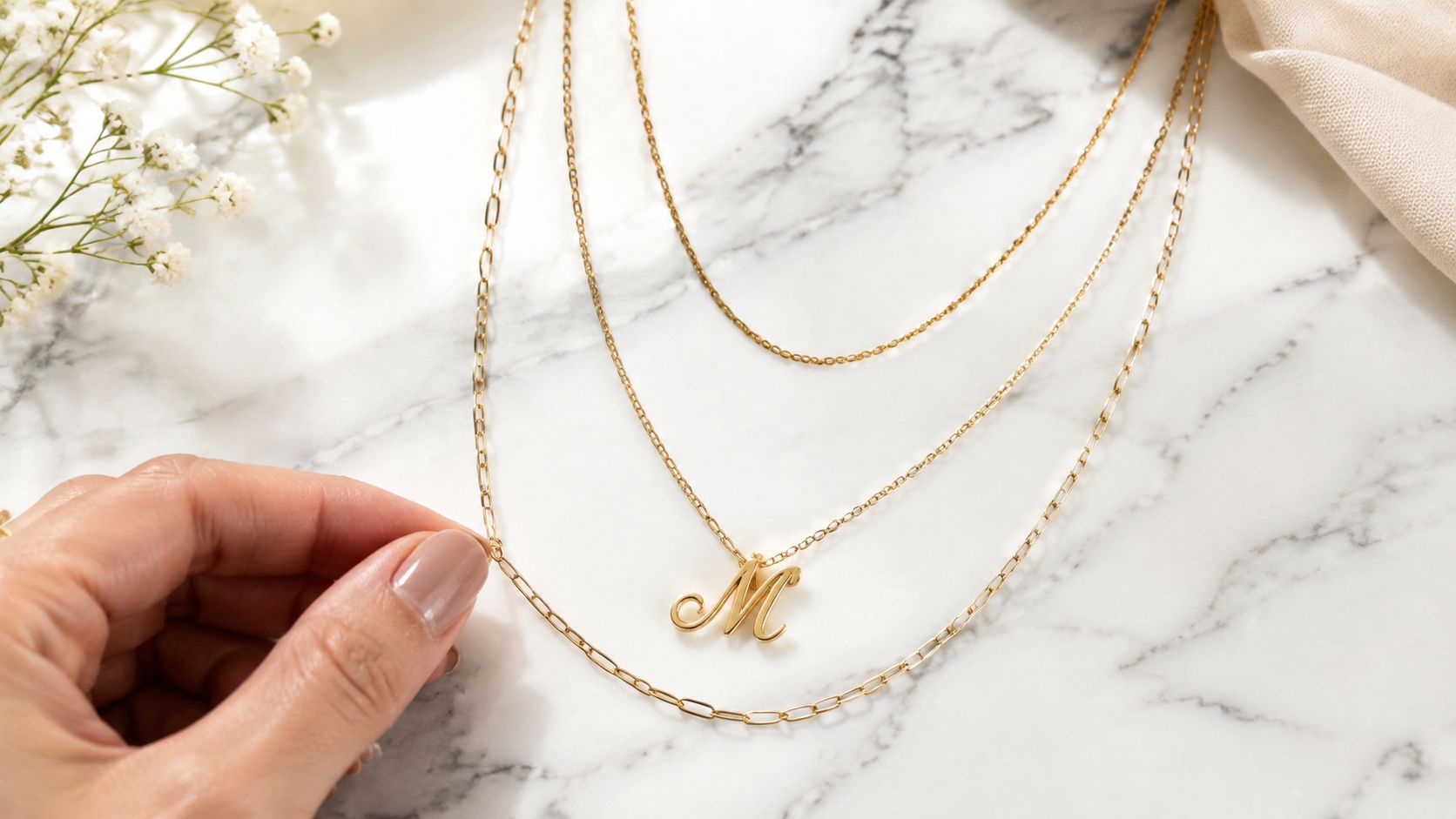
Start with the neckline. A shorter chain suits an open crew neck, scoop neck, or simple shirt collar. An 18-inch chain usually sits more comfortably over higher necklines and gives a pendant room to remain visible. For a more exact fit, compare the wearer's preferred style with a necklace length chart before checking out.
Build the stack from quiet to expressive
A good stack has separation between pieces. Put the smallest or simplest chain closest to the neck, position the cursive initial where it has enough open space to read, and add a longer pendant only if the arrangement still feels balanced. Three ornate pendants competing at the same height will make the initial look cluttered.
A practical combination might include:
- Closest layer: A fine chain with no pendant.
- Middle layer: The cursive initial, placed where the letter can lie flat.
- Longer layer: A simple bar, small medallion, or understated charm.
Keep the initial toward the front rather than allowing it to rotate sideways. A wider bail, a slightly stronger chain, or a pendant with balanced weight can help. If the initial repeatedly flips, the issue is often the pendant's center of gravity rather than the chain length.
For everyday clothing, gold script looks easy with denim, knitwear, and plain cotton. Silver works neatly with cooler colors and crisp professional clothing. At night, let the initial stand alone or pair it with one restrained chain so its curves remain visible.
Mixed metals can work, but repeat the contrast elsewhere. If the initial is gold and the second chain is silver, add a ring or bracelet that echoes one of those finishes. The combination will look deliberate instead of accidental.
A short visual reference can help you judge spacing and movement before creating a stack.
Smart Gifting Strategies for Personalized Necklaces
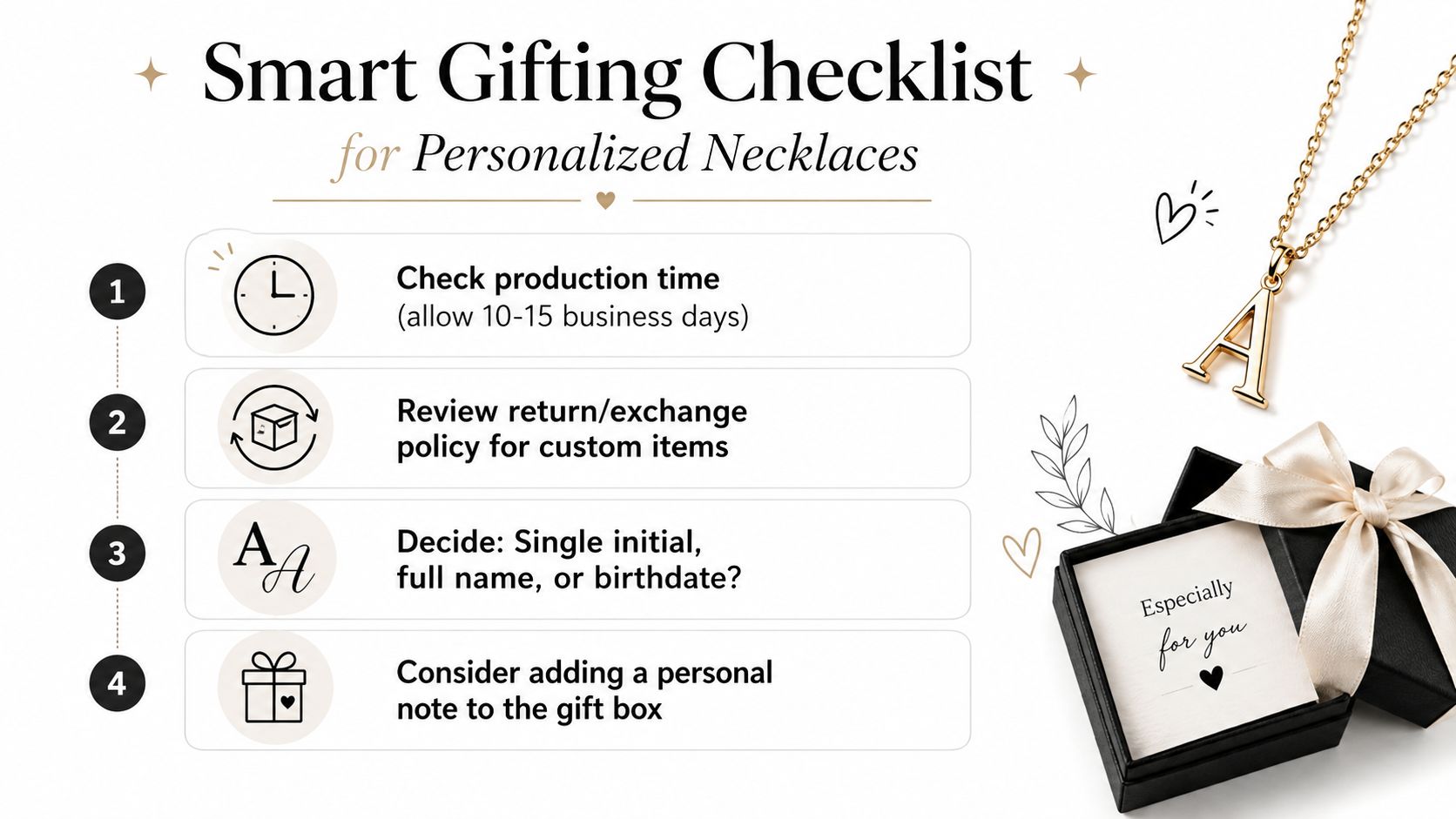
A personalized necklace is a thoughtful gift only if it arrives on time and matches the recipient's tolerance for custom jewelry. Production can take a few days to several weeks, depending on the design and seller, so check the stated timeline before paying. For a dated occasion, order early enough to leave room for shipping and unexpected delays.
Use the recipient, not the trend, as your guide
Choose a single initial when you want a personal gift with a low style risk. It's usually less visually demanding than a full name and can represent a first name, surname, child, or shared connection. It's the safest option when you know the person's taste but aren't certain she wants her full name displayed.
Choose a full name necklace when the recipient already wears obvious personalized jewelry or enjoys statement pieces. The added lettering communicates more directly, but it also demands more confidence about font, size, and daily styling.
Choose an engraved pendant when the meaning matters more than immediate readability. A date, short message, or private word can feel very personal, although the design may be less visibly decorative than cursive lettering.
One current market source reports that 68% of consumers prefer personalized accessories over standard retail offerings, while millennials and Gen Z represent about 72% of custom jewelry purchases, according to Fashion Puzzle's personalization overview. Those figures support the broader appeal of customized gifts, but they don't remove the need to match the piece to one individual.
Protect the gift decision
Personalized jewelry is typically non-returnable unless it has a defect, so read the return and exchange policy before submitting the letter. Independent custom-jewelry guidance also emphasizes that production windows vary from days to weeks, making the seller's exact estimate more important than a general promise of fast fulfillment. Review this custom pendant buying guide for the practical questions worth asking.
Before checkout, confirm:
- The letter: Verify spelling, capitalization, and the exact font preview.
- The deadline: Check the production window and shipping estimate together.
- The policy: Confirm whether custom work is final sale or eligible for correction.
- The presentation: Consider a gift box and an order note with a personal message.
For more gift-oriented ideas, browse personalized jewelry gifts for her, then choose the simplest piece that clearly fits her style. A meaningful initial in the right metal will beat a more elaborate design that she never wears.
Caring for Your Cursive Initial Necklace
Cursive details need gentler handling than a plain disc or solid bar. Thin loops and projecting tails can catch on knitwear, towels, hair, and seatbelts, while repeated pulling can stress the bail or clasp ring. Put the necklace on after dressing and remove it before changing clothes whenever the pendant has an open flourish.
Keep the piece away from perfume, hairspray, lotion, chlorine, and household cleaners. Apply personal-care products first, allow them to dry, and then fasten the necklace. Remove it before bathing, swimming, exercising, or sleeping if you want to reduce exposure to moisture, friction, and accidental snags.
Clean according to the finish
For routine cleaning, use a soft, lint-free cloth and light pressure. Wipe the pendant and chain after wear to remove surface oils, then inspect the loops and bail for trapped fibers. Don't use a stiff brush on delicate script because bristles can catch in narrow spaces.
Sterling silver may need a suitable silver-polishing cloth when tarnish appears, but avoid aggressive rubbing around fine details. Gold surfaces should be cleaned with mild soapy water only when the seller confirms that method is appropriate for the finish. Gold vermeil and plated surfaces require extra restraint because vigorous polishing can wear the outer layer.
Store the necklace without stress
Close the clasp before storage and lay the chain flat in a soft pouch or separate jewelry compartment. If you're storing several necklaces together, keep each one in its own section to prevent the initial from rubbing against other pendants. Untangle knots with your fingers on a flat surface, never by pulling both ends apart.
Check the bail, clasp, and connecting rings periodically. A small opening or bent ring is easier to repair before the chain separates and the pendant goes missing.
Your Quick Purchase Checklist
Use this list at checkout. If a seller can't answer one of these questions clearly, pause before ordering.
- Font clarity: View the actual initial at its finished size. Choose a simplified or bolder script if loops merge.
- Letter structure: Pay special attention to crowded letters such as A or E. Confirm that open spaces remain visible.
- Pendant connection: Inspect the bail and jump ring. The initial should hang flat without grinding against the chain.
- Chain support: For everyday wear, look for at least 1.6 mm where appropriate, and consider 2.0 to 2.5 mm for heavier or wider pendants, based on the technical chain guidance.
- Metal choice: Match the finish to what the recipient already wears and the amount of maintenance she'll accept.
- Length: Choose 16 inches for a closer placement, 18 inches for more flexibility, or an adjustable option when gifting from a distance.
- Custom timing: Confirm the production estimate before buying for a birthday, holiday, or ceremony.
- Return terms: Assume personalized work may be final sale unless defective, and verify the policy in writing.
- Gift presentation: Add a gift box and a message if the seller offers those options.
The best cursive initial necklace balances meaning, readability, and construction. Don't sacrifice a secure chain or clear letter for a more elaborate font.
EP Fine Jewelry offers personalized necklaces, including initial-focused designs, with gift presentation and order-note options available through its shopping experience. Visit EP Fine Jewelry to compare cursive styles, check the product details and custom timing, and choose a necklace that will look good beyond the gift box.